Sunday, December 09, 2012

Former Space Agency President Joins Canadian Space Start-up


Mac Evans knows the way this "WIND" is blowing.
William MacDonald ("Mac") Evans, a 34-year veteran of Canadian public service, the key architect of the 1985, 1994 and 1999 Federal government space plans, Canadian Space Agency (CSA) president from 1994 - 2001 and recent contributor to the David Emerson led Aerospace Review has joined the board of directors of Canadian space start-up UrtheCast.

The formal announcement was made by UrtheCast in the December 7th, 2012 press release "UrtheCast Appoints Former Canadian Space Agency President To Its Board." According to the press release, Evans "will help guide the international tech startup in providing the video stream from the International Space Station (ISS)."

As outlined in the December 2nd, 2012 Commercial Space blog post "Space Start-up UrtheCast Named One of Canada's Most Innovative Companies,". the company intends to install two digital cameras (one medium and one high resolution) on the Russian segment of the International Space Station (ISS) over the next year in order to stream near-live video and static imagery to Earth and offer those images for sale.

It's worth noting that UrtheCast Chairman Tony Lacavera, is also the Chairman and CEO of of Globalive Communications Corporation and Chairman of WIND Mobile.

According to UrtheCast Chairman of the Board Tony Lacavera, the next battleground in the telecommunications world is content and specifically “over-the-top content.” According to Lacavera, “I’ve been looking where I can get involved in companies that will be manufacturing content that is both unique and also hard to replicate. And that’s specifically why UrtheCast got my attention.

According to Evans, UrtheCast is "going to bring Earth observation information directly to the consumer with their web-based portals and all that sort of stuff. And quite an intriguing approach to do that because (previously) we would always scratch our heads over how to commercialize Earth observation data and moving it into the consumer realm seemed to be a very difficult task. And I think the UrtheCast approach is quite promising.

Wednesday, December 05, 2012

What the Space Volume of the Aerospace Review Actually Says

          by Chuck Black

As outlined in the December 3rd post "Initial Feedback from the Emerson Report" the early responses to the David Emerson led Aerospace Review have been generally positive.

Industry Minister Christian Paradis and David Emerson are both speaking at the official opening of the Canadian Aerospace Summit in Ottawa from December 5th - 6th. Photo c/o Aerospace Review website.

This reception is due to its surprisingly robust endorsement of the importance to Canada of both the larger "aerospace and space industry" and the small, emerging Canadian "NewSpace" sector of innovative, space focused businesses.

But the devil is always in the details and the document also includes a series of new oversight recommendations for the Canadian Space Agency (CSA), an acknowledgement of ongoing CSA procurement problems plus a recommendation to remove CSA from its current policy-making role and also from direct involvement in the design and manufacture of "space assets purchased by the government."

For those who haven't yet downloaded a copy from the Aerospace Review website, here are a few high level talking points and perceptions from the second volume of the report titled "Reaching Higher: Canada's Interests and Future in Space." They include:
  • An understanding of the long term high level of growth going on in the industry right now (just under 10% a year), accompanied by an equivalent contraction in national space agency budgets, which is what the report calls a global "re-balancing" as traditional players begin to step aside in favor of newer players.
  • An acknowledgement of the importance of the space industry for Canada and a recommendation that the government make the same acknowledgement.
  • A second, ongoing acknowledgement of procurement problems and a lack of direction within government in general and the CSA in particular with regard to "Canada's space program and its role in advancing national priorities." This acknowledgement comes with a recommendation to establish another level of government, a "Space Program Advisory Council" reporting to the Minister of Industry and tasked with CSA oversight, along with the development of a series of one, five and ten year space plans and milestones (Page 32).
A shrinking, non-policy making role for the Canadian Space Agency.
  • A second recommendation to narrow the CSA mandate to the point where it would no longer be a "policy-making body" or "directly involved in designing and manufacturing space assets purchased by the government." It would instead advise and support the Minister of Industry, act "as a technical supervisor" to project specific committees and to the Minister of Public Works in order to help negotiate "co-operative agreements with other countries space agencies," plus co-manage (along with the National Research Council) new space technology development. Under this recommendation, the CSA would continue to conduct its own research, operate its existing satellite inventory and maintain the Canadian astronaut program (Page 45). 
    A potential policy pitfall.
  • In conjunction with the reduced role and new oversight, a third recommendation to stabilize overall CSA funding plus expand funding for programs which support the development of space technologies for the enhancement of industrial capabilities, such as the Space Technologies Development Program (STDP), by an additional $10M per year over each of the next three years (Page 41).
  • A sense that the current crop of major Canadian commercial space players have grown up "in an atmosphere of limited competition and in some cases, excessive reliance on government spending," with an acknowledgement that this needs to change (Page 26).
  • A telling quote, originally from one of the three Canadian Space Commerce Association (CSCA) submissions to the Aerospace Review (but also included in the final report) on "Commercial Space" or "NewSpace" activities and their overall importance to ongoing growth and the future of the industry (page 21).
    A possible future?
  • A recommendation for "encouragement" of commercial space activity. According to the report "some of these ideas may prove fanciful, but others may be visionary and produce tremendous profits for their proponents and the companies in which those proponents operate. The R&D support recommended previously (the CSA technology development program and others listed on page 41) will help stimulate development of the most promising proposals, but its impossible to know with certainty whether a notion which appears unrealistic today might lead to tomorrows breakthroughs. Without endorsing specific speculative projects, public policies and programs can create the conditions for entrepreneurs and researchers to test and pursue creative approaches and, in so doing, jump start Canada's private space activity at a time when the global commercial space business is gaining momentum." (Page 43).
  • Comments on the need to develop an independent launch capability in order to avoid "delays, operational complications and cost overruns," especially in the case of the growing small-sat marketplace (Page 26).
  • A variety of other measures when "costs were modest and there is no risk to public safety" to encourage space related commercial activity (Page 44). These include:
    • Intensifying efforts to procure for Canada more geostationary orbital slots.
    • Simplifying regulatory regimes covering high altitude testing, suborbital and orbital launches and human spaceflight.
    • Making available public infrastructure, such as CSA and NRC laboratories and unused runways, at modest cost for the safe testing of new, space related technologies.
    • Adapting an open data policy for non-security-sensitive raw data generated by publicly owned satellites.
      Another possibility.
    • Extending the "favorable tax treatment currently afforded to investors in flow through mineral exploration companies to investors in commercial activities in space."
    • Having the Federal government negotiate effective bilateral agreements that increase the access of the Canadian space industry to global markets.
Only time will tell whether some or all of the recommendations listed above are ever implemented.

The first true test of their political viability will likely come down with the next Federal budget in March 2013.

Monday, December 03, 2012

Initial Feedback from the Emerson Report


     by Brian Orlotti

Initial feedback from the David Emerson-led Aerospace Review (now available in two volumes online at the Aerospace Review website) has been largely favorable with literally dozens of media outlets and organizations weighing in on the issue.

   
 Here are a few of the more notable comments:
  • According to the November 29th, 2012 Canadian Newswire (CNW) press release “Telesat Strongly Supports the Recommendations of the Aerospace Review on Canada's Future in Space” Ottawa based satellite operator Telesat, “welcomes the Report of the Aerospace Review released earlier today and believes that its recommendations provide a clear path forward for the Government of Canada. Telesat congratulates Minister Paradis for mandating the Aerospace Review and Mr. Emerson and his colleagues for their work in delivering a timely and focused report that addresses many of the critical issues facing Canada's space industry." 
Even better, as outlined in the November 30th, 2012 Vancouver Sun article, “Federal Finance Minister Flaherty in Victoria today talking budgets with business leaders” Telesat CEO and President Dan Goldberg had a chance the very next day to present those views to the Federal Finance Minister. 
The article quotes AIAC chairman David Schellenberg as stating, "Mr. Emerson recognizes the critical juncture the aerospace and space industry is facing and the urgent need for government, industry, academia and unions to adapt to a rapidly changing and highly competitive global environment. Early and effective implementation of these policies is critical to achieving the intended results. Canada's aerospace industry is ready and willing to do its part."
  • Universities and educational facilities have also weighed in on the report. As outlined in the November 29th, 2012 CNW press release "Ryerson University Welcomes Emerson Aerospace Review Report" the Toronto based facility believes that the report "reinforces the critical importance of the industry to job creation and Canada's global competitiveness." The press release quotes Wendy Cukier, Ryerson University's Vice President of Research and Innovation as stating "this is an industry where Canada is among the top five countries in the world. It generates annual revenues of $22 billion and employs nearly 66,000 Canadians. We cannot afford to fall behind.  The report reinforces the need for the sector to be a national priority. We are particularly pleased the report mentions the importance of strengthening the Greater Toronto Area (GTA) aerospace cluster." 
  • BC based MacDonald Dettwiler (MDA) also "welcomes" the release of the  Aerospace Review, at least according to their November 29th CNW press release "MDA welcomes Government focus on aerospace and space industries" which quotes MDA executive VP Dave Caddey as stating that "we are grateful to the Government and to Minister Paradis for mandating the Aerospace Review and for taking an in-depth look at this important sector. There is a clear recognition of the strategic role of space and aerospace to the economic well-being of Canada and this report is a critical first step towards revitalizing this sector. We will take the time to examine the report. We look forward to working with the government to ensure the competitiveness of the Canadian space sector for the next generation.
  • As for the traditional "mass" media, the key to their responses might lie within the headlines. 
The November 29th, 2012 Postmedia News article "David Emerson urges Canada to pump up its aerospace and space industry" covers much the same territory as the November 30th, 2012 Toronto Star story "Global threat to Canada's aerospace industry" and the November 29th, 2012 Reuters article "Review says Canadian controls hamper aerospace sales." 
Each reminds us that amidst global economic hardship, emerging new players, and an opening Arctic frontier, Canada's space sector stands at a crossroads. 
So just what specifically does the Emerson Report recommend? That will be the subject of a future post.

Sunday, December 02, 2012

Space Start-up UrtheCast Named One of Canada's Most Innovative Companies


BC based space start-up UrtheCast has been named as one of Canada's 20 hottest innovative companies by the Canadian Innovation Exchange (CIX). 

...
The 20 firms were highlighted as part of the 2012 CIX National Conference, held November 27th at the MaRS Discovery District in Toronto, Ontario.

The event, focused on emerging trends in the Canadian technology sector, attracted Canadian investors, entrepreneurs, and business leaders in digital media, communication technology and other areas.

According the the November 29th, 2012 media release on the UrtheCast website titled "Space Tech Startup, UrtheCast Named One of Canada’s 20 Hottest Innovative Companies" the firm is currently:
...building, launching, installing, and operating two cameras on the Russian segment of the International Space Station. Video data collected by the cameras will be downlinked to ground stations across the planet and displayed in near-realtime on the UrtheCast web platform, or distributed directly to exclusive partners and customers. UrtheCast will provide this interactive platform and Earth imagery for Internet users, app developers, educators, media outlets, government bodies, humanitarian relief organizations, and environmental monitoring services.

The 140 companies and organizations listed in the Canadian Space Directory generated $3.44 billion CDN in revenue and employed over 8000 Canadians in 2010, according to the 2010 State of the Canadian Space Sector Report. Over the last five years, total revenues generated by the Canadian space sector have increased by 38%.

Monday, November 26, 2012

More Radarsat, Hadfield, Launch Delays and Profitable Dealmaking


Collin Kenny.
Here's a quick listing of stories currently being tracked for the Commercial Space blog:

  • Of course, RCM isn't the totality of the Federal government space program. Canadian Space Agency (CSA) astronaut Chris Hadfield is also waiting patiently for a ride aboard the upcoming Expedition 34/35 long duration mission to the International Space Station (ISS). The current schedule is for Hadfield to launch December 19th, 2012 from Kazakhstan to carry out scientific experiments, operate the Canadarm2, perform other robotics tasks as required and oversee operations as the first Canadian ISS commander beginning in March 2013. 

  • Meanwhile, back in the private sector, there seems to be a great deal of money to be made in the space industry, especially if you're able to sell into the US. For example, according to the November 26th, 2012 4-Traders website article "COMDEV wins follow-on contract for U.S. Government Satellite Program," Cambridge based COMDEV International has been "has been awarded a follow-on contract to deliver active and passive microwave equipment in support of a major U.S. Government procurement" with a full contract value of up to $19M CDN.  

Saturday, November 24, 2012

Aerospace Review to be Released November 29th.


David Emerson.
According to the November 15th, 2012 SpaceRef.ca article "Aerospace Review Report to be Released November 29," the David Emerson led Aerospace Review panel has fulfilled its mandate "to produce concrete, fiscally-neutral recommendations on how federal policies and programs can help maximize the competitiveness of Canada's aerospace and space sectors" and will be presenting those recommendations to the Federal Industry Minister next Wednesday.

This will be followed up be the public release of the recommendations at a press conference being held at the Canadian Aviation and Space Museum in Ottawa, Ontario on Thursday, November 29th.

What does this mean for the Canadian space industry? As outlined in my June 26th, 2009 blog post "UK joins Canada and the US in "Not Knowing Quite What To Do" with their Space Program," it could mean nothing or it could mean everything. After all, politicians and government institutions form commissions when they don't know what to do or don't really want to do anything but need to create a perception of activity.

...
Now that the report is finished, the Federal government still has the option of either partially (or totally) accepting (or rejecting) the findings, an activity which can itself be stretched out into quite a large number of perceived and distinct decisions (which is really helpful for governments when they have trouble deciding things but need to convince the public otherwise).

So it's fortunate that the players in the Canadian space industry aren't going to wait until the Federal government digests the Emerson report. Most already have strong ideas on how to maximize competitiveness and encourage innovation, at least at the corporate level and are currently testing out those ideas on a day to day basis.

But back in 2009, the US, UK and Canadian governments were each involved with ongoing reviews of their national space capabilities and those reviews were each perceived of as being critically important.

And maybe they were. Since the Brits released their public report in 2010 (the UK Space Innovation and Growth Strategy), they seem to have figured out what's going on and are moving forward with a "swagger in their step," according to the November 9th, 2012 BBC News article "Space ticks the boxes for UK plc."


...
The US NewSpace industry is also leaping from success to success for a fraction of the cost of their traditional competition since the public release of the US government report titled the "Review of Human SpaceFlight Plans Committee Report," in October 2009.

Space entrepreneur Elon Musk, fresh from his first low cost Dragon missions to the International Space Station, is even making public comments about privately funded manned trips to Mars and long-term Martian colonization efforts, at least according to the November 23rd, 2012 Space.com article "Huge Mars Colony Eyed by SpaceX Founder Elon Musk."


...
As for the Canadian government, we seem to be a little slow on the uptake so far. It will be interesting to see if the public release of the Emerson report on November 29th ends up changing this.

Monday, November 19, 2012

Earth Observation Express Provides Insight into CSA Activities


Anyone looking for insight into Canadian Space Agency (CSA) activities will find much useful information contained within the monthly "Earth Observation Express" newsletter.


As outlined on the website, the newsletter "informs and raises the awareness of managers, scientists and students regarding Canadian activities in the field of Earth observation (EO) from space."

It also provides some useful background on the intersection of business, the public and rocket science. For example, the most current newsletter (issue 56, dated November 19th, 2012) covers a number of items including:
  • Using RADARSAT-2 images to ensure that in-situ bitumen extraction in the Alberta oil sands is done safely.
  • A project examining the usefulness and value of using Earth images in monitoring and managing microbial risks associated with recreational waters.
  • How CSA and NASA cooperate to monitor the impacts of Hurricane Leslie on Newfoundland and Labrador.

For those looking for practical applications for Earth imaging satellites, this publicly available, monthly newsletter is a must read.

May it continue along on it's merry way.

Sunday, November 18, 2012

Foundation Funding "Rocket" Science


According to BC based Foundation Search, there are over 112,000 registered public and private foundations in the United States with almost a trillion dollars under management and they're required to give away 5% of those assets each year in order to retain their tax exempt status.

So why can't rocket scientists access these funds? Well, maybe they can...

Foundation grants related to "Aerospace Education." Images c/o Foundation Search.

A quick search of publicly available tax data from US based foundation grants over the past ten years which include the keywords "aerospace education" in the grant description indicate that $3M USD's (divided up among 62 grants) has been provided to various organizations by US based foundations interested in encouraging "aerospace education."

It seems that rocket scientists, at least those with students and interested in "aerospace education" are able to access these funds.

The National Aeronautics and Space Administration (NASA) has also accessed foundation funding.

NASA foundation funding. Images c/o Foundation Search.

Publicly available tax data indicates that at least $5.6M USD's (divided up among 450 grants) has been provided to either NASA or various NASA subsidiaries over the past ten years by US based foundations. While this doesn't seem like a lot for an organization with a $17B USD annual budget like NASA, it's worth noting that the search covered only foundation grants which included the term "NASA" in the grant title. The true total funding from foundations providing money to NASA (but not using the term "NASA" in the grant title) is likely to be much higher.

The Silicon Valley Community Foundation has provided grants  through out the world.. Images c/o Foundation Search.

Best of all for Canadians, the Silicon Valley Community Foundation (which provided the two largest NASA grants to "build community" and "support education") also provided funding throughout the world during that same period. The foundation provided 52 grants totaling $2.29M to US based organizations and a further 21 grants totaling $433M CDN over the same period.

Canadian universities are already taking advantage of this funding channel.

University of Western Ontario grants from US foundations over a ten year period. Images c/o Foundation Search.

For example, the University of Western Ontario (Western) has received over $5M CDN in funding (spread among 99 grants) during the same period in which NASA received only slightly more. As well, Western (and other Canadian universities) have undoubtedly received far more money from Canadian foundations and donors than from US foundations and donors.

In essence, while the overall funding amounts are small when compared to the total budgets of the space agencies, the prospect of foundation funding is something that should not be dismissed when figuring out how to fund "rocket" science.

Money is money, no matter where it comes from.

Sunday, November 11, 2012

Canadian Air and Space Museum Begins $500,000 Fundraising Campaign


As outlined in this November 7th, 2012 press release from the Canadian Air and Space Museum (CASM), the not-for-profit (and often under estimated) repository of Canadian aerospace history has just launched a "$500,000 fundraising campaign" to help defray the costs of moving museum displays "to the the south end of Lester B. Pearson International Airport" where the facility is expected to be relocated over the next few months.


A key component of the fundraising campaign is the web site Indiegogo.com, which will be used by CASM for a crowd-sourced appeal for funds under the headline "the NEW Canadian Air and Space Museum."

Of  course, crowd sourcing is no stranger to space focused organizations or museums. Crowd-sourcing campaigns for space focused start-up Uwingo (which recently raised $80,000 USD's to help fund space exploration, research and education) and the "Goddamn!" Telsa  Museum (which managed to raise $1.3 million USD's) have demonstrated that raising large amounts of money in short periods of time for a good cause is quite possible, if only you use the proper tools.


...
And the CASM museum is certainly a good cause. According to CASM Chairman Ian McDougall:
A 'new' Canadian Air & Space Museum has the potential to realize a world-class facility dedicated to the achievements of our pioneers and to inspire a new generation of air and space innovators and entrepreneurs.
The museum has other campaigns in progress as well, including a promotional video from actor Harrison Ford, a website fundraising challenge and a secondary campaign targeting large, charitable "gift givers" and not-for-profit foundations.
 ...
These campaigns are intended to protect and expand what is possibly the largest single collection of historical air and spacecraft in Canada. Displays include:
  • A full-size replica of the Avro CF-105 Arrow supersonic interceptor which first flew at Toronto's Malton Airport in 1958. 

  • The original shop equipment used by Canadian Aeroplanes Limited in Toronto to build 1,200 Curtiss JN-4 'Canuck' biplanes between 1916 and 1918.


Of course, even after the  money is raised, there will still be a great deal of  work to do. According to McDougall:
 ... the road ahead is long, and our immediate concern is focused on the safety and preservation of the existing collection. We are appealing to all Canadians to contribute towards this very worthwhile cause and help keep the legacy of Canadian history alive.
As outlined in the September 11th, 2011 blog post "Canadian Aerospace Heritage or Hockey Rink," the museum was evicted from its original home, the historic de Havilland Aircraft of Canada manufacturing facility in Downsview, Ontario (along with all the other building tenants) in September 2011.

Since March 2012, most of the museum displays and artifacts have been stored in forty-four semi trailer freight containers at Pearson Airport, waiting patiently for access to their new home.

Friday, November 09, 2012

RADARSAT Constellation Delayed Two Years


The Federal government has finally gotten around to letting slip the obvious.

Hélène LeBlanc.
The November 5th, 2012 Space News article "Canadian Radarsat Constellation Mission Delayed, Cost Rises by $400M" and the November 9th, 2012 Postmedia News article "Feds admit surveillance satellite project delayed two years" are both reporting that the estimated launch dates for the RADARSAT Constellation (RCM) series of the three Earth imaging satellites have been pushed back at least two years and that the overall costs for the program have risen dramatically.

According to the Postmedia article, an Industry Canada response to a question posed in the House of Commons last week by NDP MP HΓ©lΓ¨ne LeBlanc, stated that thelaunch of the first (RCM) satellite is planned to occur in fiscal year 2016-2017, followed a year later by the other two satellites.” The Industry Canada document blames “unexpected difficulties during the critical design phase” for the delay.

But those "unexpected difficulties" were mostly about money.

In March  2012, RCM prime contractor MacDonald Dettwiler (MDA) went so far as to issue a public press release (the March 30th, 2012 release titled "RADARSAT Constellation Mission update") which stated that the company "has concluded that the budget does not include the funds required to continue the RADARSAT Constellation Mission (RCM) as currently envisioned."

As outlined in various posts on this blog (most recently, the October 6th, 2012 post on "The Last Days of the Current CSA President"), things have gone downhill ever since.

But as recently as last month, the Federal government was insisting, in spite of all the evidence to the contrary (such as the October 5th, 2012 CBC News report below), that the first of the three RCM satellites would be launched in 2014.


Monday, November 05, 2012

Naveen Jain, Fiona Harrison & Will Pomerantz on Exploring and Commercializing Space


Entrepreneur, philanthropist and Moon Express co-founder Naveen Jain thinks that only generalists and  entrepreneurs will ever be able to stop whining and boldly go forward into space to begin collecting the new knowledge and skills necessary to start solving our pressing Earthbound problems.


And some of his best comments; along with others from Will Pomerantz, the VP of special projects for Virgin Galactic; and Fiona Harrison, a professor of physics and astronomy at the California Institute of Technology; are available online at FORA.tv as part of its coverage of the recent Atlantic Magazine Big Science Summit.

Naveen Jain.
Even better, the Atlantic has condensed the essence of their hour long discussion into the optimistic and easily digestible October 30th, 2012 article on how "the Space Race Is On: Both NASA and private enterprise look to the stars for new areas of exploration."

According to the article:
The Space Race -- both in terms of manned travel and remote sensing expeditions -- is as competitive now as during the days of Sputnik. Some new astronauts never leave the ground, but their remote probes travel hundreds of thousands of miles, sending back hi-res images and collecting terabytes of data.
Jain, with his wealth and international connections (including his Moon Express partnership with Bob Richards, the founding director of the space division of Vaughn, Ontario based Optec Incorporated) is an obvious person to track in the emerging newspace industry.

The American "mass" media seems to be in the midst of finally getting the hang of this. Kudos to the Atlantic.

Saturday, November 03, 2012

A Compact Canadian MRI for Everyone. Even Astronauts!


     by Farnaz Ghadaki

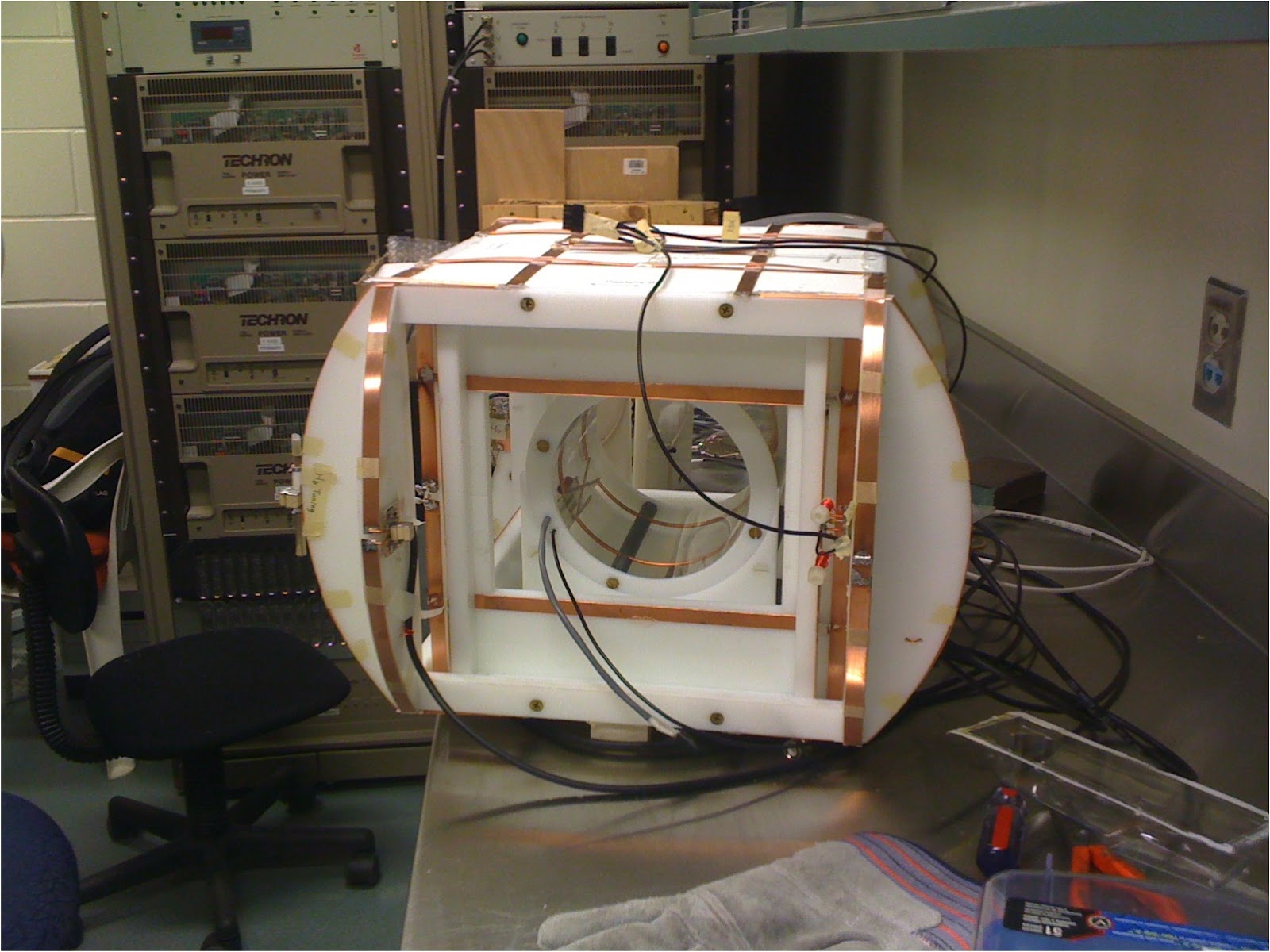
Using two novel Canadian technologies, a team of Canadian researchers plan to develop a compact magnetic resonance imager (MRI) which is much cheaper and lighter than conventional MRIs. This new MRI will have a plethora of applications, both on Earth and in space.

Full size compact MRI mockup. Images c/o Gordon Sarty, University of Saskatchewan.

A full-size mock up of the new MRI was showcased in September at the annual conference of the American Institute of Aeronautics and Astronautics (AIAA) but the technology has also been featured in a number of recent publications including TechNewsDaily and DVICE.

A few weeks ago, Gordon Sarty, Professor and Acting Chair of Biomedical Engineering at the University of Saskatchewan, presented his team’s compact MRI technology at the 63rd Annual International Astronautical Congress (IAC), in Naples, Italy. Sarty’s presentation highlighted the needs addressed by this compact MRI, as well as its weight and cost benefits, the novel technologies utilized plus various Earth and space applications.

Preliminary concept of the whole body MRI as it would appear inside an ISPR. Image c/o Andrew Bell, COM DEV Canada.

The Needs: In spaceflight, there is currently very limited amount of on-orbit physiological data available. Thus, a compact MRI suitable for the International Space Station (ISS) would be valuable in improving human health in space, as for example by enabling detailed studies of bone and muscles as well as the effects of space radiation. And on Earth, traditional MRIs are expensive and scarce resource, giving rise for a need for a smaller and cheaper solution. The compact MRI proposed by Sarty and his team addresses all these needs in a portable, robust and maintenance-free form-factor.

The Weight and Cost Benefits: The compact MRI would come in two models: whole body sized, and extremity sized. The whole body version would be roughly 750 kg (far less than the 10 ton or more weight of conventional MRIs), and meet the volume and mass limitations of the international standard payload rack (ISPR), which has been adopted by ISS participants in order to provide for a common set of interfaces for ISS equipment. The extremity version would be around 50 kg, and within the mass budget of the Canadian Space Agency (CSA) for ISS experiments.

The compact MRI would be maintenance-free, translating to cost savings of $300,000 per year over a conventional MRI, and would have one tenth of initial cost of current large MRIs ($200K vs. $2M for whole body MRI). The extremity MRI would cost considerably less, at roughly $50K. Sarty and his team estimate that the number of compact MRIs could eventually end up outnumbering traditional MRIs by a factor of ten.

According to Sarty, "a Canadian MRI on the space station would be an excellent compliment to other initiatives that the CSA is now taking to establish Canada as a world-leader in advanced crew medical systems for space exploration." 

Halback  permanent magnet geometry. Image c/o Gordon Sarty University of Saskatchewan.
...
The Novel Technologies: The compact MRI is based on three technological innovations, with the first two being Canadian:
  1. A radio frequency (RF) image encoding system called the TRansmit Array Spatial Encoding (TRASE), which eliminates the need for noisy, heavy, and power-consuming magnetic gradient field coils. TRASE was developed at the National Research Council of Canada, Institute for Biodiagnostics (NRC-IBD) by co-inventors Jonathan Sharp and Scott King.
  2. A Halbach permanent magnet, which replaces the traditional, large, heavy, and dangerous superconducting magnets. The Halbach magnet is a joint development of MRI-Tech, Canada Inc. and NRC-IBD.
  3. Miniaturization of RF electronics which eliminates the need for a separate rack of electronics. 
Earth and Space Applications: The compact MRI addresses a variety of healthcare problems on Earth, the major one being making MRI diagnostic technology available anywhere globally (e.g. rural areas, remote areas, developing countries and war zones), and for variety of applications (e.g. military, ground ambulance, air ambulance, humanitarian relief, emergency room). Compact MRIs also serve as a safe and affordable alternative to X-ray CT for children, as well as a cheaper and more precise alternative to dual-energy x-ray absorptiometry (DXA) screening for osteoporosis.

Space-based applications include studies of bone and muscle loss, monitoring renal stores and effects of radiation, and imaging changes in cardiovascular function. Also, a compact MRI can image body-wide fluid shifts and would be very useful in studying intracranial pressure (ICP), which in recent NASA studies (such as outlined in the February 9th, 2012 ISS press release on "Astronaut Visions Changes Offer Opportunity for More Research" and the NASA human research road map on the Risk of Spaceflight Induced Hytracranial Induced Hypertension/ Vision Alterations) have been associated with serious vision impairments in astronauts.

The compact MRI project involves partners from the University of Saskatchewan, Loma Linda University, NRC IBD, MRI-Tech and COMDEV International. To date, TRASE and Halbach parts have been built and had separate preliminary verifications.

The transmit array spatial encoding (TRASE) RF image encoding. Photo c/o Gordon Sarty University of Saskatchewan.

The next step for Sarty and his team is to build a technology development model (TDM) followed by a complete prototype. Then comes the building of the pilot plant, FDA approval and finally full commercialization. These are estimated to take five years and will cost tens of millions of dollars, most of which still needs to be raised.

Sarty and his team are currently attempting to raise an initial investment of $2M to begin the process.

The idea of simplifying and making portable MRIs is somewhat of a holy grail among researchers and developers”, states Sarty. “Our TRASE/Halbach approach is unique and will remain that way until someone buys a license for the TRASE patents from NRC.”

Monday, October 29, 2012

The CSA offers up a Variation in Funding


The recent Canadian Space Agency (CSA) announcement of opportunity (AO), focused on "Industrial Capacity- Building Contributions in the Area of Spacecraft Platforms" is unusual is several respects:

  • As outlined in section 1, the intent of the program is to "support Industrial Capacity Building related to the development of industrial capabilities which could range from developing novel concepts and /or products/services to improving industrial processes related to spacecraft platforms." This seems to be almost an open ended request for ideas, which the CSA could use in a variety of upcoming activities rather than a more specific request for the rovers or the next generation Canadarms which are more typical of  recent CSA procurement initiatives. 
  • Even better, as outlined in section 4.1, the theme of the AO is "to support the strengthening of industrial capabilities relating to the development of spacecraft platforms." A variety of systems are listed as being eligible for funding under the program but the key to this section is its open ended nature. According to this section, "there are no restrictions with respect to the size of the platform for which the technologies and related processes are being supported under this AO."
  • But best of all, as outlined in section 5, eligible recipients of the program are limited to "for-profit organizations established and operating in Canada." Other CSA grant or contribution initiatives have typically targeted universities or other non-profit institutions.
The program is funded for $1 million CDN to be divided up into increments of up to $100,000 CDN per project and the applications deadline was noon on October 22, 2012.

...
It's too early to tell whether or not this new variation on a very old procurement process will become a trend but it will certainly be interesting to see which projects end up getting funded.

Stay tuned. 

Sunday, October 28, 2012

Hurricane Sandy & Space Based Earth Imaging


The obvious best "human" view of Hurricane Sandy, the growing storm which has just caused the mayor of New York City to order mandatory evacuations (as outlined in the October 28th, 2012 CBC News article "Hurricane Sandy prompts mass evacuation in New York City") is aboard the International Space Station (ISS).

... 
But the best collectors of useful data on storms like Sandy are a series of crucial, but aging and unmanned weather satellites due for replacement over the next few years.

However, at least according to the October 26th, 2012 New York Times article "U.S. Satellite Plans Falter, Imperiling Data on Storms," their replacements may not come soon enough to prevent a "looming gap" in coverage. As outlined in the article, this:
...looming gap in satellite coverage, which some experts view as almost certain within the next few years, could result in shaky forecasts about storms like Hurricane Sandy, which is expected to hit the East Coast early next week.
The article blames rising costs for replacement satellites and poor project management for delays which have pushed back scheduled launch dates for replacements to a point where gaps in coverage are likely to occur.

The Geostationary Operational Environmental Satellite (GOES).

Just weeks ago, the September 28th, 2012 Accuweather.com for New York article "Replacement Weather Satellite for GOES East" discussed the recent failure of the GOES-13 satellite, operated by the National Oceanic and Atmospheric Administration (NOAA) and its temporary replacement by the GOES-14 satellite, which occurred just in time to provide coverage of Hurricane Sandy.

...
While GOES-13 has since returned to service, its quite likely that more aging weather satellites will require replacement over the next few years.

Whether or not Hurricane Sandy ever turns into the "perfect storm" predicted by forecasters, lets hope the US gets it act together before any serious gaps in weather coverage occur.

Monday, October 22, 2012

CSA Grants Students Big Opportunities at IAC


     By Farnaz Ghadaki

Ever since 2004, the Canadian Space Agency (CSA) has been part of a program called the International Space Education Board (ISEB) through which it has been organizing a student program in collaboration with other space agencies as part of the International Astronautical Congress (IAC). To date, CSA has subsidized a total of 209 Canadian students to attend and participate in IAC, an annual conference organized by the International Astronautical Federation (IAF).

Students attending the Human Space Exploration panel session at the International Student Zone at the IAC2012 in Naples, Italy. Photo courtesy of CSA.

This year, the IAC2012 was held in Naples, Italy, from Oct 1st - 5th and attracted a record-breaking 4,000 attendees, about a third of which consisted of students and young professionals. The ISEB member agencies sponsored 80 undergraduate and graduate students to attend IAC2012, 19 of whom were given grants by the CSA. These 19 Canadian students were selected among 39 applicants, and represented about a dozen universities.

ISEB’s purpose, according to the IAF website, is “a twofold objective of (1) increasing science, technology, engineering and mathematics [STEM] literacy achievement in connection with space and, (2) supporting the future workforce needs of space programmes.”

ISEB, was founded in 2005 as a voluntary membership board by the CSA, the European Space Agency (ESA), the Japan Aerospace Exploration Agency (JAXA), and the National Aeronautics Space Administration (NASA). Its membership was expanded to include the Centre National d’Γ‰tudes Spatiales (CNES) in 2006, Australia’s Victorian Space Science Education Centre (VSSEC) in 2009, plus the Korean Aerospace Research Institute (KARI) and the South African National Space Agency (SANSA) in 2012.

Leadership of the ISEB is on an annual rotating basis to a new member, and this year Canada led the program with Marilyn Steinberg (CSA Academic Development) as Chair.

The 80 students funded by the International Space Education Board to attend the IAC benefit from the opportunity to present and defend their research on a global stage as well as learn from and develop collaborations with seasoned academic, industrial and government representatives as well as their peers”, commented Steinberg.

The benefits to students were well reflected in the rich, and, as Dr. Steve MacLean put it, “outstanding student development programme”, which included orientation activities, Heads of Agency Q & A, and several Panel Sessions on topics such as Human Exploration and Space Applications.

Four of the 25 students who were involved with the Outreach Presentation at IAC2012: Marianne Mader, Canada; Stephen Indyk, USA; Marc Costa SitjΓ , Spain; Jack Yeh, Australia

Each of the 19 Canadian students presented a talk (or more in a few cases) at IAC, spanning 20 technical sessions and variety of topics including space life sciences, microgravity, space exploration, space debris, human space endeavours, space operations, astrodynamics, materials and structures, space systems, space education and outreach, and business innovation.

The students had a lot of interesting things to share including some of the latest research being done at Canadian universities.

Laura Drudi.
For example, Laura Drudi of McGill University researched women’s health issues in spaceflight and concluded that more understanding of sex-based differences is required, especially as commercial spaceflight opportunities become available.

Melissa Battler of the University of Western Ontario (UWO) presented analysis and lessons learned from analogue lunar missions led by UWO, in evaluating communication protocols between mission control and astronauts. She concluded that a new communication protocol seems to be most effective and efficient for scientific investigation, but needs further research.

Matthew Cross from Carleton University presented a novel approach to regolith parameter extraction, using the Canadian micro rover, Kapvic and an innovative artificial neural network approach which may have useful applications with the Opportunity rover and in unsupervised learning.

Another example of student talks involved the University of Alberta High-Altitude Balloon (UA-HAB) project, presented by Cory Hodgson. This project, which demonstrated a low-cost suborbital platform, involved students designing, manufacturing, testing and launching a payload on-board NASA’s High-Altitude Student Platform (HASP) which was launched in September 2011.

Aaron Persad.
CSA also organized a networking breakfast, which the students found extremely beneficial. “I think the most important student IAC event was the CSA breakfast”, commented Aaron Persad from the University of Toronto, who also added “I believe Marilyn Steinberg and her team did a great job this year of making sure students networked with space leaders.”

Another ISEB activity was having 25 of the ISEB-sponsored students present their perspectives on how to improve outreach activities with the Heads of Education during IAC2012. "The ISEB outreach presentation was a wonderful opportunity to gain an international perspective on space education and outreach,” stated Marianne Mader of the University of Western Ontario. “This experience was one of my major highlights of the IAC conference,” added Mader.

The CSA, and other members of the ISEB have been providing great opportunities for students over the past seven years, and hope to continue their support for many more students in the years to come, including in 2014 when the International Astronautical Congress will be held in Toronto, Canada.

Sunday, October 21, 2012

MacDonald Dettwiler Key Supplier for DARPA Satellite Servicing Demonstration


It was easy to miss the October 18th, 2012 press release on the MacDonald Dettwiler (MDA) website titled "MDA to be key supplier in satellite servicing demonstration for US Government" amid all the promotion by the Federal government this week for the expected December 12th launch of the Department of National Defence (DND) Surveillance of Space (Sapphire) satellite and the Friday display of various Canadian designed and funded Moon and Mars rovers from the Canadian Space Agency (CSA).

...
But the MDA announcement was by far the most important. As outlined in the press release:
Assuming the program proceeds as planned, the overall multi-year program represents a significant opportunity for MDA and a significant step forward for demonstrating certain aspects of on-orbit servicing.

A core element of the program is two primary robotic manipulator arms. MDA is working with the Naval Research Laboratory via DARPA (
the US Defense Advanced Research Projects Agency ) to provide those arms. Assuming all phases of the program are funded, the total scope for that element of the program, which is sole-sourced from MDA, is expected to not exceed $27.2 million.
Most of these "certain aspects of on-orbit servicing" will utilize technology developed by MDA in its role as prime contractor for the Canadarm and Canadarm 2 programs. In essence, the real "next generation Canadarms" as outlined in the September 27th, 2012 Spaceref.ca article "Next Generation Canadarms Unveiled at MacDonald Dettwiler Facility in Brampton" are being developed by MDA for DARPA.

The Next-Gen Small Canadarm. Photo c/o CSA.
Not that there's anything wrong with that.

As outlined in the June 27th 2012 Commercial Space blog post "MacDonald Dettwiler buys Space Systems Loral for $875M" this series of DARPA contracts has been coveted publicly by MDA for some time. The final deal was only made possible through the recent acquisition of Space Systems Loral (SSL) which included a 1.3 million sq. ft state of the art satellite facility in Palo Alto, California. This US based facility is considered suitable (and necessary) for the final assembly of any DARPA contracted satellites or systems.

The ability to sell Canadian developed and Canadarm based technology on the international market is also a vindication of longstanding Federal government policies as outlined in the Mobilizing Science and Technology to Canada’s Advantage report (May 2007) and the Mobilizing Science and Technology to Canada’s Advantage Progress Report (June 2009).

According to the MDA press release:
The goal of the DARPA Phoenix Program is to develop and demonstrate technologies to cooperatively repurpose valuable components from retired, nonworking satellites and demonstrate the ability to create new space systems at greatly reduced cost. The mission will use a robotic on-orbit servicer, and components launched alongside commercial satellites.

The program also hopes to transition its developing technologies into sustainable commercial applications, that in turn support U.S. Department of Defense (DoD) needs in the future, and MDA is under contract from DARPA to assist with defining this commercialization plan as well.
So this is a reasonable and sensible business direction for MDA. The company can now grow its business, develop new international markets for Canadian technology and even remain in compliance with both the specific letter and the overall intent of Canadian government science and technology regulations.

That's why this is the most important Canadian space focused announcement last week. It's odd that the Federal government, the CSA and  even the mass media have chosen to focus on different things.

Support our Patreon Page