Showing posts with label Canadian Space Commerce Association. Show all posts

Thursday, November 01, 2018

The REAL Path Towards Revitalizing the Canadian Space Industry

          By Chuck Black

It's worth noting that a great many academic, non-governmental and business organizations want the Federal government to give them bucketloads of new money for various projects and insist that this will revitalize the Canadian space industry.


They are wrong. Totally and irrevocably wrong. Our current worldwide explosion of private sector space accomplishments has nothing whatsoever to do with simply shoveling new government money into traditionally structured programs.

The problem is the structure of the program, not a lack of funding.

The only real way to revitalize the Canadian space industry and make it competitive in the marketplace of ideas (not just as a component manufacturer) is to change the procurement methodologies of government departments such as the Canadian Space Agency (CSA) and update the Federal tax code to support innovative, Canadian based, private sector corporations.

This is what the US and Luxembourg are currently doing and it is the main reason why companies like Hawthorne, CA based SpaceX,  Las Cruces NM based Virgin Galactic, Betzdorf Luxembourg based SES SA and even Ottawa ON based Telesat are currently investing so heavily in the final frontier.

Oddly enough, back in 2012, the Canadian Space Commerce Association (CSCA) did look at those areas in the first two of its three part series of submissions to the 2012 David Emerson led Aerospace Review.


As outlined in the June 30th, 2012 CSCA submission to the Aerospace Review under the title, "Submission to the Aerospace Review Part 1 of 3 - Fostering Innovation, Creating New Markets: Novel Approaches to Space Policy and Programs," the CSCA recommended that government "explicitly encourage the development of entrepreneurial or “commercial space” industries and approaches," using a variety of policies and programs.

These included:
  • Updated government policies and regulations covering the experimental permitting, safety standards, liability limitation and launch licencing for commercial launch providers in Canada. 
  • The ability to commercially access existing US and Canadian government civilian and military facilities related to the space industry and the encouragement of the creation of appropriate new facilities (such as spaceports and satellite receiving facilities) and build new ones, as required. 
The often discussed "unlicensed" Nunavik ground station, last covered in the June 21st, 2018 post, "The Special Senate Committee on the Arctic Holds a Hearing on Northern Infrastructure & That "Unlicensed" Inuvik Groundstation," would surely have benefited from some of the proactive approaches discussed in this paper. 

Halifax NS based Maritime Launch Services (MLS), although saddled with the obsolete, expendable Cyclone-4M launch vehicle at the core of its plan to build a launch facility on Canada's east coast, would also have benefited from at least knowing the process required to gain government approval to build a spaceport. 

And, as outlined in the May 11th, 2017 post, "CATAAlliance Calls for Adaption of the US Small Business Innovation Research (SBIR) Program," other organizations have also called for the use of novel contracting approaches for Federal procurement.

According to the May 25th, 2017 post, "Attempting Relevance, the Canadian Space Agency Announces Industry Focused & Small Business Funding," the Canadian government has at least begun to take a few small baby steps down this path. 


But it's the second of the three CSCA submissions to the Aerospace Review, "Using Tools from the Mining Industry to Spur Innovation and Grow the Canadian Space Industry," which may hold the most unique lessons for Canada's space industry.

The second submission doesn't suggest adopting new methodologies or co-opting techniques from others.

It suggests only that the techniques and tax breaks already in place to grow our mining industry, can also be used to grow our space industry.

The second submission contained two recommendations:
"Canadian companies engaging in extraterrestrial resource development should be granted all tax and other benefits now granted to them in their terrestrial exploration and development activities."
"The Federal government should create provisions in Canadian law for clear, transferable title to extraterrestrial mining claims and returned resources and work to negotiate international agreements to the same effect"
  • To support this recommendation, the paper referenced the specific terms of the 1967 United Nations Outer Space Treaty, referenced a number of independent authors with expertise in this area and reviewed how the implementation of certain "revenue neutral" changes to Canada's tax code changes led to the massive growth of the Canadian mining industry, beginning in the 1980's. 

As noted above, the changes recommended in the CSCA submissions are "revenue neutral" for the Federal government to implement. Large new buckets of funding are not required to change the tax code or modify procurement contracts.

They're also changes which are being adapted in the US and in smaller jurisdictions, like Luxemburg, with great success.

Once the recommended changes have been made, our domestic space industry will begin to grow in the same way that Canada's mining industry (which grew in response to the tax changes) and private sector companies like SpaceX (which thrived at NASA under the various COTS programs and used its resulting expertise to dominate the launch market) have started to thrive.

It's simply a question of seeding the industry with the proper resources and opportunities needed to make things grow.

Of course, the whole plan is a least modestly dependent on the willpower of our political class. They certainly didn't have the willpower to implement those recommendations six years ago. They may not have the willpower now.

But if they do then maybe one day, even some of those who've left Canada for more favorable regimes will return to put down new roots in their country of origin. They might even relocate their corporate head offices. Mining companies have certainly done that over the last thirty years.

Here's hoping.
Chuck Black.
__________________________________________________________

Chuck Black is the editor of the Commercial Space blog. 

He contributed to the CSCA's three part submission to the 2012 David Emerson led Aerospace Review. 

Thursday, April 19, 2018

The 2018 Listing of Canadian Space Lobbyists, Advocates, Activists and Groups

There are a lot of space advocates in Canada.
Some of them are affiliated with academic institutions while others are more business focused. Some are wrapped around specific ideas and concepts such as the "open source" development of space missions/ equipment or "working in space" or something else. 
A few are tied to activities such as launching rockets, building satellites, raising money for scientific research or organizing public presentations.
Below is a representative sampling of some of the more interesting organizations in this category.


_____________________________________________________

The Aerospace Industries Association of Canada (AIAC) - The biggest and most important player in this list. 
A not-for-profit business association and lobby group focused on aerospace policy issues that have a direct impact on aerospace and space companies and jobs in Canada.
AIAC was heavily involved in the November 2012 Aerospace Review (the second volume, titled "Reaching Higher: Canada's Interests and Future in Space" focused almost entirely on the Canadian space industry and has become the default operational manual for current Canadian Space Agency activities). Also of note is the September 2016 AIAC white paper on "The Future of Canada’s Space Sector: An Engine of Innovation For Over Fifty Years." 

AIAC has strong connections with the Consortium for Research and Innovation in Aerospace in Québec (CRIAQ), the Consortium for Aerospace Research and Innovation in Canada (CARIC), the British Columbia Aviation Council (BCAC), the Ontario Aerospace Council (OAC) and most of the other Canadian industry advocacy groups. Membership lists are available through the annual AIAC guide to Canada's Aerospace Industry. AIAC organizes a variety of events, including the annual Canadian Aerospace Summit, typically held each November in Ottawa, ON.
The Astronomy and Space Exploration Society (ASX) - Engineering and science students often receive their first opportunity to meet industry executives and university academics by participating in campus clubs like this non-profit, student run organization at the University of Toronto. ASX is best known for its annual "Expanding Canada" symposiums held in Toronto every January.

The AstroNut's Kids Space Club - A space focused educational group for elementary school students created in May 2010 by the father/ son team of Ray and Brett Bielecki. The various "missions" of spaceship "Mercury One" and its successor "Mercury Two" have been profiled on CBC, CTV, CITY-TV, A-Channel, the Daily Planet (for the Discovery Channel) and Rogers TV. Best known for its annual "What's Up in Space Camp and STEM Conference," which is targeted to elementary and secondary school students.

The Calgary Space Workers Society - A local, Alberta based advocacy group focused on how "to live and work in space." which rose to prominence 2007 after hosting the "2007 Canadian Space Summit," at the University of Calgary, but maintained a lower profile since then. Still active and operating as a "science club."

The Canadian Association of Rocketry and its listing of affiliated organizations - Who says that Canadian's don't build rockets? Certainly not the members of these self-supporting, non-profit clubs focused around building rockets and promoting the development of amateur rocketry in Canada.

The Canadian Advanced Technology Alliance (CATA Alliance) – The largest hi-tech association in Canada.
Not specifically an aerospace or space focused organization, but knowledgeable on many of the same taxation and innovation issues faced by aerospace.

Originally focused on software and telecommunications, the organization also provides good background material on government programs related to innovation, such as the Federal government Scientific Research and Experimental Development (SR&ED) tax credit and the CATA Innovation Nation National Campaign (designed to boost Canada’s competitiveness and innovation rankings).
The Canadian Aeronautics and Space Institute (CASI) - A nonprofit technical organization for aeronautics, space and remote sensing.
CASI is another of the big players straddling the Canadian landscape, with a storied history built around strong business and international partnerships.

CASI hosts and contributes to a variety of local and international events including the 65th International Astronautics Congress (IAC), which was held in Toronto from September 29th - October 3rd, 2014; the 2016 CASI ASTRO conference, which was held in Ottawa, Ontario from May 17th - 19th, 2016; and the upcoming 2018 CASI ASTRO conference, which will be held in Quebec City, PQ from May 15th - 17th, 2018.
The Canadian Association of Science Centres (CASC) - An organization promoting and encouraging public involvement and funding for Canada's public science centres. CASC includes over forty member institutions and organizes a variety of events through out the year. 

The Canadian Astronomical Society (CASCA) – Academic focused organization founded in 1971 and incorporated in 1983 as a society of astronomers devoted "to the promotion and advancement of knowledge of the universe through research and education."
The CASCA Joint Committee on Space Astronomy advises the Canadian Space Agency (CSA) on matters pertaining to the space astronomy segment of the CSA space science program, including priorities, areas of research, selection mechanisms, funding areas and the extent of funding.
The Canadian Remote Sensing Society (CRSS-SCT) - Focused on Canadian activities relating to geomatics (the discipline of gathering, storing, processing, and delivering geographic information, or spatially referenced information), this scientific association organizes conferences and publishes (in conjuction with CASI) the Canadian Journal of Remote Sensing (CJRS)

The Canadian Satellite Design Challenge - A privately funded, biannual event focused on teams of Canadian university students (undergraduate and graduate) who design and build an operational small-satellite, based on commercially-available, "off-the-shelf" components.
As outlined in the November 30th, 2017 post, "Update on the 2017 Canadian Satellite Design Challenge," while the CSDC is still active, there is quite a bit of overlap between what the CSDC has been doing with university student run teams since 2011 (without large amounts of funding) and the Canadian Cubesat Project, a recent CSA proposal to fund and launch university designed and built cube-sats.
The Canadian Science Policy Centre (CSPC) - Passionate professionals from industry, academia, and science-based governmental departments focused on "building bridges between science, policy and society."
The centre also organizes the annual Canadian Science Policy Conference, a well attended event featuring a variety of knowledgeable academic and government experts.

Until now, the CSPC hasn't really focused on private sector research and development (R&D), which is kinda odd since, as outlined in the recently released Council of Canadian Academies (CCA) report, "Competing in a Global Innovation Economy: The Current State of R&D in Canada," the majority of Canadian based R&D is performed by the private sector. Perhaps that focus will change over the next little while.
The Canadian Space Commerce Association (CSCA) – A registered Canadian not-for-profit industry organization existing "to advance the economic, legal and political environment for space and aerospace focused companies." Organizes meetings for the hobbyist, the academic and (sometimes) the entrepreneur. Recently resigned executive director Michelle Mendes was a member of the ill-fated Space Advisory Board (SAB).

The Canadian Space Society (CSS) – A small, but well respected charity created to promote Canadian space activities. Functions mostly as a "big tent," for those with a general interest in the CSA and space activities. Has organized the annual Canadian Space Summit since 2008.

Engineers Canada - The national organization of the 12 provincial and territorial associations that regulate the profession of engineering in Canada and license the country's more than 260,000 members of the engineering profession. The organization also issues national position statements on key issues relating to the public interest, including infrastructure, labour mobility and regulating the profession.

The Geological Association of Canada - A national geo-science society, publisher and distributor of geo-science books and journals.
The association also holds a variety of conferences, meetings and exhibitions for the discussion of geological problems.
Hacklab.TO - One of a number of small Canadian organizations like the Interaccess Electronic Media Arts Centre, the Kwartzlab Makerspace, the Makerkids non-profit workshop space for kids, Think|Haus, the Site 3 coLaboratoryUnLab and others who focus on the technologies associated with open source additive manufacturing/ 3-D printing. These techniques show great promise for a variety of low cost space manufacturing technologies.

The North York Astronomy Association (NYAA) - This Ontario based club is the organizer of the annual StarFest star party, which is recognized as one of the world's top 10 gatherings of amateur astronomers for the purpose of observing the sky.

The OpenLuna Foundation - A privately funded public outreach program (officially a US based 501(c) 3) to encourage the use of open-source tools and methodologies (open design) for space focused activities.
Once quite active, but has mostly slipped under the radar since 2010. The founding member and project manager/ director of the organization is Paul Graham, who lives in London, Ontario.
The Planetary Society Canada - A subgroup of the larger US based Planetary Society. a non-government, nonprofit organization involved in research and engineering projects related to astronomy, planetary science, exploration, public outreach, and political advocacy, which was founded in 1980 by Carl Sagan, Bruce Murray, and Louis Friedman.
The current CEO is Bill Nye who, as outlined in the March 6th, 2018 Global News post, "Justin Trudeau, Bill Nye talk pipeline politics, Kinder Morgan in post-budget meeting," recently shared the stage with Prime Minister Justin Trudeau to talk science and politics.

Planetary Society global community outreach consultant Kate Howells was also a member of the ill-fated Space Advisory Board (SAB).
The Royal Astronomical Society of Canada (RASC) - 4,800 members, including about 500 "unattached" members from remote parts of Canada and around the world and strong chapters in Vancouver and 28 other centres across the country makes RASC one of Canada's largest space and astronomy advocacy groups.
Since 2009, the organization has purchased the David Dunlap Observatory in Richmond Hill, Ontario and SkyNews; the Canadian Magazine of Astronomy and Stargazing. An underrated and successful gem, mostly hiding in the much larger, Canadian landscape.
The Royal Canadian Institute (RCI) - The oldest scientific society in Canada, founded in Toronto in 1849 by a small group of civil engineers, architects and surveyors led by Sandford Fleming. The current membership is focused around events and lectures promoting scientific advancement.

Science Rendezvous - A "grassroots" not-for-profit organization and public platform to promote science awareness and increase science literacy in Canada. Holds the yearly, spring Science Rendezvous at the University of Toronto, St. George campus.

Space Canada – A not-for-profit organization dedicated to the promotion of solar energy from space.
Organized the 2009 Symposium on Solar Energy from Space and currently promoting the 2018 International Symposium and Workshop on Space Solar Power, which will be held in concert with the National Space Society (NSS) International Space Development Conference (ISDC 2018), being held in Los Angeles, CA from May 23rd - 27th, 2018.
Space Canada president and CEO George Dietrich has a long history of supporting and funding US and Canadian space activists and their activities. 
Students for the Exploration and Development of Space (SEDS) Canadian chapter - Part of an international group of student-run organizations dedicated to promoting public interest in space through the use of unique projects, research programs, and professional development opportunities in the Canadian space industry.
SEDS was founded September 1980, primarily by Peter Diamandis, Scott Scharfman, Richard Sorkin, Robert D. Richards and Todd B. Hawley.

Other countries with active SEDS groups include the US, the UK and India.
The Toronto International Space Apps Challenge - An annual "hackathon" organized each spring as part of the NASA International Space Apps Challenge.

Toronto Students for the Advancement of Aerospace (TSAA) - Another of the multitude of inter-university student organization striving to promote the advancement of aerospace through student leadership and hands-on initiatives plus serve as the student's first academic contact point to the wider world of academics and business.

The University of Toronto Aerospace Team (UTAT) - One of the more successful campus clubs focused on the building of aerospace focused projects for international competitions, but otherwise typical of clubs found on most college and university campuses with science and engineering faculties.
Last profiled in the April 3rd, 2017 post, "UofT Undergraduate Satellite Builders Raise Almost $500K to Build & Launch a Microsatellite in 2019."

Friday, November 10, 2017

Even its Head Office Now Considers MDA, "a business unit of Maxar Technologies"

          By Henry Stewart

Suppose you're an iconic Canadian space company with tens and perhaps even hundreds of millions of Canadian dollars worth of annual revenue tied up in ongoing Federal government space and communications contracts which are, at least in part, dependent upon your firm being viewed as a fully Canadian supplier, immune to foreign influence.

And even your US HQ keeps forgetting to acknowledge your independence. What would you do?

As outlined in the November 9th, 2017 National Post article, "Canadarm creator to transform into U.S. company, raising concerns of tech heading south of the border," Maxar CEO Howard Lance believes that "Canadians don’t need to worry (over MDA's status) since the country will still retain overall control of the Radarsat-2 surveillance satellite," and he has no plans "to cut jobs in Canada." That's not to say that the US executive wouldn't be able to lay off workers at any of his worldwide subsidiaries or rearrange his business units in any way that his US based board might see fit, if the need arose. Given that, the appropriate customer response should be to cultivate alternative suppliers for critical requirements, just in case. Graphic c/o National Post.

That's the situation Richmond BC based MDA, a company once known as MacDonald Dettwiler and Associates, but re-branded and re-organized into a subsidiary of the larger San Francisco, CA based Maxar Technologies earlier this year, is currently faced with.

As outlined in the November 8th, 2017 Maxar Technologies press release, "MDA to provide communication subsystems," MDA is "a business unit of Maxar Technologies."

November 9th, 2017 MDA online display ad from the SpaceQ website.
On the other hand, the MDA business unit has just "signed a contract valued at approximately US$9 million for an undisclosed customer," so things aren't all bad.

MDA will provide two communication subsystems that will increase the time LEO satellites are in communication with the ground and improve the amount of data that could be transferred, according to the press release.

However, in order to keep the Canadian orders flowing and combat the perception that the company is no longer Canadian, MDA has embarked on a marketing campaign touting its Canadian origins and independence.

The campaign includes various sponsorships in a variety of space focused conferences, including the Canadian Space Commerce Association (CSCA) 2017 Canadian Space Policy Summit, which was held in Ottawa on November 9th, 2017.

MDA has also purchased display ads in the Ottawa, ON based Hill Times and other publications.

Of course, the marketing campaign will do little more than postpone the inevitable. MDA will likely begin to bleed Canadian market share as the Justin Trudeau Liberal government moves to diversify its supplier base.

If the Feds don't do this, the Federal Conservative party will begin asking uncomfortable questions in Parliament and the issue will divide up along party lines. It's not that there's anything wrong with that. It's just business.

Potential hungry MDA competitors include Toulouse, France based Airbus (bolstered by its new partnership with Montreal PQ based Bombardier and its influential Quebec voting base), Carlsbad, CA based Viasat (just itching to sell new communications capabilities to the Canadian military) and even Vancouver BC based Urthecast (the only Canadian company on this list, but one chock full of ex-MDA employees so there might be some synergies).

Stand by. There's a great deal of money at stake.
_______________________________________________________________________

Henry Stewart is the pseudonym of a Toronto based aerospace writer.

Thursday, November 09, 2017

Commercial Space and Rocket Port Shenanigans

          By Chuck Black

There's weird stuff going on behind the November 9th, 2017 announcement from Steve Matier, the CEO of Halifax, NS based based Maritime Launch Services (MLS), that his firm is targeting a May 1st, 2018 start date to begin construction on Canada’s first commercial spaceport.

The pitch and the people, including a new one. Since the last time this blog checked, as part the November 7th, 2017 post, "The Ukraine State Space Agency & Aerospace Industry Needs All the Help It Can Get," MLS has added director Joseph Hasay (second from left) to it's roster. According to his Linked-In profile, Hasay is President/CEO at Santa Maria, CA based United Paradyne Corporation, which provides operations and engineering support for the space launch industry. Others listed include CEO Matier (who currently lives in New Mexico and acts as an independent consultant), CTO Dave Walsh (the VP and chief technical officer at United Paradyne), program manager Alona Andriienko and VP of strategic development Yaroslav Pustivyi who, at least until noon today, was listed on the Canadian Space Commerce Association (CSCA) website at their "director and acting chair of the board." Graphic c/o MLS

According to Matier, the space port will be funded through private financing (with "secured commitments" of nearly $400Mln CDN  and with "series A," financing currently in "final closing," whatever that might mean), but with "no funding coming either from the Canadian or Ukrainian governments."

This information was passed along via the November 9th, 2017 SpaceQ post, "Maritime Launch Services Targets May 1 to Begin Construction at Nova Scotia Spaceport," but has not been corroborated through any other source this blog has been able to access.

Forgive us if we're missing something, but if true, this makes the project very, very unusual and quite confusing.

November 9th, 2017 screenshot of the SpaceQ website showing comments from MLS CEO Steve Mattier reflecting his statements that the MLS proposal to set up a commercial space port in Canso, NS is a "commercial project with no funding coming from either the Canadian or Ukrainian government." As for the MDA promotional ad on the SpaceQ site, you'll need to check out the November 10, 2017 post, "Even its Head Office Now Considers MDA, 'a business unit of Maxar Technologies'." Graphic c/o SpaceQ

For example, Spaceport America, generally considered to be"the world's first purpose-built commercial spaceport" is funded much like most other commercial airports and space launch facilities as a public private partnership (P3), in order to spread out risk and insure the participation of the appropriate legislators, who tend to have a lot of laws relating to this sort of thing.

The investors look to government as guarantors to confirm that the law will not stand in the way of the project and the government looks to the private sector to drive the project forward and insure funding.

MLS and their proposed Canso, NS rocket launch facility isn't a P3, at least according to the announcement. Here's what we know so far.

There is evidence, even within the SpaceQ website that MLS is absolutely hoping to line up government partnerships. The November 4th, 2017 SpaceQ post, "Canada and Ukraine Sign Space Agreement to Cooperate on Space Activities," has made clear both the connections MLS currently enjoys with the Ukrainian government and the connections it hopes to develop in the near future with the Canadian government.

Oddly enough, SpaceQ has backtracked on this story.

A retraction, plus a clear statement of bias. From the November 9th, 2017 Short Cuts from SpaceQ post. 

As outlined in the November 9th, 2017 More Commercial Space News post, "Glad to see SpaceQ set record strait on erroneous Canada/ Ukrainian space story," SpaceQ admitted that Canada and the Ukraine did not sign a "comprehensive memorandum (MOU) of understanding."

Instead SpaceQ said that, while "discussions leading up to the signing of the MOU were comprehensive," the agreement itself was not. The SpaceQ post then went on to say:
While the CSA did not think it warranted a press release or informing the public though social media of the agreement, SpaceQ feels that was a mistake. As a government agency it has a responsibility in being transparent and providing the public with information pertaining to agreements it signs. After all, it is the public that funds the agency through their tax dollars. The CSA works for each and every one of us.
As outlined in the November 6th, 2017 post, "The Ukraine State Space Agency & Aerospace Industry Needs All the Help It Can Get," MLS CEO Matier was invited to a signing ceremony between the Ukrainian and Canadian governments by the Ukrainian government at the Canadian-Ukrainian aerospace forum in Montreal, PQ last week.

There is certainly nothing wrong with that. It's pretending that government participation hasn't been solicited and isn't required which is the problem.

It's amazing what can happen over lunch. As shown above, the CSCA website as recently as the morning of November  9th, 2017 included both MLS VP Pustivyi and Marc Boucher, the editor/ owner of SpaceQ.ca (which has acted in the past as a strong advocate for the MLS proposal), as part of their "Mission Team." But by the afternoon on November 9th, both names had been removed, replaced by new set of directors. These included Alec Wenzowski (previously listed as the CSCA VP of development and partnerships), Randal Lilko (no bio, but likely Randall Lilko,  an engineer with Honeywell Aerospace in Toronto, ON who spells his name with two "L's"), Tasha De Freitas (also with no bio, but likely a senior associate focused on intellectual property at the Tory's law firm in Toronto, ON) and "Stuart Crane," who could very well be the person previously known as "Baron Stewart Crane of Cluny." Screenshot c/o CSCA website

And here's where it gets really weird.

When the November 9th, 2017 More Commercial Space News post, "Glad to see SpaceQ set record strait on erroneous Canada/ Ukrainian space story," suggested that now would be a good time to come clean on the connections between SpaceQ, MLS and the Canadian Space Commerce Association (CSCA), an advocacy group pushing for more space engagement for the Canadian government, this blog received the most peculiar e-mail from SpaceQ editor Marc Boucher.

As stated in his first November 9th, 2017 e-mail correspondence to this blog, "FYI. The CSCA has yet to update their website since the last AGM but Yarko (MLS VP and CSCA director and acting chair Pustivyi, has) resigned. They have a new board."

When asked a follow-up question on the composition of the new board, Boucher said, "Ask them. Also, I had resigned as an advisor. The CSCA website does not reflect that."

The new CSCA board of directors as per the CSCA website at 6pm EST on November 9th, 2017. A quick search through the CSCA media release page shows no explanation for the changing board composition when compared to the day before. Graphic c/o CSCA website.

Inquiries to CSCA executive director Michelle Mendes and others have so far met with no response but this blog was prudent enough to record what the CSCA site looked like previous to today.

As outlined in the November 2nd, 2017 post, "Media Refused Entrance to Thursday's CSCA Meeting at Denton's Law Firm," the CSCA has certainly not been forthcoming about its activities lately.

That's not to say that any of the above information and list of activities make a whole lot of sense as it stands.

To see where does this story goes, you'll have to stay tuned.
    Chuck Black.
    ___________________________________________________________

    Chuck Black is the editor of the Commercial Space blog.

    Thursday, June 22, 2017

    Classic Trek Offers Advice to the Canadian Space Industry on Our Latest Postponed Space Plan

             By Chuck Black

    Innovation, Science and Economic Development Canada (ISED) has gone on record to address the rumours that an expected report from the Federal Space Advisory Board will not be ready in time to meet the government's self-imposed June 2017 deadline for publication.

    As outlined in a June 22nd, 2017 e-mail from ISED media relations officer Hans Parmar, the report is to be updated to become more "action oriented."


    Parmar provided no estimate of when the final report would be completed and refused to answer a question on whether it will be ready for September, when an expected Federal Cabinet shuffle could potentially plop a new Liberal face into Innovation Minister Navdeep Bains' current portfolio and cause the entire process to reset to zero. 

    According to Parmar:
    Based on feedback from the Space Advisory Board consultations, the government heard that Canada needs a long term approach that recognizes the strategic importance of space and that is action-oriented.

    The Government of Canada continues to work on a space strategy that will support growth in the sector and leverage the benefits of space for all Canadians.

    This strategy will set a new approach for space – setting clear directions, promoting partnerships and defining a future role for Canada in space. This comprehensive approach will help to coordinate policies and programs across government, including Canada’s Defence Policy and the Innovation and Skills Plan.
    An "action oriented" Boeing F/A-18 E/F Super Hornet at the 2014 Farnborough International Air Show. There's nothing like a quick reminder of the great many political fish still to fry on the Innovation Minister's plate and the June 22nd, 2017 CTV News Post, "Boeing plays down Bombardier dispute, still hopes to sell fighter jets to Canada," notes two in a single post. Another, as outlined in the April 17th, 2017 post, "'Massive' Review of Federal Science Funding Finally Released; Will Likely Soon 'Drop Down the Memory Hole'" also directly affects science funding and the Liberal "Innovation Agenda." A fourth crisis, the looming purchase of Canadian satellite communications provider Norsat by either an American hedge fund or a Chinese conglomerate is playing out this week in Vancouver. Photo c/o AP/Sang Tan.

    While expected for some time, the delay first surfaced in the June 21st, 2017 SpaceQ post, "New Canadian Space Strategy Delayed," which didn't reference any primary sources, but did give two potential reasons for the delay.
    • First of all, "the Space Advisory Board was not announced until mid-April providing it little time to consult with stakeholders and to formulate a report for the government to analyze," which is true enough as things go, but could also indicate incompetence, since government reviews normally take far longer than the two and a half months the ruling Liberal party allotted. This would have been known in advance. 
      Nice, but not "action oriented." Graphic c/o CSA.
    • Secondly, "there was a greater response to the consultation process than was expected including numerous written submissions. What this all means is the government has a lot of input to digest." It could also indicate a lack of understanding of the complexity of the issues facing our space industry.
    There is also the possibility that the Space Advisory Board was convened to give the space industry the perception of participation in the process for when the Liberal party rolled out another generic, but mostly useless document in the same vein as the February 7th, 2014 Conservative Party Canada's Space Policy Framework.

    A potential template for this new paper might even have been one of the policy documents which derived from the "1st Canadian Space Policy Symposium," focused on "Aligning Canada’s Future in Space with Canada’s Innovation Agenda," an agenda chock full of Liberal party buzzwords, which was held in Ottawa on November 8th, 2016.

    As outlined in the November 13th, 2016 post, "Generalists, Data Miners, Lotteries, Comedy, Open Access and the Future of Science in Canada," the Commercial Space blog mentioned the event in passing, as part of the coverage of the larger 2016 Canadian Science Policy Conference, but was refused admission to the space policy symposium.

    Talk, but no action. Graphic c/o CSCA.
    It's interesting to note that many of the people currently active in the Space Advisory Board did attend the 2016 Space Policy Symposium.

    If the outline of the current postponed space policy document was known last November, then a three month turn around time becomes understandable, since the Space Advisory Board would be expected to simply "glad handle" and build consensus for an already existing plan, but wouldn't need to develop anything new.

    In retrospect, it seems as if participants in both the 2016 Space Policy Conference and the more recent round table discussions of the Space Advisory Board were sold a bill of goods by the organizers, since people who might possibly disagree with the anticipated policy document were refused admission to the Space Policy Forum, and a reasonable discussion of options relating to Canada's Future in space, including contrary viewpoints, doesn't seem to have occurred until the round tables were held.

    Now that expectations have been raised, the government will need to spend some time either distilling the round table discussions into a real policy document, or they'll need to find a way to bury the report.


    Of course, this isn't the first time that a Federal minister has offered up a plan to "revitalize" the Canadian space industry and our space agency. 

    Back in 2008, then Conservative Industry Minister Jim Prentice, offered up the following mandate to the then new Canadian Space Agency (CSA) president Steve MacLean:
    Jim Prentice. Photo c/o Wikipedia
    I have given Steve a mandate to make sweeping changes at the CSA. 
    As we stand at this crossroads, he will revitalize the Agency. He will restore its ability to punch above its weight in an international quest. He will develop Canada’s capacity for a new era of prestige and achievement.  
    And to that end, as one of Steve MacLean’s first acts as new President, the CSA will begin consultations with stakeholders that will lead to a new Long-Term Space Plan. 
    I expect this plan – the fourth in the series – to be as influential for our generation of exploration and development as any plan that Canada has produced for charting our future in space. 
    That’s a tall order. I know that Steve is capable of bringing together the stakeholders. Time is of the essence, and I look forward to the plan in the coming months. 
    But after the 2008 election, Prentice moved on to became Minister of Environment. MacLean wrote his report, but it was never released to the public and, as outlined in the May 8th, 2017 post, "Steve MacLean's 2010 Long-Term Space Plan Surfaces, CSA Clarifies its Communications Policy & California's Rocket Tax," that document eventually became marketing material for the Gordon Group, an Ottawa based marketing company which assisted with its creation.

    During the 2016 election, and as outlined in the October 13, 2015 post on "Part 2 of "Abandoning the Emerson Aerospace Review?," both the Liberals and the NDP wanted a review of the 2012 David Emerson led Aerospace Review (perhaps even culminating in a new "long-term space plan"), but once the Liberals gained power in October 2015, that review fell by the wayside.

    The current Liberal government mostly supports the Emerson Review, but would prefer the electorate forgot that Emerson happened under Conservative Prime Minister Stephen Harper and currently enjoys wide bipartisan support.

    As Mr. Scott, the Chief Engineer in the 1967 Star Trek episode, "Friday's Child," once said, "Fool me once, Shame on you. Fool me twice, Shame on me."
    Chuck Black.
    ___________________________________________________________

    Chuck Black is the editor of the Commercial Space blog.

    Monday, April 10, 2017

    General Fusion, exactEarth's Missing (But Insured) Satellite, More CSA Rovers & ULA Drops Launch Costs

              By Henry Stewart

    For the week of April 10th, 2017, here are a few of the stories we're currently tracking for the Commercial Space blog:

    July 29th, 2014 video overview of General Fusion. Screenshot c/o General Fusion.

    • Burnaby, BC based General Fusion has claimed a breakthrough in plasma technology. 
    As outlined in the April 3rd, 2017 The Province post, "General Fusion introduces new leadership group as company claims plasma breakthrough," the alternative energy firm "claims to have succeeded in sustaining plasma fuel with a small, prototype injector just 40 centimetres in diameter, a significant technical hurdle."
    The announcement was made last week by new CEO Christofer Mowry who, as outlined in the article, "is taking the reins at Burnaby’s General Fusion as the company is poised for a great leap forward."
    According to Mowry, "GF now plans to proceed with building a larger plasma injector and a working prototype of its unique, compression-based reactor."
    General Fusion and its partners, which include Chrysalix Energy, GrowthWorks Capital, Cenovus Energy, Amazon and Blue Origin CEO Jeff Bezos and the sovereign wealth fund of Malaysia, have already sunk about $100Mln CDN into the project. 
    The company was last referenced in these pages in the May 25th, 2015 post, "Three Small Fusion Companies Approaching a Critical Funding Mass."

    • The exactEarth EV-5 satellite is missing. As outlined in the April 6th, 2017 exactEarth press release, "exactEarth Provides Update on EV5 Satellite," communication were originally lost with the satellite on February 3rd, 2017 and subsequent efforts to make contact were not successful. 
    But the company quickly filed a claim "for the full insured value of the satellite," with an undisclosed insurance company and has received $3.5Mln CDN to cover the loss.
    The insurance claim could even end up assisting in the growth of small-sat insurance coverage. As outlined in the April 6th, 2017 Insurance Business post, "Influx of orbital satellites could burst open cosmic insurance sector," with "about 80-90 rocket launches every year, and with that number set to grow massively," the space insurance business is "an interesting, well, space to be."
    As outlined in Gunther's Space Page post on, "LatinSat A, B, C, D / AprizeSat 1, ..., 10 / exactView 3, 4, 5, 5R, 6, 11, 12, 13," the EV-5 satellite is one of a series of similar designed satellites, operating under different names and out of different corporations and jurisdictions, but intended to function together as "a constellation of small Low-Earth-Orbit satellites (64 satellites planned) to achieve a global communication system of data transmission and fixed and mobile asset tracking and monitoring (GMPCS)."
    The loss of one satellite is not considered critical to the performance of the constellation. 
    Two recent CSA rover designs, being taken for a ride by Innovation Minister Navdeep Bains in May 2016. With him are Ontario Drive and Gear (ODG) space and robotics manager Peter Visscher and Canadian astronaut David Saint-Jacques. ODG has build many rovers for the CSA and is likely to win at least one of the newly announced RFP's. Photo c/o CSA.
    As outlined in the April 5th BuyandSell.ga.ca government procurement website posting under the title, "Lunar Surface Mobility Concept Study (C3P-CS-04) (9F050-16-0980/A)," the Federal government, under its Public Works and Government Services Canada (PWGSC) department and on behalf of the CSA, is seeking "proposals for a concept study aimed at developing a potential solution for lunar surface mobility." 
    The request for proposal (RFP) builds on previous CSA work in this area, beginning in 2009, when the Federal Conservative government under then Prime Minister Stephen Harper allocated $110Mln CDN in funding to the CSA as part of its 2009 Economic Action Plan to cover rover development, a "next generation Canadarm" and other smaller projects.
    Because of the CSA's heritage work in this area, any new intellectual property generated through the RFP's will vest with the government. This should make the RFP a difficult proposition to any robotics firm which hasn't worked with the CSA before.
    The government expects to issue two contracts, worth up to $450K CDN each (excluding applicable taxes) and are expected to fund six months worth of work.
    As originally outlined in the October 20th, 2012 post, "Lots and Lots of Rovers Looking for Missions," Canadian rovers don't typically sell well on the international markets. Some of the reasons for that state of affairs are discussed in the September 26th, 2016 post, "The REAL Reason Why Canada Won't Be Participating in the NASA Resolve Mission Anytime Soon, Probably!"
    The announcement is also the latest in what should have been a series trumpeting new areas of research and funding for the CSA. However, as outlined in the April 3rd, 2017 post, "The Canadian Space Agency is "Very" Cautious About Its Post ISS Role," most of the items supported under the new programs are items the CSA and its partners have been dealing with in some way, shape or form for a very long time.
    As outlined in the April 4th, 2017 Reuters post, "United Launch Alliance cuts Atlas rocket price amid competition," ULA’s cost reductions include "trimming its payroll. The company last year said it planned to cut as many as 875 jobs, or about one-quarter of its workforce, before the end of 2017."
    In March 2017, ULA lost a US Air Force global positioning satellite launch contract to SpaceX, which bid $96.5Mln US ($129Mln CDN) for the work. 
    Typical ULA pricing, at least until now, has started at $109Mln US ($145Mln CDN), though satellite operators can make up at least half that cost by getting more favorable insurance rates and other factors, including an on-time launch, ULA has said.
    ULA is currently heavily dependent on the Russian RD-180 rocket engine, a hot potato in US political circles, but has promised to develop a domestically produced and lower cost engine over the next few years. 
    However, as outlined in the April 7th, 2017 Space News post, "RD-180 provider seeks additional ULA engine order," the new CEO of the US-Russian joint venture that provides RD-180 engines to ULA has indicated that he "hopes" to win at least one further order for the Russian engine in the near future. 
    For more, check out our upcoming stories in the Commercial Space blog.
    _______________________________________________________________________

    Henry Stewart is the pseudonym of a Toronto based aerospace writer.

    Monday, December 05, 2016

    Another Call for Federal Assistance in Space, plus Kepler, Clyde Space, ULA & Mars One, Which Can Now Sell Stock

              By Henry Stewart

    This publication has always felt that bankers, businessmen and bureaucrats were more important to our conquest of space than scientists or engineers.

    With that in mind, here are a few of the items we're currently tracking for the Commercial Space blog:

    Canada isn't the only country with ongoing discussions and differences of opinion over "space policy." Shown above is a May 24th, 2015 recording of Dr. Scott Pace, a professor at the George Washington University’s Elliott School of International Affairs, speaking on "U'S Space Policy Choices." Canadian policy discussions are usually more limited on scope (reflecting our smaller capabilities) and more circumspect. Canadian space activities are more likely to depend on government funding and subcontract work to larger, international firms and no subcontractor or collaborating university wants to come out in public opposition to a well paying client. Screenshot c/o You-Tube.
    • Another person has come out in favor of using Federal government resources to assist at least the government supported components of our Canadian space industry.
    The December 5th, 2016 SpaceRef.ca post, "Op Ed - The Government Should Support Canada Becoming a Small Satellite Manufacturing Hub," begins with a partial list of privately owned companies (including two Canadian) which have recently made requests to the US Federal Communications Commission (FCC) to launch large constellations of satellites into a variety of Earth orbits for a variety of reasons.
    The article suggests that, since this satellite market is growing and seems to be bypassing Canada, the Federal government under Prime Minister Justin Trudeau, has "an opportunity in the small satellite sector to make an impact that will foster innovation, create more high tech jobs, keep them in Canada, and it should act now" by offering up "more support" to organizations like the Canadian Satellite Design Challenge, a competition for teams of Canadian university students to design and build small "cube-sats."
    Not that there's anything wrong with that.  
    It's just that organizing student run contests to build small, custom satellites for scientific use is a far cry from funding, building and delivering the large numbers of standardized, commercial satellite constellations expected to go into orbit within the next few years. 
    For the complete list of FCC applications, and some business context as to why this is happening, check out the November 20th, 2016 post, "SpaceX, Telesat & Kepler Just Three of the Dozen Satellite Constellations Currently on the FCC Table."
    An October 2016 discussion on "The Resurgence of Constellations – Small & Large," from the Asia Pacific Satellite Communications Council (APSCC) 2016 Satellite Conference and Exhibition, which was held in Kuala Lumpur, Malaysia from October 4th - 6th, 2016.  Screenshot c/o You-Tube.
    It's also worth noting that the author of the piece, SpaceRef CEO Marc Boucher has also been active in the Canadian Space Commerce Association (CSCA), where he helped craft the March 7th, 2016 CSCA press release, "2016 Canadian Budget Needs to Recognize Canada’s Space Program as a National Priority" and the August 4th, 2015 CSCA press release, "The Canadian Space Commerce Association Calls on all Federal Parties to Commit to a Long-Term Space Plan."
    Of course, Boucher isn't the only individual or organization advocating for assistance to Canadian space activities. As outlined in the November 28th, 2016 post, "An ESA Event, SEDS Objects, the CSA Budget Shrinks, the JWST & the Downsview Aerospace Hub," the Students for the Exploration and Development of Space Canada (SEDS-Canada) have also recently released an editorial critical of Liberal government performance in this area.
    But, as outlined in the November 25th, 2016 post, "Another Op'nin Another Show... Next CDN Space Policy June 2017," the Federal government has at least offered up the promise to unveil an updated Canadian space policy document in June 2017. 
    They've also promised a "chief science advisor." As outlined in the December 5th, 2016 iPolitics post, "Liberals may protect chief science advisor with legislation: Duncan," at least that search seems to be moving forward. 
    So while its unlikely that the Trudeau government will offer up the billions of dollars currently available on the international market needed to fund and support domestic satellite construction, here's hoping that they'll come up with enough of something to placate their increasingly strident critics.
    The reason why Clyde Space is an award winning space business and an effective competitor in international markets has more to do with marketing savvy than space science or government support. The company has a standardized listing of several dozen common parts and modular components able to fit together into satellites able to perform a wide variety of missions. Clyde Space first gained fame in 2014, when the 3U cubesat bus was used in Ukube-1, the UK Space Agency's first national spacecraft. Photo c/o Clyde Space.
    • Toronto based Kepler Communications has selected Glasgow, UK based Clyde Space to supply two 3U spacecraft, which will launch Kepler’s novel software defined radio (SDR) and antenna array in 2017.
    As outlined in the November 30th, 2016 Kepler press release, "Kepler Communications selects Clyde Space as Spacecraft Manufacturer," the microsat "will support Kepler in deploying its in-space telecommunications network, which will use nanosatellites to relay data in real-time for devices deployed in terrestrial, remote operations and satellites deployed in low Earth orbit."
    The spacecraft will be built and tested by Clyde Space in Glasgow for delivery next autumn. 
    Currently, Clyde Space produces "produces an average of six satellites each month for a range of customers world-wide and is pursuing an expansion in the United States." 
    Kepler has applied to the FCC to deploy up to 140 satellites, including spares, in a non-geostationary (NGSO) low-earth polar orbit with seven orbital planes between 2017 and 2022 in order to build a wireless pipeline to facilitate machine to machine communications.
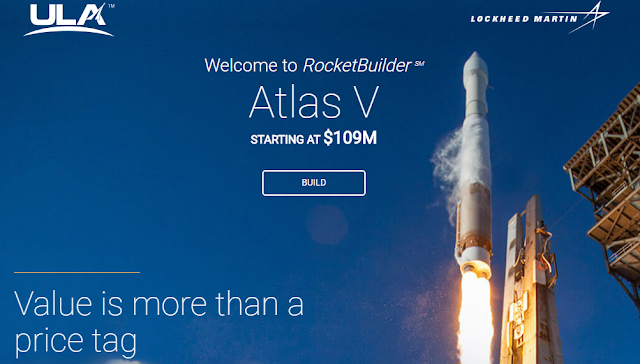
    Come on down to the ULA website, where "value is more than a price tag," many options are available and prices start at $109Mln US ($145Mln CDN). Photo c/o ULA.
    • Speaking of marketing initiatives, United Launch Alliance (ULA), in an effort to demonstrate that they provide value with their rocket launch prices, have unveiled an interactive website which offers potential customers the ability to get price estimates for Atlas V launches.
    As outlined in the November 30th, 2016 Space News post, "ULA debuts online pricing tool for Atlas launches," the new ULA "RocketBuilder" website is "designed to let users select variables about their launch, including their desired orbit, payload mass, fairing size and desired launch date. The site then calculates the estimated price of the Atlas 5 rocket for that mission."
    The article also quotes ULA chief executive Tory Bruno as saying, "it will be easier to buy a ride in space than to get a plane ticket home for the holidays.” 
    According to Bruno, “all of that guesswork and all of that murkiness that an operator has to go through to figure out launch services, how that balances against the choices they make on their spacecraft, that is a thing of the past.” 
    Of course, like any sales promotional material. the site also estimates the “added value” that ULA argues an Atlas 5 launch provides. 
    According to the article, that value supposedly "comes in the form of insurance savings because of the vehicle’s high reliability, elimination of costs from launch delays and increased revenue the satellite can generate from an extended lifetime enabled by the Atlas’ accuracy in placing the satellite in the desired orbit." 
    Let the buyer beware.
    Graphic c/o Daily Dot.
    • Speaking of business, its worth noting that one of the craziest business pivots of the year is the reverse merger of Netherlands-based Mars One with Switzerland based Innovative Finance AG (InFin). 
    As outlined in the December 2nd, 2016 Mars One press release, "Mars One Takeover Approved by InFin Shareholders," the takeover of the failed mobile payment company will provide "a solid path to funding the next steps of Mars One’s mission to establish a permanent human settlement on Mars."
    At the very least, they'll be able to sell stock on the Frankfurt stock exchange, where InFin is already available and publicly traded. 
    The press release quoted Moritz Hunzinger, the CEO of InFin, as stating "the board of InFin has received a strong mandate from its shareholders for the Mars One Ventures takeover. We're looking forward to the exciting new steps that lay ahead."
    Also quoted was Mars One CEO and co-founder Bas Lansdorp, who stated, "the Mars One board will approve the acquisition as soon as possible. Once this deal is completed, we’ll be in a much stronger financial position as we begin the next phase of our mission. Very exciting times!"
    The reverse takeover has been on the table since November. As outlined in the November 7th, 2016 Ars Technica post, "Mars One merges with failed mobile payment company so it can sell stock," it's not currently clear what resources InFin brings to the deal beyond the access to the Frankfurt stock exchange.
    Nor is it clear if Mars One has the technical capacity to actually develop a plan to land people on Mars. Recent attempts to counter that impression, such as the one outlined in the September 15th, 2015 Business Insider post, "Two MIT students lay out the facts about why the Mars One mission is bogus," have typically met with failure.
    But privately held, BC based UrtheCast raised over $77Mln CDN selling stock after going public via a reverse takeover of publicly-traded Longford Energy Inc in June 2013. 
    There is no reason why a publicly traded Mars One could not end up doing the same, or more.
    For more, check out upcoming editions of the Commercial Space blog.
     _______________________________________________________________________

    Henry Stewart is the pseudonym of a Toronto based aerospace writer.

    Support our Patreon Page