Showing posts with label Carnival of Space. Show all posts

Thursday, May 31, 2018

Inuvik Mayor Calls Feds "Not Forthcoming" Regarding Private Sector Commercial Ground Station Application

         By Chuck Black

According to Inuvik Mayor Jim McDonald, "while the city is not directly involved with the ongoing efforts to license the commercial ground station built by Inuvik, NWT based New North Networks  (NNN) for San Francisco, CA based Planet and Tromsø, Norway based Kongsberg Satellite Services (KSAT), we have been talking to both sides in an effort to get this thing up and running."

Inuvik Mayor McDonald in front of a local warehouse slated for demolition due to melting permafrost, which has shifted the building's foundation. As outlined in the April 7th, 2015 CBC News post, "Inuvik economy struggling, says new report commissioned by town," the local economy, heavily dependent on the oil and gas sector, has struggled as it attempts to diversify into tourism, emerging technologies and other areas, while at the same time dealing with a warming climate. Photo c/o CBC.

"And while some of the problems do seem to be regulatory, the Federal authorities involved with this process have simply not been forthcoming with their requirements and concerns," he said during a recent interview with this blog.   

As outlined most recently in the March 5th, 2018 post, "That Commercial Ground Station Built by New North Networks in Inuvik Still Can't be Used," the privately operated ground-station has still not received the second of two sets of Federal government approvals needed to operate under Canadian law.

The Federal department of Innovation, Science and Economic Development Canada (ISED), which is responsible for authorizing the radio licences needed to operate fixed Earth stations in Canada, approved their portion of the ground station application in March 2018, after a twenty-two month review.

Global Affairs Canada must still issue a second license under Canada's Remote Sensing Space Systems Act, for the facility to open. Planet and KSAT have both previously indicated that they will withdraw their application to use the facility and relocate to another jurisdiction if the second license isn't issued by June 1st, 2018.

Decisions to build satellite tracking stations are not taken lightly, nor in a vacuum. Above is a photo of the construction of the MacKenzie Valley Fibre Link (MVFL), a state-of-the-art fibre optic telecommunications link connecting communities in the Mackenzie Valley and Beaufort Delta regions. As outlined in the June 11th, 2017 CBC News post, "Mackenzie Valley Fibre Link brings opportunities, challenges to NWT," the new link, completed in 2017, involved the installation of 1,154km (717 miles) of high-speed fiber optic telecommunications cable from McGill Lake in the south to Inuvik in the North. One of the selling points of the $110Mln CDN link, according to Mayor McDonald, was that the new capacity could be used to attract more satellite tracking stations to the region. The NWT government has also committed up to $7Mln CDN per year for up to the next twenty years to support MVFL operating costs if the line is unable to find paying users in the satellite industry or from other sources. Photo c/o MVFL.

"License applications always have a process," said McDonald, who's used to working with oil and gas companies subject to regional and Federal regulations and licensing requirements:
But on this project, there has simply been no direction on how to move forward. Other licenses have been issued and my personal feeling is that KSAT and Planet have made real efforts to resolve any impasses.  
There is the real possibility that KSAT and Planet could simply end up walking away...
According to NNN CEO Tom Zubko, while Planet and KSAT are currently optimistic that the second required license to operate the Inuvik facility will be issued in a timely manner, both companies are "evaluating options" and the appropriate people at the US Department of Commerce have been informed of the situation. 

KSAT, which is hoping to use the Inuvik facility to fulfill a contract for the European Space Agency (ESA), has likely also informed the ESA of their situation.

Given the previously announced June 1st, 2018 deadline to resolve the issue, this story will continue to be updated as new information becomes available. Stay tuned.
Editors Note: In a June 4th, 2018 e-mail exchange with Trevor Hammond, Planet's director of corporate communications, he stated that, "Negotiations are healthy and ongoing with Global Affairs Canada regarding operational conditions of the Inuvik site. We’ll share more information when we have an update." 
So nothing has been terminated but nothing has also been concluded. 
As mentioned above, "stay tuned."
Chuck Black.
___________________________________________________________

Chuck Black is the editor of the Commercial Space blog.

Monday, May 21, 2018

EU "Freezes" Britain out of Galileo SatNav System; RAF Promises New "British" SatNav & Space Defence Policy

          By Henry Stewart

In the latest example of how politics influences the activities of the space industry, the United Kingdom (UK) has learned that, after contributing £1.2Bln ($2.06Bln CDN) of the estimated £8.5Bln ($14.6Bln CDN) total cost towards the building of the European Union (EU) Galileo navigation satellite system (GNSS) UK scientists will not be allowed to remain involved with the program.


As outlined in the May 21st, 2018 Express post, "RAF to launch NASA-style space agency after EU freezes Britain out of Galileo project," the non-elected governing body of the European Union (EU), known as the European Commission (EC), has said that continued UK participation in the Galileo program would “no longer be appropriate” after the expected exit of the UK from the EU (known as 'Brexit"), currently scheduled for midnight on March 30th, 2019 Central European Time.

In response, UK Secretary of State for Defence Gavin Williamson has tasked the UK Royal Air Force (RAF) with assessing "the military requirements for a UK global navigation system," and developing partnerships "with other close allies such as Canada, New Zealand, Australia and the US" interested in contributing to a UK based satellite navigation project.

UK Defence Secretary Williamson. Photo c/o Mirror.
The assessment will become a core component of the first UK Defence Space Strategy, which is expected to be developed over the next few months.

Other UK news services are also reporting on the story.

As outlined in the May 21st, Independent post, "UK plans own space programme after dispute with EU over Galileo project, defence secretary announces," the UK will:
...review its contribution to the EU’s Galileo satellite programme and “plan for alternative systems in this crucial area”, Gavin Williamson has said as he announced the launch of the UK’s first Defence Space Strategy. 
The move follows an increasingly bitter dispute between Whitehall (the centre of the UK government) and Brussels (the EU capital) over the access the UK, the European Union’s biggest spender on defence, will have to the bloc’s satellite navigation project after it leaves the EU.
The article also quoted the EU’s chief Brexit negotiator, Michel Barnier, who said last week that British companies could not be directly involved in a new EU satellite navigation system after Brexit, but Britain would have access to its signal.

It cannot be business as usual,” according to Barnier. “Third countries and their companies cannot participate in the development of security-sensitive matters.”

The announcement that the UK is planning “alternative systems” suggests that the UK government is resigned to being excluded from Galileo and forfeiting its investment.


The proposed new UK Space Defence Strategy "aims to significantly boost the sector in response to changing threats to the country’s critical infrastructure," according to the May 21st, 2018 Government Europa post, "UK launches first space defence strategy to protect space-based infrastructure."

According to the post:
Under the new strategy, the RAF Air Command will take control and assume responsibility for the UK’s military space operations in the future. These operations are set to increase as the nature of space-based threats changes.
According to UK Secretary of State Williamson, “Britain is a world leader in the space industry and our defence scientists and military personnel have played a central role in the development of the EU’s Galileo satellite programme alongside British companies, so it is important we also review our contribution and how we plan for alternative systems in this crucial area.”

Galileo GNSS is being built through the European Union (EU) by the European Space Agency (ESA). It's advertized as being intended primarily for civilian use, unlike the more military-orientated systems such as the US based Global Positioning System (GPS), Russia's  Global Navigation Satellite System (GLONASS) or China's 1st generation BeiDou Navigation Satellite System (BDS) and 2nd generation COMPASS system.

The Canadian Space Agency (CSA) is a "cooperating state" of the ESA and participates in a variety of ESA programs and missions including Galileo, as outlined in the October 8th, 2003 Universe Today post, "Canada Joins Galileo System."
_______________________________________________________________________

Henry Stewart is the pseudonym of a Toronto based aerospace writer

Thursday, April 19, 2018

The 2018 Listing of Canadian Space Lobbyists, Advocates, Activists and Groups

There are a lot of space advocates in Canada.
Some of them are affiliated with academic institutions while others are more business focused. Some are wrapped around specific ideas and concepts such as the "open source" development of space missions/ equipment or "working in space" or something else. 
A few are tied to activities such as launching rockets, building satellites, raising money for scientific research or organizing public presentations.
Below is a representative sampling of some of the more interesting organizations in this category.


_____________________________________________________

The Aerospace Industries Association of Canada (AIAC) - The biggest and most important player in this list. 
A not-for-profit business association and lobby group focused on aerospace policy issues that have a direct impact on aerospace and space companies and jobs in Canada.
AIAC was heavily involved in the November 2012 Aerospace Review (the second volume, titled "Reaching Higher: Canada's Interests and Future in Space" focused almost entirely on the Canadian space industry and has become the default operational manual for current Canadian Space Agency activities). Also of note is the September 2016 AIAC white paper on "The Future of Canada’s Space Sector: An Engine of Innovation For Over Fifty Years." 

AIAC has strong connections with the Consortium for Research and Innovation in Aerospace in Québec (CRIAQ), the Consortium for Aerospace Research and Innovation in Canada (CARIC), the British Columbia Aviation Council (BCAC), the Ontario Aerospace Council (OAC) and most of the other Canadian industry advocacy groups. Membership lists are available through the annual AIAC guide to Canada's Aerospace Industry. AIAC organizes a variety of events, including the annual Canadian Aerospace Summit, typically held each November in Ottawa, ON.
The Astronomy and Space Exploration Society (ASX) - Engineering and science students often receive their first opportunity to meet industry executives and university academics by participating in campus clubs like this non-profit, student run organization at the University of Toronto. ASX is best known for its annual "Expanding Canada" symposiums held in Toronto every January.

The AstroNut's Kids Space Club - A space focused educational group for elementary school students created in May 2010 by the father/ son team of Ray and Brett Bielecki. The various "missions" of spaceship "Mercury One" and its successor "Mercury Two" have been profiled on CBC, CTV, CITY-TV, A-Channel, the Daily Planet (for the Discovery Channel) and Rogers TV. Best known for its annual "What's Up in Space Camp and STEM Conference," which is targeted to elementary and secondary school students.

The Calgary Space Workers Society - A local, Alberta based advocacy group focused on how "to live and work in space." which rose to prominence 2007 after hosting the "2007 Canadian Space Summit," at the University of Calgary, but maintained a lower profile since then. Still active and operating as a "science club."

The Canadian Association of Rocketry and its listing of affiliated organizations - Who says that Canadian's don't build rockets? Certainly not the members of these self-supporting, non-profit clubs focused around building rockets and promoting the development of amateur rocketry in Canada.

The Canadian Advanced Technology Alliance (CATA Alliance) – The largest hi-tech association in Canada.
Not specifically an aerospace or space focused organization, but knowledgeable on many of the same taxation and innovation issues faced by aerospace.

Originally focused on software and telecommunications, the organization also provides good background material on government programs related to innovation, such as the Federal government Scientific Research and Experimental Development (SR&ED) tax credit and the CATA Innovation Nation National Campaign (designed to boost Canada’s competitiveness and innovation rankings).
The Canadian Aeronautics and Space Institute (CASI) - A nonprofit technical organization for aeronautics, space and remote sensing.
CASI is another of the big players straddling the Canadian landscape, with a storied history built around strong business and international partnerships.

CASI hosts and contributes to a variety of local and international events including the 65th International Astronautics Congress (IAC), which was held in Toronto from September 29th - October 3rd, 2014; the 2016 CASI ASTRO conference, which was held in Ottawa, Ontario from May 17th - 19th, 2016; and the upcoming 2018 CASI ASTRO conference, which will be held in Quebec City, PQ from May 15th - 17th, 2018.
The Canadian Association of Science Centres (CASC) - An organization promoting and encouraging public involvement and funding for Canada's public science centres. CASC includes over forty member institutions and organizes a variety of events through out the year. 

The Canadian Astronomical Society (CASCA) – Academic focused organization founded in 1971 and incorporated in 1983 as a society of astronomers devoted "to the promotion and advancement of knowledge of the universe through research and education."
The CASCA Joint Committee on Space Astronomy advises the Canadian Space Agency (CSA) on matters pertaining to the space astronomy segment of the CSA space science program, including priorities, areas of research, selection mechanisms, funding areas and the extent of funding.
The Canadian Remote Sensing Society (CRSS-SCT) - Focused on Canadian activities relating to geomatics (the discipline of gathering, storing, processing, and delivering geographic information, or spatially referenced information), this scientific association organizes conferences and publishes (in conjuction with CASI) the Canadian Journal of Remote Sensing (CJRS)

The Canadian Satellite Design Challenge - A privately funded, biannual event focused on teams of Canadian university students (undergraduate and graduate) who design and build an operational small-satellite, based on commercially-available, "off-the-shelf" components.
As outlined in the November 30th, 2017 post, "Update on the 2017 Canadian Satellite Design Challenge," while the CSDC is still active, there is quite a bit of overlap between what the CSDC has been doing with university student run teams since 2011 (without large amounts of funding) and the Canadian Cubesat Project, a recent CSA proposal to fund and launch university designed and built cube-sats.
The Canadian Science Policy Centre (CSPC) - Passionate professionals from industry, academia, and science-based governmental departments focused on "building bridges between science, policy and society."
The centre also organizes the annual Canadian Science Policy Conference, a well attended event featuring a variety of knowledgeable academic and government experts.

Until now, the CSPC hasn't really focused on private sector research and development (R&D), which is kinda odd since, as outlined in the recently released Council of Canadian Academies (CCA) report, "Competing in a Global Innovation Economy: The Current State of R&D in Canada," the majority of Canadian based R&D is performed by the private sector. Perhaps that focus will change over the next little while.
The Canadian Space Commerce Association (CSCA) – A registered Canadian not-for-profit industry organization existing "to advance the economic, legal and political environment for space and aerospace focused companies." Organizes meetings for the hobbyist, the academic and (sometimes) the entrepreneur. Recently resigned executive director Michelle Mendes was a member of the ill-fated Space Advisory Board (SAB).

The Canadian Space Society (CSS) – A small, but well respected charity created to promote Canadian space activities. Functions mostly as a "big tent," for those with a general interest in the CSA and space activities. Has organized the annual Canadian Space Summit since 2008.

Engineers Canada - The national organization of the 12 provincial and territorial associations that regulate the profession of engineering in Canada and license the country's more than 260,000 members of the engineering profession. The organization also issues national position statements on key issues relating to the public interest, including infrastructure, labour mobility and regulating the profession.

The Geological Association of Canada - A national geo-science society, publisher and distributor of geo-science books and journals.
The association also holds a variety of conferences, meetings and exhibitions for the discussion of geological problems.
Hacklab.TO - One of a number of small Canadian organizations like the Interaccess Electronic Media Arts Centre, the Kwartzlab Makerspace, the Makerkids non-profit workshop space for kids, Think|Haus, the Site 3 coLaboratoryUnLab and others who focus on the technologies associated with open source additive manufacturing/ 3-D printing. These techniques show great promise for a variety of low cost space manufacturing technologies.

The North York Astronomy Association (NYAA) - This Ontario based club is the organizer of the annual StarFest star party, which is recognized as one of the world's top 10 gatherings of amateur astronomers for the purpose of observing the sky.

The OpenLuna Foundation - A privately funded public outreach program (officially a US based 501(c) 3) to encourage the use of open-source tools and methodologies (open design) for space focused activities.
Once quite active, but has mostly slipped under the radar since 2010. The founding member and project manager/ director of the organization is Paul Graham, who lives in London, Ontario.
The Planetary Society Canada - A subgroup of the larger US based Planetary Society. a non-government, nonprofit organization involved in research and engineering projects related to astronomy, planetary science, exploration, public outreach, and political advocacy, which was founded in 1980 by Carl Sagan, Bruce Murray, and Louis Friedman.
The current CEO is Bill Nye who, as outlined in the March 6th, 2018 Global News post, "Justin Trudeau, Bill Nye talk pipeline politics, Kinder Morgan in post-budget meeting," recently shared the stage with Prime Minister Justin Trudeau to talk science and politics.

Planetary Society global community outreach consultant Kate Howells was also a member of the ill-fated Space Advisory Board (SAB).
The Royal Astronomical Society of Canada (RASC) - 4,800 members, including about 500 "unattached" members from remote parts of Canada and around the world and strong chapters in Vancouver and 28 other centres across the country makes RASC one of Canada's largest space and astronomy advocacy groups.
Since 2009, the organization has purchased the David Dunlap Observatory in Richmond Hill, Ontario and SkyNews; the Canadian Magazine of Astronomy and Stargazing. An underrated and successful gem, mostly hiding in the much larger, Canadian landscape.
The Royal Canadian Institute (RCI) - The oldest scientific society in Canada, founded in Toronto in 1849 by a small group of civil engineers, architects and surveyors led by Sandford Fleming. The current membership is focused around events and lectures promoting scientific advancement.

Science Rendezvous - A "grassroots" not-for-profit organization and public platform to promote science awareness and increase science literacy in Canada. Holds the yearly, spring Science Rendezvous at the University of Toronto, St. George campus.

Space Canada – A not-for-profit organization dedicated to the promotion of solar energy from space.
Organized the 2009 Symposium on Solar Energy from Space and currently promoting the 2018 International Symposium and Workshop on Space Solar Power, which will be held in concert with the National Space Society (NSS) International Space Development Conference (ISDC 2018), being held in Los Angeles, CA from May 23rd - 27th, 2018.
Space Canada president and CEO George Dietrich has a long history of supporting and funding US and Canadian space activists and their activities. 
Students for the Exploration and Development of Space (SEDS) Canadian chapter - Part of an international group of student-run organizations dedicated to promoting public interest in space through the use of unique projects, research programs, and professional development opportunities in the Canadian space industry.
SEDS was founded September 1980, primarily by Peter Diamandis, Scott Scharfman, Richard Sorkin, Robert D. Richards and Todd B. Hawley.

Other countries with active SEDS groups include the US, the UK and India.
The Toronto International Space Apps Challenge - An annual "hackathon" organized each spring as part of the NASA International Space Apps Challenge.

Toronto Students for the Advancement of Aerospace (TSAA) - Another of the multitude of inter-university student organization striving to promote the advancement of aerospace through student leadership and hands-on initiatives plus serve as the student's first academic contact point to the wider world of academics and business.

The University of Toronto Aerospace Team (UTAT) - One of the more successful campus clubs focused on the building of aerospace focused projects for international competitions, but otherwise typical of clubs found on most college and university campuses with science and engineering faculties.
Last profiled in the April 3rd, 2017 post, "UofT Undergraduate Satellite Builders Raise Almost $500K to Build & Launch a Microsatellite in 2019."

Tuesday, February 20, 2018

Fascinating Graphic on "Punks: from Different Decades"

Graphic c/o QAOSbringer.
         By Chuck Black

It's well known that some of today's most famous scientists, engineers and space focused entrepreneurs honed their imaginations with a steady childhood diet of science fiction and fantasy.

Even Elon Musk has named SpaceX drone ships after vessels in the Iain Banks' Culture series of science fiction novels.

It's less well known how those stories and images are broadly divided up into different genre's and era's depending on the topics covered and the style of writing used.

One of the more interesting categorizations of those various styles is the January 16th, 2018 post, "Punk Types of Different Decades," on the Imgur website.

This blog has also reposted this graphic on the new Commercial Space Blog Pinterest site, along with over 100 other images of spacecraft schematics, astronomy infographics and other useful charts.

It's just one of the items we'll be upgrading over the next little while in an effort to bolster our social media presence and improve our coverage of the Canadian and international space industry.

Enjoy.


Chuck Black.
_________________________________________________________

Chuck Black is the editor of the Commercial Space blog.

Friday, February 16, 2018

Ottawa Announces Winners of $950Mln 'Supercluster' Competition

         By Henry Stewart

Ottawa has announced the five "industry led" technology groups slated to get a piece of the $950Mln Federal government “superclusters” funding.

Minister Bains at the CSTM on Thursday, February 15th, 2018. The supercluster funds will be distributed over five years to the winners, which will be required to match the federal funding they receive with equivalent private sector funding. Photo c/o CBC News.

As outlined in the February 15th, 2018 Global News post, "Government reveals who is getting $950M in ‘supercluster’ funding," Federal Innovation Minister Navdeep Bains made the announcement Thursday at a press conference held in the Ottawa, ON based Canada Science and Technology Museum (CSTM).

The announcement "closed out a nine-month contest central to the Liberals' so-called innovation agenda. The project was designed to encourage academia and businesses to work together on strategies to boost fast-growing sectors" and is a central platform in the Liberal's Innovation Agenda, according to the February 15th, 2018 CBC News post, "AIs, Oceans and proteins: Ottawa announces winners of $950 million 'supercluster' competition." 

The five technology groups chosen for funding include:
  • Canada's Ocean Supercluster, based in Atlantic Canada, which will develop and utilize innovative technologies to improve competitiveness in Canada’s ocean-based industries, including fisheries, oil and gas and clean energy. Partners include PQ based ABB Canada, Ottawa ON based C-CORE and Cambridge, ON based exactEarth.
  • The Quebec based SCALE.AI Supply Chain Supercluster, which will work on building intelligent supply chains using artificial intelligence and robotics. According to its website, the consortium includes "over 80 Canadian companies, 26 business associations and 12 Canadian academic institutions." 
A proposal from the Satellite Canada Innovation Network, which was discussed in the August 3rd, 2017 post, "Satellite Canada Applies for Innovation SuperCluster Funds," didn't make the list of finalists.

As second proposal, the Prairies’ smart agri-food supercluster, profiled in the August 31st, 2017 post, "MacDonald Dettwiler is Part of an Alberta Based Agrifood ‘Supercluster’ Proposal"and listed as one of the nine finalists, also didn't make the final cut.

Last fall, the government narrowed a field of about 50 applicants to nine organizations. The money will be distributed over five years to the five winners, which will have to match the federal funding they receive, dollar for dollar.

The government expects the program to eventually create more than 50,000 jobs for Canadians.
_______________________________________________________________________

Henry Stewart is the pseudonym of a Toronto based aerospace writer.

Thursday, September 28, 2017

A New Science Advisor, that "Massive" Science Review, the Deep Space Gateway & the Latest JWST Postponement

          By Chuck Black

Science is a method to help us answer questions about the physical world, officially at least. 


But in this age of military/university partnerships, government grants, industry-funded research and "evidence based decision making," it's not the scientists, but instead its the people who fund the science, who control the questions being asked and the answers being provided.

After all, even scientists have families and gotta eat. Given that, it's useful to note the context of some of the important government focused science and space stories which broke this week.
  • Canadian Prime Minister Justin Trudeau, along with Science Minister Kirsty Duncan, have announced the appointment of Canada’s new chief science advisor, Dr. Mona Nemer. 
As outlined in the September 26th, 2017 Canadian Press post, "Mona Nemer, heart researcher, appointed Canada's new chief scientist," the new chief scientist begins with a staff of two "to help with transition" and a $2Mln CDN annual budget. Her job will be to advise the government on ways to keep "government science accessible and public" and protect "federal scientists from being muzzled."
Dr. Nemer. Photo c/o Sean Kilpatrick/Canadian Press
Many remain cautious over the new appointment. 
As outlined in the September 25th, 2017 Macleans post, "Commander Spock, report to the PMO," the real purpose of the 2015 Liberal campaign promise, and the subsequent appointment, might have been simply to "remind people that Stephen Harper had fired the previous science advisor, Arthur Carty, in 2008." 
But the announcement does provide Trudeau, Duncan and the Liberal government a little extra time and goodwill to deal with their Federal review of science, released back in April 2017 and officially ignored ever since. 
As outlined in the April 17th, 2017 post, "'Massive' Review of Federal Science Funding Finally Released; Will Likely Soon 'Drop Down the Memory Hole,'" no one in government really wants to tackle the reports key recommendation, which is an increase in "core" Federal science funding from $3.5Bln CDN per year to $4.8Bln CDN. Canada currently spends more than $10Bln CDN annually on science research and development. 
Here's hoping the new chief scientist has enough time and funding to cover her new beat.
  • They call it the "Deep Space Gateway," but it's really a US/ Russian collaboration (with the potential for other countries, such as Canada, to contribute) to consider building another space station, this time near the Moon.
As outlined in the September 28th, 2017 Popular Mechanics post, "NASA is teaming up with Russia to put a new space station near the moon. Here's why," the main thrust of this new proposal, first unleashed publicly at the 2017 International Astronautical Congress (IAC2017), which is being held in Adelaide, Australia from September 25th - 29th, is to build a way-point to anywhere we might want to go in the solar system. 
Politically incorrect. Graphic c/o Quote Addicts.
The International Space Station (ISS) in Earth orbit was once considered to be a way-point to anywhere we wanted to go in the solar system, but evidently that was wrong. 
The new station has been pitched as an "enabler" for an "affordable" and "sustainable" exploration architecture and far better than the aging ISS, at least according to the article. 
But the new station is only affordable because its just "half way" to any potential destination and nothing important has so far been defined. 
As outlined in the article, "speculation on the cost of the station is not available yet."
It could certainly end up as a gateway to nowhere, in much the same way as the NASA Space Launch System (SLS), which currently has no real mission to justify its ongoing existence.
Of course, if the Deep Space Gateway is build then the SLS has at least one destination. It could go to the Deep Space Gateway. As outlined in the article, "These plans are all based around the Space Launch System and Orion capsule, NASA’s next-generation system that it hopes will have its first crewed launch in 2023."
Problem solved.  
In addition to Russia and the United States, Canada, Japan, and the European Space Agency (ESA) are all interested in the project. The Canadian Space Agency (CSA) has already issued several small proposals (and pitched at least one idea for the Gateway to use a solar sail) to generate potential contributions.
And that's the real problem with this proposal. Nothing is yet defined and the funding does not yet exist. The Deep Space Gateway is simply a paper study awaiting funding from whichever government or private concern sees fit to salute the proposal, now that its been hoisted up its public flagpole. 
Will the proposal move forward? Stay tuned. 

  • For a sense of what political promises related to science are currently worth in the real world it's worth noting that the James Webb Space Telescope (JWST) has been delayed, again.
As outlined in the September 28th, 2017 Ars Technica post, "The oft-delayed James Webb Space Telescope gets delayed again," the latest delays will push out the next-generation space telescope expected launch in October 2018 into 2019. According to the article, the integration of the various subsystems into a complete satellite is simply taking longer than expected.
The original JWST contract, as described by the September 11th, 2002 New York Times (NYT) article "Next Generation Space Telescope Chosen to Peer into Past" was expected to cost $824.8Mln USD ($1.1Bln CDN) and launch in 2010. 
The current budget is estimated at $8.8Bln USD ($11Bln CDN) and the launch is currently scheduled for 2019, but only if everything goes well, which is kinda like hoping for a miracle based on the history of the program. 
For a sense of the cost overruns and delays which have dogged the program since the beginning, its worth checking out the July 12th, 2011 post, "Tracking Costs for the James Webb Telescope." 
Here's hoping everyone in government funded space and science programs a bit more luck next week.


Chuck Black.
___________________________________________________________

Chuck Black is the editor of the Commercial Space blog.

Monday, September 25, 2017

IAC 2017, the Australian Space Agency, Canadian Space Miners & the Seraphim Space Fund

          By Henry Stewart

It's conference season, a season which normally kicks off with the annual International Astronautical Congress (IAC 2017) at the end of September. But conferences aren't the only things happening in the space industry.

For the week of September 25th, 2017, here are a few of the stories we're currently tracking for the Commercial Space blog:

Australian senator Simon Birmingham announcing the creation of an Australian Space in Adelaide, on September 25th, 2017 as part of the IAC 2017 opening ceremonies. As outlined in the September 25th, 2017 Agence France-Presse post, "Australia to create national space agency," Birmingham committed on Monday "to creating a national space agency as it looks to cash in on the lucrative and fast-evolving astronautical sector." 
  • It looks like Australia is gonna get its own space agency, although most of the details are still to be decided. 
According to the September 25th, 2017 The Register post, "Australia commits to establish space agency with no budget, plan, name, deadline …," an ongoing Federal government review of Australia's space capabilities has evidently demonstrated an "overwhelming need" to establish a national space agency.
Oddly enough, although the review is not yet complete, the formal announcement that the Australian government was intending to create a space agency was made by Senator Simon Birmingham, the minister of education in the government of Prime Minister Malcolm Turnbull, during the opening ceremonies of IAC2017, which is being held in Adelaide, Australia from September 25th - 29th.
According to The Register, this announcement, when combined with the July 2017 Australian government "Terms of Reference for a Review of Space Industry Capability," which outlined the scope of the inquiry and the August 2017 "Australian Government Issues Paper," which further defined the issues the committee is expected to address, could lead the committee to only two possible conclusions: 
The Register mentions those documents because it appears that either the Reference Group's consultations to date have so unanimously recommended the creation of a space agency that any other recommendation would be folly, or because the contents of its output have been decided in advance. 
Whatever the reason for today's announcement, there's zero evidence Australia hopes to build launch capacity or has any missions in mind... 
How's that for democracy in action?
The review, under the title, "Review of Australia's Space Industry Capability," was announced in July 2017. Formal consultations began in mid-September, after the review had staged "preliminary chats" with 400 people. 
Thousands of the world's top scientists, business people and space experts are attending the week-long IAC 2017 in Adelaide and many more announcements are expected.
Graphic c/o NRC

  • Curiously enough, Australia is Canada's biggest competitor for mining technology. Where Australia's space industry goes, can Australia's mining industry be far behind? 
Maybe not. As outlined in the September 19th, 2017 Computerworld post, "Govt to launch ‘Digital Economy Strategy’," the Australian government will also release a "digital economy strategy" early next year “to seize the benefits of digital transformation and secure Australian jobs into the future.” 
The new strategy will cover "areas of competitive strength," including energy resources, medical and mining related technologies. According to the article, the latest consultation also "welcomes views on a number of emerging technologies, namely 5G, artificial intelligence, blockchain and quantum computing."
The new strategy is in addition to the government’s $1.1Bln AUD ($1.08Bln CDN) "National Innovation and Science Agenda" which was launched in December 2015, and seems to have much in common with Canada's Innovation Agenda (now renamed "Canada's Innovation and Skills Plan"), a 2016 Canadian Liberal government initiative to do much the same thing.
And here's where we come to space mining. Canada still has no formal position or initiatives related to space mining on the books although, as outlined in the May 1st, 2017 post, "This Week's 8th Joint Planetary and Terrestrial Mining Sciences Symposium & Space Resources Roundtable," there is an active Canadian community involved in this area.
If Australia becomes interested in space mining initiatives, either through tax changes like those advocated in the October 31st, 2016 post, "'Super"' Flow Through Tax Shares & Why Space Companies Need Them," or through the direct funding of new initiatives (the favored methodology of the Americans, although they have also passed recent legislation), then Canada companies will not be able to compete in this new frontier as effectively as they have been able to compete terrestrially.
In essence and from the Canadian perspective, here's hoping that the new Australian space agency doesn't set up a "space mining group."

The Seraphim Space Index covering $2.57Bln US ($3.17Bln CDN) in major space focused investments from July 2016 to June 2017. Graphic c/o Seraphim.

  • Given the above, it's worth noting that not all news about the space industry involves a government or a government space agency.
For example, the world's first venture fund "dedicated to financing the growth of companies operating in the Space ecosystem," London, UK based Seraphim Capital, has closed out the latest round of funding for its Seraphim Space Fund at £70Mln ($116Mln CDN). 
As outlined in the September 18th, 2017 This is Money post, "SES invests in Seraphim's £70 million Space Fund," the money raised came from a variety of small and large space focused players including Luxembourg based SES SA, Paris based Airbus, Mumbai-based Rolta, California's Teledyne Technologies and Rome-headquartered Telespazio. 
"By virtue of being a specialist space-tech investor – the only dedicated space-focused VC globally  – we are benefiting from very strong global deal flow," said Michael Jones, a managing partner at Seraphim in a press release outlining the close. "We've been targeted by many other VCs asking us to participate in space-related transactions they're working on."
As outlined in the August 27th, 2015 Via Satellite post, "European Space Industry to get Venture Capital Boost," the new fund has partnered with the European Space Agency’s (ESA) Advanced Research in Telecommunications Systems (ARTES) applications program and "is poised to accelerate startup and small business activity within the UK space industry.
Seraphin's primary focus is to invest in projects that commercialize data above the earth, collected either by satellite or drone. The company manages £100Mln ($166Mln CDN) in venture capital across two funds, the newly launched Seraphim Space Fund and a £30Mln ($50Mln CDN) fund launched in 2006, which is currently in divestment. 
For more, check out upcoming stories in the Commercial Space blog.
_______________________________________________________________________

Henry Stewart is the pseudonym of a Toronto based aerospace writer.

Friday, September 15, 2017

Politico Revisits Kennedy's Famous "We choose to go to the Moon" Speech

          By Henry Stewart

On the anniversary of president John F. Kennedy's famous "Moon Speech" at Rice University on September 12th, 1962, a new generation of explorers, politicians and adventurers sat down in Washington, DC with the Arlington based Politico News Service to revisit many of the same questions which fascinated Kennedy.

The complete eighty-one minute discussion is available by clicking on the graphic above. Graphic Politico.

The September 12th, 2017 public presentation, sponsored by Colorado based geo-spatial content provider DigitalGlobe (currently being acquired by Richmond, BC based MacDonald Dettwiler), focused on Kennedy's legacy and how to move forward from it.

Featured speakers at this event included:
  • John Logsdon, the founding director and professor emeritus of the Space Policy Institute, at George Washington University.
  • Alex MacDonald, the senior economic adviser at NASA.
  • Teasel Muir-Harmony, the curator of the space history department, at the Smithsonian National Air and Space Museum.
  • Bob Richards, the founder and CEO of the Silicon Valley, CA based Moon Express.
  • Secretary Heather Wilson, the principal space adviser at the US Department of Defense.
  • Eric Stallmer, the president of the Commercial Spaceflight Federation.
The complete discussion, moderated by Politico defence editor Bryan Bender is available online by clicking on the graphic above. It's well worth a look.


And for those of us who'd like to compare the original, in all its glory, to what we say about it today, here's Kennedy's seventeen minute "Address at Rice University on the Nation's Space Effort" from 1962.
_______________________________________________________________________

Henry Stewart is the pseudonym of a Toronto based aerospace writer.

Thursday, September 07, 2017

Hurricane Irma Satellite Images Flooding the Internet

          By Chuck Black

It's bigger and expected to be badder. But it's also terribly photogenic, newsworthy and tracked using space based assets.

As outlined in the September 7th, 2017 Washington Post article, "What’s in the path of Hurricane Irma," the storm could reach the Florida coast this weekend. For more satellite images of Hurricane Irma, check out this Google image search. Graphic c/o Washington Post

Satellite images of Hurricane Irma, currently considered to be the largest tropical cyclone ever tracked using modern methodologies, have dominated the internet in the wake of Hurricane Harvey, which devastated the Texas coast last week.

Harvey was the first major hurricane to make landfall in the United States since Hurricane Wilma in 2005, which makes Irma's almost immediate follow-on storm unexpected, at least to meteorologists and weather experts.

But Wilma was also the climax of the record-breaking 2005 Atlantic hurricane season, which included three of the top ten most intense Atlantic hurricanes ever. At the time, Wilma was considered the most intense tropical cyclone ever recorded in the Atlantic basin (its now second), Hurricane Rita was considered fourth, and Hurricane Katrina was considered seventh (even after earning notoriety as the "costliest" natural disaster in the history of the United States).

And now it looks like two more tropical storms are are forming close behind Irma. As outlined in the September 6th, 2017 Fortune Tech post, "Satellite Image Shows Hurricanes Irma, Jose, and Katia in One Powerful Portrait," the latest satellite imagery shows the unusual sight of "three hurricanes spiraling in the Atlantic at the same time."


All three storms are currently being tracked by the Geostationary Operational Environmental Satellite (GOES) system operated by the US National Oceanic and Atmospheric Administration (NOAA). The system provides atmospheric and surface measurements of the Earth’s western hemisphere for weather forecasting, severe storm tracking, space weather monitoring and meteorological research.

Three GOES satellites are currently available for operational use:
  • GOES-14, launched in June 2009 and currently parked in orbit awaiting orders from the ground. The satellite will be reactivated should one of the other GOES satellites be damaged or if extra capacity is required. 
  • GOES 15, launched in March, 2010.
GOES-16, launched in November 2016, is currently undergoing acceptance testing and is expected to be declared fully operational in November 2017.


As outlined on the August 12th, 2017 update of the Government of Canada "Satellite Images and Animation," web page, the Canadian government makes substantial use of the GOES satellites and a variety of other NOAA capabilities for weather forecasting and and other uses.

Here's hoping we never need to use those satellites to plan an evacuation and avoid a natural disaster.  That's what the American's in Texas and Florida are dealing with right now.

Until then, NOAA satellites and the other space and terrestrial based assets being used by the various weather and disaster preparedness agencies, are helping to give us a leg up on the current situation.
Chuck Black.
___________________________________________________________

Chuck Black is the editor of the Commercial Space blog.

Friday, August 25, 2017

Space Advisory Board Report: "Sound and Fury, Signifying Nothing" Except that Board Members Want to Keep their Jobs

          By Chuck Black

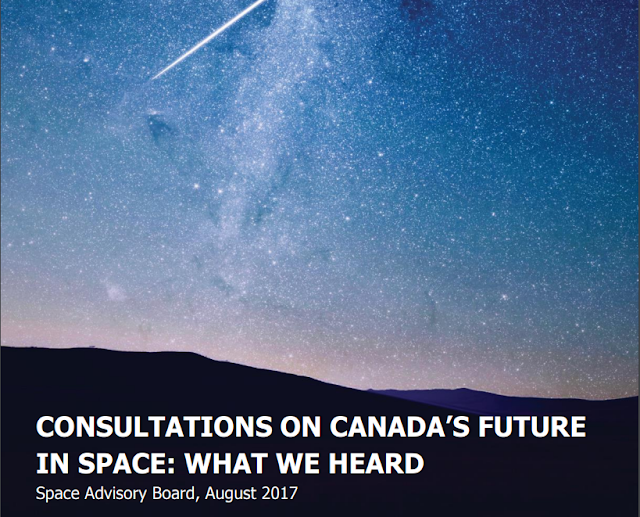
Amidst all the sound and fury of their "urgent call to action," and requests to "designate" space as a "national strategic asset," (whatever that might happen to mean) the essential truth of the August 18th, 2017 Space Advisory Board (SAB) report, released under the title, "Consultations on Canada’s future in space: What we heard: Space Advisory Board, August 2017," is that it's not quite done yet.

Sometimes, what's said isn't what's heard, especially when it comes to politics. For more background on what was really said during the SAB consultations, check out the August 18th, 2017 post, "Three Academics With a Paper on Canada's Future in Space," the April 20th, 2017 post, "Space Advisory Committee Members Announced: Various Stakeholders Release Independent Assessments, Just in Case," and the public records of various SAB meetings, which were held in Ottawa (April 21st, 2017), Halifax (April 28th, 2017), St. Hubert (May 5th, 2017), Calgary (May 10th, 2017), Vancouver (May 12th, 2017), Toronto (May 16th and 17th, 2017) and online (May 18th and 19th, 2017). Graphic c/o www.ic.gc.ca.

As outlined on the bottom of page eleven of the nineteen page final report, under the title "Key Proposal," the SAB suggests the development, "in time for the next federal budget (which is expected to be presented to the House of Commons in March 2018), a new space strategy and follow-on space plan that provides the policies, programs and funding essential for the revitalization of Canada's space capacity."

No wonder its a key proposal. The current document, which everyone agrees lacks "the  policies, programs and funding essential for the revitalization of Canada's space capacity," isn't really much good for anything except pushing off any final political reckoning.

But in order to atone for failing to come up with the serious and actionable policies which most reasonable observers had expected to be completed by June 2017, the SAB members have offered to remain "involved someway in the implementation of the Space Strategy," once it's developed.

That's quick thinking on their part.

It kinda sounds like they had fun making the report, would like a hand in developing the newly promised March 2018 report/ budget input paper (the one which includes the "policies, programs and funding") and want to follow through on the generalizations presented in the current report.

Of course, they might just mostly want to make their jobs permanent.

The  December 21st, 2016 Ottawa Citizen post, "If the port of Churchill is a strategic asset, then why did the Canadian government allow it to close?" questions the utility of designating something as a  "national" or "strategic asset," without supporting legislation or a strong case (business or otherwise) to back up the claim.  For more on what the term has historically meant under the Investment Canada Act, check out the the August 22nd, 2012 Dan Herman's blog post, "Defining a strategic asset – maybe." It's worth noting that the definition relates to the ability of a foreign company to buy a Canadian based firm. Photo c/o Adrian Wyld.

As outlined in the report, the original mandate of the SAB was to:
...conduct outreach and consultations with stakeholders on a vision that: 
  • Encourages a growing and sustainable space sector in the long term. 
  • Inspires Canadians and attracts talent. 
  • Contributes to scientific advancement and the development of emerging technologies; and 
  • Supports companies to scale-up as well as clean growth”
The Minister asked the Space Advisory Board to report on its findings in order to “inform the new space strategy which will use space to drive broader economic growth and innovation while inspiring the next generation of space scientists.”
But the outreach and consultations were held under Chatham House rules where, as outlined on the Royal Institute of International Affairs Chatham House website, "participants are free to use the information received, but neither the identity nor the affiliation of the speaker(s), nor that of any other participant, may be revealed." The intent is to provide anonymity to speakers and "encourage openness and the sharing of information," but the rules often lead to generalizations (since all participants can use the knowledge gained at the meetings when they leave) and insure an overall lack of accountability.

Even worse, participants were discouraged from discussing specific policies or policy changes during the discussions. At the request of the Justin Trudeau Liberal government, the SAB was specifically tasked to build a document to "inform," but not develop, define or create anything which could be mistaken for a new space policy or long-term space plan.

Which, of course, was a large part of the reason why the report was subtitled "What We Heard" instead of "What We Concluded."

The members of the SAB gave the Federal government exactly what they were asked to give when, as outlined in the April 18th, 2017 government of Canada post, "Government of Canada renews Space Advisory Board," the government reformed the board earlier this year. In exchange, board members might even get new part time jobs, if the government reacts positively to their request.

It's just a damn shame they weren't able to provide a document of use to the industry and all the people who participated in those meetings. Some were even counting on them.

So here we go again. The next stop is March 2018.
Chuck Black.
___________________________________________________________

Chuck Black is the editor of the Commercial Space blog.

Support our Patreon Page