Showing posts with label hackerlabs. Show all posts

Friday, February 16, 2018

Ottawa Announces Winners of $950Mln 'Supercluster' Competition

         By Henry Stewart

Ottawa has announced the five "industry led" technology groups slated to get a piece of the $950Mln Federal government “superclusters” funding.

Minister Bains at the CSTM on Thursday, February 15th, 2018. The supercluster funds will be distributed over five years to the winners, which will be required to match the federal funding they receive with equivalent private sector funding. Photo c/o CBC News.

As outlined in the February 15th, 2018 Global News post, "Government reveals who is getting $950M in ‘supercluster’ funding," Federal Innovation Minister Navdeep Bains made the announcement Thursday at a press conference held in the Ottawa, ON based Canada Science and Technology Museum (CSTM).

The announcement "closed out a nine-month contest central to the Liberals' so-called innovation agenda. The project was designed to encourage academia and businesses to work together on strategies to boost fast-growing sectors" and is a central platform in the Liberal's Innovation Agenda, according to the February 15th, 2018 CBC News post, "AIs, Oceans and proteins: Ottawa announces winners of $950 million 'supercluster' competition." 

The five technology groups chosen for funding include:
  • Canada's Ocean Supercluster, based in Atlantic Canada, which will develop and utilize innovative technologies to improve competitiveness in Canada’s ocean-based industries, including fisheries, oil and gas and clean energy. Partners include PQ based ABB Canada, Ottawa ON based C-CORE and Cambridge, ON based exactEarth.
  • The Quebec based SCALE.AI Supply Chain Supercluster, which will work on building intelligent supply chains using artificial intelligence and robotics. According to its website, the consortium includes "over 80 Canadian companies, 26 business associations and 12 Canadian academic institutions." 
A proposal from the Satellite Canada Innovation Network, which was discussed in the August 3rd, 2017 post, "Satellite Canada Applies for Innovation SuperCluster Funds," didn't make the list of finalists.

As second proposal, the Prairies’ smart agri-food supercluster, profiled in the August 31st, 2017 post, "MacDonald Dettwiler is Part of an Alberta Based Agrifood ‘Supercluster’ Proposal"and listed as one of the nine finalists, also didn't make the final cut.

Last fall, the government narrowed a field of about 50 applicants to nine organizations. The money will be distributed over five years to the five winners, which will have to match the federal funding they receive, dollar for dollar.

The government expects the program to eventually create more than 50,000 jobs for Canadians.
_______________________________________________________________________

Henry Stewart is the pseudonym of a Toronto based aerospace writer.

Monday, April 25, 2016

A Weekend at the 2016 NASA Space Apps Challenge

          By Chuck Black

Graphic c/o NASA.
For those interested in the intersection of space advocacy, software applications and commercial business activities, the 2016 NASA Space Apps Challenge, which was held from April 22nd - 24th at various locations around the world, provided an interesting canvas of exploratory ideas for our next great space age.

First held in April 2012, the international hackathon partnered NASA with small groups engaged in organized challenges to develop innovative solutions focused around the use of NASA data.

As outlined in the March 23rd, 2016 NASA press release, "NASA Announces Dates for One of World’s Largest Hackathons," the "global main stage for this year’s event" was Pasadena, California,

Local events took place at 193 other locations in 72 countries and were expected to attract approximately 15,000 participants.

In Toronto, the teams picked to move on to global judging, the next phase of the event, include:
  • Vesta Rainbow - A generic digital online tool designed to build constant scale natural boundary (CSNB) maps of Vesta (one of the largest objects in the asteroid belt) utilizing the digital elevation model (DEM) found through Vesta Trek. According to the website, tool could be applicable to any 2D or 3D surfaces (not necessarily terrains) in order to "visualise the dissipation of potential. An example could be “virtual flood” analysis of income distribution on a city map."
  • Kid on the Moon - An interactive children's app which allows smartphones and tablets to locate the Moon any time of the day (even when the Moon is below the horizon) and unlock current lunar data (phase, distance, etc), and other items.
As well, team Space Off (which explored ways to adapt common gym tools to reduced gravity environments and design a workout routine to minimize bone and muscular loss) received a Peoples Choice nomination and will also move on to global judging.


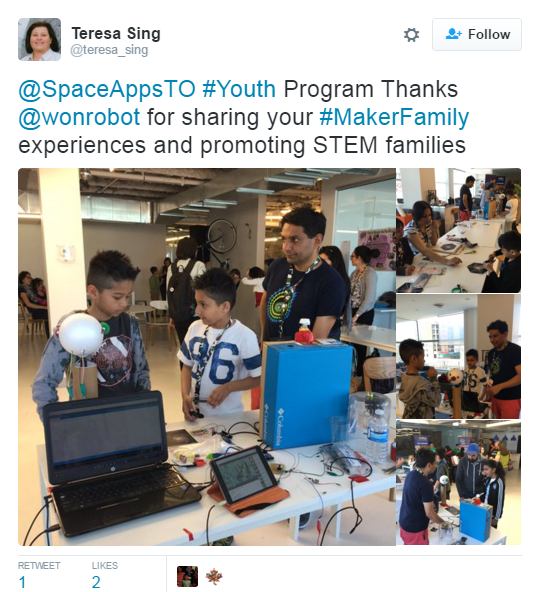
According to Toronto Space Apps Challenge organizer James Costa, the real Toronto challenge was to organize a separate one-day youth event for kids ages 7-15, which was held on Saturday, April 23rd, in conjunction with, but at a separate location, from the main event.

As outlined on the 2016 Toronto Space Apps Youth website, "It’s a day set with unique challenges that encourages kids to use their hands and brains to explore and learn about space like never before." The youth event involved robotics, space-related arts and crafts and coding workshops.

Don't just stand there. Click on the image to re-tweet and show your support. Photo's c/o @teresa_sing.

Meanwhile, over at the NASA space apps Waterloo location, the big news was the MaxQ "business accelerator for space start-ups," which formally announced a pilot program for three to five teams, which will begin in September, 2016 and run for six months.

To join the first cohort, the MaxQ organizers are looking for:
  • Teams of 2-10 founders, of whom one must be willing to be at Communitech in Kitchener-Waterloo full-time for the duration of the program.
  • Teams focused on developing "downstream applications" or software applications able to run on existing hardware, focused around the areas of Earth observation, geo-analytics, big data, geomatics, wearables and/ or bio-medicine.
  • Teams with a working prototype that is close or ready to be launched into the market.
In exchange, the company offers "an intensive program of mentoring, business development assistance and access to industry experts." The program is open to Canadian citizens and Canadian residents only.

According to MaxQ president Brodie Houlette, "We want to make Kitchener/ Waterloo the epicenter for Canadian space activities."

He said the Canadian accelerator will be modeled on the successful UK based Satellite Applications Catapult accelerator, which was established in May, 2013 by Innovate UK, a UK government agency.

CEO Houlette giving a presentation at the Waterloo Space Apps Challenge on April 24th. MaxQ will be based in the Communitech innovation centre in Kitchener, Ontario, which has donated space for up to 20 people, according to the April 24th, 2016 The Record article, "New space-sector accelerator to touch down in Kitchener." Photo c/o B. Houlette.

MaxQ founders include Houlette, Marc Boucher (the co-founder and CEO of SpaceRef.com), Robert Gissing (a co-founder, past director and past president of the Kwartzlab MakerSpace) and James Slifierz (the co-founder and CEO of SkyWatch Space Applications which, as outlined in the May 19th, 2014 post, "CDN "SkyWatch" wins "Best Use of Data" at Int'l Space Apps Challenge," won the 2014 Space apps challenge).

No funders for the accelerator have so far been announced.

Chuck Black.
The potential for a Canadian space focused accelerator has been discussed previously, most recently in the March 30th, 2016 post, "Changing Times; Space Start-up Accelerator Announced in Waterloo."
___________________________________________________________

Chuck Black is the editor of the Commercial Space blog.

Monday, February 01, 2016

A New, Smart Manufacturing Hub for Kitchener/ Waterloo

          By Chuck Black

It's common knowledge that SpaceX houses its office space, mission control, and vehicle factory in a single, three story facility in Hawthorne, California. Canadian companies will soon have the option of locating in a very similar sort of "all in one" manufacturing facility at the centre of Canada's technology triangle.

The current ex-Kumpfort Zone warehouse will become the Catalyst 137 IoT manufacturing facility sometime in 2017. Current plans include a managed innovation space for smaller companies (with suites as small as 2,000 square feet available for rent) and a variety of "maker spaces" for on-site rapid prototyping, 3D printing, RF testing/ certification lab plus an indoor test environment for drones and other physical objects, plus government, legal, import-export, venture capital, retail and health facilities. Photo and graphic c/o Myvisuallistings.com and catalyst137.com

At least that's the plan behind the Catalyst 137 smart manufacturing campus, currently scheduled to open in Kitchener, Waterloo, in early 2017. The 475,000 square foot facility will be the largest of the"smart" manufacturing, Internet of Things (IoT) and "maker space" operations in North America.

"I think it's going to become the place to be in Canada for the development of hardware," according to Michael Bierstock, the president of Pierpoint Developments, and one of the people responsible for moving the project forward.

Bierstock considers the current generation of manufacturing "ill served" by cubicle farms where people have traditionally developed software applications. "With the current generation of tech being embedded into machinery, cell phones and even sneakers, we need to develop facilities from a manufacturing perspective, with physical storage and places to tinker and test real objects."

In essence, the new facilities are necessary in order to support the revolution in manufacturing just now getting underway.

Michael Bierstock, at Communitech, a Kitchener/ Waterloo industry-led innovation centre which supports nearly 1,000 local tech companies,where he spoke as part of the Catalyst137 Launch Party on January 29th, 2016. According to Bierstock, 137 isn't just the address on Glasgow Street in Kitchener where the facility is located. It's also a mystical and scientific number. As outlined on the Richard Feynman tribute website "Friends of Tuva," the "mysterious number 137," it was even once suggested that electrons captured by the as yet undiscovered "element #137" would move at the speed of light. According to Bierstock, "we hope to grow our companies at about that same speed." Photo c/o Chuck Black.

As outlined in the January 27th, 2016 The Record article, "Catalyst 137 smart manufacturing campus to open in 2017," the new facility should have room for thirty-five or more companies, with space ranging from 2,000 to 50,000 square feet for each tenant.

According to Miovision CEO and co-founder, Kurtis McBride, "the vision with Catalyst is basically to kind of give the hardware cluster a home or a brand it can attach to.” McBride feels that it's also important to try to bring on-site the sort of infrastructure that help firms to get their products to the market faster.

Miovision, a local Kitchener/ Waterloo success story founded in 2005 by three classmates from the University of Waterloo Systems Design engineering program, will serve as the anchor tenant for the campus.

The third partner in the Catalyst 137 project is Voisin Capital CEO Frank Voison. Voison began his real estate investment company in 2010 and it has since grown to include holdings across southwestern Ontario. His firm specializes in adaptive reuse projects, when an old site or building is re-purposed for a use other than which it was originally built or designed for.

The concept of a "new manufacturing economy," enabled by digital technologies and wrapped around a highly trained and knowledgeable workforce, has always been the "pot of gold" for city councils looking to improve upon the low paying service industry and contract jobs which so many of their current voters are saddled with.

Chuck Black.
Here's hoping the Kitchener/ Waterloo area a great success with Catalyst 137.
___________________________________________________________

Chuck Black is the editor of the Commercial Space blog.

Friday, June 19, 2015

Canadian Space Advocates, Activists and Groups

          By Chuck Black

There are a lot of space advocates in Canada.

Some of them are wrapped around academic institutions. Others are wrapped around ideas such as "open source" or "working in space" and a few are even wrapped around activities like launching rockets or space tourism.

Below is a representative sampling of some of the more interesting.
_________________________________________________________________________________

The Astronomy and Space Exploration Society (ASX) - A non-profit organization run out of the University of Toronto with a mandate to educate, excite, and inspire students, professionals, and the general public about astronomy and space. Best known for its annual January astronomy symposium.

The AstroNuts Kids Space Club - A space focused educational group for elementary school students created in May 2010 by the father/ son team of Ray and Brett Bielecki. The various "missions" of spaceship "Mercury One" and its successor "Mercury Two" have been profiled on CBC, CTV, CITY-TV, A-Channel, the Daily Planet (for the Discovery Channel) and Rogers TV.

The Calgary Space Workers Society - Local advocacy group focused on how "to live and work in space." The group hosted the 2007 "Canadian Space Summit."

The Canadian Association of Rocketry listing of affiliated organizations - Who says that Canadians don't build rockets? Certainly not these self-supporting, non-profit organizations whose sole purpose is to promote the development of amateur rocketry as a recognized sport and worthwhile activity.

The Canadian Aeronautics and Space Institute (CASI) - A nonprofit technical organization for aeronautics, space and remote sensing. Host for a variety of annual events including the recently concluded 65th International Astronautics Congress (IAC), which was held in Toronto from September 29th - October 3rd, 2014 and the 2015 CASI AERO Conference, which was held from May 19th - 21st, 2015 in Montreal, PQ.

The Canadian Association of Science Centres - An organization promoting and encouraging public involvement with Canadian public science centres and the organizations needed to support them.

The Canadian Astronomical Society – Founded in 1971 and incorporated in 1983 as a society of professional astronomers devoted to the promotion and advancement of knowledge of the universe through research and education. Membership is open to persons with a professional involvement with these goals in astronomy and the related sciences.

The Canadian Foundation for the International Space University (CFISU) – The charitable organization promoting the International Space University (ISU) in Canada.
The Canadian Remote Sensing Society (CRSS-SCT) - Focused on the Canadian activities relating to geomatics (the discipline of gathering, storing, processing, and delivering geographic information, or spatially referenced information), this scientific association organizes conferences and helps publish the Canadian Journal of Remote Sensing (CJRS).

The Canadian Satellite Design Challenge - A privately funded, biannual event focused on teams of Canadian university students (undergraduate and graduate) who design and build an operational small-satellite, based on commercially-available, "off-the-shelf" components. The current challenge, with eight participating teams, began in September 2014.

The Canadian Science Policy Centre - Passionate professionals from industry, academia and government who organize the yearly Canadian Science Policy Conference.

The Canadian Space Society (CSS) – A non-profit corporation promoting Canadian space activities. Organizes the annual Canadian Space Summit, which will be held this year from November 19th - 20th, in Vancouver, BC, along with a variety of other local, regional and national events.

The Centre for Spatial Law and Policy - Not Canadian, but this Virginia based think tank does focus on the legal and policy issues associated with geo-spatial data and technology, which is of some use to the Canadians who are ranked as leaders within this growing field.

Engineers Canada - The national organization of the 13 provincial and territorial associations that regulate the profession of engineering in Canada and license the country's more than 260,000 members of the engineering profession. The organization issues national position statements on key issues relating to the public interest, including infrastructure, labour mobility and regulating the profession.

Friends of NASA - An independent non-governmental organization (NGO) dedicated to building international support for peaceful space exploration, commerce, scientific discovery and STEM education organized by Montreal, PQ based Dwayne Lawrence in 2008. The organization claims over 10,000 professional members worldwide from over 50 countries plus 180,000+ public followers on social media: Google+, Twitter and Facebook.

The Geological Association of Canada - A national geo-science society, publisher and distributor of geo-science books and journals. Also holds a variety of conferences, meetings and exhibitions for the discussion of geological problems and the exchange of views in matters related to geology. Geologists often use Earth imaging and geo-spatial satellite technology derived from our space program to inventory natural resources.

Hacklab.TO - One of a number of small Canadian organizations like the Interaccess Electronic Media Arts Centre, the Kwartzlab Makerspace, the Makerkids non-profit workshop space for kids, Think|Haus, the Site 3 coLaboratory, UnLab and others who focus on the technologies associated with open source additive manufacturing/ 3-D printing. These techniques show great promise for a variety of low cost space manufacturing technologies.

The Mars Society Canada - Although this semi-active Canadian subsidiary of the US based Mars Society advocacy group has a past history of strong activism and support for research projects like the Flashline Mars Arctic Research Station on Devon Island, the current website is down. The one remaining active Canadian chapter of the society is in Winnipeg, MB.

The North York Astronomy Association (NYAA) - This Ontario based club is the organizer of the annual StarFest star party, recognized as one of the world's top 10 gatherings of amateur astronomers for the purpose of observing the sky.

The OpenLuna Foundation - A privately funded public outreach program (officially a US based 501(c) 3) to encourage the use of open-source tools and methodologies (open design) for space focused activities. The founding member and project manager/ director of the organization is Paul Graham, who lives in London, Ontario.

The Planetary Society Canada - A subgroup of the larger US based Planetary Society. a non-government, nonprofit organization involved in research and engineering projects related to astronomy, planetary science, exploration, public outreach, and political advocacy founded in 1980 by Carl Sagan, Bruce Murray, and Louis Friedman. The current CEO is Bill Nye.

The Royal Astronomical Society of Canada - 4,000 members, including about 500 "unattached" members from remote parts of Canada and around the world and strong chapters in Vancouver and 28 other centres across the country.

Science Rendezvous - Grassroots not-for-profit organization and public platform to promote science awareness and increase science literacy in Canada. Holds the yearly spring Science Rendezvous at the University of Toronto, St. George campus.

Space Canada – A not-for-profit organization dedicated to the promotion of solar energy from space. Organized the 2009 Symposium on Solar Energy from Space. Space Canada president and CEO George Dietrich has a long history of supporting US and Canadian NewSpace activities.

The Space Society of London (SSoL) - Aims to unite members of the University of Western Ontario who have a common interest in space.

The Space Tourism Society Canadian Chapter - A Canadian chapter of the US based Space Tourism Society (STS) which intends to promote space tourism and the acquisition of "financial, political and public support to make space tourism available to the general population in the near future."

Students for the Exploration and Development of Space (SEDS) Canadian chapter - Part of an international group of student-run organizations dedicated to promoting public interest in space. Countries with active SEDS groups include the US, the UK and India.

The Toronto International Space Apps Challenge - An annual "hackathon" organized each spring as part of the NASA International Space Apps Challenge.

The Toronto Students for the Advancement of Aerospace (TSAA) - A relatively new group focused on building an annual conference series focused around promoting aerospace. Planning an "aerospace hackathon" for 2015.

Tuesday, March 31, 2015

Crowd Sourcing the Next Great Space Application

          By Brian Orlotti

The 2015 Toronto Space Apps Challenge, being held this year from April 10th - 12th at the offices of BNOTIONS (a mobile data and analytics firm) as part of the larger NASA International Space Apps Challenge, promises to once again serve as a catalyst for innovative solutions to the challenges of space.

The Toronto based Skywatch team won the 2014 NASA International Space Apps Challenge in the "best use of data" category by creating a visual representation of data collected from observatories around the world. As outlined in the SkyWatch website, the developers were then accepted into the Google for Entrepreneurs program at Communitech in Waterloo, Ontario. Graphic c/o SkyWatch. 

Since 2012, the International Space Apps Challenge has brought together coders, makers and entrepreneurs from around the world to foster innovation and make space exploration more engaging by solving various 'challenges' devised by NASA. Over two days, participants work in teams to solve these challenges by creating software and hardware solutions utilizing science data from NASA assets, including satellites and space probes. In 2014, over 8,000 people in 95 events around the world took part.

Challenges to be tackled this year by Toronto teams include:
  • 3-2-1 LIFTOFF - In this challenge, the team must develop an application that portrays all the variables involved with making a rocket launch decision. Teams are to create a way to analyse data from a rocket, weather conditions, range safety, etc. The application should enable the user to decide when to fuel a rocket, when to clear the launch range and its airspace, and how to detect weather that could affect a launch.
  • Open-source Air Traffic Tracking -  In this challenge, the team must build an open-source air traffic tracking tool that allows users to select a particular flight and see out-the-window or other views of the aircraft and airspace. Using current and/or historical data from sources like radio traffic, weather reports, air traffic control and flight plans, such a tool could allow air crash investigators to replay accidents from any angle or let researchers replay a test flight from any angle.
  • 3D AstroMed Devices - In this challenge, the team must utilize 3D modelling software and 3D printers to reimagine medical devices and equipment for use on long-duration space missions far from Earth.

BNOTIONS partner Mark Reale at his offices on March 31st. "This is the third year my company has been involved in the planning and organizing of this event. We're looking forward to exposing a new crop of contestants to an extraordinary roster of mentors." Mentors for the event include past and present astronauts, aerospace engineers, and software designers. Sponsors and community supporters for the event include Phuse, SkyWatch, #DevTO, MLH, CleverHost and Pebble. Photo c/o Chuck Black.

The International Space Apps Challenge was created by former NASA Open Innovation Program members Nicholas Skytland, Ali Llewellyn, and Sean Herron to fulfill a White House mandate to make US government science data available to the public. NASA, by distributing this data via mechanisms like the Space Apps Challenge, seeks to create a global community of problem-solvers.  In turn, this community would not only give rise to new companies and industries, but also provide new innovations that could be incorporated back into NASA’s own programs.

Brian Orlotti.
If previous years are any indication, the 2015 Toronto Space Apps Challenge promises to be an engaging showcase of Canadians' creativity and skill.
____________________________________________________________

Brian Orlotti is a network operations centre analyst at Shomi, a Canadian provider of on-demand internet streaming media and a regular contributor to the Commercial Space blog.

Tuesday, February 03, 2015

Preliminary Results from 3D Printing Experiments Onboard the ISS

          By Brian Orlotti

Made in Space (MIS), a Silicon Valley-based start-up that built a zero-gravity 3D printer installed on the International Space Station (ISS) four months ago, says the first set of objects is complete and the preliminary results are good.

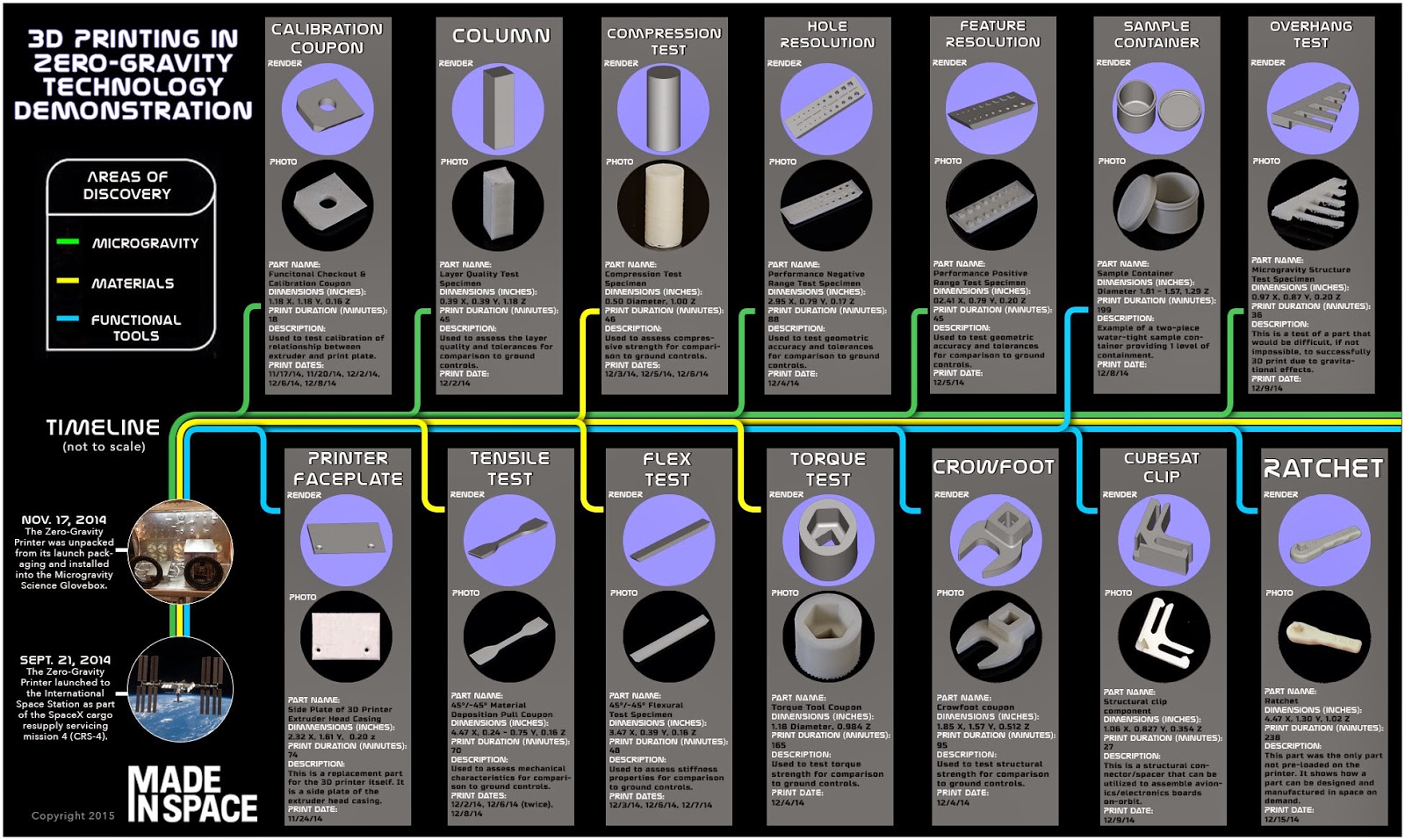
Graphic showing the parts that were printed as part of the 3D printing in zero gravity technology demonstration. Graphic c/o Made in Space.

According to a Jan 27th, 2015 Made in Space blog post, "3D Printing In Space: Four Months In," the printer created fourteen unique objects over the course of the experiment.

These ranged from objects designed to test the printer's accuracy at creating features like holes and overhangs, to a part for the 3D printer itself (a faceplate), to an actual working tool: a small ratchet. The ratchet's design file was even emailed to the ISS to be printed; the first time in history that this has been done in space.

The printed objects will be brought back to Earth later this year and sent to the NASA Marshall Space Flight Centre in Alabama for analysis and stress testing.


The use of 3D printing technology in space, though still in its earliest stage, is poised to make a big impact. Space-based 3D printers would give astronauts the ability to manufacture tools and components on-site without needing to bring them along, with significant savings on space, weight and fuel.

In addition, the ability to manufacture objects in space would give astronauts greater options in unforeseen situations like malfunctions and accidents. In a sign of the technology's potential, the US Navy is also experimenting with 3D printers, installing them on combat ships to see if they can be used to produce tools, components and weapons.

MIS was founded in August 2010 by Aaron Kemmer, Jason Dunn, Mike Chen, and Michael Snyder, who all met while taking part in the graduate studies program at Singularity University (SU), a private, unaccredited learning institution/space start-up accelerator located at the NASA Ames Research Centre in Moffett Field, California.


Also located at Moffett Field, MIS was one of the first startups to emerge from SU. MIS' goal is “enabling humanity’s future in space,” by developing additive manufacturing (i.e. 3D printing) technology for use in the space environment. By creating an additive manufacturing capability in space, MIS seeks to accelerate and expand space development.

The emailing of an object to a space station for manufacture in orbit, which would have seemed the most Star Trekkian of fantasies 20 years ago, is now reality.

Brian Orlotti.
In the coming decades, we might gaze in wonder at 3D-printed solar arrays, space stations and spaceships; more science fiction marvels brought to life.
____________________________________________________________

Brian Orlotti is a network operations centre analyst at Shomi, a Canadian provider of on-demand internet streaming media and a regular contributor to the Commercial Space blog.

Sunday, June 08, 2014

MakerBots on Mars!!!

          by Brian Orlotti

Graphic c/o Thingiverse.
NASA and 3D printing pioneer Makerbot Industries have sponsored an online competition to harness the talents of the maker community to design a future Mars base.

The contest, called the MakerBot Mars Base Challenge, was created by Makerbot in collaboration with the NASA Jet Propulsion Laboratory (JPL) in California with the stated goal, as outlined on their website, of designing "a utilitarian Mars base that can withstand the elements and maybe even make you feel at home, despite being 140 million miles away from Earth, on average."

The public can upload their 3D design files to Makerbot's 3D design portal, Thingiverse (using the tag #MakerBotMars) between May 30th and June 12th. Entries will be judged by a panel of NASA-JPL and MakerBot employees on scientific feasibility, creativity, and print-ability. The 1st place winner will receive a MakerBot Replicator 2 desktop 3D printer and three spools of plastic filament. The 2nd place winner will receive two spools of plastic filament and 3rd place will receive one spool. All winners will have their designs featured on Thingiverse.


NASA is expecting that crowd-sourcing the Mars base design to non-scientists in the public will unearth new innovations as well as inspire the next generation of astronauts. 

The Makerbot Mars Base Challenge continues the trend of the last few years of various government agencies soliciting the public for innovative new ideas that can foster new companies and products as well as be incorporated back into government programs.

Examples include The NASA Space Apps Challenge (most recently profiled in the April 14th, 2014 post "Commercializing the Winners of the Space Apps Challenge") the DARPA Open Source Catalog (as described in the March 3rd, 2014 post "DARPA Goes Open Source as Others Beg for Government Assistance") and the European Union's Open Data Challenge


The crowd-sourcing model is also making headway in the private sector, enabling businesses like open-source vehicle maker Local Motors.

Some of the more interesting designs submitted so far to the MakerBot Mars Base Challenge have included:

"The Sustainable Base," submitted by user "VFXBase." The base is circular and designed around a central area containing a greenhouse and a "roof" of arching solar panels. Forming a rectangle around the centre are modular tunnels which connect various housing units together. The outer "ring" of the base holds fuel and oxygen tanks, heating units, and four landing pads, which completes the circular design of the base and provides an easy way to land in and enter. The base was designed to be both visually striking as well as comfortable to live in.

"The Mars Atmosphere Mine," submitted by user "NathansMind." In this design, the base uses a combination of both solar cells and wind turbines for power geeeration for the sake of redundancy. NathansMind argues that Martian dust storms would block out the sun for months at a time, making some form of backup power desirable. The base also incorporates absorption-based separators to harvest various gasses i.e. CO2 from the Martian atmosphere. Interestingly, NathansMind cites a variety of web links on gas separation, in-situ resource utilization, carbon monoxide fuel cells, and Mars polar wind turbines, which were consulted when developing thh design.

Brian Orlotti.
The MakerBot Mars Base Challenge is an attempt to tap the creative power of the public to envision a human home on another world. What greater challenge for a "maker" than to make a new world?
____________________________________________________________

Brian Orlotti is a Toronto-based IT professional and a regular contributor to the Commercial Space blog.

Monday, March 03, 2014

DARPA Goes Open Source as Others Beg for Government Assistance

          by Brian Orlotti

DARPA turned 50 in 2008. Graphic c/o DARPA.
The US Defense Advanced Research Projects Agency (DARPA) has created a new website to make software, publications, and experimental data from its various projects available to the public.

DARPA, an agency of the US Department of Defense responsible for the development of new military technologies (notable examples include the internet and the global positioning system), has over decades amassed a large quantity of research in fields as diverse as robotics, programming languages, advanced communication systems and even mind reading. Much of this data is open source, but hasn't always been readily accessible.

On Feb 4th, DARPA responded to requests from the research and development community by publishing the DARPA Open Catalog, a website that aggregates source code and other data for all public DARPA-funded projects. Currently, this includes 60 different projects, done in collaboration with a variety of organizations including Microsoft Research, Yahoo Research and the Massachusetts Institute of Technology (MIT).

Examples of projects in the Open Catalog include "Vowpal Wabbit," a fast machine learning system sponsored by Microsoft Research and Yahoo Research and the MIT-developed dynamic programming language "Julia."

Sample DARPA challenges showing how often DARPA looks outside itself to develop new ideas. Graphic c/o DARPA.

DARPA’s rationale for creating the Open Catalog is two-fold. First, DARPA hopes to foster research and development communities around its research which could give birth to new technology companies and industries. Secondly, DARPA hopes to harness the strengths of the open source software model by allowing the public to contribute to its research, which could then be incorporated back into DARPA’s own programs. Call it crowd-sourcing for the military-industrial complex.

As outlined in the February 27th, 2014 SpaceTravel.com article "DARPA Open Catalog Makes Agency-Sponsored Software and Publications Available to All," DARPA has stated that if R&D communities show sufficient interest, "they will continue to add information generated by its programs (including software, publications, data and experimental results) to the Open Catalog."


The rationale behind the program is similar to that of IT and NewSpace incubators, where individuals & small businesses are developed in the hopes of fostering larger growth. It's also a logical outgrowth of DARPA's recent quest to rebuild its original reputation to bring together academics and public workers from disparate areas to generate "outside the box thinking." 

But while DARPA seems attuned to this way of thinking and has embraced it, other communities appear less than receptive.

For example, the February 28th, 2014 Space Policy online article "House Hearing Underscores Lack of Consensus on Next Steps in Human Spaceflight," discussed the February 27th appearance of Denis Tito before the US House of Representatives Science, Space and Technology Committee to present the newest re-branding of his ‘Inspiration Mars’ mission concept.

An artist's conception showing components of the new and improved Inspiration Mars spacecraft design. The stack now includes, from left, an Orion-derived re-entry pod, a Cygnus-derived habitat module and a service module for avionics, control and communications. A previous configuration, utilizing SpaceX and Bigelow components, seems to have been abandoned in the quest for government funding. Graphic c/o NBC News

In this iteration, all funding would come from the US government, the mission would now explicitly utilize the troubled NASA Space Launch System (SLS), thus providing SLS with what it has lacked until now (a mission), plus the launch date has been pushed out to 2021 instead of 2018 to allow the SLS to become operational.

Since there is no direct launch window for a Mars trip in 2021, the revised mission calls for a flyby of Venus for a gravity assist which would then propel the crew to Mars.

Brian Orlotti.
In the case of Inspiration Mars, we see a failed private entity now completely dependent on government resources for progress. In the case of the DARPA Open Catalog, we see government distributing its knowledge to private entities, enabling them to acquire resources and achieve for themselves. 

The contrast is a stark one and should not be lost on the space sector.
____________________________________________________________

Brian Orlotti is a Toronto-based IT professional and the treasurer of the Canadian Space Commerce Association (CSCA).

Tuesday, December 17, 2013

3D Printing Industry Expected to Grow 12% Annually Over Next Five Years

The MaRS Discovery District, a well known not-for-profit corporation founded in Toronto in 2000 to commercialize publicly funded medical research and other technologies, has finally weighed in on 3D printing, with a generally positive and useful report.

As outlined in the December 16th, 2013 blog post "Is 3D printing ushering in the third Industrial Revolution?" on the MaRS website, the new report, titled "Layer-by-Layer: Opportunities in 3D Printing" is an overview of how this technology is expected to affect manufacturing and various other industries in the near future.

The report focused on the aerospace, healthcare and consumer markets as being the industries most likely to provide new opportunities for 3D printing methodologies and predicted an average industry growth at around 12% annually over the next five years.

The report also discussed commercial opportunities for entrepreneurs and new investors, potential financing sources, viable business models and potential legal and copyright hurdles needing to be addressed.

It even included interviews with seven Ontario-based companies involved with the development of 3D printing technology in a variety of areas including manufacturing prototyping, art, architecture and medical research.

However, the report failed to mention the automobile industry, one of the largest current users of the technology (for prototyping) or the fast growing Canadian hackerlab movement with organizations like the Interaccess Electronic Media Arts Centre, the Kwartzlab Makerspace, the Makerkids non-profit workshop space for kids, Think|Haus, the Site 3 coLaboratory, UnLab and others currently utilizing 3D technology in a variety of innovative ways.


But while the effects of 3D technologies on the aerospace and space industry have been noted in a variety of recent posts including the December 12th, 2012 post "3D Printers, Additive Manufacturing, Aston Martins & Star Trek Replicators," the August 26th, 2013 post "3D Printing in Space Now With Holographic Controls" and the October 22nd, 2013 post "3D Metal Manufacturing Waiting for Patents to Expire," its good to see many of the concepts finally validated through the official Canadian eyes of one of our best known entrepreneurial ecosystems.

We too often come to these sorts of parties grudgingly and too late to do any more than simply look on as the winners collect their spoils. Perhaps this time will be different. 

Support our Patreon Page