Showing posts with label Department of National Defence. Show all posts

Thursday, April 20, 2017

Space Advisory Committee Members Announced: Various Stakeholders Release Independent Assessments, Just in Case

          By Chuck Black

With almost no fanfare in either the mainstream media or amongst the Federal government, but with a great deal of confusion from the Ministry of Innovation, Science and Economic Development (ISED), the Federal government department tasked with administering its activities. the members of the long awaited space advisory board were finally announced last Tuesday evening.

Industry minister James Moore at the 2014 Canadian Aerospace Summit and his successor, innovation minister NavDeep Bains at the 2016 edition of the same event. As outlined in the November 19th, 2014 post, "Industry Minister Moore Announces Space Advisory Board Members," the membership of the space advisory board was long-awaited even in 2014, when Moore appointed Colonel Chris Hadfield, retired general and former CSA president Walt Natynczyk and others to the original committee. However, the 2014 board never issued a report and so the search for a new board was announced by innovation minister Bains in November 2016 at the 2016 Aerospace Summit. The creation of a space advisory board was one of the recommendations of the November 2012 Federal Review of Aerospace and Space Programs and Policies (or "Emerson Report") which was presented to another industry minister, Christian Paradis, in November 2012. Photo's c/o Chuck Black & Brian Orlotti.

As outlined in the April 18th, 2017 Government of Canada news release, "Government of Canada renews Space Advisory Board," the new board, chaired by Dr. Marie Lucy Stojak, the Director of the Summer School on Management of Creativity in an Innovation Society at HEC Montréal, will:
... engage with Canadians to develop a new vision for Canada’s space sector and define key elements of a strategy that will be launched this summer. The advisory board’s input will inform the strategy, which will focus on using space to drive broader economic growth and innovation, while inspiring the next generation of space scientists.
The other committee members include:

A reminder that one of the real issues currently preoccupying  the Canadian government is whether it should continue  supporting at least one Canadian based contractor capable of building large, multi-function Canadian military satellites like RADARSAT-2 and the upcoming RADARSAT Constellation or open future competition to lower cost, international bids. The March 29th, 2017 SatCom Frontier post, "Commercial Space Operators to Canada; 'We're Here and We can Help,'" argues that large, international satellite providers like Intelsat General Corporation are able to assist with complex military programs like the proposed Enhanced Satellite Communication Project (ESCP). For a contrary view on this issue, its worth taking a look at the April 9th, 2017 post, "Part 4: A History of the Canadian Space Program - Policies & Lessons Learned Coping with Modest Budgets," which focused on "the 1970's, "Equal Access" to Communications, "Improved Industrial Capability" and the Hermes Communication Satellite" and was even co-written by one of the new members of the current space advisory board. Graphic c/o Intelsat General Corporation.

The new members replace others appointed by the previous government to the same board in 2014. That board never issued a public report or held any public meetings.

The new board is expected to engage in a process similar to the methodology employed during the "massive" review of Federal science funding which wound up last week.

As outlined in the April 17th, 2017 post, "'Massive' Review of Federal Science Funding Finally Released; Will Likely Soon 'Drop Down the Memory Hole,'" that review seems to have achieved less than stellar results and might not be a good model to emulate.

The only real surprise expected to come out of this review (and how's that for irony) could be an acknowledgement that foreign companies like Airbus and Intelsat General Corporation might soon be able to bid on large Canadian space projects.

This is especially likely given the inclusion of Pley and Tovee on the board, although the debate on this particular issue originated in the early days of Canada's space efforts.

Some organizations are willing to lobby the Federal government even without the bully pulpit provided by the space advisory board. An example would by the 8th Joint Planetary and Terrestrial Mining Sciences Symposium (PTMSS) and Space Resources Roundtable, which will be held in conjunction with the 2017 Canadian Institute of Mining (CIM) Convention in Montreal, PQ and promises "major announcements" from international space mining companies. Event organizers, such as Deltion Innovations CEO Dale Boucher have long advocated the use of tax credit system currently used in the mining, to grow the Canadian space industry. Boucher was last profiled in the April 10th, 2016 post, "Deltion Innovations Receives Gov't Funding to Develop Multi-Tool for Space Mining; Will Anyone Buy It?" For more on the mining industry and how it could drive space exploration, check out the July 30th, 2012 CSCA submission to the Aerospace Review, "Using Tools from the Mining Industry to Spur Innovation and Grow the Canadian Space Industry." Graphic c/o Deltion Innovations.

Besides, as recently as a few years ago, Canada had two domestic firms capable of building large satellites.

However, as outlined most recently in the April 19th, 2017 post, "American MDA Subsidiary Promotes "DEXTRE" for US as NASA RESTORE-L Satellite Servicing Budget Slashed," Richmond, BC based MacDonald Dettwiler (MDA) is currently hunting US government and Defense Advanced Research Projects Agency (DARPA) contracts, which subjects the company to many of the same US export licencing regulations that delayed the launch of RADARSAT-2 for almost seven years, and currently causes concern among those responsible for developing Canadian policies relating to northern sovereignty.

Also, in February 2016, common shares of Cambridge, Ontario based COM DEV International were de-listed from the Toronto Stock Exchange (TSX) as the iconic Canadian company finished up its final task of becoming a subsidiary of US conglomerate Honeywell.

However, nothing is ever certain in politics or in political committees. Board member Evans has often argued publicly for a policy of "capacity building" which would favor specific Canadian companies with additional funds and tax benefits to allow them to compete with large foreign multinational competitors, who typically also receive subsidiaries from their national governments.

Evans argues that the creation of a domestic space industry outweighs the up-front costs associated with "capacity building," and supports the growth of domestic expertise and industry.

The Canadian Senate isn't waiting for the space advisory committee to issue a report when it can issue its own. As outlined in the April 19th, 2017 Space News post, "Report: Canada should work with U.S. to protect satellites as “critical infrastructure,” a report from the Senate’s Standing Committee on National Security and Defence and Security advocates the designation of "satellites and radar installations as critical infrastructure and seek ways to secure the full spectrum of all critical infrastructure assets against significant threats, including electromagnetic pulse, by 2020 in partnership with the United States and other countries." The article notes that the Canadian Space Agency (CSA) has long been advocating this approach. Screenshot c/o Space News.

Support for the new space advisory board, at least among the Federal government departments likely to be the most affected by any final report, seems tentative at best.

For example, the Canadian Space Agency (CSA) is in the midst of a series of announcements related to the development of technologies they expect to utilize over the coming years and have been doing this without any guidance from the space advisory board.

As outlined most recently in the April 3rd, 2017 post, "The Canadian Space Agency is "Very" Cautious About Its Post ISS Role," and the April 19th, 2017 More Space News post, "The Canadian Space Agency has just announced 15 more "priority technologies" it wants to develop," the CSA already has a strong, if also strongly conservative, sense of where it wants to go over the next decade.

There is also some question about whether the Department of National Defense (DND) is on-board with the new board.

As outlined in the April 17th, 2017 post, "An Update on NS Rockets, Intelsat Hunting for Canadian Gov't Satellite Contracts & More Ukrainian Lybid News," DND is pushing its own military space program, the proposed Enhanced Satellite Communication Project (ESCP), and the new project is likely out of the scope of the space advisory board mandate.

Professor Ram Jakhu, the associate director of the Centre for Research of Air and Space Law at McGill University, was one of two authors of the February 17th, 2017 "Independent Review of the Remote Sensing Space Systems Act." The report makes a number of recommendations directly relevant to the mandate of the new space advisory board but there was no plans from the Federal government to release the report for public comment. Fortunately, and as outlined in the April 20th, 2017 SpaceQ post, "Exclusive: A Review of Canada’s Remote Sensing Law Recommends Creating a New General Outer Space Act," that review is now open to public perusal. The report and other issues relating to it, will be the topics of discussion when Jakhu and the Centre hold the 5th Annual Manfred Lachs International Conference on Global Space Governance, which will be held in Montreal, PQ from May 5th - 6th. Hopefully, someone from the space advisory board will also be there. Photo c/o McGill University.

It's also worth noting that, while the space advisory board members are expecting to hold a series of town halls across the country to solicit feedback and assist with the development of useful policy, the secretariat supporting the space advisory board has so far refused to confirm or deny any activities the committee could possibly be conducting, except for one meeting taking place in Ottawa on Friday, April, 21st.

Here's hoping that they organize a few more meetings after that first one. There's a lot of data to collect and some actual activities culminating in a proper, publicly available report would certainly be an improvement over the last time.
Chuck Black.
___________________________________________________________

Chuck Black is the editor of the Commercial Space blog.

Sunday, November 27, 2016

Apogee Publishes New Book on "The Father of Canadian Astronautics"

          By Chuck Black

Collector's Guide (CG) Publishing, under its award winning Apogee Books imprint, has just released the second of two new books on notable, but until now mostly forgotten, Canadian space pioneers.

Author Robert Godwin with Colleen Lapp at the Canadian Aeronautics and Space Institute (CASI) Toronto branch meeting at the University of Toronto Institute of Aerospace Studies (UTIAS) on November 24th, 2016. Godwin was in town to speak on the topic of "The Empire Strikes Out - The Commonwealth Space Program," and to promote his latest books. According to Godwin, Phil Lapp "embodied Canadian Space achievement" and even "put the space in CASI." Among other things, Lapp helped to found the Canadian Astronautical Society (CAS) in 1957, and then helped it merge with the Canadian Aeronautical Institute (CAI) to become CASI in 1962. For more on the Commonwealth space program, check out the July 20th, 2015 post, "Part 1 of The Empire Strikes Out - Canada's Defence & The Commonwealth Space Program," or subscribe to the Space Library. Photo c/o Chuck Black. Graphic c/o CG Publishing.

The book is called "The Father of Canadian Astronautics; The Life of Dr. Philip A. Lapp O.C.," and CG Publishing owner/ author Robert Godwin admits that he chose the title. "It would never occur to Phil to be so self-aggrandizing," Godwin said during a recent interview.

But Lapp did make a difference. As outlined in the book:
Working from within DeHaviland's newly formed missile division (beginning in the 1950's) Lapp immediately recognized the new world that was opening up in Sputnik's wake. 
Within a few weeks of that momentous event he organized a meeting of his fellow engineers to inaugurate a "Canadian Astronautical Society" at the De Haviland factory in Downsview, Ontario. This meeting heralded the birth of Canada's space program.  
Lapp also co-authored, along with John Chapman, P.A. Forsyth and G. N. Paterson, the 1967 report on "Upper Atmosphere and Space Programs in Canada." Known today as the "Chapman Report," it's generally considered to be "Canada's original blueprint" for space activities.

The book takes the reader on a journey from Lapp's beginnings in Toronto, through his contributions to the Avro Arrow, the Allouette 1 satellite, the birth of Direct-TV, the iconic Canadarm and RADARSAT, to the end of his life when he earned Canada's highest civilian award, the Order of Canada.

Colleen Lapp, Phil Lapp's widow, at UTIAS on November 24th, 2016. "I'm so happy to reconnect with some of my husband's old colleagues as a result of the publication of the book.  It's kinda been my baby since Phil died and I'm so happy to be able to help Rob (Godwin) and others to bring it to fruition," she said. Perhaps now, the completed book will help to give purpose to others. Photo c/o Chuck Black.

The second book, also written by Godwin, is "William Leitch; Presbyterian Scientist & the Concept of Rocket Space Flight 1854 - 1864."

Regular readers of this blog will recognize Leitch as the subject of previous articles, including the October 4th, 2015 post "Rocket Spaceflight Accurately Described by Scottish-Canadian Scientist in 1861," which describes Godwin's original paper on the topic, and the September 12th, 2016 post, "William Leitch: Presbyterian Scientist & the Concept of Rocket Spaceflight 1854-64," which described the steps leading up to the publication of the book in September 2016.

Understanding Leitch and Lapp, their history and the context surrounding those who came before us is always the first step in climbing upon their giant shoulders and building our own future.

We should learn more about them.

To facilitate that, both books are available on the CG Publishing website.
Chuck Black.
___________________________________________________________

Chuck Black is the editor of the Commercial Space blog.

Monday, November 14, 2016

Public Private Partnerships, Marc Garneau, Telesat, DND, WGS, DoD, CSA & Urthecast

          By Henry Stewart

Here are a few of the stories we're currently tracking in the Commercial Space blog:

Garneau on stage at P3 2016. As outlined in his presentation, the Federal government will invest $10.1Bln CDN in transportation infrastructure for trade and travel, and roll out a new federal infrastructure bank, which will develop public private partnerships to help fund the needed infrastructure. As outlined in the July 6th, 2016 post, "Brownsville, STARGATE and SpaceX," the space industry has also utilized public private funding mechanisms to build out infrastructure and generate jobs. Photo c/o Chuck Black. 
As outlined in the November 13th, 2016 Globe and Mail post, "Ottawa to make 'unprecedented' appeal for private investment in infrastructure," the Justin Trudeau government has been looking to foreign investors to park billions of dollars in Canadian based public-private partnerships, to help fund the construction of needed infrastructure projects such as hospitals and highways throughout the country.
Of course, not everyone is in favor of these partnerships. Many are concerned that they are simply the first stage in the privatization of major Canadian utilities. Over lunch, a small protest of about 100 people, mostly Ontario government workers, disrupted the conference proceedings by marching through the event shouting "Ontario is not for sale," before they were escorted off the premises by local police. 
But it's worth noting that public private partnerships also helped create Telesat Canada, now the fourth-largest fixed satellite services provider in the world, but once a Canadian crown corporation created in 1969 as a public private partnership to provide telecom access in the far north.
Canada is considered a world leader in the creation of public private partnerships and P3 2016 is generally considered the premier event for gaining knowledge in this area. 
The November 10th, 2016 SpaceNews post, "Canada says military satcom negotiations with U.S. are much improved" quotes Canadian Forces Lt. Col. Abde Bellahnid,  as saying that his "US counterparts have become increasingly willing to take allied opinions into account." 
According to the article, Bellahnid said he "was particularly impressed by the U.S. Defense Department’s willingness to allow allies a seat at the table as the Pentagon evaluates next-generation satellite communications requirements and the future involvement of the commercial sector and U.S. allies." 
The process, known as an Analysis of Alternatives (AoA), has included an invitation to 16 allies, including Canada, to take part.
Canada is expected to eventually gain access to the $11Bln USD ($15Bln CDN) constellation for about a half-billion dollars and discussion is also slowly moving forward on other potential collaborations. 
  • The Canadian Space Agency (CSA) has finally begun promoting Apogy, an open source tool developed and used by the space agency to simplify the creation of the software needed to operate physical systems such as rovers, robotic arms, scientific instruments and sensors. 
As outlined in the November 11th, 2016 CSA blog post, "Apogy: the one-stop-shop solution for operating robots, satellites and beyond," the technology is designed to offer "a one-stop-shop solution where all the basic functions needed to manage that platform are standardized and accessible from a single place."
Background on the Apogy tool is available online at Eclipse, an open source community of tools, projects and collaborative working groups.
IFRS revenue for the quarter was $20.7Mln CDN, a 37% increase over the $15.0Mln CDN reported in the same period last year. 
The company, which seems to employ a surprisingly large number of ex-MacDonald Dettwiler (MDA) employees, sells Earth imaging data collected from a variety of orbital sources and has announced plans to place a 16 satellite Earth imaging constellation in Earth orbit to bolster its capabilities.
For more, check out upcoming editions of the Commercial Space blog.
 _______________________________________________________________________

Henry Stewart is the pseudonym of a Toronto based aerospace writer.

Monday, July 18, 2016

Arctic Satellites Should Serve Northerners According to Nunatsiaq Online

          By Henry Stewart

Not everyone likes the idea that the Polar Communications and Weather mission (PCW), the long awaited but never funded Canadian Space Agency (CSA) project to provide continuous 24/7 broadband communications services and monitor weather and climate change conditions in the Canadian arctic, is about to be replaced by a Canadian military based program without any weather component or assured civilian access to communications.

Areas of interest in the high arctic for the meteorological and communications components of PCW. As outlined by Brigadier General Rick Pitre, the then Director General for Space in the 2013 Frontline Defence article, "Director General talks about 'Space'," the Canadian military was, even in 2013,"very interested in PCW." Graphic c/o FrontLine Defence.

As outlined in the July 18th, 2016 Nunatsiaq Online post, "Arctic satellites should serve northerners," the latest plans are that the two satellites expected to built will be equipped for communications purposes only, and used primarily by the military. According to the article, "the military will likely operate the satellites in conjunction with a private company, which could perhaps market any unused bandwidth to northern residents and businesses."

But unlike PCW, any "public access (to the replacement satellite constellation) would not be assured," because of the military nature of the program. According to the article;
Under the new plan, the satellites will not be equipped to support weather forecasting, climate change science, or the monitoring of solar flares. 
Environment Minister Catherine McKenna. Photo c/o Wikipedia.
These reductions in capabilities could limit northern economic development, the safety of northern residents and visitors, research on climate change, and Canada’s ability to fulfill its marine weather forecasting commitment.  
The reductions are due to a recent decision by Environment Canada to withhold its portion of the funding for the Polar Communications and Weather Project, which amounted to about $10 million per year over the 15-year projected lifespan of the satellites.  
It was this decision that killed the multi-departmental project and forced the Department of National Defence to move forward on its own.
As outlined in the December 5th, 2012 post, "What the Space Volume of the Aerospace Review Actually Says," the 2012 Emerson Aerospace Review recommended that the Federal government narrow the CSA mandate to the point where it would no longer be a "policy-making body" or "directly involved in designing and manufacturing space assets purchased by the government." Nor would it embark on any new large satellite programs.

Instead, individual government departments (such as DND) would manage their own space projects just so long as they also funded them. This is why DND felt justified in radically revamping the PCW program after the Federal ministry of the Environment and Climate Change withdrew its funding.

The total cost of PCW was estimated to be around $4.5Bln CDN over the life of the project. Environment Canada's amounted to 3% of the 15-year budget.

Of course, all the money is supposedly coming from the same Federal government. Prime Minister Justin Trudeau can essentially reallocate funding between departments at any time.

For more on the cancellation of PCW, check out the July 17th, 2016 post, "The Polar Communications & Weather Satellite (PCW) Mission is Dead; To Revive it, our Military Wants More Money."
 ________________________________________________________________________________

Henry Stewart is the pseudonym of a Toronto based aerospace writer.

Monday, July 04, 2016

That 2013 "Fixed Pricing" Contract for RCM Might Not be Entirely Fixed

          By Chuck Black

According to its project manager, the question of whether the Canadian Armed Forces (CAF) Polar Epsilon 2 (PE2) program should be within the scope of the 2013 fixed price agreement negotiated by the Stephen Harper conservative government to cover all space and ground operations of the upcoming RADARSAT Constellation mission (RCM) over its first year of operations, is certainly an interesting one.

One of three identical RCM synthetic aperture radar (SAR) satellites expected to launch in 2018. As outlined in the January 12th, 2013 post "A $706Mln Fixed Price Contract and Hard Launch Date for RADARSAT Constellation," the last contract signed for RCM was pitched as being a "fixed price" which covers the completion of "phase D" or final construction, plus launch costs, operational costs for the first year" plus a contractual requirement to "launch the (three) satellites in 2018." The new contract covers the ground operation of the military component of RCM, including new construction and operational costs to cover the first two years of operation, items which were evidently overlooked in the original contract. Graphic c/o CSA

But, at least according to Lieutenant Commander Kabatoss, the current project manager of PS2 and a subject manager expert recommended by the Department of National Defence (DND), "now that we have a determination from DND that the new PE2 contract is outside the scope of the 2013 contract negotiated by the previous government," there is the potential for additional "out of scope" RCM related contracts between now and 2018, when the three satellites which comprise RCM, are expected to launch.

"DND has a separate contract for PS2 and we felt the additional charges were appropriate," he said in a recent interview.

And those contracts will cost Canadian taxpayers money.

As outlined in the June 19th, 2016 post, "Our Space Agency Needs More Astronauts & MacDonald Dettwiler Might Just Have Received $50Mln CDN for an RCM Data App," the current Justin Trudeau liberal government has recently announced a new addition to RCM requirements in the form of an upgraded PR2 ground facility, at an initial cost of $48.5Mln CDN, with an option for further improvements and additional costs of up to $63.1Mln CDN, somewhere down the road.

PS2 background material as provided by prime contractor MacDonald Dettwiler (MDA). It's worth noting that MDA has been unwilling to go on record as confirming that PE2 is out of scope of the 2013 fixed price contract covering RCM. As outlined by MDA corporate communications manager Wendy Keyser in a June 30th, 2016 e-mail, "DND has answered your first question (relating to PE2 being out of scope of the 2013 fixed price contract), and we need to direct you to the Government to ask your second question (relating to whether there could be further RCM related out of scope contracts and additional RCM costs not covered by the 2013 fixed price agreement)." To see the complete MDA backgrounder, please click on the screenshot. Screenshot c/o MDA

But according to Kabatoss, the new facilities are needed. "There are three satellites, with three times the data, plus the requirement to collect and correlate the automatic identification system (AIS) data from RCM, a new system which wasn't part of RADARSAT 2, and combine it into a coherent whole. The requirement for ground stations has simply expanded to reflect the additional information which RCM is expected to provide."

AIS is an automatic tracking system used on ships and by vessel traffic services (VTS) for identifying and locating vessels by electronically exchanging data with other nearby ships. Ships not transmitting AIS data are likely trying not to be seen.

One of the real challenges of Polar Epsilon, according to Kabatoss, is to relate the AIS data to the synthetic aperture radar (SAR) data, which RCM also collects. "Anyone visible on SAR, but not transmitting on AIS, is worth taking a closer look at," according to Kabatoss.

Which is all well and good. But it seems there may be other RCM contracts coming down the pipeline over the next little while and, much like a nontransmitting AIS ship, these upcoming contracts are also trying not to be seen.

Chuck Black.
Let's see if we can do the taxpayers a favor, and try to change that.

We might even end up saving a little bit of government money, which could be redirected to some of the smaller players in our space industry.
___________________________________________________________

Chuck Black is the editor of the Commercial Space blog.

Sunday, June 12, 2016

A Quick Conversation with Euroconsult on the "Comprehensive Socio-Economic Impact Assessment of the Canadian Space Sector"

          By Chuck Black

Adam Keith. Photo c/o Euroconsult.
The June 3rd, 2016 release of the Canadian Space Agency (CSA) report on the 2015 "Comprehensive Socio-Economic Impact Assessment of the Canadian Space Sector," originally categorized as "a sweeping study of the benefits of Canada’s involvement in space," seems to have sunk without notice into a summer news cycle more focused around terrorism, consumerism, anecdotal personal interest stories and government PR. 

But according to Adam Keith, the managing director of Euroconsult Canada (the firm which compiled the report under CSA contract), there are a number of useful take-aways which could certainly assist with the development of federal economic and innovation policy. 

Keith corresponded with the blog last week, with a little help from his colleagues and a little input from the CSA. The questions asked and the answers provided are listed below:

The objective of the CSA report is to measure, on an annual basis, changes to the baseline features of the Canadian space sector. 
Regional distribution of jobs and revenue in the Canadian space sector. Source c/o CSA Annual Survey 2013/ Euroconsult.
These baseline features take stock of the number of organizations active in the sector and their composition (i.e. the percentage of small, medium enterprises, or SMEs, the share of universities, etc), the sectors of activity (i.e. Earth observation or EO, exploration, science, navigation, satcom and other), the Canadian space workforce and composition (including its share of highly qualified personnel or HQPs, the regional distribution of the workforce and the types of jobs held by the workforce), R&D and innovation, as well as a few other baseline indicators.
The CSA report [i.e CSA's 2013 report] provided data on the sector for 20 years, following a consistent methodology, which enabled comparisons across the years and with other countries. The objective of this current report (the Euroconsult report) is to assess socio-economic impacts of the Canadian space sector.
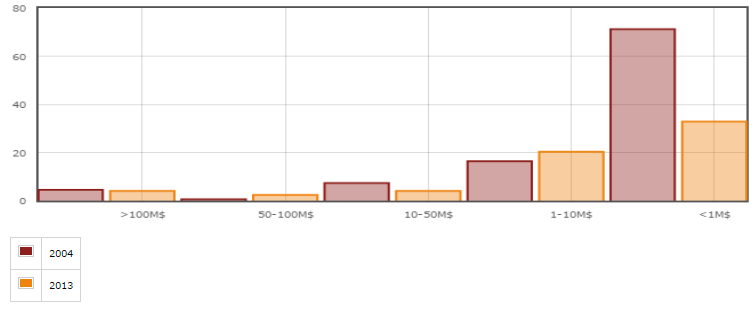
Chart showing the distribution of companies by revenue in the Canadian space sector. As outlined in the Euroconsult report, "the Canadian space sector is characterized by the presence of a large number of SMEs (firms with under 500 employees) who account for nearly 90% of all organizations. These SMEs are primarily anchored in the engineering & research and services segments." Graphic c/o CSA/ Euroconsult.
The scope includes the baseline data of the CSA report, and is wider in that it seeks to determine the impacts of that baseline, its social (e.g. connectivity amongst participants in the sector), environmental (e.g. improved natural resource management), strategic (e.g. increased capabilities for DND); and economic impacts (e.g. GDP and stimulation of job creation in the economy)…  
The two reports are complementary and do not intend to replace one another. 
Editor's Note: As outlined explicitly in the opening "Note to Reader / Upcoming Transition" preface to the 2013 State of the Canadian Space Sector Report, the 2013 CSA report was intended to be the last to use the standard CSA methodologies.
According to the 2013 CSA report, future assessments would use methodologies developed by the Organisation for Economic Co-operation and Development (OECD) which, as noted below, are the methodologies used in several chapters of the more recent Euroconsult report. 
It is interesting to note that a review of the graphs and tables contained in the Euroconsult report appear to terminate with 2013 data, as did those in the CSA's 2013 report. Hence, the two documents appear to cover the same time frame.
The 2013 CSA report coincides very closely with section two of the Euroconsult report (but)... there are two main differences. 
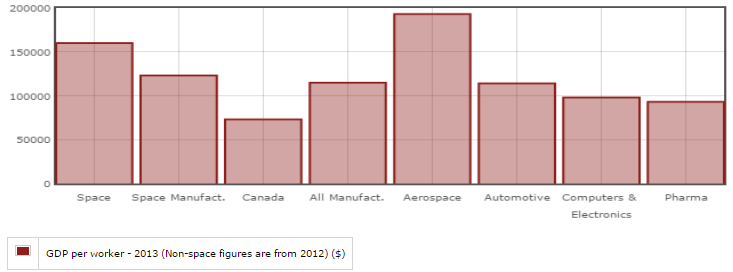
Labour productivity of the typical Canadian space sector worker as compared to other Canadian industry sectors. According to the Euroconsult report, "with a GDP per worker of roughly $123,000, space manufacturing firms had higher productivity levels than several notable manufacturing sector peers including computers and electronics, pharmaceutical and automotive manufacturing firms. Space manufacturers trailed the productivity levels of the aerospace manufacturing sector, partially attributable to the fact that space firms generally manufacture goods in smaller, less standardized batches than their aerospace peers." Graphic c/o CSA/ Euroconsult.
First, the CSA data from 1996-2013 had organized revenues into the following categories: Space Research, Space Segment, Ground Segment, Applications and Services. 
In collaboration with CSA, Euroconsult reorganized the presentation of this data into categories that align with a value-chain approach: Research, Engineering and Consulting, Space System Manufacturing, Ground System Manufacturing, Satellite Operations, Products and Applications, Services. 
This work was in line with new methodologies developed at the Organisation for Economic Co-operation and Development (OECD) Global Forum on Space Economics. Details about these categories can be found in the report. 
The second difference is that, since the definitions of the value chain include an expanded view of downstream services, more organizations with broadcasting revenues were included. You will see reference throughout the report to revenues with and without broadcasting included. 
A graphic mapping of private sector and government department end users of space based solutions in Canada. According to the Euroconsult report, "there are three different segments to end users of space based solutions in Canada, falling under the categories Communications, Imagery, and Navigation. All of these segments contain private users in Energy/Mining, Forestry, and Maritime; and public users in DFO (the Department of Fisheries and Oceans), EC (Environment Canada), DND (the Department of National Defence), NRCAN (National Resources Canada), and Parks. Communications and Navigation share private users in Telecom, Air, Rail, Road, and Finance; with public users in Telecom. Communications and Imagery share private users in Media and Retail, and public users in Health. Finally, Imagery and Navigation have overlapping private users in Agriculture and Engineering, with public users in AAFC (Agriculture and Agrifoods Canada)." Graphic c/o CSA/ Euroconsult.
Section three does not have a counterpart in the 2013 CSA report.  This section is the core of the economic impact assessment which uses economic modeling to determine impacts on the national GDP and stimulation of jobs created (in addition to those tracked by CSA in the baseline features). 
Section three also captures tax benefits to the government.  The methodology for this modelling was developed in collaboration with the federal department of Innovation, Science and Economic Development (ISED) and the CSA.  A description can be found on page 94 of the Euroconsult report.
  • Government space activities as outlined in section two of the Euroconsult report on "The Canadian Space Sector," seem limited to the projects listed on page 17 of the report and include no pure research or R&D functions, except as they relate to the fulfilment of the listed programs. Is this a fair assessment of the current responsibilities of the CSA?
The objective of the report was to assess the Canadian space sector, not to perform an exhaustive review or catalogued audit of the CSA’s activities. 
Section two outlines the roles of Canadian government agencies in space, including but not limited to the CSA and is certainly not an assessment of the latter’s responsibilities. 
The table specifies in its title that it represents a selection of “major current government space projects”. Impacts of the CSA’s R&D and innovation functions are described in other sections of the report, notably section 3.3.1 the “Support to Innovation” chapter. 
The Canadian space manufacturing sector and its connected sectors. According to the Euroconsult report, "For the approximately 10 Tier 1 companies, another 55 companies are estimated to be Tier 2 suppliers and over 200 Tier 3 suppliers, all in all active in well over 20 distinct sectors or industries." Source c/o CSA/ Euroconsult.
  • On page 89 of the report, it states explicitly that "this report does not aim to formulate recommendations." But let's be fair, no government spends $250K CDN without a reasonable expectation that their contracted report will at least collect together some new information useful to the development of policy. What should be the takeaways from the Euroconsult report?
Indeed, providing recommendations was not within the scope of the report. The purpose was to arm the CSA and government policy-makers with a view of the benefits derived from space activities in Canada. 
Key takeaways relevant to policy-making are detailed in section five, the “Conclusions” chapter. 
A key message/finding derived from the expanded analysis of the sector’s broader economic impacts is that the Canadian space sector, notably within its manufacturing base, is highly productive in terms of its GDP creation per worker as compared to most of Canada’s leading industries. 
This is despite the sector’s large number of small and medium enterprises (SMEs), which, as a group, have been historically cited as a reason for Canada’s labor productivity deficit as compared to the United States. 
Canada’s space sector also compares favorably in terms of economic (GDP) multipliers (described in the Economic footprint chapter) with the U.K’s space sector, which has benefited from heightened government support in recent years.
It's worth noting that this specific type of report might never have seen the light of day and its creators would almost certainly have felt far less comfortable discussing it publicly under the previous government.

But that was then, and this is now. The current question is perhaps a bit more prosaic. Now that this report has been released, what does the current federal government intend to do with it?
Chuck Black.

Will it contribute to policy or be ignored by the current Federal government? That's the important question, today.
___________________________________________________________

Chuck Black is the editor of the Commercial Space blog.

Sunday, September 06, 2015

David N. Caddey: A Driving Force in Canada's Space Industry

          By Chuck Black

Dave Caddey. Photo c/o AIAC.
David N. Caddey, the recently retired senior executive at Richmond, BC based MacDonald Dettwiler (MDA), who spent most of the last three decades managing the technical, economic and political issues associated with large space projects such as RADARSAT-2, has passed after a short illness.

As outlined in the November 19th, 2014 Aerospace Industries Association of Canada (AIAC) post, "2014 James C. Floyd Award Recipient for Aerospace Excellence," Mr. Caddey joined MDA in 1986 as project manager for all "major programs within the company."

Given the broad mandate of the original title, it's no wonder that, by 1997, Caddey knew most of the operational details of MDA projects and had a more than passing acquaintance with the intricacies of their funding mechanisms.

After periods as vice-president and general manager in both the fast growing MDA geo-information division and in the space and defense systems division, Caddey became the program manager for RADARSAT-2, in 1998. The following year, he was again promoted, this time to executive vice-president and general manager of the MDA space missions group, which was formed following MDA’s acquisition of Spar Aerospace’s Robotics Division.

Caddey was finally promoted to president of the MDA space missions group in 2002, but in 2004 he moved back into the special projects role, this time at the VP level. With one exception, a short stint as executive vice-president of and general manager of MDA’s surveillance and intelligence group from 2012 - 2014, Caddey remained the senior MDA troubleshooter until his retirement last year.

Dave Caddey presenting at the 2012 Innovation Nation Conference and Robotics competition, which was held in Huntsville, Ontario from July 9th - 10th, 2012. To view the complete presentation, please click on the image. Video and screenshot c/o InnovationNationCSII's channel. 

From 2000 until 2014, Caddey fulfilled various roles on the AIAC board of directors and chaired the space working group during the 2012 Emerson aerospace review.

As outlined in the July 22nd, 2013 post, "Whatever Happened to the National Aerospace and Defence Framework?" Caddey was also involved in the 2007 National Aerospace and Defence Framework, another federal government review headed by David Emerson which, in so many ways, served as the test run for the later Emerson aerospace review.

More recently, as outlined in the June 1st, 2015 Defence Watch post, "Conservative government appoints defence procurement panel," Caddey was appointed to the first federal independent review panel for defence acquisition, an "expert third-party panel,” created to review and assess requirements for all Department of National Defence (DND) projects valued over $100Mln CDN.

Marc Garneau. Photo c/o Wikipedia.
Prior to joining MDA, Caddey spent 19 years holding down a variety of technical and operational positions in the Royal Canadian Air Force (RCAF). This gave him a point of commonality with astronaut and colleague Marc Garneau, who served as president of the Canadian Space Agency (CSA) from 2001 until 2005.

According to Garneau:
I worked with him on RADARSAT-2 and on other programs. We both had backgrounds in the military and similar mindsets.  
He was down to earth, direct and unlikely to beat around the bush when there were important issues needing to be dealt with. 
He was one of the driving forces in the Canadian space industry and performed the crucial function of providing important industry perspective...
Jim Quick. Photo c/o AIAC.
According to AIAC president and CEO Jim Quick:
Dave Caddey was a leader, visionary and dear friend to many of us, and we are all mourning his sudden, tragic passing. Dave was a major contributor to the development of some of Canada’s most advanced space systems projects and achievements over the last three decades, and his influence was felt across the industry. 
He was a long-standing AIAC Board member who held roles as board chairman, honourary treasurer, chair of the AIAC finance and audit committee, and chair of the space committee and the space working group during the Emerson review. 
For all of those contributions and more, it was our great pleasure to award him a James C. Floyd Award for Achievement in Aerospace at the Canadian Aerospace Summit in Ottawa last November. Dave leaves behind a legacy which most of us in this industry only aspire to. He will be deeply missed.
Don Osborne. Photo c/o MDA.
Don Osborne, the current president of MDA's information systems group echoed that sentiment. According to Osborne:
Dave Caddey was an extraordinary person that will be profoundly missed. 
He leaves a remarkable legacy that will continue to significantly impact the space industry and MDA. 
His leadership, vision, tenacity and courage are renowned, but it is his wonderful sense of humour and passion to mentor that is at the forefront of what we will remember. 
Another colleague, UrtheCast president & chief operating officer Wade Larson said that:
It is difficult to even find the words to pay tribute to Dave Caddey. Recognizing that he made such a huge contribution to Canada's space program is only part of his story. 
Wade Larson. Photo c/o Twitter.
He was a good man, fundamentally decent, generous, and principled.   
He loved to tell jokes and he loved to laugh.  He was a leader, mentor, role model and friend to so many people. 
He is profoundly missed.
All things considered, Dave Caddey has provided as important a legacy to Canada's aerospace industry as any one of us is truly capable of.


_______________________________

Chuck Black is the editor of the Commercial Space blog.

Tuesday, August 11, 2015

MEOSAR Project Funded & CCMEO Gets Free TerraSAR-X and TanDEM-X Satellite Imagery

          By Chuck Black

Two recent announcements highlight the growing Canadian demand for global positioning and Earth imaging technology.

Connected by a constellation of satellites and rescue assets, today's modern, highly accurate GPS-equipped Emergency Position Indicating Radio Beacons (EPIRBs) and personal locator beacons (PLB), which were developed as part of the International Cospas-Sarsat programme, could be your lifesaver in an emergency. MEOSAR will integrate into this system  using a series of search and rescue (SAR) transponders aboard Europe's Galileo satellite navigation system, the Russian Glonass space based navigation system and the US Global Positioning System (GPS) satellite constellation to report signals through Cospas-Sarsat search and rescue beacons in the 406.0–406.1 MHz band. Graphic c/o Boat.U.S.

As outlined in the August 3rd, 2015 Space News article, "Canada Finds its Way To Providing GPS 3 Search and Rescue Repeaters," funding has finally been approved for a resumption of a project to provide repeaters for the Medium Earth Orbit Search and Rescue (MEOSAR) satellite system.

According to the Department of National Defence (DND) website on the MEOSAR program, the project "will deliver a space segment, comprising up to 24 Search and Rescue (SAR) repeaters that will piggy-back on the satellites of the United States Air Force's (USAF) next-generation GPS III constellation," along with "a ground segment comprising satellite ground stations in Canada with specialized satellite tracking software and information processing systems."

According to the article:
The Canadian government first announced the MEOSAR project in 2013, awarding COM DEV International (COM DEV) of Cambridge, Ontario, an initial contract worth $4.7Mln CDN for research and design work on the repeaters. COM DEV successfully completed that phase and had expected a follow-on contract to proceed with the MEOSAR project...
Unfortunately, right after the initial announcement, further funding for the program was put on hold. One of the reasons for the delay might just have been the give and take between the DND and other Canadian government departments over who would fund the repeaters.

PSC seems to be the go-to website for issues the Federal government would like to address outside of traditional channels. The department has a broad mandate encompassing a wide variety of matters.  Graphic c/o PSC website. 

Public Safety Canada (PSC) eventually stepped up to the plate. As outlined in the July 24th, 2015 Federal government press release, "Government of Canada announces improvements to Canada's Search and Rescue system," PSC will be taking over investment in the MEOSAR program, and will provide "up to $249 million (in additional funding), as identified in the 2015 Defence Acquisition Guide."

But more importantly, the program will be transferred from DND to PSC, since PSC is supposedly covering the cost.

MEOSAR, is an add-on to the International Cospas-Sarsat programme of satellite-based search and rescue (SAR) system established by Canada, France, the United States and the former Soviet Union in 1979. The Secretariat of the International Cospas-Sarsat Programme is based in Montréal, PQ.

TerraSAR-X and TanDEM-X. The satellites use phased array synthetic aperture radars (SAR) operating in the X-band (31 mm, frequency 9.6 GHz) to acquire high-quality images of the Earth for environmental planning, land use and natural resource exploration, disaster relief, insurance and defence applications. They operate together, using a HELIX satellite formation, in a close polar orbit at 514 km altitude. Graphic c/o Airbus.

But MEOSAR isn't the only program moving forward.

As outlined in the August 5th, 2015 Airbus press release "Free Provision of TerraSAR-X and TanDEM-X Data for Government Studies and Professional Training in Canada," Airbus Defence and Space has signed an agreement with the Canada Centre for Mapping and Earth Observation (CCMEO) in order to provide Canadian governmental and institutional data users free access to TerraSAR-X and TerraSAR-X add-on for Digital Elevation Measurement (TanDEM-X) satellite imagery for "pre-operational use."

The main goal of the agreement, according to the press release, is to "support current efforts of Canadian agencies working on the development of operational monitoring concepts that exploit the benefits," of paring the data collected by Canada's existing C-band SAR (utilized by the various RADARSAT missions) and the German X-band SAR utilized by TerraSAR-X and TanDEM-X for maritime surveillance, disaster management and environmental monitoring.

Given that the CCMEO mandate is to provide access to satellite image data and products to both government and public users, it seem reasonable to believe that some of this new data will eventually begin filtering out into the private sector.

Chuck Black
Then the real development can begin.
_____________________________________________________________

Chuck Black is the editor of the Commercial Space blog.

Support our Patreon Page