Showing posts with label Uthecast. Show all posts

Monday, January 16, 2017

Quantum Computing Is Real; A Canadian Company Now Offers Open-Source Tools & the Chinese are Building Spacecraft

          By Brian Orlotti

The Canadian company behind Google's quantum computer has released a new set of open source tools so coders can create software without needing an advanced physics degree.

D-Wave officials pose in front of one of their machines alongside American businessman and venture capitalist Steve Jurvetson (on the far right) in 2014. Photo c/o Steve Jurvetson.

As outlined in the January 11th, 2017 Wired post, "Quantum Computing Is Real, and D-Wave Just Open-Sourced It," the new tools were released to the public by Burnaby, BC based D-Wave Systems in order "to get more smart people thinking about applications."

As outlined in the article, the new tool, called Qbsolv, "is designed to help developers program D-Wave machines without needing a background in quantum physics. A few of D-Wave’s partners are already using the tool, but today the company released Qbsolv as open source, meaning anyone will be able to freely share and modify the software."

The goal, according to D-Wave International president Bo Ewald, is to "kickstart a quantum computing software tools ecosystem and foster a community of developers working on quantum computing problems. In recent years, open source software has been the best way to build communities of both independent developers and big corporate contributors."

D-Wave is only one of several dozen organizations included in the Wikipedia List Companies involved in Quantum Computing or Communication, who are attempting to develop quantum computing technology.

Although Canada remains a leader in this field, calls for greater investment in quantum and other leading internet technologies from other countries are becoming louder. And at least one country has taken the lead in developing space based assets to study quantum computer technologies.

China’s quantum satellite takes off from Jiuquan in Gansu provinceon on August 16th, 2016. As outlined in the August 22nd, 2016 Indian Express post, "In fact: Understanding Micius, Beijing’s big push for quantum security," the satellite is not the only satellite designed to study quantum effects. According to the article, that honour belongs to "SPEQS, a joint project of the National University of Singapore and the University of Strathclyde, which reported success in creating correlated photon pairs in orbit in May (2016)." Photo c/o China Daily via Reuters. 

In August 2016, China launched an experimental quantum communications satellite into orbit.

The Quantum Experiments at Space Scale (QUESS) satellite, also called Micius (after an ancient Chinese philosopher), will establish a quantum key distribution network and perform a series of quantum entanglement experiments in space over the next two years. 

Micius is part of the Quantum Science Satellite (QSS) program sponsored and managed by the China Academy of Sciences (CAS). The satellite’s payload was a joint development of the CAS’s Shanghai Institute of Technical Physics (SITP) and the University of Science and Technology of China (USTC).

Micius will also perform three sets of experiments. In the first phase, secure transmission of quantum data will be tested by beaming chains of photons containing a message from Micius to three ground stations at Beijing, Hainan and Xinjiang, to be processed by the National Space Science Centre (NSSC) of the CAS. These ground stations will then beam the photon chains (now containing an encrypted message) back to Micius, which will relay them to other ground stations for decryption.

The second and third phases will be more ambitious, focusing on the use of particle entanglement to enable long distance communications (using photons) without the need to transmit radio signals.

"So it is said that if you know others and know yourself, you will not be imperiled in a hundred battles; if you do not know others but know yourself, you win one and lose one; if you do not know others and do not know yourself, you will be imperiled in every single battle." From The Art of War, by Sun Tzu.

QSS is a classic ‘dual-use’ program, with both civilian and military applications. While advancing research that could form the basis for the much-speculated "quantum internet," QSS will also advance quantum cryptography, communications and cyberwarfare capabilities for the Chinese military. 

China plans a constellation of quantum satellites by 2030, which will augment a ground-based quantum computer network, which will likely be extended from the currently operational 2,000 kilometer link between Beijing and Shanghai.

The People’s Liberation Army (PLA) also foresees quantum communications being used in combination with synthetic aperture radar (SAR) and optical reconnaissance satellites. 

The SAR and optical satellites would gather information on sea and ground-based targets in real-time and in all-weather conditions. Quantum communication satellites would then be used as data relays to securely transmit targeting data to and from command centers while evading interception. These capabilities would serve as a force multiplier, enabling air and naval superiority in contested areas.

Tony Lacavera looking pensive. Photo c/o Canadian Business.
The January 13th, 2016 Computer Dealer News post, "Globalive CEO Tony Lacavera on how Canada can become a leader in AI," quoted Tony Lacavera, the former CEO of Wind Mobile (now Freedom Mobile), and founder of tech angel investment firm Globalive Communications Corp., who felt that Canada has the potential to become a world leader in fields such as artificial intelligence, fintech, machine-learning, autonomous vehicles, and quantum computing, though its institutions must step up their efforts to fulfill it. 

Lacavera, who has helped finance at least two satellite companies (Toronto, ON based Kepler Communications and Vancouver, BC based UrtheCast) also said that Canada’s efforts must go beyond presentations and broad allocations of resources; Canada must narrow its actions and focus on areas where it can win.

Our traditional dependence on its close ties with the US for economic growth will soon be under threat by the incoming protectionist, ultra-nationalist Donald Trump Administration. China is independently pursuing new technologies to fuel future growth. 

Canada must do the same if it is to survive in the coming world. 
Brian Orlotti.
  ______________________________________________________________

Brian Orlotti is a network administrator at KPMG and a regular contributor to the Commercial Space blog.

Monday, November 14, 2016

Public Private Partnerships, Marc Garneau, Telesat, DND, WGS, DoD, CSA & Urthecast

          By Henry Stewart

Here are a few of the stories we're currently tracking in the Commercial Space blog:

Garneau on stage at P3 2016. As outlined in his presentation, the Federal government will invest $10.1Bln CDN in transportation infrastructure for trade and travel, and roll out a new federal infrastructure bank, which will develop public private partnerships to help fund the needed infrastructure. As outlined in the July 6th, 2016 post, "Brownsville, STARGATE and SpaceX," the space industry has also utilized public private funding mechanisms to build out infrastructure and generate jobs. Photo c/o Chuck Black. 
As outlined in the November 13th, 2016 Globe and Mail post, "Ottawa to make 'unprecedented' appeal for private investment in infrastructure," the Justin Trudeau government has been looking to foreign investors to park billions of dollars in Canadian based public-private partnerships, to help fund the construction of needed infrastructure projects such as hospitals and highways throughout the country.
Of course, not everyone is in favor of these partnerships. Many are concerned that they are simply the first stage in the privatization of major Canadian utilities. Over lunch, a small protest of about 100 people, mostly Ontario government workers, disrupted the conference proceedings by marching through the event shouting "Ontario is not for sale," before they were escorted off the premises by local police. 
But it's worth noting that public private partnerships also helped create Telesat Canada, now the fourth-largest fixed satellite services provider in the world, but once a Canadian crown corporation created in 1969 as a public private partnership to provide telecom access in the far north.
Canada is considered a world leader in the creation of public private partnerships and P3 2016 is generally considered the premier event for gaining knowledge in this area. 
The November 10th, 2016 SpaceNews post, "Canada says military satcom negotiations with U.S. are much improved" quotes Canadian Forces Lt. Col. Abde Bellahnid,  as saying that his "US counterparts have become increasingly willing to take allied opinions into account." 
According to the article, Bellahnid said he "was particularly impressed by the U.S. Defense Department’s willingness to allow allies a seat at the table as the Pentagon evaluates next-generation satellite communications requirements and the future involvement of the commercial sector and U.S. allies." 
The process, known as an Analysis of Alternatives (AoA), has included an invitation to 16 allies, including Canada, to take part.
Canada is expected to eventually gain access to the $11Bln USD ($15Bln CDN) constellation for about a half-billion dollars and discussion is also slowly moving forward on other potential collaborations. 
  • The Canadian Space Agency (CSA) has finally begun promoting Apogy, an open source tool developed and used by the space agency to simplify the creation of the software needed to operate physical systems such as rovers, robotic arms, scientific instruments and sensors. 
As outlined in the November 11th, 2016 CSA blog post, "Apogy: the one-stop-shop solution for operating robots, satellites and beyond," the technology is designed to offer "a one-stop-shop solution where all the basic functions needed to manage that platform are standardized and accessible from a single place."
Background on the Apogy tool is available online at Eclipse, an open source community of tools, projects and collaborative working groups.
IFRS revenue for the quarter was $20.7Mln CDN, a 37% increase over the $15.0Mln CDN reported in the same period last year. 
The company, which seems to employ a surprisingly large number of ex-MacDonald Dettwiler (MDA) employees, sells Earth imaging data collected from a variety of orbital sources and has announced plans to place a 16 satellite Earth imaging constellation in Earth orbit to bolster its capabilities.
For more, check out upcoming editions of the Commercial Space blog.
 _______________________________________________________________________

Henry Stewart is the pseudonym of a Toronto based aerospace writer.

Friday, October 07, 2016

Iconic MacDonald Dettwiler is Now SSL MDA Holdings, a US Based Company with a Canadian Subsidiary

          By Chuck Black

Eight years after the Federal government rejected its sale to US based Alliant Techsystems (ATK) because it was not of "net benefit" to the country, BC based Macdonald Dettwiler (MDA) has quietly turned into a Delaware holding company, changed its name, added several new US based board members and moved its corporate headquarters to San Francisco.

Once the headquarters of Canada's preeminent space company, MDA HQ in Richmond, BC is now just another regional office for a Canadian subsidiary of a giant US multinational. Photo c/o T-Net.

And those actions seem to have been undertaken without triggering a formal review under the Investment Canada Act (ICA), the Canadian Federal law governing large, foreign direct investment in Canada, which was used as the legal basis for rejecting the 2008 sale.

MDA is the iconic Canadian space company which manages, supports and builds a variety of Canadian civilian and military assets including the Canadarm, RADARSAT-2 and the upcoming RADARSAT Constellation Mission (RCM).

According to the October 3rd, 2016 MDA press release, "MDA announces board and senior executive appointments to enable US Access Plan implementation," the current actions by the MDA board have built upon previously announced plans designed to gain access to the lucrative US military and civilian satellite marketplace. Those plans include the creation of a San Francisco, California based holding company (SSL MDA Holdings) to serve as the operating entity for "all MDA businesses, including both the US and Canada."

Richmond, BC based MDA which, as outlined in the June 27th, 2012 post, "MacDonald Dettwiler buys Space Systems Loral for $875M," purchased Space Systems Loral (SSL) outright in 2012, will now function as a subsidiary of the new SSL MDA Holdings Inc., as will Palo Alto, California based SSL. 

New SSL MDA Holding CEO Lance. Photo c/o NAB.
According to the press release:
Previous actions included the establishment of SSL MDA Holdings, Inc., a Delaware corporation, which will serve as the operating company for all MDA businesses, including both the US and Canada. 
Howard L. Lance, MDA president and chief executive officer, has been appointed chairman, president and chief executive officer of SSL MDA Holdings, Inc., with its headquarters office in San Francisco, CA.
Eric Zahler and Lori Garver, members of the MDA board of directors, have been appointed to also serve on the SSL MDA Holdings, Inc. board of directors. In addition, two new outside directors have been appointed.
The additional SSL MDA board appointments include retired USAF General C. Robert Kehler (just coming off a distinguished US military career with a deep focus on space strategy and policy) and Joanne O. Isham, a former senior executive within the US intelligence community who has acted as deputy director of the National Geospatial Intelligence Agency (NGIA), the deputy director for science and technology and the director of congressional affairs at the Central Intelligence Agency (CIA), and the director of legislative affairs at the National Reconnaissance Office (NRO).

The new appointments follow a common pattern in the space industry of appointing military and intelligence experts. As outlined in the February 23rd, 2015 post, "The Growing Military Importance of Earth Imaging,"other Canadian companies, including Vancouver, BC based UrtheCast, have recently been bolstering their board as a preliminary to soliciting large US government and military contracts.

New SVP & CFO Bill McCombe. Photo c/o SSL.
According to the press release, William D. McCombe has been appointed senior vice president and chief financial officer of SSL MDA Holdings, although current MDA executive vice president and chief financial officer Anil Wirasekara will retain his post.

As outlined in the April 10th, 2008 CBC News post, "Federal government blocks sale of MDA space division," the last time MDA attempted to relocate itself to the US, the Federal government under then Prime Minister Stephen Harper, blocked the sale, citing ICA provisions requiring a "net benefit" to Canada resulting from the sale.

But according to Macdonald Dettwiler (MDA) corporate communication manager Wendy Keyzer, no money has changed hands and no sales have taken place.

Therefore, "the Investment Canada Act does not apply" and any review would "require a transaction by a foreign investor of a Canadian company of over a threshold of $600Mln"she said, in an e-mail interview on October 5th, 2016.

But her statement might not be entirely accurate. According to the Federal government website on "An Overview of the Investment Canada Act (FAQs) - Frequently Asked Questions" section titled "Does the Investment Canada Act apply to me?" the official answer is far more ambiguous:
If you are not a Canadian citizen or a permanent resident, within the meaning of the Immigration and Refugee Protection Act (i.e., a person who has been ordinarily resident in Canada for not more than one year after the time at which he/she first became eligible to apply for Canadian citizenship), then you are a non-Canadian and must comply with the provisions of the Investment Canada Act.

For the purposes of the Act, a non-Canadian includes any entity that is not controlled or beneficially owned by Canadians.

If you are a non-Canadian and you propose to establish a new Canadian business or to acquire an existing Canadian business, then you MUST either file a Notification or an Application for Review of the investment unless a specific exemption applies...
As outlined in the exemptions section of the Investment Canada Act, those exemptions are numerous and subject to legal interpretation.

Neither Keyser nor others at MDA have responded to follow-up questions related to this story and a request for an interview with subject matter experts at the Federal Ministry of Innovation, Science and Economic Development to discuss MDA compliance with the terms of the Investment Canada Act has, so far at least, not been confirmed.

This article will be updated as new information becomes available.

What happened the last time MDA tried to relocate control of its space assets to the US. As outlined in the April 10th, 2008 CBC News post, "Federal government blocks sale of MDA space division," then Industry Minister Jim Prentice said he was "not satisfied" the sale would be a net benefit for Canada and rejected it. Screenshot c/o CBC.

Over the last year, two of the three largest Canadian space companies (MDA and Cambridge, ON based COM DEV International, which was purchased by New Jersey based Honeywell International in January 2016), have ended up as subsidiaries of US based corporations. 

Ottawa based Telesat Canada, the third of what were once the "Three Kings" of the Canadian space industry, has been unsuccessfully trying to sell itself off for years.
Chuck Black.
___________________________________________________________

Chuck Black is the editor of the Commercial Space blog.

Sunday, September 25, 2016

Scott Larson Has Started Another Space Company

         By Henry Stewart

Scott Larson. Photo c/o @scolarson.
The ex-founder and CEO  of Vancouver based Urthecast, has resurfaced as the owner of another Vancouver based space company.

Entrepreneur Scott Larson, whose brother Wade Larson helped to co-found Urthecast and continues in the role of CEO, spoke about his latest venture in the September 23rd, 2016 Globe and Mail post, "UrtheCast founder plots a new course to space."

The new start-up, called Helios Wire, is attempting to build out and democratize a space-enabled internet of things network.

As outlined on the company website, "Helios believes that the IoT shouldn't be expensive, complicated, or only for large global companies. If done right, it can literally be for everyone."

As outlined in the article:
Mr. Larson’s plan for Helios Wire – having acquired the use of spectrum, originally reserved for cattle tracking in Australia, through a partnership with (the Australian based mobile satellite systems operator) Sirion Global – is to raise $10-million to launch a mobile satellite system by 2018 using 30 MHz of the S-band spectrum, enough bandwidth to potentially service five billion transmitters. 
The plan is to deliver a two-way communications from space for potential IoT customers in transportation, security/public safety, energy, industrial and agriculture.
Helios will have access to the spectrum through its partnership with Sirion until 2019, which is enough time, at least according to Larson, to get the first couple of satellites up and demonstrate the commercial viability of the program.

Graphic from the Helios website. The company expects to use low cost micro-satellites and and other tools to provide a price advantage over traditional earth imaging organizations. Graphic c/o Helios.

According to the Sirion Global website, "there are numerous industries that could benefit significantly from the Sirion global M2M (machine to machine, another term for internet of things) service," because they require the tracking of assets located outside of the range of terrestrial cellular services. These include the livestock industry, the agricultural industry, the environmental industry, the transportation industry and the defence industry.

As outlined in the September 19th, 2016 post, "New Leonardo DiCaprio App Tracks Fishy Things on the High Seas," applications are already being developed to utilize the data which can be derived from these sorts of networks.
_______________________________________________________________________

Henry Stewart is the pseudonym of a Toronto based aerospace writer.

Saturday, May 07, 2016

Orbcomm, Skywave, exactEarth, CSA Rovers, High School Robotics, MDA, Emerson, Magellan, Honeywell & UrtheCast

          By Henry Stewart

It's been a busy week for space focused business activities in Canada. With that in mind, here are a few of the items currently being tracked by the Commercial Space blog.

exactEarth CEO Peter Mabson. Photo c/o TheRecord.
  • New Jersey based Orbcomm, and its local subsidiary, Ottawa, ON based Skywave Mobile Communications, have been defeated by Cambridge, ON based exactEarth for a Canadian government contract for satellite-based maritime surveillance. 
But the final deal has turned out to be far smaller than originally anticipated.
When exactEarth was last profiled in the February 14th, 2016 post, "Newborn exactEarth Faces its First Battle for the Worm," the new contract was expected to be a simple renewal of an existing exactEarth contract worth $19Mln CDN covering a period of 18 months, which expired in March 2016. 
But that's not quite how it worked out. 
As outlined in the May 6th, 2016 Space News post, "exactEarth bests Orbcomm for Canadian contract that shrank to a pittance," the new contract has shrunk in value to only $116,000 CDN in total and will expire on March 31st, 2017. For exactEarth, this represents an approximately $600,000 CDN reduction in revenue for each month the contract is in force, which is quite the hit to take given that the firm only booked $26.6Mln CDN in total revenue for the twelve month period ending October 31st, 2015.
As outlined in the May 5th, 2016 exactEarth press release, "exactEarth Awarded Canadian Government AIS Maritime Data Services Contract," even exactEarth CEO Peter Mabson wasn't totally happy with the situation. According to Mabson, "While we are always pleased to win competitive tenders, our solution to the GoC requirements in this case required only a small fraction of our satellite AIS capabilities, which was below our expectations."
Nice baby! CSA astronaut David Saint-Jacques, CSA president Sylvain Laporte and Ontario Drive and Gear (ODG) space and robotics manager Peter Visscher discuss Canada's newest rover with innovation minister Navdeep Bains at CSA headquarters on Thursday. To view the complete video, simply click on the photo. Photo c/o CSA.

However, as outlined in the October 20th, 2012 post, "Lots and Lots of Rovers Looking for Missions," rovers have been popular science projects among CSA managers since well before the current round of rover funding began under the Stephen Harper government's 2009 Economic Action Plan.  
That plan allocated $110Mln CDN over a three year period to the CSA for development of the next generation Canadarm (which received $53.1Mln) and for Canadian rovers (which received most of the rest). 
But the first generation of rovers were clunky and expensive toys which compared poorly to rovers funded by other governments and even to private sector competitors such as those working on the Google Lunar X-Prize. Those rovers, like the next generation Canadarm, never ended up being used for anything after funding ran out in 2012.
The CSA, perhaps expecting to use the experience gained last time to figure out the right way to build them, embarked on a new round of rover funding in 2014.
As outlined in the December 1st, 2014 post, "New CSA Rover Contracts Worth Over $3.28Mln CDN Uncovered," the additional funding was to "prepare Canada for space exploration activities beyond the International Space Station (ISS) by developing key technologies including Moon/Mars rovers, on-orbit servicing, active vision systems (for spacecraft rendezvous and navigation), in-situ resource utilization (ISRU) (i.e. drills) and surface power/communications systems."
Here's wishing them luck with that.
The new rovers are "priced to sell," and range from $40K to $150K CDN, but still look uncomfortably close to the rovers profiled in the March 7th, 2016 post, "High School Engineering Contests as the REAL Future of Innovation."
The busy front door at MDA headquarters. Photo c/o BC Technology.

The new funding, as outlined in the press release, will "help MDA and its partners develop and test next-generation satellite technologies, which will lead to better radar and search and rescue capabilities, faster data transmission, and improved cloud-based data processing capabilities." 
MDA partners in this project include Lethbridge, AB based Whipcord; Cambridge, ON based COM DEV International (which is now more properly known as the Canadian subsidiary of Honeywell International); Cambridge ON based exactEarth; Winnipeg, MB based Magellan Aerospace and Vancouver, BC based UrtheCast. Several universities will also be involved. 
Oddly enough, the new money wasn't offered up through the CSA, which suggests that the innovation minister has bypassed it (except for their rovers) and will fund this project directly through MDA, which will also serve as the primary point of contact for the subcontractors.
It's just another example of the changes which have engulfed the CSA since volume 2 of the Emerson Aerospace Review was released in 2012.  For more on those changes, check out the December 5th, 2012 post on "What the Space Volume of the Aerospace Review Actually Says."
  • Other companies are also moving from success to success. Take for example Vancouver, BC based Urthecast, which has just announced that it's looking for US partners.
As outlined in the May 6th, 2016 UrtheCast press release, "UrtheCast Announces Invitation to Discuss Potential U.S. Partnership to Serve U.S. Government Customers and Plans to Issue Request for Information (RFI)," the company plans to issue a request for information (RFI) to US based firms willing to assist with the sale of data services "from UrtheCast’s planned OptiSAR™ Constellation, as well as its proposed UrtheDaily™ Constellation concept," to US Government customers.
Breaking into new markets, especially US markets, with products, data or anything else which could possibly cause conflicts with international traffic in arms regulations (ITAR), a set of US government regulations controlling the export and import of defense related articles and services, is always a difficult situation for a Canadian company. 
As outlined in the February 15th, 2015 post, "2015 is Shaping Up to be a Good Year for UrtheCast," the company went so far as to appoint to its board Letitia "Tish" Long, the former director of the National Geospatial-Intelligence Agency, in the expectation of future US government contracts. 
Wanna learn more? Then check out future posts from the Commercial Space blog.
_________________________________________________________________________________

Henry Stewart is the pseudonym of a Toronto based aerospace writer.

Sunday, March 27, 2016

No Puppies Falling from the Heavens With Space Funding in this Federal Budget

          By Chuck Black

It's worth noting that puppies haven't begun falling from the heavens with new funding for the Canadian Space Agency (CSA) in the wake of last weeks Federal budget.

It's certainly not focused on growing  the "space class" as can be seen from the cover page of the 2016 Federal budget. For the full document along with the text of Finance Minister Bill Morneau’s budget speech, which he delivered on Tuesday in the House of Commons, check out the March 22nd, 2016 National Post article, "Federal budget 2016: The full document." For Federal government literature on the budget, check out the Budget 2016 website. Screenshot c/o Government of Canada. 

That budget, the first under the new Liberal government headed by Prime Minister Justin Trudeau, predicted large deficits over the next five years (beginning with $29.4Bln CDN in the first year), which will be used to finance a new tax-free monthly child benefit, more money for First Nations, infrastructure spending and extended employment insurance benefits to hard-hit regions.

But it didn't provide any real boost in Federal funding for space technology development or discuss any new attempt to create a "long term space plan."

As outlined in the October 13th, 2015 post on, "Part 2: Abandoning the Emerson Aerospace Review?," both of those campaign promises were made and promoted in the media, but evidently weren't taken terribly seriously by the Liberal party candidates who originated them in the last Federal election.

Overall CSA funding is an estimated $432Mln CDN in 2016, approximately $49Mln CDN more than 2015's projected budget of $383Mln CDN. That total is actually declining when the RADARSAT Constellation Mission (RCM) is removed from the totals. As outlined in the January 12th, 2013 post "a $706Mln Fixed Price Contract and Hard Launch Date for RADARSAT Constellation," the RCM program should be pretty much wound down except for maintenance and support costs within the next two years.

And the "big announcement," that the government has committed up to $379Mln CDN over eight years (beginning in 2017), in order to maintain Canada's commitment to its International Space Station (ISS) partners, is something the government always knew it had to do in order to preserve slots for Canadian astronauts David Saint-Jacques and Jeremy Hansen to visit the ISS in 2019 and 2021. Of course, those travel commitments were made well before the current government took office.

The Aerospace Industries Association of Canada (AIAC) rather liked the Federal budget, at least if you take the March 22nd, 2016 press release, "AIAC applauds budget commitments to space, innovation, defence strategy" at face value. The press release applauds the $379Mln CDN the budget commits over the next eight years to extend Canada’s participation in the ISS to 2024. According to the press release, the budget "also reaffirmed last year’s commitment to provide $30 million over four years for Canadian participation in the European Space Agency’s Advanced Research in Telecommunications Systems (ARTES) program." However, the press release failed to mention $8.7Mln CDN which was set aside to to upgrade the anechoic chamber at the David Florida Laboratory test facility at Shirleys Bay, Ontario. As outlined in the expansively titled March 22nd, 2016 SpaceRef.ca post, "What You Need to Know About the Budget and Canada's Space Program," the funds will allow the CSA to "continue to support technology development in Canada's space sector through state-of-the-art assembly, integration and testing capabilities." Screenshot c/o AIAC.

Of course, some companies and institutions, although not likely firms focused around space activities, will absolutely benefit from the latest budget. As outlined in the March 25th, 2016 Motley Fool Canada post, "Get to Know 6 Companies Poised to Benefit From the Federal Budget," these firms are mostly focused around infrastructure, which is scheduled to receive $11.9Bln over five years. They include:
  • Etobicoke, ON. based Aecon Group - Canada's largest public construction and infrastructure development company.
  • Winnipeg, MB. based New Flyer Industries - The company manufactures transit buses and, with $3.4Bln CDN is tagged for transit spending. If new vehicles are part of the $3.4Bln tagged for transit spending in the budget, then New Flyer is very likely to get in on the action.
  • Mississauga, ON. based Pure Technologies - The Motley Fool article considers this company, with its focus on pipeline managements technologies, as being well placed to receive a large chunk of the $5Bln allocated in the budget for new water and waste water management technologies.
  • Montreal, PQ. based SNC-Lavalin - A "one stop shop when it comes to engineering and construction" according to the article. 
  • Edmonton, AB. based Stantec - A professional services company wrapped around design, energy, environmental and infrastructure projects.
More money (around $800Mln CDN over four years) is budgeted for incubators and accelerators to help grow new ideas and start small businesses. According to the Canadian Association of Business Incubation (CABI) there are currently 60+ business incubators and accelerators across Canada with a broad range of expertise. That total is sure to grow with this new funding.

A further $2Bln over three years is allocated for a new post-secondary institutions Strategic Investment Fund. This initiative will support up to 50 per cent of the eligible costs of infrastructure projects at post-secondary institutions and affiliated research and commercialization organizations, in collaboration with provinces and territories.

Taken together, it's not too shabby. But its also not directly related to the Canadian space industry, although space companies might certainly take advantage of many of the programs.  

It's worth noting that the Prospectors and Developers Association (PDAC) also came down in favor of the Federal budget. As outlined in the March 22nd, 2016 PDAC post "PDAC welcomes measures to support Canada’s mineral exploration and development sector," the organization was particularly happy with the renewal of the Mineral Exploration Tax Credit (METC) and the expansion of deductions allowed under the Canadian Exploration Expense (CEE)." As outlined in the June 30th, 2012 submission to the Emerson Aerospace Review under the title, "Using Tools from the Mining Industry to Spur Innovation and Grow the Canadian Space Industry," many of the legislative tools and regulations which currently support our domestic mining industry could also be used to support our space industry. Graphic c/o PDAC.

Although not mentioned in the budget, it's expected that Montreal, PQ based Bombardier Inc. will receive substantial Federal funding over the next little while. As outlined in the February 21st, 2016 post on "Saving Bombardier," the giant Canadian company requires the new funds in order to remain solvent and (perhaps) protect Canadian jobs.

Also not mentioned in the budget was funding for the upcoming (at least officially) Polar Communications and Weather (PCW) mission. As outlined in the February 14th, 2014 post, "'Team Canada' Solution for PCW Mission Competing Against US Bid," PCW development (estimated to cost upwards of $600Mln CDN in total) was expected to begin this year.

So where does that leave our space industry? Pretty much where we expected it to be.

As outlined in the September 16th, 2015 post, "Meanwhile, Back in the Real World: Seasoned Entrepreneurs are Jockeying for Position in the Fast Growing NewSpace Economy," the government isn't really in a position to drive space exploration and is not currently funding any large projects, except for those related to previously announced international initiatives.

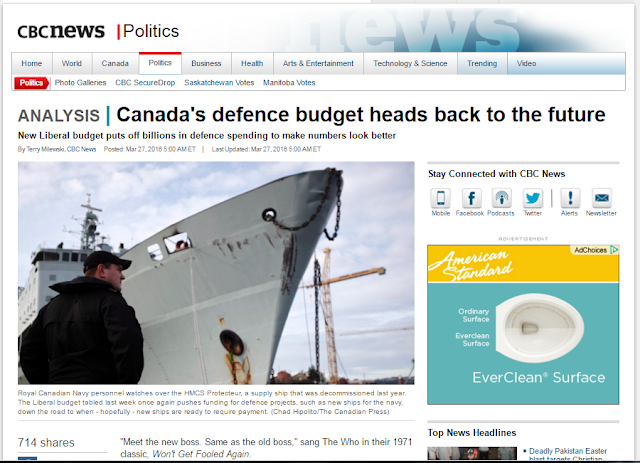
Those hoping that military programs will require the purchase of space based assets might also be in for a disappointment. As outlined in the March 27th, 2016 CBC News post, "Canada's defence budget heads back to the future," the new Liberal government seems set to follow along the same path of inactivity as did its predecessor. For more on the intersection of Canadian space and the military, check out the four part series on "Canada's Military Space Policy." Graphic c/o CBC.

Companies like Telesat, MacDonald Dettwiler, UrtheCast (a space company which has taken advantage of legislation originally designed to support the mining industry) and exactEarth now drive our domestic space agenda irrespective of what Ottawa might want or wish simply because they have the money to do things and not just talk.

So the Federal government has moved on to other, less specific tools which the space industry may or may not decide to use. Innovation, incubators, infrastructure and accelerators are now the order of the day.

However, if someone could find an infrastructure project which required the use of space based assets (for example, the original mandate of Telesat Canada to improve communications in the far north, which required the development and use of communications satellites), then there might still be opportunities for a savvy space company.

Chuck Black.
But the CSA itself has become far less trendy. There are no puppies falling from the heavens with space funding for new programs in this Federal budget.

All that's really left for us to do is to wish our space companies the best of luck. They're in the driver seat now.
___________________________________________________________

Chuck Black is the editor of the Commercial Space blog.

Saturday, March 12, 2016

Bond, Beer and UrtheCast; Heineken Builds Event to Take "Selfies from Space"

          By Brian Orlotti

As part of a global marketing campaign for the recent James Bond film, 'SPECTRE,' powerhouse beer brewer Heineken International held a contest utilizing ultra HD satellite imagery provided by Urthecast Inc. of Vancouver, BC. The contest is an example of NewSpace firms reaching out to untapped, non-traditional markets for space technology.

Neither Bond nor "M" nor even "Basil Exposition," but useful background material nonetheless. Futurist Peter Diamandis discusses why we haven't gone back to the Moon or sent people to Mars and why this state of affairs will likely change soon because of innovative NewSpace companies like UrtheCast in this March 5th, 2016 video titled, "Why Don't We Explore More." Screen shot c/o Google Lunar XPRIZE.

As outlined in the March 7th, 2016 Marketing post, "Direct mail case study: Taking a selfie from space," back in November 2015, Heineken invited over 200 guests (including journalists, social media stars and other "opinion influencers") to a private party held at the Hoover Dam.

Organizers, using Urthecast's Deimos-2 satellite as well as its "Iris" camera mounted on the International Space Station (ISS), took ultra HD imagery of the party from space. In an innovative twist, the cameras were used in tandem to create satellite images of individuals. Proclaiming this to be the "first selfie from space,"

Heineken has dubbed this the "spyfie" and party guests were able to post their "spyfies" on social media.


The November 6th, 2015 Broadway World post, "Heineken Celebrates James Bond with World's First Selfie from Space Dubbed 'Spyfie'," quoted Urthecast CEO Scott Larson as  stating:
When Heineken approached us with the idea earlier this year, capturing a SELFIE from space was not something we'd ever attempted, but we were delighted to lend our technological expertise. 
This "Spyfie" showcases the capabilities of Deimos-2 in a truly original way, and highlights precisely what our camera and web technology provides tools for change and creative collaboration.
Urthecast's and Heineken's unique application of space technology to wow a non-technical/scientific audience is a definite change of tack. Traditional efforts at promoting space products and services have tended to focus on their technical/scientific merits rather than framing them as something (in the words of Steve Jobs), "insanely great."

Brian Orlotti.
Just as over decades of improvement and innovation computers and telecom gear evolved from arcane geek's toys to the hipster fetish items of today, so too must space tech.
______________________________________________________________

Brian Orlotti is a network operations centre analyst at Shomi, a Canadian provider of on-demand internet streaming media and a regular contributor to the Commercial Space blog.

Support our Patreon Page