Showing posts with label Telesat. Show all posts

Monday, May 06, 2019

Telesat Prepares to Issue Contracts for its $3Bln CDN Constellation

          By Chuck Black

It's fortunate that Canada's space industry isn't entirely dependent on the $2Bln CDN in new Federal contracts expected to be issued for the US led Lunar Gateway program over the next twenty-four years.

Telesat isn't the only company attempting to build out these complex. satellite constellations As outlined in the March 13th, 2018 Space News post, "LEO and MEO broadband constellations mega source of consternation," the demand for ever-faster broadband internet connections "is maxing out today’s satellites, setting off an industry-wide stampede toward increasingly powerful high-throughput satellites (HTS)." Graphic c/o Space News.

A larger, mostly private sector series of contracts worth approximately $3Bln CDN in total is also expected to roll out within the next few months from Ottawa ON based Telesat for its proposed constellation of low Earth orbit (LEO) small communications satellites.

Telesat is competing against London UK based OneWeb, Hawthorne CA based SpaceX and a variety of other satellite providers attempting to build out enormously complex, but potentially profitable satellite communications networks able to compete with existing DSL, cable, fibre and/or other ground based terrestrial networks in urban areas plus provide internet access to rural regions currently without service.

As outlined in the May 2nd, 2019 Space News post, "Telesat to receive constellation bids this summer," Ottobrunn Germany based Airbus Defence is competing for the Telesat contract against a consortium of companies wrapped around Westminster CO based Maxar Technologies and Paris France based Thales Alenia.

Both Airbus and the Maxar/Thales consortium already possess connections with Telesat competitor, OneWeb.

As most recently noted in the May 6th, 2019 SpaceQ post, "Airbus and Thales Alenia Space-Maxar Consortium Complete Milestones in Bid for Telesat Contract," Brampton ON based MDA, a Maxar subsidiary, is providing antennas for OneWeb satellites. And, as outlined on the Airbus website promoting their OneWeb satellite contributions, OneWeb and Airbus have teamed up to design and manufacture up to 900 satellites for the OneWeb constellation.

Airbus and the Maxar/Thales have also said they’re willing to establish factories in Canada to build the satellites.


According to Telesat CEO Dan Goldberg, the next step in the process "would be getting commercial proposals from both of these prospective suppliers,” an activity expected to move forward over the summer.

As outlined in the May 6th, 2019 Telesat press release, "Another Milestone for Telesat’s LEO Program – Manufacturing Teams Complete System Definition and Risk Management Phase," both teams are moving forward with their bid. The proposals are focused around how the satellites would be built and inter-operate with ground systems once in orbit.

According in the April 9th, 2019 post, "Telesat Hires a Four Year Old US Based Start-up to Launch its Satellites," Telesat has signed multiple-launch agreements with at least two launch providers, but hasn't specified how many satellites each company will launch.

Much of the funding for the Telesat LEO constellation is expected to be provided through the $1.7Bln CDN Universal Broadband Fund, first noted earlier this year as part of the Budget 2019 commitment to universal high speed internet access for all Canadians.

Telesat plans to have the constellation in service in 2022 and is expected to decide on a prime contractor to manufacture the satellites in the second quarter of 2019. The Telesat constellation is expected to contain 292 satellites, but could potentially grow to 512 satellites.
Chuck Black.
___________________________________________________________

Chuck Black is the editor of the Commercial Space blog. 

Tuesday, April 09, 2019

Telesat Hires a Four Year Old US Based Start-up to Launch its Satellites

          By Brian Orlotti

On April 5th, Los Angeles CA based Relativity Space, a manufacturer of 3D-printed rockets, announced that it has signed its first commercial contract with Telesat, the Ottawa-based commsat operator and pillar of Canada’s space sector.

The agreement is a major coup for the young American NewSpace firm and a sad reminder of Canada’s willingness to support foreign space industries at the expense of its own plentiful and skilled homegrown talent.


As outlined in the April 5th, 2019 Space News post, "Relativity signs contract with Telesat for launching LEO constellation," the contract covers the launch of an unspecified number of Telesat LEO satellites on Relativity launch vehicles, starting no earlier than 2021. The companies declined to disclose the terms of the contract.

Relativity Space was founded in 2015 by former Blue Origin and SpaceX engineers Tim Ellis and Jordan Noone. Ellis and Noone both felt that their employers were not harnessing 3D printing’s full potential in the manufacture of rockets and forged out on their own.

During their initial fundraising round, they courted American billionaire Mark Cuban and impressed him enough to obtain an initial $500,000 US ($655,000 CDN) of seed capital. At the same time, Relativity Space was accepted into the Mountain View CA based Y-Combinator tech accelerator.

The company has since raised over $44.5Mln US ($59Mln CDN) and now has 60 employees.

Relativity’s main product, the Terran-1 rocket, is a 3D-printed, expendable, two-stage launch vehicle. The Terran-1’s maximum payload will be 1,250 kg to low Earth orbit, or a normal payload of 900 kg to 500 km sun synchronous orbit.

The Terran-1 will be powered by the Aeon 1, a 3D printed, liquid methane and liquid oxygen-fueled engine. Made of a nickel alloy, the Aeon 1 consists of about 100 parts.


To build Terran-1 and Aeon-1, Relativity created its own custom metal 3D printer called ‘Stargate.’ Stargate utilizes 18-foot-tall robotic arms equipped with lasers that melt metal wire. These arms can deposit about eight inches’ worth of metal onto a large turntable in just one second.

Directed by custom software, these robotic arms can produce entire rocket bodies and fuel tanks as one piece. The Stargate 3D printer enables Relativity Space to reduce the part count of a typical rocket from 100,000 to 1,000 and build entire rockets in 60 days.

The company has a launch site at Cape Canaveral in Florida and a test facility at NASA’s Stennis Space Centre. It is currently in the process of acquiring a launch site in California that will expand its launch capabilities for customers.

Relativity’s first launch of the Terran-1 is slated for late 2020. Terran-1’s price is around $10Mln US ($13.3Mln CDN) for a 1,250-kilogram payload launch to low Earth orbit.

The Relativity-Telesat deal comes on the heels of Amazon’s unveiling of its plans to create a SpaceX Starlink-esque low-earth-orbit satellite network of its own, with Billionaire Amazon founder Jeff Bezos’ own rocket company, Kent WA based Blue Origin, doing the heavy lifting.

As outlined in the January 31st, 2019 Space News post, "Telesat signs New Glenn multi-launch agreement with Blue Origin for LEO missions," Telesat has also struck a deal with Blue Origin to launch satellites for its future low-Earth-orbit broadband constellation.

Useful wisdom from Lebanese-American writer, poet, visual artist and Lebanese nationalist Kahlil Gibran (1883 - 1931). Photo c/o Wikipedia.

It is a cruel irony of history that as a storied Canadian space firm like Telesat pays a US startup to build rockets, Canada’s own capable and ambitious young rocket engineers are starved of both funding and support.

Talented groups like the University of Toronto Aerospace Team (UTAT) and the McGill Rocket Team are forced to hone their skills in competitions south of the border due to lack of funding and regulatory mechanisms in their homeland. Groups whose talented members, lacking investment capital to form their own companies will, upon graduation, emigrate to work in other nation’s space industries.

As next-generation American, Chinese, Indian and New Zealander rockets soar into space to begin the next epoch of humanity, Canada seems content to stand ashore slurping a Tim Horton's "double double" with an oh-so-Canadian shrug.
Brian Orlotti.
  ______________________________________________________________

Brian Orlotti is a network operator at the Ontario Research and Innovation Optical Network (ORION), a not-for-profit network service provider to the education and research sectors.

Friday, January 25, 2019

Airbus and Thales Athena Maxar Teams Complete System Requirements Reviews for Telesat LEO Constellation

          By Henry Stewart

Ottawa ON based Telsat has announced that the two teams developing competing designs for Telesat’s global low earth orbit (LEO) satellite constellation have successfully completed their system requirements reviews.


As outlined in the January 24th, 2019 Telesat press release, "System Requirements Review Completed for Telesat’s LEO Constellation" both teams, the first led by Leiden Netherlands based Airbus Defence and Space (Airbus) with a second composed of Cannes France based Thales Alenia Space and Westminster CO based Maxar Technologies, are "continuing to advance their detailed designs for the complete LEO system, both space and ground segments."

Systems requirement reviews typically examine functional and performance requirements to insure that the concept proposal will satisfy the mission. They are a critical component in the design review.

As outlined on its website, the Telesat global LEO constellation is a proposed:
... state-of-the-art satellite constellation of highly advanced satellites in low-earth-orbit (~1,000 km from earth; ~35 times closer than traditional satellites) that will seamlessly integrate with terrestrial networks. 
The global network will deliver fiber quality throughput (Gbps links; low latency) anywhere on earth. This is a highly flexible system that dynamically allocates capacity where there’s demand, thus maximizing system efficiency.
Telesat has worldwide rights to the ≈4 GHz of Ka-band spectrum the constellation will use. Initial funding for the LEO constellation was provided by the Canadian and Ontario governments.


As outlined in the August 2nd, 2018 post, "Airbus Competing Against Thales/ Maxar to Design and Build the 117 Satellite Telesat Constellation," two Telesat development satellites using slightly different design philosophies were initially contracted for testing. However:
... the low Earth orbit prototype 2 (LEO-2) built by Palo Alto, CA based SSL (a Maxar subsidiary) with Toronto ON based University of Toronto Institute of Aerospace Studies (UTIAS) Spaceflight Laboratories (SFL) acting as prime contractor, was lost when the Soyuz-2.1b rocket carrying the satellite failed to reach orbit in November 2017.  
LEO Vantage-1, built by Guildford UK based Surrey Satellite Technology Ltd. (SSTL), a world leader in small satellites and part of Airbus Defence and Space, launched successfully in January 2018.
While it's not clear how the LEO-2 team completed their reviews without a satellite to test, it seems that both teams are still in the running.

Telsat has promised that a final decision on which team will build the Telesat LEO constellation will be made later this year.
_______________________________________________________________________

Henry Stewart is the pseudonym of a Toronto based aerospace writer.

Thursday, December 20, 2018

Airbus Has Been in Canada for Thirty-Five Years and Wants to Increase its Contribution to Our Space Activities

          By Chuck Black

Most Canadians don't think of Airbus as a space company. Those who track the industry recognize Airbus as the firm which took a 50.1% stake in the Dorval PQ based Bombardier Aerospace C Series Aircraft Limited Partnership (CSALP) in July 2018 to fund the production ramp-up needed to turn Bombardier’s single-aisle C Series (now known as the Airbus A220) into a commercial success.

Airbus in Canada. As outlined on the Airbus in Canada website, Airbus is a successful provider "of space technology and solutions to Canada’s government, military, commercial and civil space markets. Airbus’ commercial space credentials include providing advanced geostationary telecommunications satellites to Telesat, a leading satellite operator headquartered in Ottawa. The company’s military communications accomplishments include providing military satellite communication terminal equipment and secure communications services to the Canadian Armed Forces." The page also notes Airbus contributions to the DND Sapphire space surveillance satellite and the upcoming Radarsat Constellation Mission (RCM). Graphic c/o Airbus.

Others note the Fort Erie ON based Airbus helicopter manufacturing facility and the contract awarded in 2016 by the Department of National Defence (DND) Fixed Wing Aircraft Procurement Project, for 16 Airbus CC-295 aircraft to take over the search and rescue duties currently provided by six CC-115 Buffalo aircraft and 12 CC-130 legacy Hercules aircraft.

But according to Simon Jacques, the President at Airbus Defence and Space Canada, Airbus is also the second largest aerospace company in the world and heavily involved with Canada's space industry.

Simon Jacques. Photo c/o LinkedIn.
Jacques, along with Pierre-Alexis Joumel, the Airbus executive who recently co-founded "The Moon Race," initiative and Chris Dodd, the Director of business development at Airbus, spoke with this blog on Tuesday. 

According to Jacques, "Airbus has been in Canada for thirty-five years. We are Canadian and our roots are as deep as any other large company operating here."

He should know.

Jacques is also a Canadian, who spent who spent seven years at what was then known as MacDonald Dettwiler and Associates (now a part of ‎Westminster CO based Maxar Technologies).

He began his career in the Canadian Armed Forces (CAF) as a combat system engineering naval officer, according to his bio on the Montreal PQ based Aero Montreal website.

According to Jacques, his current priority is grow the Airbus footprint in Canada by building out partnerships with Canadian experts and companies able to supplement the capabilities of existing Airbus suppliers. Airbus currently lists 665 suppliers across Canada and supports over 17,000 direct and indirect jobs, according to the Airbus website.

"Our existing supply chain already supplies us with much interaction with space companies," he feels.


According to Pierre-Alexis Joumel, one of the current Airbus initiatives to target key technologies for future space exploration is "The Moon Race," an international competition to support technology demonstrations in space and on the lunar surface.

As outlined in the October 1st, 2018 Moon Race press release, "The Moon Race: Pioneering Sustainable Lunar Exploration," the goal is to:
...bring together a group of space and non-space partners from the Moon-bound community (and beyond) that will jointly award opportunities for technology demonstrations on the lunar surface to up to four candidates in order to foster global entrepreneurship.
Pierre-Alexis Joumel. Photo c/o LinkedIn.
The initial announcement of the competition was made during the 69th International Astronautical Congress (IAC2018), which was held in Bremen Germany from October 1st - 5th, 2018.

As outlined in the October 3rd, 2018 Space.com post, "'Moon Race' Backed by Blue Origin, Airbus Aims for 2024 Lunar Flight," participating entities in the competition include the European Space Agency (ESA), the Mexican Space Agency, Airbus, Kent WA based Blue Origin and Cedex France based construction giant Vinci Construction.

"We're looking to bring the best and most useful technologies to the Moon's surface," according to Joumel. Those technologies are currently divided up in to four "parallel technology streams" including:
  • Manufacturing ("to construct useful items wherever they're needed" according to Joumel). 
  • Energy ("to help survive the long winter night").
  • Resources ("to provide the raw materials for manufacturing" and maybe even fill the first bottle of Moon water).
  • Biology ("to eventually grow food on the Lunar surface").
"We're attracting teams from all over the world. We're actively looking for Canadian teams and talking with the Canadian Space Agency (CSA)," he said. "I invite Canadians who are interested in participating in the Moon Race to contact me."

More information on the event will be announced in January 2019


The Airbus executives also had some strong opinions and useful suggestions relating to Canada's future in space. 

According to Chris Dodd, "we need to move forward with the low-Earth orbit telecommunications constellation infrastructure."

As outlined in the February 28th, 2018 post, "'Big Winners' in Tuesday's Federal Budget," the Federal government included $100Mln CDN in the 2018 Budget to develop constellations of low Earth orbiting (LEO) satellites intended to bring internet services to rural parts of the country, but the program hasn't been moving forward as fast as expected. 

"A $100Mln contribution is a good start, but most of it hasn't been released yet and it's not a lot when you look at the big picture and how many Canadian companies could participate in building this system," he said. 

According to Dodd, the total cost of the LEO constellation is in the range of several billions of dollars and the amount so far provided by the Federal government is only a small proportion of the total amount needed.

He also added that:
Telesat’s LEO constellation is largest space project ever conceived in Canada. It has the potential to revolutionize the delivery of affordable, high capacity, secure and resilient broadband connectivity throughout Canada and the world. 
The government needs to join with private industry to bring this ambitious telecommunications infrastructure project to fruition. It’s a good investment that will benefit Canadian, increase exports and is fully aligned with both the skills and innovation agendas.
As outlined in the August 2nd, 2018 post, "Airbus Competing Against Thales/ Maxar to Design and Build the 117 Satellite Telesat Constellation," Ottawa ON based Telesat will act as the lead on the project.

Dodd also believes in increased transatlantic space co-operation. "Canadian industry acknowledges the benefits of the current CSA efforts within the ESA. Major Canadian players including Honeywell and MDA benefit from Canadian/European co-operation and much can be gained from our partnerships." He added “The CSA should increase its contribution to ESA programs to create more opportunities for Canadian industry to participate in Europe’s Earth observation, telecommunications, science and exploration projects.” 


According to Jacques, it's "difficult for the government to pick out what's important and while we all agree that aerospace is vitally important, we often get hung up on the specifics. That's why we need a balanced space plan, something that's good for Canada and for the industry as a whole including stakeholders."

"A clear commitment by the government to a long-term, balanced space plan is long overdue," he said.

Jacques also said that the Federal government plans to begin moving forward with the proposed enhanced satellite communication project (ESCP). The program is a long running Federal proposal to build a two node constellation of modified Molniya orbiting DND satellites "to fill the requirement of the new Canadian defense policy for all-Arctic (communications) coverage."

But as outlined in the December 8th, 2017 post, "Long Awaited DND Polar Sats Postponed. Will be Cancelled/ Replaced/ Renamed After Next Election (Like Last Time)," this blog doesn't expect any further announcements on ESCP until after the next election.

Of course, who knows what will happen over the next few months, especially since it's an election year. Here's wishing Airbus the best of luck with their future plans.
Chuck Black.
___________________________________________________________

Chuck Black is the editor of the Commercial Space blog.

Friday, April 20, 2018

Telesat Moves Forward with New Offices, New Plans, New Challenges and New Funding

         By Chuck Black

It's twenty years older than the Canadian Space Agency (CSA) so Ottawa, ON based Telesat has more than a little experience putting together useful commercial deals funded from a variety of sources without the need for a domestic space agency to act as the prime contractor.

Out with the old and in with the new. As outlined in the March 12th, 2018 Ottawa Business Journal post, " Ottawa satellite firm Telesat moving downtown with new Place Bell lease," the satellite technologies firm "is preparing to move from its east-end campus to two floors inside the office tower at 160 Elgin St. (in downtown Ottawa) as part of a bid to attract new talent " Younger employees generally prefer a more vibrant downtown environment, according to the article. Photo c/o Telesat.

In the post Emerson Aerospace Review landscape, that skill-set will come in handy. The company has announced that it expects to begin the first trials on its new low Earth orbit (LEO) communications constellation sometime later this year.

As outlined in the April 18th, 2018 Via Satellite post, "Backed by Government, Telesat to Initiate First Customer LEO Trials This Year," Telesat will be depending on Federal government contributions from the $100Mln CDN Strategic Innovation Fund, allocated in the 2018 Federal budget to support upcoming LEO satellite projects to bolster a $20Mln CDN direct contribution from the government of Ontario, to help fund the constellation.

As outlined in the post:
The investments seem to reflect the government’s confidence in LEO constellations as a solution to bridging Canada’s digital divide. 
There, the issue of rural broadband is a salient one due to the country’s distinct, often harsh geography and population distribution. At least half of its approximately 36 million citizens live south of the Washington-Oregon border, while most of the remainder live in sparse communities scattered across a 3.5 million square mile landscape. 
Telesat believes blanketing these rural regions with satellite-based connectivity is a profitable niche, and will work hand-in-hand with the Canadian government to do so.
The Souyz-2 spacecraft with Meteor-M satellite and 18 additional small satellites, including one from Telesat, launches from Russia's new Vostochny cosmodrome, near the town of Tsiolkovsky in Amur region, Russia, on November 28th, 2017. As outlined in the November 28th, 2017 Associated Press post, "Canadian satellite lost after Russian rocket fails during launch," the failure of the booster's final stage prevented the satellites from entering orbit and led to the failure of the mission. It was one of two Telesat satellites designed to test out concepts for the Telesat LEO constellation. A second test satellite was launched successfully on January 12th, 2018 aboard a Polar Satellite Launch Vehicle (PSLV) operated by the Indian Space Research Organization (ISRO) Photo c/o Stringer/Reuters.

As outlined in the April 16th, 2018 Telesat press release, "Telesat Canada Announces Preliminary Revenue and Adjusted EBITDA1 for the Quarter Ending March 31, 2018," the company revenues are expected to keep even with last year’s performance.

The projections were released early in connection with a potential amendment to its US$2.43Bln CDN loan facility, a formal financial assistance program offered by lending institutions to help a company that requires operating capital. Telesat intends to file "full interim unaudited consolidated financial statements for the period prepared in accordance with IFRS" on or about May 3rd, 2018.

The loan modification might not just be for new operating capital. It could also mean that a corporate restructuring is in store for Telesat.

As outlined in the March 16th, 2018 Space News post, "Loral warns of possible Telesat legal battle, Xtar restructuring," New York, NY based Loral Space and Communications has indicated that it wants to move ahead with a “strategic transaction” involving fleet operator Telesat that may spark a legal fight with Telesat’s other major shareholder, the Public Sector Pension Investment Board (PSP Investments), a Canadian crown corporation established by an act of parliament in September 1999.
Chuck Black.
___________________________________________________________

Chuck Black is the editor of the Commercial Space blog.

Wednesday, February 28, 2018

"Big Winners" in Tuesday's Federal Budget

         By Henry Stewart

The big winners of Tuesday's Federal budget, at least as far as the space industry is concerned, might just be the firms planning to develop constellations of low Earth orbiting (LEO) satellites intended to bring internet services to rural parts of the country.


As outlined in the February 28th, 2018 Space News post, "Canada budgets a boost for LEO broadband constellations," Finance Minister Bill Morneau announced the $100Mln Cdn initiative in the 2018 Federal government budget released Feb. 27th, 2018.

The Liberal government under Prime Minister Justin Trudeau wants to extend internet service to rural areas in the country and believes that constellations of low-Earth-orbit (LEO) satellites providing low latency access to internet services could prove to be the solution.

As outlined in the post, the Finance Minister "didn’t get into specific details on how the funds would be dispersed or whether the Canadian Space Agency would be behind those decisions."

According to the February 28th, 2018 Los Angeles Times post, "SpaceX's Elon Musk dares to go where others failed with space-based web," there are a number of corporations which could benefit from the Canadian funding, including Hawthorne, CA based SpaceX, UK based OneWeb and Ottawa, ON based Telesat Canada.

SpaceX has it's own rocket fleet, which will cut costs associated with launching it's approximately 4,000U+ satellites into orbit, but OneWeb, last profiled in the May 3rd, 2016 post, "OneWeb Goes to Gatineau" went so far as to outline it's plans to Canadian officials during the April 25th, 2016 public meeting at Canadian Radio-Television and Telecommunications Commission (CRTC) headquarters in Gatineau, PQ.

That meeting included OneWeb founder Greg Wyler and policy director Marc Dupuis, plus then Richmond, BC based MacDonald Dettwiler (MDA) Information System Goup CEO Don Osborne and director of government and public affairs Leslie Swartman.


But MDA is now a part of  San Francisco, CA based Maxar Technologies and Telesat, as one of the only real Canadian options in the current market, might have the inside track at accessing the new Federal funds plus some made in the US advantages as well.

As first reported in the September 11th, 2017 post, "New FCC Rules a Defeat for SpaceX, But May Signal Opportunity for OneWeb & Telesat," a series of proposed (and now implemented) Federal Communication Commission (FCC) regulations may have given a competitive advantage to smaller satellite constellation proposals from firms such as Telesat and others as they attempt to compete with SpaceX and its proposed 4000 plus army of super-fast internet satellites.

As outlined in the February 28, 2018 Telesat press release, "Telesat Applauds Government’s Support in Budget 2018 of LEO Satellite Constellations to Deliver Advanced Rural Broadband Services" the company "welcomes the Government of Canada’s commitment in Budget 2018 to support investment in new Low Earth Orbit (LEO) satellite constellations for rural broadband communications."

Other, smaller Canadian providers may also receive some of the Federal funds.

For example, Woodstock, NB based Xplornet Communications has also been focused on improving rural broadband services by subcontracting bandwidth from the EchoStar 19 (launched in December 2016) and the ViaSat-2 satellite (launched in June 2017).
_______________________________________________________________________

Henry Stewart is the pseudonym of a Toronto based aerospace writer

Friday, November 03, 2017

Telesat Reviewing US Proposal for C-band Satellite Spectrum Use

          By Henry Stewart

Ottawa, ON based Telesat is reviewing a plan first proposed last month to the US Federal Aviation Commission (FCC) by Virginia based satellite provider Intelsat and Santa Clara, CA based  semiconductor manufacturing company Intel, which would allow terrestrial 5G networks use C-band satellite spectrum in the United States.

Telesat CEO Goldberg. As outlined in the November 2nd, 2017 Telesat press release, "Telesat Reports Results for the Quarter Ended September 30, 2017," the company reported consolidated revenues of $214 million, a decline of 4% ($10 million) from the same period in 2016. Photo c/o SpaceNews/Kate Patterson.

As outlined in the November 2nd, 2017 Space News post, "Telesat undecided on Intelsat, Intel C-band proposal," Telesat is one "of a handful of satellite operators with meaningful C-band capacity over the US, having less than Intelsat and SES, but more than Eutelsat." 

The article quoted Dan Goldberg, Telesat’s president and CEO, who said his firm is well aware that the FCC “is looking hard at candidate frequency bands to accommodate more terrestrial wireless growth, particularly for 5G,” and that C-band from 3.7 to 4.2 GHz is a popular candidate. C-band stretches from 3.4 to 4.2 GHz, but in the U.S., 3.7 to 4.2 is allocated to satellite operators and predominantly used for television broadcasts."

According to Goldberg, Telesat has yet to make a decision for or against the proposal.

Satellite overcapacity and the effects of newer technology, especially proposals for large constellations of low cost, low and medium Earth orbit communications satellites have disrupted the legacy players in the satellite industry. Satellite providers have struggled to adapt to the changes using a variety of technological, business and legal methods.

Last month, as outlined in the October 3rd, 2017 Space News post, "Intelsat, with Intel, proposes way for 5G to use satellite’s C-band spectrum," Intelsat and Intel made a proposal to "allow incumbent satellite operators to collaborate with terrestrial networks on ways to clear swaths of C-band from 3,700 to 4,200 MHz based on 5G needs and the presence of existing fixed satellite service (FSS) systems. Satellite operators would retain ownership of the spectrum, and auction the right for joint use of frequencies with terrestrial companies in cleared areas."
_______________________________________________________________________

Henry Stewart is the pseudonym of a Toronto based aerospace writer.

Monday, September 18, 2017

Telesat Now Planning 290 Satellite Constellation

          By Henry Stewart

Ottawa, ON based Telesat has confirmed that its proposed 117 satellite low Earth obit (LEO) constellation has now grown to approximately 290 satellites.

Artist’s rendition of a small satellite in LEO. Photo: SSTL

As outlined in the September 13th, 2017 Advanced Television post, "Canada’s Telesat planning 290 satellites," Telesat CEO Dan Goldberg made the announcement to delegates at the recently concluded 2017 Euroconsult World Satellite Business Week, which was held in Paris, France from September 11th - 15th.

Goldberg also told delegates that, under proposed new FCC regulations, Telesat was obliged to launch half of the new fleet, about 140 craft, within six years. The balance, once the second batch of 140 had been launched, would be in-orbit spares/replacements.

As outlined in the November 20th, 2016 post, "SpaceX, Telesat & Kepler Just Three of the Dozen Satellite Constellations Currently on the FCC Table," Telesat had initially proposed a much smaller fleet.

Telesat CEO Goldberg. Photo c/o SpaceNews/ Kate Patterson.
However, and as first reported in the September 11th, 2017 post, "New FCC Rules a Defeat for SpaceX, But May Signal Opportunity for OneWeb & Telesat," a series of proposed new Federal Communication Commission (FCC) regulations may have given a competitive advantage to smaller satellite constellation proposals from firms such as Telesat, UK based OneWeb and others as they attempt to compete with Hawthorne, CA based SpaceX and its proposed 4000 plus army of super-fast internet satellites.

The new FCC rules were released for comment and feedback on September 7th and are expected to be approved at the next open FCC meeting on September 26th, 2017. Goldberg and others may be positioning themselves to take advantage of the new rules, once they take effect.

Telesat’s 1st prototype test LEO satellite is currently scheduled for launch in November on an Arianespace Soyuz rocket. A second LEO prototype is also scheduled for launch before the end of the year.

The satellites are built by UK based Surrey Satellite Technology (SSTL) and Palo Alto, CA based Space Systems/Loral (SSL).
_______________________________________________________________________

Henry Stewart is the pseudonym of a Toronto based aerospace writer.

Monday, September 11, 2017

New FCC Rules a Defeat for SpaceX, But May Signal Opportunity for OneWeb & Telesat

          By Chuck Black

The US Federal Communications Commission (FCC) has released its proposed updates to the rules for non-geostationary-satellite orbit (NGSO) fixed-satellite service constellations and reasonably expects that the new rules will be adapted by majority vote at the next open FCC meeting, currently scheduled for September 26th, 2017.

An overview of Musk's plan. As outlined in the November 17th, 2016 International Business Times post, "Space invader Elon Musk to swarm Earth with 4,425-strong army of superfast internet satellites," the eccentric entrepreneur and Tony Stark doppelganger has asked the FCC for approval to launch thousands of satellites into low Earth orbit. And he's not the only one. As outlined in the November 20th, 2016 post, "SpaceX, Telesat & Kepler Just Three of the Dozen Satellite Constellations Currently on the FCC Table," there are quite a few others. Screenshot c/o IBT.

But those updates, posted online as the September 7th, 2017 FCC Fact Sheet, "Updating Rules for Non-Geostationary-Satellite Orbit Fixed-Satellite Service Constellations; Report and Order and Further Notice of Proposed Rulemaking, IB Docket No. 16-408," could mark a major defeat for Hawthorne, CA based SpaceX, which intends to launch several thousand satellites into orbit over the next several years.

On the other hand, those same rules could also signal opportunity for UK based OneWeb and Ottawa based Telesat, who are hoping to do much the same.

As outlined in the September 8th, 2017 Telecom, Media and Finance (TMF) Associates blog post, "Me first, no me…," the key text on the geographic scope of the FCC’s in-line interference avoidance rule, that requires the spectrum to be shared equally between NGSO systems when their satellites are aligned with one another, marks "a major defeat for SpaceX," because the FCC will need to defer to the International Telecommunication Union (ITU), an international body which uses a “first-come, first-served” coordination procedure and allows for non-US satellite systems operating outside the US to take precedence in some cases.

According to the FCC Fact Sheet:
While SpaceX argues that it (the FCC) should govern such operations worldwide, a grant of market access typically considers radio frequency operations only within the United States. 
Sharing between systems of different administrations internationally is subject to coordination under Article 9 of the ITU Radio Regulations. We believe this international regime is the appropriate forum to consider NGSO FSS radio frequency operations that fall outside the scope of a grant of U.S. market access. Because ITU coordination procedures do not apply between two U.S. systems, our coordination trigger of ΔT/T of 6 percent will govern such operations both within and outside the United States.
In essence, since OneWeb is licensed by the UK and Telesat by Canada, and those nations have domestic priority over their airspace through the ITU, SpaceX will have to operate on a "non-interference basis" with respect to these systems outside of the US when it comes to deciding how to deal with any potential constellation interference.

If the competition launches first, they might even end up with priority, under the proposed rules. The FCC changes are also expected to benefit satellite networks backed by SES Networks’ O3b and Space Norway, whose constellations are not intended to provide all-US coverage.


Of course, SpaceX doesn't like the plan.

According to the TMF post, the proposed ruling "represents a big problem for SpaceX, which needs to find another line of business outside of launch to justify its latest $21Bln US ($25.4Bln CDN) valuation."

The ruling could even "force SpaceX to completely reconsider its strategic approach to its proposed Low Earth Orbit broadband constellation."

As outlined in the September 11th, 2017 Teslarati post, "SpaceX’s internet satellite strategy faces possible setback after FCC decision,"  SpaceX had specifically "requested that the FCC apply their non-interference rules for lower orbit communications satellites to internet constellations operating both inside and outside the physical United States," and is quite disappointed that the FCC has decided not to do so.

Teslarati is the Tesla Motors blog, another firm controlled by SpaceX CEO Elon Musk, so it presumably knows what it's talking about.

On the other hand, as outlined in the September 8th, 2017 Space Intel Report post, "U.S. regulators propose to relax satellite constellation in-service, coverage rules," there are a least a few FCC rule changes which are expected to assist the SpaceX program.

The lowering of the proposed in-service requirements to 50% of the proposed constellation within six years will benefit all satellite constellation operators, except perhaps OneWeb. The current rules require complete deployment within six years and OneWeb is on track to make this milestone.

Other proposed FCC changes also enjoy broad support.


As for Telesat, the TMF post claims that the company is sitting pretty and will "wait until next summer before deciding how to move forward, presumably expecting to have a wide variety of suitors once its ITU priority status is recognized."

OneWeb also has a Canadian connection. As outlined in the May 3rd, 2016 post, "OneWeb Goes to Gatineau," the company has partnered by Richmond, BC based MacDonald Dettwiler (MDA) and applied to the Canadian Radio-Television and Telecommunications Commission (CRTC) to provide broadband access to remote Canadian communities, using its satellite network.

As for TMF, the company is, at least according to it's website, a "consulting and research firm based in Menlo Park, CA. We focus on business planning, technical analysis, financial and spectrum valuations and expert witness services in the satellite and telecom sectors and have particular expertise in mobile satellite services (MSS), where we have worked for almost all of the leading operators over the last decade."

As the old saying goes, sometimes it's hard to tell the players without a scorecard.
Chuck Black.
___________________________________________________________

Chuck Black is the editor of the Commercial Space blog.

Monday, July 31, 2017

Large Satellite Manufacturers Like MDA/SSL are Already Coping with a SmallSat Revolution in LEO Orbit

          By Henry Stewart

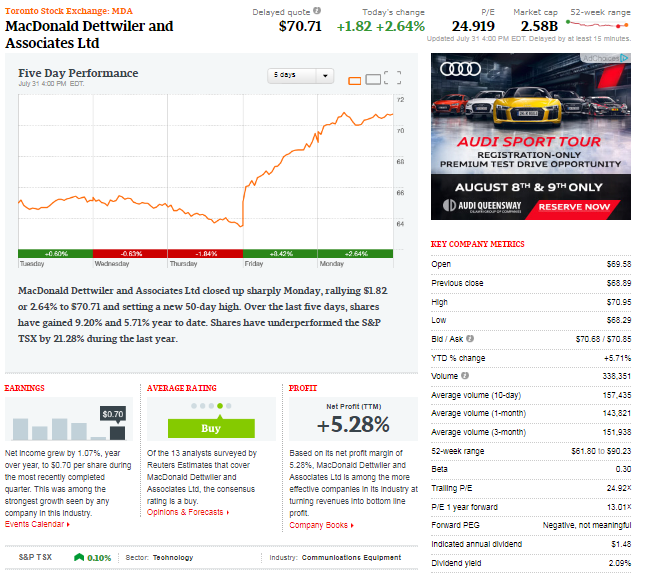
Iconic Canadian space company and well known American wannabe, Vancouver BC based Macdonald Dettwiler (MDA) surged 8.42% in a single trading session following the release of it's Q2 2017 results and seems poised to keep going.

As outlined in this July 31st, 2017 Globe and Mail post on "MacDonald Dettwiler and Associates Ltd," the company "closed up sharply Monday, rallying $1.82 or 2.64% to $70.71 and setting a new 50-day high. Over the last five days, shares have gained 9.20% and 5.71% year to date."  Of course, the stock rise came hot on the heels of a mostly positive Q2 earnings call, which was held after the markets closed on Thursday, July 27th. It's good news for MDA, which has under-performed the S&P TSX by 21.28% during the last year. For a transcript of the Q2 call, check out the July 28th, 2017 Seeking Alpha post, "MacDonald, Dettwiler & Associates' (MDDWF) CEO Howard Lance on Q2 2017 Results - Earnings Call Transcript." Graphic c/o Globe & Mail.

But the results weren't all sweetness and light. 

As outlined in the July 28th, 2017 Space News post, "MDA slashes GEO order expectations," MDA CEO Howard Lance believes that "commercial satellite operators will probably order half as many geosynchronous satellites this year than usual, deepening a drought that has affected satellite manufacturers for the past two years."

According to Lance, "MDA counted just three commercially awarded satellite orders for the first half of this year, none of which went to Space Systems Loral (SSL), the satellite manufacturer MDA owns in Palo Alto, California." Lance forecasted ten to twelve large satellite orders he expected to be awarded in the second half of the year, but did not say how many he thinks his company will win.

“I don’t know that it will ever get back to 22 satellite (contracts being awarded) a year,” Lance said, “but … the question is less around numbers and, from our standpoint, more around dollars.”

Of course, as outlined in the July 27th, 2017 post, "SpaceX Dominates, MDA Builds Comms & Telesat Plans LEO Sats (But Hasn't Yet Committed)," the real problem with the current crop of large commercial satellites placed in geostationary equatorial orbit (GEO) which MDA's subsidiary SSL has traditionally preferred to build is that they are increasingly in competition with large numbers of smaller, lower cost satellites being place in low (LEO) or medium Earth orbits (MEO) which, because of those lower orbits, possess lower latency (the time between when a signal is sent and received) and are therefore better for two way communication.

Expect this to further reduce the pool of available, large GEO satellite contracts traditionally preferred by MDA/SSL for their high dollar value in the coming months. The SSL subsidiary laid off some of its workforce in June to compensate for the paucity of communications satellite orders.


Of course, Lance remained bullish on the impending purchase of Earth observation satellite operator DigitalGlobe, even while acknowledging (and then dismissing) concerns over MDA’s refiling of acquisition paperwork to the US government's Committee on Foreign Investment in the United States (CFIUS), a US Treasury Department agency which assesses the national security impact of foreign acquisitions.

As outlined most recently in the July 17th, 2017 post, "Orbital ATK, DARPA, MacDonald Dettwiler, DigitalGlobe & Unleashing the Lobbyists," MDA has promised that it will eventually control Digitalglobe through a US based holding company in order to satisfy CFIUS requirements.

Only time will tell if CFIUS buys that story. Lance said the re-filing of CFIUS documentation initiated a new 30-day review period, which will close on August 14th. The impending DigitalGlobe acquisition is likely the reason for MDA's stock surge which likely means that the market does buy that story.

As for DigitalGlobe, financial results for the three months ending June 30th show the effects of the addition of the WorldView-4 satellite, which entered service in February 2017 and those results, as outlined in the  July 21st, 2017 Space Intel Report post, "DigitalGlobe: US government exercises option, WorldView-4 draws commercial customers," are good.

According to the Space Intel Report, "DigitalGlobe’s five-satellite fleet generated $225.7Mln US ($282Mln VDN) in revenue for the 3 months ending June 30. Two-thirds of it was from U.S. government contracts. The company is spending up to $600Mln US ($750Mln CDN) to replace the WorldView-1, WorldView-2 and GeoEye-1 satellites starting in 2020. A fleet of at least six smaller, lower-resolution satellites, being built with the government of Saudi Arabia, is scheduled to enter service in 2019." The “CE90” metric is a measure of geolocation accuracy. Graphic c/o DigitalGlobe.

Also, as outlined in the conference call, MDA reported a $29Mln CDN drop in its communications segment for the three months ended June 30th, which generated $332.4Mln CDN in revenue. The company’s surveillance and intelligence segment balanced the loss from fewer geostationary satellite orders by pulling in $171.3Mln CDN for the quarter, up $30.1Mln CDN.

The total revenue for the quarter was $503.7Mln CDN, comparable to last year’s $502.5Mln CDN. Net MDA income was $25.8Mln CDN, slightly up from last years $28.3Mln CDN but the order backlog shrank to $2Bln CDN, down $500Mln CDN over last year.
_______________________________________________________________________
Henry Stewart is the pseudonym of a Toronto based aerospace writer.

Thursday, June 15, 2017

Telesat Supports Defence Budget But Inuvik Left Out & Teledyne Dalsa Employee Convicted of Selling Satellite Data to China

          By Henry Stewart

For the week of June 12th, 2017, here are a few of the stories we're tracking in the Commercial Space blog:

Has this man got a deal for Telesat? Defence Minister Harjit S. Sajjan in Parliament earlier this year. Photo c/o CTV News.

  • Ottawa, Ontario based Telesat seems to have responded with enthusiasm after learning the details of Canada’s new defense policy last week, especially the parts which included new Federal funding for arctic military satellites.
As outlined in the June 13th, 2017 Space Intel Report post, "Telesat sees possible LEO partnership in Canada’s new defense posture," just hours after the document was published, "Ottawa-based Telesat said the Canadian government’s willingness to strike public-private partnerships, (is) a move that gives 'an unprecedented opportunity for the Canadian defense industry, including the space sector, to effectively support the military.'"
According to the article, "The biggest near-term potential benefit to Telesat would appear to be having Canada’s armed forces as an anchor tenant for Telesat’s proposed global constellation of broadband satellites in low Earth orbit. The constellation, for which two prototype satellites are scheduled for launch this year, would appear to fill the requirement of the new Canadian defense policy for all-Arctic coverage."
As outlined in the June 9th, 2017 post, "Liberals Waive Review of Chinese Norsat Purchase, but also Pledge Billions in Defence Spending & Revise Satellite Licencing Regs," the Minister has proposed up to $62Bln CDN worth of new defence contracts, which would include space-based telecommunications in the Arctic, plus various space based intelligence, surveillance, reconnaissance and situational awareness initiatives plus perhaps even "a counterspace option."
For more on Telesat's proposed global constellation, check out the May 8th, 2017 Space Intel post, "Telesat: LEO gives more user bandwidth than GEO HTS." 
For more on Telesat's two prototype satellites, check out the February 29th, 2016 post, "Telesat makes Agreements, MDA likes the USA, COM DEV not Forgotten & NSERC has Needs."
Tom Zubko, the president of New North Networks, is concerned Inuvik's image as a good place to invest in satellite related technology could face a setback if the federal government does not move faster to approve transmission licenses for two clients who built six new satellite dishes in Inuvik last year. Photo c/o David Thurton/CBC.

  • Of course, while it's hypothetically possible that the new military spending promised by Minister Sajjan is on the way and will indeed show up sometime after the next election, Canada's north will continue for face telecommunication challenges. 
As outlined in the June 9th, 2017 CBC News post, "Federal delays could smother Inuvik's fledgling satellite industry, says telecom prez," six new satellite antennae are ready for service in Inuvik,a town in the Northwest Territories which acts as the administrative centre for the Inuvik Region, but delays in licensing could kill the project.
The article quoted Tom Zubko, the president of Inuvik based New North Networks, who stated that two clients (Norway based Kongsberg Satellite Services and San Francisco, CA based Planet Labs, also known as Planet) have spent upward of $10Mln CDN to install the antennas, but are unable to use them, because of the "slow progress on a federal licence to transmit data" and are thinking of abandoning the project.
Zubko said Inuvik has great potential for this kind of high-tech investment, but only if proponents can get their projects licensed in a timely matter. According to the article, "New North Networks was contracted to build the basic infrastructure for the equipment, which the two satellite companies then installed. Zubko said his company also has a contract to provide care and maintenance of the new equipment."
As outlined most recently in the July 18th, 2016 post, "Arctic Satellites Should Serve Northerners According to Nunatsiaq Online," the 2016 cancellation of the dual civilian and military use Polar Communications and Weather mission (PCW) in favor of a Canadian military based program without any weather component or assured civilian access to communications, has caused confusion in the North as the civilian population scrambles for an alternative. 
Teledyne Dalsa HQ in Waterloo, Ontario. Photo c/o Teledyne Dalsa.

  • In contrast to the recent public and Parliamentary concerns expressed over attempts the proposed sale of Vancouver, BC based Norsat International Inc. to Shenzhen, China based Hytera Communications, there has been little attempt to assess or comment on the recent situation at Waterloo, Ontario based Teledyne Dalsa, where two employees were arrested in February 2017 on charges of stealing sensitive satellite imaging technology from their company and selling the information to China.
As outlined in the June 12th, 2017 The Record post, "Waterloo tech theft case ends with $50,000 fine," Arthur Pang and Binqiao Li faced a raft of charges, including theft, fraud, conspiracy to commit fraud and possession of property obtained by crime. 
As outlined in the article, charges were the result of a two-year investigation by the RCMP's organized crime unit, which started after a complaint from the Waterloo company in early 2014. 
Both Pang and Binqiao were fired after being charged and Pang eventually pleaded guilty only to breaking Canada's export and customs laws and was fined $50,000 CDN. 
According to the article, "the other 18 charges he faced were dropped by the prosecution. All charges against Li were withdrawn." As outlined in court documents, Pang admitted to competing against his own employer on bids for space projects in China.
For more, check out our upcoming stories in the Commercial Space blog.
_______________________________________________________________________
Henry Stewart is the pseudonym of a Toronto based aerospace writer.

Sunday, April 02, 2017

Part 3: A History of the Canadian Space Program - Policies & Lessons Learned Coping with Modest Budgets

The 1970's, A Canadian Space Industry, Telesat, ANIK and a "Canadian Content Premium"


Anik A. Photo c/o Telesat Canada. 
By Graham Gibbs & W. M. ("Mac") Evans

This paper, first presented at the 65th International Astronautical Congress, which was held in Toronto, Ontario from September 29th - October 3rd, 2014, is a brief history of the Canadian space program, written by two of the major participants.


The 1970's, Part 1

The Act of Parliament that created Telesat Canada stipulated that Telesat “shall utilize, to the extent practicable and consistent with its commercial nature, Canadian research, design and industrial personnel, technology and facilities in research and development connected with its satellite telecommunication systems and in the design and construction of the systems.” 
Before Telesat could purchase any satellite or ground system, the Act required Telesat to obtain the approval of the Minister of Communications that he or she was satisfied that the procurement would result in “a reasonable utilization of Canadian design and engineering skills and the incorporation of an appropriate proportion of Canadian components and materials.” 
A reminder that, the more things change, the more they stay the same. This short CBC radio segment from December 1st, 1971 under the title, "The Anik satellite and northern Canada," discussed the advantages and disadvantages of the new communications technologies being rolled out with the three Anik satellites is well worth comparing to the July 18th, 2016 post, "Arctic Satellites Should Serve Northerners According to Nunatsiaq Online." Graphic c/o CBC.

It is clear that the government saw Telesat as an instrument of industrial policy wherein Telesat procurement's would be used as much as possible to assist the development of the Canadian space industry. 
In the debates in Parliament that led to the creation of Telesat, the then Minister of Communications made it clear that Canadian industry would play a major role in building Telesat’s satellites.  
In the period leading up to the creation of Telesat, the government run Satellite Project Office in 1969 had let major competitive study contracts to two Canadian companies, RCA Limited in Montreal (the prime contractor for the ISIS spacecraft) and the Northern Electric Company in Ottawa. Upon completion of these studies, Telesat proceeded to enter into negotiations with RCA to build two satellites. 
However, in the middle of these negotiations, Hughes Aircraft in the United States (builder of the first satellites for Intelsat) submitted to Telesat an unsolicited proposal for the construction of three satellites, based on a flight proven design, at a price considerably lower than the RCA price and with a shorter construction schedule. The Hughes offer included a much smaller Canadian content (from Northern Electric and SPAR) than the RCA bid. 
An image of the Anik A, "a forerunner of the Boeing 376 satellite,"" from Boeing Images, the external licencing arm of the Boeing Corporation. The Anik's were a part of the Hughes HS-333 generation of spin stabilized communication satellites, which later evolved into the popular Boeing 376 satellite line now in use around the world. Hughes was purchased by Boeing in 2000 and became Boeing Satellite Systems. Graphic c/o Boeing Images.

Thus the ink was hardly dry on the Telesat Canada Act when one of its key provisions (Canadian content) faced a significant challenge. Except for Canadian content, the Hughes bid was substantially better than the RCA bid in all respects (cost, risk, and schedule). In essence, the Hughes bid established a benchmark to measure the extra cost of including significant Canadian content in Telesat’s first series of satellites. 
The issue of this so-called “Canadian Content Premium” became the subject of considerable debate in the House of Commons. In the end, in 1970 the Minister of Communications authorized Telesat to proceed with Hughes Aircraft for the construction of three Anik A satellites. 
The Anik A1 satellite was launched by NASA on November 9, 1972 and Canada became the first country to have a domestic satellite system in geosynchronous orbit. Anik A2 followed shortly afterwards in April 1973 and Anik A3 was launched in May 1975. 
The satellites operated in the 6/4 GHz bands and each provided 12 channels capable of carrying either one television program or 960 one- way telephone conversations. Telesat’s Anik system revolutionized communications in Canada and for the first time ever, reliable telephone services and television programming were available to most of the rural and remote areas of Canada. 

The failure of Canadian companies to win the contract for the Anik satellites had a profound impact on the government’s space program. 
The setback of the Anik procurement decision clearly showed that the Canadian space industry was not yet internationally competitive. In the wake of the Telesat procurement decision, and with the wind down of the ISIS program, it was clear that another major space program would be needed if Canada’s fledgling space industry was to survive. 
Fortunately, as a result of the government’s decision in 1969 to transform planning for the ISIS III spacecraft into planning for a communications technology satellite, the government was in a position to act swiftly.
________________________________________________________________________

Graham Gibbs & Mac Evans. Photos c/o MyCanada & CSA.
Graham Gibbs represented the Canadian space program for twenty-two years, the final seven as Canada’s first counselor for (US) space affairs based at the Canadian Embassy in Washington, DC. 

He is the author of "Five Ages of Canada - A HISTORY from Our First Peoples to Confederation."

William MacDonald "Mac" Evans served as the president of the Canadian Space Agency (CSA) from November 1991 to November 2001, where he led the development of the Canadian astronaut and RADARSAT programs, negotiated Canada’s role in the International Space Station (ISS) and contributed to various international agreements that serve as the foundation of Canada’s current international space partnerships.

He currently serves on the board of directors of Vancouver, BC based UrtheCast.

Last Week: "The 1960's, Alouette, ISIS, Chapman & Telesat," in part two of "A History of the Canadian Space Program: Policies & Lessons Learned Coping with Modest Budgets."

Next Week: "More on the 1970's,"Equal Access" to Communications, "Improved Industrial Capability" and the Hermes Communication Satellite," as part five of "A History of the Canadian Space Program: Policies & Lessons Learned Coping with Modest Budgets," continues.

Support our Patreon Page