Showing posts with label crowd funding. Show all posts

Thursday, July 19, 2018

Requiem For the Canadian Space Commerce Association

         By Chuck Black

The failure of the Federal government Space Advisory Board (SAB) to contribute to real change in the Canadian space industry has claimed another victim, the Toronto ON based Canadian Space Commerce Association (CSCA).

CSCA website screenshot dated May 31st, 2018. Graphic c/o Wayback Machine.

On Tuesday, July 16th, 2018 the entire CSCA website was replaced with single press release from CSCA president Michelle Mendes titled "CSCA Ceases Operations."

As outlined in her post:
After significant consideration and exploring all options, it is with great sadness that the board of directors has decided to declare the CSCA insolvent and will be ceasing operations immediately. 
It is important to note that this is not indicative of Canadian commercial space in general. Due to historical issues, pre-2016, which the new board and management worked very hard to rectify, it was difficult to raise funds and therefore made the business unsustainable. 
Please note that the CSCA email addresses will no longer be monitored as we wind down. However, if there is anything you would like to discuss, please feel free to contact me at my email address michelle.mendes@spacecommerce.ca as I will periodically check in for the next several months. 
For more details about the insolvency, please click on the above Advisory link.
Many thanks to all for your work and support advancing the Canadian space sector.
 
With kindest regards,
Michelle Mendes
Mendes was also active in the failed SAB.

The current CSCA website on July 19th, 2018 includes a message from president Michelle Mendes. Screenshot c/o CSCA

As outlined in the March 8th, 2018 post, "Space Advisory Board Chair Admits Disappointment over Budget but Promises to Continue to Support Space Sector," she was one of the SAB members who strongly advocated the creation of an initial inventory of problems needing to be addressed before going back to the Federal government to see if it would fund a search for solutions.

This approach was taken up by SAB chair Lucy Stojak and served as the core of the August 2017 report by the SAB on "Consultations on Canada’s Future in Space: What We Heard."

As requested by the government, the report included no solutions. It was mostly a request for more money so that the SAB could consult further and perhaps come up with something in the future.

But political advocates know that the ability to develop and recommend solutions is always the first real step in the development of a successful advocacy, not the last. A defined and prepared solution allows advocates to obtain consensus independently from government, and allows them to apply pressure for change independent of any Federal mandate.

But the SAB didn't do this and so their report was mostly ignored. Smart governments look for solutions where they can act and then promote their actions. The lack of actionable items in the SAB report meant that the Federal government wasn't required to do anything and therefore wouldn't be blamed for inactivity.


In March 2018, after the 2018 Federal Budget made it clear that there were no plans to fund further SAB consultations, Mendes resigned from her position as CSCA executive director but retained her position as CSCA president and her role on the CSCA board.

CSCA then embarked on an ineffective campaign to hire a new CSCA executive director.

According to CSCA promotional material, the vacant executive director position would be "unpaid" although candidates which came with sponsors and the promise of funding could certainly negotiate a different package.

The implication was that anyone with a little extra cash would be given special consideration, which is a bad thing for any advocacy group to promise.

In the end, no one was willing to pay for special consideration or even willing to work for free and Mendes and the CSCA simply closed up shop.


It's possible that, over the last few years, the CSCA simply tried a little too hard to make friends with the ruling Federal Liberal party. After all, the Liberals provided many verbal indications of support, but never came through with funding or anything tangible.

The Liberals didn't need to. They knew instinctively that any advocacy group that couldn't support itself or develop solutions wasn't going to influence the next election and didn't deserve their support.

Even CSCA members knew this. Over time, the smart ones went back to work at their day jobs, moved abroad (where the political climate for space and newspace projects was certainly more favorable) or joined domestic organizations such as the Canadian Aeronautics and Space Institute (CASI) or the Aerospace Industries Association of Canada (AIAC), which possessed lobbying expertise, access to the levers of power in Ottawa and independent sources of funding. 

And that's why the CSCA cited insolvency for it's closure. They had no money and no real members. 

Nor should they have had any. They had no solution; only a litany of problems needing to be addressed.

There were even indications that Mendes was self-funding the organization out of her own pocket near the end. While laudable, this lack of community support for the CSCA must have been troubling for those involved.

So rest in peace, CSCA. Maybe the next time, someone will come up with a real plan of action and a proper source of funding.

As for the SAB, they're subject to the same constraints as the CSCA. If SAB chair Stojak doesn't start changing her strategy soon and start coming up with a few solutions for the Federal government to ponder, the SAB will be the next advocacy group to shuffle off this mortal coil.
Editors Note: According to this July 18th, 2018 CSCA Advisory on the CSCA website, the organization has "filed an application to commence insolvency proceedings and is immediately ceasing all operations. The Board has appointed insolvency practitioners David Sklar and Associates to act as the independent administrator for the CSCA."
Chuck Black.
__________________________________________________________

Chuck Black is the editor of the Commercial Space blog. From 2007 until 2014 he was on the board of directors of the Canadian Space Commerce Association.

Monday, June 12, 2017

Engineering: Kardashev Style

          By Brian Orlotti

A new series of YouTube videos portraying a well-rendered vision of future human space exploration is making impressive viewer numbers.

Graphic c/o Fraser Cain.

As outlined the June 8th, 2017 Fraser Cain video "Construction Tips from a Type 2 Engineer - Part 1: Collaboration with Isaac Arthur," and its same day sequel, "Tips from Kardashev 2 Engineers, part 2," the series tells a story, from the perspective of future engineers, of humanity’s transformation into a solar system-spanning civilization.

In Part 1,  ‘practical’ construction tips are discussed as well as key questions such as ‘How did we extract energy and resources from the Moon, planets and even gas giants of the Solar System?’ as well as ‘How did we shift around and dismantle the worlds to provide the raw resources of our civilization?

Part 2 examines the potential mega-engineering projects civilizations may tackle on their way to achieving Kardashev Type 2 status, such as artificial magnetospheres, mining and disassembling comets, asteroids, and even entire planets, as well as harvesting the Sun itself.


The videos are a collaboration between futurist Issac Arthur and Fraser Cain, publisher of space and astronomy news site Universe Today. The two videos were funded via Patreon. Arthur and Cain asked the Patreon community to brainstorm ideas, with Patreon member Gannon Huiting’s idea being chosen for their collaboration.

The video’s striking visuals were created by artists Jakub Grygier, Kevin Gill and Sergio Botero, comprising both custom imagery and animations as well as NASA photos. Audio and music included "We Roam the Stars" by Lombus, "Dark Future - Staring Through pt 1" by AJ Prasad and "A Memory of Earth" by Markus Junnikkala.

According to the video’s narrative, Humanity’s ability to settle the Solar System was spurred by the harvesting of helium 3 from the Moon. This isotope of helium, rare on Earth but more abundant on the Moon, changed everything by enabling the construction of fusion reactors which release no neutrons, enabling them to be used on bases or starships with minimal shielding.

Eventually, lunar helium-3 was depleted but other sources across the Solar System were tapped, like the regolith (dirt) of Mercury, various moons and asteroids and the atmospheres of the gas giant planets (i.e Uranus and Neptune).


One of the videos’ main points was that asteroids and small moons, rather than planets with deep gravity wells, provide an ideal source of raw materials for space construction. These asteroids also enabled humanity to kickstart space-based infrastructure (solar arrays, asteroid habitats) by providing an income stream from vast deposits of precious metals. In addition, these asteroids and moons often contained water in the form of ice, vital to creating life-sustaining habitats in space, as well as fuel for spaceships.

The video’s narrative goes on to say that while these sources offer plentiful supplies for early infrastructure efforts but not enough for major projects like terraforming Mars or creating many artificial habitats. The video then delves mining comets and large moons in the outer solar system. Later the narrative moves into more esoteric realms such as moving planets and building Dyson swarms.

Examining such future scenarios as shown in these videos may appear fanciful and frivolous to some. However, as new technologies and economics that are now opening the space frontier enable more possibilities, such speculation will help humanity decide on where to direct its efforts as well as what shape its future form will take.
Brian Orlotti.
  ______________________________________________________________

Brian Orlotti is a regular contributor to the Commercial Space blog.

Monday, June 15, 2015

Space; The Final Frontier for Porn

          By Brian Orlotti

As outlined in the June 11th, Washington Post article, "PornHub crowdfunds for sex tape filmed in space," one of the internet's top adult content websites has launched a crowdfunding campaign for the first XXX adult film to be produced in space.

Sex in space is certainly not a new concept. The scene above shows actress Jane Fonda being tortured with an excessive machine by the villainous Dr. Durand Durand (played by actor Milo O'Shea) in Barbarella, a 1968 French-Italian science fiction film based on Jean-Claude Forest's Barbarella comics. The machine eventually overloads and is destroyed, while Barbarella survives and feels rather well for the experience. Photograph c/o Rex/Everett Collection.

Though the effort might seem frivolous and distasteful to some, it is backed by an industry possessing both considerable financial resources and a track record of influencing the adoption of new technologies.

As outlined on the Indiegogo website under the title, "Pornhub Space Program - SEXPLORATION," the campaign's pitch video reveals that two top adult film stars, Eva Lovia and Johnny Sins, have signed on for the project. As of June 15th, the campaign has raised $20,021 USD ($24,664.87 CDN) of its $3.4Mn USD ($4.19Mln CDN) goal. 

The campaign ends July 27th. 

In response to an email question from The Washington Post, Pornhub vice president Corey Price explained the rationale behind the project: 
Honestly, we’re always looking for new and creative ways to push boundaries and use the theme of adult entertainment to do things no one would normally expect us to. This is an extension of that thought process, and it’ll let us sort of nudge that envelope into a place that we’ve never been before. It’s exciting stuff!


Unsurprisingly, Corey also told The Washington Post that Pornhub is negotiating with several commercial space firms as opposed to NASA. Corey declined to name specific companies, not wishing to give them bad press. 

Doubtless, NASA's cleancut, "Goshdarnit, Gee-willickers!" culture wouldn't mate well (so to speak) with that of the freewheeling adult entertainment industry. Historically, both space agencies and astronauts have been reluctant to discuss sex in space. NASA denies that sexual liaisons have ever occurred in space, though at least one married astronaut couple has been in space together and astronaut lore does describe flirting and frequent solo sexual activity. 

Mary Roach's book, "Packing for Mars," even quotes Cosmonaut AlexandrLaveikin as stating:
It's up to yourself how you will deal with it. But everybody is doing it, everybody understands. It's nothing. My friends ask me, 'How are you making sex in space?' I say, 'By hand!'
The porn industry has a history of influencing the development of various technologies, both in the pre-internet age and beyond.


During the videotape format wars of the 1970's, the adult film industry backed the VHS format both due to its ability to hold more video than Sony's Betamax as well as Sony's moralistic anti-porn stance. By the late 1970's, adult films comprised over half of all US videotape sales, permanently tipping the scales in VHS' favour. 

During the mid-2000's high-definition optical disc war between Sony's Blu-Ray and Toshiba's HD-DVD formats, history repeated itself, though in reverse. This time, heeding the lessons of history, Sony's product triumphed due to its adoption by the porn industry, who favoured the format's higher storage capacity.

This influence continued into the Internet Age. As outlined in the April 4th, 2012 Extreme Tech article, "Just how big are porn sites?" adult video websites like XvideosYouPorn and Pornhub boast data storage and bandwidth usage that dwarf all but the biggest internet players such as GoogleFacebook, Netflix, and Hulu. 


During peak periods, Xvideos' traffic can burst to 1 terabit per second (1,000 gigabits per second) or more. YouPorn claims it hosts “over 100 Terabytes of porn,” with bandwidth usage of 35-40 Petabytes (1 Petabyte = 1,000 Gigabytes) a month.

Brian Orlotti.
Sex in space is a murky and complex topic. Though long taboo in space circles, it will gain greater focus as space settlement enters the realm of possibility.

Whether Pornhub's crowdfunding succeeds or not, the topic will not simply go away.

Perhaps the noted social commentators Beavis and Butthead put it best when they said simply "Hehehe, Hehehe, Hehehe. Cool!"
____________________________________________________________

Brian Orlotti is a network operations centre analyst at Shomi, a Canadian provider of on-demand internet streaming media and a regular contributor to the Commercial Space blog.

Sunday, March 22, 2015

Spring Time for Mars One

          By Chuck Black

While not officially a Canadian story, recent comments from a variety of domestic space pundits suggest that Netherlands based Mars One, a non-profit organization which advocates a series of one way colonizing trips to the red planet beginning sometime in the late 2020's, has slowly slipped into the public conscious of space activists, although not in a good way.

Opening screenshot from "The Mars 100 - Mars One Astronaut Selection Round Three Trailer," a promotional video released  on February 15th, 2015 by Mars One to celebrate the third round selection of 100 potential semifinalists in the running to take part in what the organization calls an ambitious, multi-billion dollar private mission to colonize the red planet. As outlined in the February 17th, 2015 MacLean's article, "Newsmakers of the day: Canada’s Mars One semi-finalists," six Canadians still remain in the race to become one of the 24 astronaut colonists who believe they could just possibly be sent one day on a one way trip into the history books. They include "Toronto’s Reginald Foulds, a former military pilot and self-proclaimed jack-of-all-trades; TV journalist and teacher Karen Cumming of Burlington, Ont.; Toronto’s Andreea Radulescu, a Romanian-Canadian IT analyst; English teacher Joanna Hindle from Whistler, B.C.; Vancouver scout leader Sue Higashio Weinreich; and University of Waterloo Ph.D. candidate Ben Criger. " Graphic c/o Mars One

The current spike in interest seems to have mostly derived from the March 16th, 2015 Medium article, "Mars One Finalist Explains Exactly How It‘s Ripping Off Supporters," As outlined in the article, the Mars One organization possesses "no plan, no process" and no real ability to accomplish anything even approaching the scale of the $6Bln USD ($7.53Bln CDN) fund raising campaign required to organize the effort, much less send anything real to the red planet.

The article extensively quoted Dr. Joseph Roche, an assistant professor at Trinity College Dublin School of Education, who made the shortlist of 100 candidates willing to undertake the theoretical journey. According to Roche, the successful Mars One candidates were mostly the ones who had contributed the most money to the program.

The article left readers with the strong impression that application fees for the mission were the current and primary source of revenue for the Mars One team and also alleged that Mars One has received only 2701 applications in total, rather than 200,000+ applicants it publicly promotes on its website and sales literature.


For his part, Mars One co-founder and CEO Bas Lansdorp released a video just three days later attempting to respond to the statements made in the March 16th Medium article. According to Lasdorp:
The recent bad press about Mars One was largely caused by an article on medium.com, which contains a lot of things that are not true. 
Bas Lansdorp. Photo c/o Mars One.
For example, the suggestion was made that our candidates were selected on the basis on how much money they donate to Mars One. That is simply not true and this is very easy to find that on our website. There are a lot of current Round Three candidates that did not make any donations to Mars One and there are also lot of people that did not make it to the third round that contributed a lot to Mars One. The two things are not related at all and to say that they are is simply a lie. 
The article also states that there were only 2,700 applications for Mars One which is not true. We offered the reporter, the first journalist ever, access to our list of 200,000 applications but she was not interested in that. It seems that she is more interested in writing a sensational article about Mars One than in the truth...
Of course this isn't the first time Lansdorp has been on the hot-seat. As outlined in the  January 4th, 2014 article, "Mars One co-founder called out for “treachery, deceit and fraud” on Reddit," the self proclaimed "born entrepreneur" who has "never been one to let bold ventures intimidate him," often gets questions related to the feasibility of the Mars One plan of action.

Chris Hadfield. Image c/o CTV News.
Even normally reticent Canadians are getting into the spirit of criticizing Mars One.

As outlined in the November 9th, 2014 Medium article, "All Dressed up For Mars and No Place to Go," Canada's favorite ex-astronaut Chris Hadfield called Mars One "a failure from even the most basic starting point of any manned space mission." According to Hadfield:
I really counsel every single one of the people who is interested in Mars One, whenever they ask me about it, to start asking the hard questions now. I want to see the technical specifications of the vehicle that is orbiting Earth. I want to know: How does a space suit on Mars work? Show me how it is pressurized, and how it is cooled. What’s the glove design? 
None of that stuff can be bought off the rack. It does not exist. You can’t just go to SpaceMart and buy those things.
Julie Payette. Photo c/o Matt Stroshane/Getty
And, as part of her key-note speech to the 2015 AeroSPACE Symposium, organized by the International Civil Aviation Organization (ICAO) and the United Nations Office for Outer Space Affairs (UNOOSA), which was held from March 18th - 20th in Montreal, PQ, former Canadian astronaut Julie Payette said “We don’t have the technology to go to Mars, with everything we know today, so I don’t think that a marketing company and a TV-type of selection is sending anybody anywhere.

As outlined in the March 18th, 2015 Canadian Press article, "Ex-Canadian astronaut Julie Payette says Mars One, the one-way mission to the red planet, is going nowhere," the current chief operating officer for the Montreal Science Centre and director of the National Bank of Canada also felt that,“if you meet any of those people (who've signed up with Mars One), don’t tell them they’re courageous because the only courage they had was to sign up on a website.”

Payette may have a more nuanced opinion of the Mars One effort than most others because she's one of the few who've grasped the essential truth of the effort. It's essentially very little more than a website with a marketing plan which expects to work out the details of the actual activity at some future date, after the money begins to flow in.

The  Producers. Graphic c/o Amazon.
The March 17th, 2015 NPR news story, "Are Humans Really Headed To Mars Anytime Soon?" even quoted Mars One CEO Lansdorp as believing that the voyage "will likely pay for itself because it will be a media spectacle. Everyone in the world will want to watch the whole adventure."

To take advantage of the opportunity "Mars One is planning a reality TV show with sponsorships and advertising," according to Lansdorp. "We expect it's worth up to 10 Olympic Games' [worth] of media revenue, which is $45 billion."

Of course, this sort of public statement puts Mars One squarely in the category of grandiose claims so far untainted by any semblance of reality, if only because it would seem to be exceedingly difficult to generate an order of magnitude more revenue than an event like the Olympic Games with an order of magnitude less resources and only a couple of employees.

At this point, the overall picture seems quite similar to the 1967 Mel Brooks movie "The Producers," which focused on down-on-his-luck producer Max Bialystock (played by Zero Mostel), who teamed up with a timid accountant (Gene Wilder) in a get-rich-quick scheme to put on the world's worst show and make off with the production funds.

Mars One essentially smells the same at this point.

Of course, in the movie the get rich quick scheme is undone when the production becomes a smash hit and the perpetrators are sent to jail for oversubscribing the production.

Will the Mars One team end up in a similar position? If they do, then perhaps that's entertainment!

Dick Shawn auditions for the role of Hitler in the 1967 movie, The Producers.

Sunday, January 04, 2015

The Right Way to Crowd Fund

          by Brian Orlotti

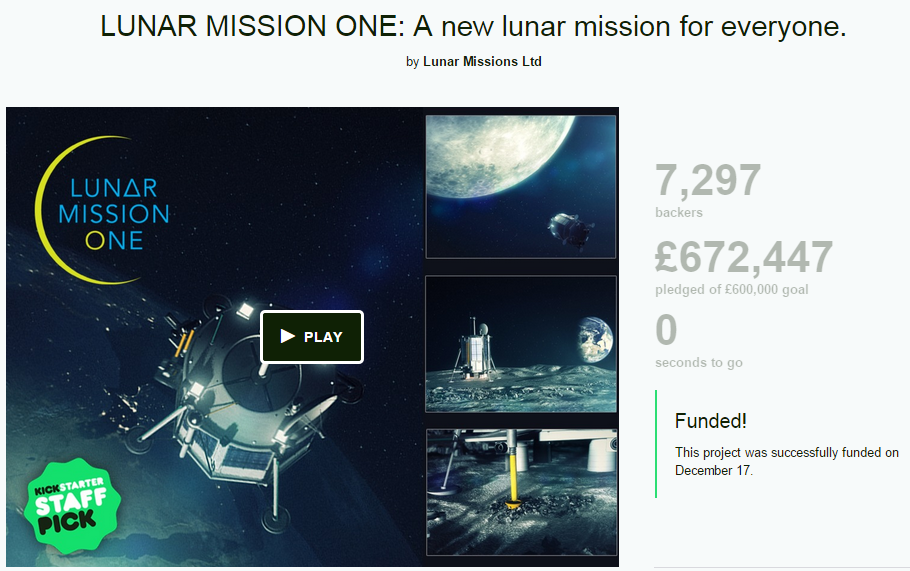
A private UK-based group that aims to land a probe on the lunar surface by 2024 has successfully raised over £672,447 GBP ($1.2Mln CDN) via crowd funding.


The ambitious Lunar Mission One (LMO) project seeks to land a drill-equipped probe on the Moon capable of drilling to a target depth of 100 m beneath its surface. The drill will penetrate down to unexposed rock and extract core samples for transport back to Earth. In addition to collecting rock samples, the probe will deploy thermal sensors that will measure heatflow through the moon's core as well as a seismometer that will measure moon quakes and meteor impacts. The samples and sensor data will provide greater insight into the Moon's origins as well as provide data that can be used to plan future missions, including long-term projects such as a crewed lunar base/spaceport.

Besides achieving these scientific objectives, LMO will also pursue a more connected goal. Inside the borehole, the probe will place a time capsule containing a record of life on Earth.

Backers who pledged more than £60 GBP (approx $108 CDN) will receive their own "digital memory box" to be buried in the time capsule. Backers can fill their "box" with personal messages, photos, audio or video. They can can even send a strand of their hair if they want their DNA on the moon. The group will continue selling the digital memory boxes even though the crowd funding campaign has ended.

The LMO kickstarter crowd funding website on December 18th, 2014. Graphic c/o Kickstarter.
As of Wednesday, Dec. 17th, 2014 (the campaign's end date), LMO had raised enough money to fund the project.

The project is managed by the Lunar Missions Trust, a UK-based not-for-profit group whose board includes engineers, investment advisers and space scientists. The probe will be built by RAL Space, a space R&D group that operates out of the Harwell Oxford Science and Innovation Campus, located in Oxfordshire, UK.

The project has assembled an impressive list of partner organizations from across UK academia, industry and government including the British Interplanetary Society, international law firm Fieldfisher Waterhouse LLP, the Imperial College London, the Open University, the Pagefield independent communications consultancy, the Science & Technology Facilities Council and the University of Oxford.


In addition to bringing professional scientific, financial, marketing and legal talent on board, LMO has also waged an aggressive social media campaign with endorsements from such notables as:
  • United Kingdom Member of Parliament Adam Afriyie, who chairs the UK Parliamentary Space Committee
LMO, by harnessing the skills of a broad pool of talent, gained a support base from multiple organizations and crafted a clear and focused message by offering a personal connection (via the memory boxes) to provide the ideal template for space-related crowd funding.

Brian Orlotti.
With such a firm support base, the odds for success increase...breeding further success.

Others would do well to watch and learn.
____________________________________________________________

Brian Orlotti is a Toronto-based IT professional and a regular contributor to the Commercial Space blog.

Monday, December 08, 2014

Engineering Expertise, Marketing Knowledge & Business Acumen Each Needed for "Beaver" Crowd Funding

          by Brian Orlotti

An Ontario company has launched an ambitious crowd funding campaign for a Canadian mission to Mars in late 2018. However, much like another recent Canadian effort in this area, a lack of business acumen and marketing knowledge seems to have derailed plans generated by acknowledged engineering experts.


Since beginning its November 4th, 2014 Indiegogo campaign for the "Northern Light Mission to Mars," North York, Ontario based Thoth Technology has managed to raise only a little more than $9,000 CDN of its listed $1,1Mln CDN goal. The campaign, scheduled to close out on January 3rd, 2015, is focused on funding the delivery of a lander and a 6 kg micro-rover called "Beaver," to the distant Martian surface.

The plan is for the Northern Light's lander and rover to carry a variety of instruments for studying Mars' atmosphere, surface and subsurface geology. The lander is expected to feature an infrared spectrometer for examining the Martian atmosphere for bio-marker gases like methane (a possible indicator of life) as well as classifying rocks and minerals and includes a robotic arm and grinding tool to assist with these tasks.

The Beaver micro-rover is also projected to carry an infrared camera able to study Mars' surface features and analyse surface boulders. Designed to operate almost fully autonomously during its projected 90-day mission, Beaver is expected to rely on its sensors to provide information on hazards and obstacles, then use an algorithm to select its next destination.

Thoth was founded in 2001 by Dr. Brendan Quine, a professor of space engineering & planetary physics at York University, and Dr. Caroline Roberts, a technical writing instructor at York University’s Lassonde School of Engineering, to commercialize the Argus family of infrared spectrometers developed at York University. Thoth's product lineup also includes the Argus-derived Aurora infrared camera as well as the IBIS flight computer.


These are useful and well designed camera's with flight heritage, something most other Canadian companies cannot claim. In 2008, an Argus spectrometer was even launched into space on the University of Toronto Institute of Aerospace Studies (UTIAS) Space Flight Laboratory (SFL) CanX-2 nano-satellite to monitor greenhouse gasses in Earth's upper atmosphere.

Thoth is also a provider of space services. It offers thermal vacuum and vibration testing services (utilizing York University facilities and equipment), spectral analysis simulation and space tracking/communications services via the Algonquin Radio Observatory (a re-purposed 1960's Northern Ontario facility purchased by Thoth in 2008).

Given its scientific and engineering expertise, plus its existing flight heritage, the project's lack of traction appears to be the result of the same mistake made by another Canadian space crowd funding campaign held earlier this year.

Two useful tools from Thoth Technology. On the left is an Argus IR spectrometer. On the right is an Aurora line-scan camera. Both items are available commercially. Photo's c/o Thoth Technology.

As first discussed in the September 7th, 2014 post "Open Space Orbital Post Mortem: Lessons Learned & Moving Forward," product/project teams need to spend time building up a following on social (and other forms of) media prior to launching a crowd funding campaign.

The most successful crowd funding campaigns, such as the ISEE-3 Reboot Project (which raised $160,000 USD to re-establish a ground connection with the retired International Sun/Earth Explorer 3 spacecraft), the Pebble smartwatch (which raised over $10.3Mln USD as part of a kickstarter campaign initially intended to raise only $100,000 USD), and the Oculus Rift virtual reality headset (which raised almost $3.5Mln USD during a kickstarter campaign originally intended to raise only $250,000 USD) each held aggressive social media campaigns prior to their start. The brand awareness and goodwill gained via social media fueled these projects' success.

Such groundwork is not only being done by start-ups, but also, increasingly, by large firms.


In a recent example, Shomi, a Canadian streaming video on demand (SVOD) service (part of Rogers Inc.), launched in November to great success. For three months prior to launch, the company made extensive use of social media (primarily Facebook and Twitter) to promote brand awareness and elicit public feedback. (Note: the author is employed by Shomi and his comments do not reflect the views of Shomi or Rogers Inc).

Thoth's lack of in-house marketing expertise may hamper its current crowd funding campaign, but certainly shouldn't preclude future efforts. However, in order to succeed, space crowd funding efforts need to include a broader skill-set; sales and marketing alongside science and engineering.

Brian Orlotti.
Embracing a broader pool of talent will broaden space crowd funding's success.
____________________________________________________________

Brian Orlotti is a Toronto-based IT professional and a regular contributor to the Commercial Space blog.

Monday, October 13, 2014

Canadian Entrepreneur Returning Rocketry to its Roots

          by Brian Orlotti

Building rockets is an activity that many in the public consider out of reach of individuals; the exclusive domain of governments and multi-billion dollar corporations, but a Toronto-based aerospace engineer is seeking to change that perception by taking rocketry back to its small-scale, craft-based roots.

Testing a small liquid fueled rocket at a Kitchener, Ontario test site. In the background on the left is a trailer containing the testing equipment and storage facilities for the fuel. Photo c/o Michael Viechweg.

Adam Trumpour obtained his undergraduate degree in Engineering Science at the University of Toronto and a Master’s degree in Aerospace Engineering from Ryerson University. Prior to his formal rocketry education, he, like many others bitten by the space bug, built model rockets.

Dissatisfied with off-the-shelf model rocket parts, Trumpour moved into amateur rocketry, building his own test stand and small liquid-fueled rockets.

Trailer and test stand. Photo c/o A Trumpour.
During his undergrad years, Trumpour worked as a volunteer with the Da Vinci Project, a Toronto-based team working to build a balloon-launched suborbital passenger rocket (dubbed "Wild Fire") in a bid to win the Ansari X-Prize. During his time with the Da Vinci Project, Trumpour helped design and build a 1000-lb nitrous oxide-parrafin hybrid rocket engine demonstrator.

In the wake of The Da Vinci Project's 2004 X-Prize loss to Scaled Composites (its hardware having never flown), many of the teams' engineers chose to band together to form Continuum Aerospace, a space systems research and consulting firm. The Toronto-based Continuum Aerospace would continue development of the technology initially created for the Da Vinci Project. Adam Trumpour was one of its founders,

After completing his Master's degree, Trumpour obtained a position as a Concept Designer at Pratt & Whitney Canada, where he works today. Trumpour is also a consultant to Open Space Orbital (OSO), a group of entrepeneurs working to build an indigenous orbital launch vehicle for Canada and even authored a submission to the 2012 Federal Review of Aerospace and Space Programs and Policies (or "Emerson Report") under the title "Fostering Innovation, Creating New Markets: Novel Approaches to Space Policy and Programs," which discussed government procurement methodologies used in the space industry.


While working for a large aerospace firm by day, Trumpour has found a way to pursue his passion during off-hours, as well. In his garage, Trumpour has built his own machine shop/rocket lab, where he designs and builds liquid and hybrid rocket engines.

This home lab, financed out of his own pocket (and to which the author was kindly given an invitation to see), includes machine tools purchased second-hand or surplus from eBay and various other sources, including a massive 1980's vintage Bridgeport milling machine, a metalworking lathe, and a custom-designed cleanroom-type glovebox for cleaning rocket engine parts.

Most impressive of all is a trailer that Trumpour has customized to act a a mobile fuel depot/service hangar for his home-built liquid-fuelled rocket engine.

With his home-based machine shop, Trumpour seeks to drive home the point that the political, legal and financial constraints that hamper large space companies have left a considerable space open to the do-it-yourself crowd.

Brian Orlotti.
The field of rocketry was born in garage-based workshops, where brilliant tinkerers like Robert Goddard and Hermann Oberth, along with Canadians like Lawrence Manning and Kurt Stehling, laid the foundations of the space age. By reviving the craft aspect of rocketry, Trumpour seeks to revive its creativity as well.
____________________________________________________________

Brian Orlotti is a Toronto-based IT professional and a regular contributor to the Commercial Space blog.

Sunday, September 07, 2014

Open Space Orbital Post Mortem: Lessons Learned & Moving Forward

          by Brian Orlotti

The group of Nova Scotia space entrepreneurs calling themselves Open Space Orbital (OSO) might only have managed to raise $5,568 of their $100,000 CDN goal during their recently concluded Kickstarter campaign to fund Canada's first orbital micro-satellite launch vehicle, but the lessons learned from the effort will help steer the team towards long-term success.

A static test of  a 1,000 lbf thrust hybrid rocket test engine developed during the Ansari X-Prize competition by Canadian competitors in 2004. According to the OSO website, rocket designer Adam Trumpour was a propulsion group volunteer for a Canadian team that competed in the X-Prize competition and a founding member of Continuum Aerospace, an engineering R&D and consulting group, before joining OSO as the designer of its proposed Neutrino rocket. Photo c/o OSO.  

As outlined in the August 4th, 2014 blog post, "New East Coast Rocket Start-up Announces Kickstarter Campaign," the thirty-two day campaign ran from August 4th to September 5th, 2014 and attempted to raise money for what OSO hoped would be the prototype engine for Canada's first orbital launch vehicle (called Neutrino), a market analysis, an updated business plan and legal services.

In a followup interview with the Commercial Space Blog, OSO Founder and CEO Tyler Reyno said that, although the team was not able to meet their funding goal, they are nevertheless pleased with the results. 

Reyno said that the publicity generated by the campaign has enabled the OSO team to forge new relationships with industry and pave the way toward tapping other funding sources. Reyno stated that his team will now be applying for various Canadian federal grants and courting private investors. 


Among private funding sources, Reyno mentioned Futurpreneur Canada, a national non-profit organization dedicated to fostering young entrepreneurs aged 18–39. Futurpreneur provides business resources, start-up financing and mentoring to young entrepreneurs to enable them to launch and sustain successful businesses.

In talking to Reyno, two key lessons emerged:
  • Take the time to build up a following on social media prior to launching a Kickstarter campaign. OSO's month-long campaign was unable to generate much word-of-mouth hype or public debate about the Neutrino launch vehicle's potential to shape Canada's space future. Indeed, the most successful Kickstarter campaigns (including the Pebble smart-watch, the Oculus Rift virtual reality headset, the Ouya gaming console, GoldieBlox engineering toys for girls and Golden Age) all held aggressive social media campaigns prior to beginning. The awareness and goodwill gained via social media fueled these projects' success.
  • Develop relationships with universities prior to starting fundraising. Reyno frankly admitted that he had hoped that OSO would receive more support from Canadian universities than it did. Although confident of Canadian universities' interest in a homegrown Canadian launch system, OSO failed to reckon with academic bureaucracies and their often slow decision-making processes. Some universities may simply not have had the time to make their interest known.
Although OSO's Kickstarter campaign proved unsuccessful, it is important to remember that the early history of rocketry was riddled with setbacks (not to mention explosions). A decade ago, a small startup called SpaceX announced its plans to build rockets cheaply and more efficiently than established players, a plan for which it was ridiculed and ignored for years. 

Brian Orlotti.
The road ahead for OSO may be difficult, but Reyno and his team possess the best competitive "edge" of all; the ability to learn from mistakes and press on towards success.
____________________________________________________________

Brian Orlotti is a Toronto-based IT professional and a regular contributor to the Commercial Space blog.

Saturday, August 09, 2014

Industry Minister Allocates $6.7Mln to Develop Space Apps

          by Chuck Black

Minister Moore on Thursday. Photo c/o CBC.
Spending almost $7Mln CDN to develop a series of applications ("apps") for satellite derived data seems a little expensive in a country chock full of software developers offering up their services for free at events like the annual International Space Apps Challenge.

Of course, that's not the impression intended to be conveyed by the August 7th, 2014 Industry Canada press release, "Industry Minister Moore announces support for new space technologies that will provide crucial information about the Earth."

The announcement that the Canadian Space Agency (CSA) would be awarding contracts worth a total of $6.7Mln CDN to develop new applications for satellite derived Earth imaging data was intended to bolster Canadian claims of competitiveness in the fast growing but crowded commercial marketplace. 

But while space has always been difficult to get to and operate in, the development of applications intended to utilize the data collected from space has always followed pretty much the same processes and methodologies as any other software development project.

This is why NASA, Google, Yahoo, HP, the World Bank and others banded together to create the International Space Apps Challenge in 2012.

As outlined in the May 19th, 2014 post "CDN "SkyWatch" wins "Best Use of Data" at Int'l Space Apps Challenge," a Canadian team even won the 2014 Challenge by designing and building (over a single weekend) an application which takes worldwide observatory data and combines it in an easy to understand, twitter-like set up to plot the data on on Google Sky.


Of course, in the absence of any real innovation and as outlined in the August 7th, 2014 Government of Canada list of organizations scheduled to receive a contract, the CSA funding will be provided to 3vGeomatics, AECOM, Array Systems Computing, ASL Environmental Sciences, C-CORE, Effigis Géo-Solutions, GHGSat, the Institut national de la recherche scientifique (INRS), Kepler Space Inc., MacDonald Dettwiler (MDA) and PCI Geomatics as per the standard CSA operating procedures.

The individual awards are each around $500,000 CDN and most of the applications being developed will use commercially available RADARSAT 2 derived synthetic aperture radar (SAR) data.

But will the CSA awards preserve Canadian competitiveness in the growing Earth imaging applications industry?

Yeah, Right....

UPDATE:

As per the the August 18th, 2014 Government of Canada press release, "The Government of Canada announces investment in innovative mapping system for first-ever global surface water survey," the Federal government has allocated an additional $3.3Mln CDN to Georgetown-based manufacturer, Communications and Power Industries Canada Inc. (CPI Canada), to develop the extended interaction klystron (EIK), a satellite radar component that will:
generate pulses used to gather surface information. This investment will support local high-technology jobs and economic growth while the resulting information could help Canada more efficiently manage water resources, prepare for potential flooding, and help avoid costly damage from flooding or drought. 
The Surface Water and Ocean Topography (SWOT) mission will survey 90 percent of the globe, studying the Earth's lakes, rivers, reservoirs and oceans. SWOT data could lead to improvements in many water-related services in Canada, including operations at sea and water management systems, and will provide measurements for lakes and rivers in Northern Canada for which none currently exist.
Meanwhile, back on Earth, and as outlined in the August 18th, 2014 Waterloo Journal article, "Waterloo makes public most complete Antarctic map for climate research," the University of Waterloo:
has unveiled a new satellite image of Antarctica, and the imagery will help scientists all over the world gain new insight into the effects of climate change.

Thanks to a partnership between the Canadian Space Agency (CSA), MacDonald, Dettwiler and Associates Ltd. (MDA), the prime contractor for the RADARSAT-2 program, and the Canadian Cryospheric Information Network (CCIN) at UWaterloo, the mosaic is free and fully accessible to the academic world and the public...
Only time will tell if the open source development model has staying power, but this looks like a good start.

Canada can create useful instruments to place in space with funding from the Federal government while the data derived from those programs is provided for free to the public which paid for the data. 

Monday, August 04, 2014

New East Coast Rocket Start-up Announces Kickstarter Campaign

          by Brian Orlotti

A group of Nova Scotia space entrepreneurs have launched a Kickstarter campaign to raise the $100,000 CDN needed to begin building Canada's first orbital micro-satellite launch vehicle. According to Open Space Orbital (OS) founder and CEO Tyler Reyno, the goal is to build and launch rockets to serve the burgeoning international small-sat market and reduce Canada's reliance on other nations for space launches.

A screen shot from the official Open Space Orbital Kickstarter campaign video.  To go to the campaign, please click on the graphic. Image c/o OS

The thirty-two day campaign went live the evening of August 4th and will run until the evening of Friday, September 5th, 2014. As outlined on its Kickstarter website, the funds raised will be used for:
  • Further development of the launch vehicle prototype engine (dubbed "Neutrino") using outsourced components from partners ERFT Composites and Composites Atlantic. Both firms are subsidiaries of the French aerospace/defense giant Safran Group.
  • Preliminary launch vehicle design, which is currently being done in partnership with Continuum Aerospace, an aerospace design and consulting firm in Toronto, ON.
  • Legal services pertaining to facility and launch site property selection, regulatory challenges, and intellectual property through East coast law firm McInnes Cooper.
Founder & CEO Tyler Reyno. Photo c/o OS.
The OS board of directors possesses a wide range of skill-sets and includes the former Canadian Space Agency (CSA) scientist and current Federal Liberal party candidate for Dorval-Lachine-LaSalle, Dr. Alain Berinstain, along with retired Canadian senator and former Nova Scotia premier John Buchanan and retired naval officer and defence consultant Anthony Goode.

OS's engineers are also presented as an experienced group who have honed their skills in many places including the CSA, the National Research Council (NRC), Transport Canada, NASA, the European Space Agency (ESA), Roscosmos, the Indian Space Research Organization (ISRO) along with private firms like COMDEV International and others.

In an interview with the Commercial Space blog, Reyno, a recently-graduated mechanical engineer who studied at Dalhousie University, said he has been a passionate and vocal space advocate, even prior to founding OS.

As outlined in the May 14th, 2014 Metro article "One way ticket to Mars—who on Earth wants to go," Reyno was an applicant for the MarsOne project and has also created a series of You-tube videos entitled "Send Nova Scotia to Space," as part of his entry for last year's AXE Apollo Space Academy competition.


According to Reyno, the Crimean Crisis and its affect on Canadian space operations, such as the postponement of the Maritime Monitoring and Messaging Microsatellite (M3MSat), described in the April 28th, 2014 post "M3MSat and the Politics of Dancing in the Crimea," highlight the need for a domestic launch capability.

In addition, Reyno foresees Canadian-built launch vehicles as a means of stimulating both the Canadian and the Maritime economy. He notes that Atlantic Canada is not known as a technology hub and sees space as a path to prosperity for the region.

Brian Orlotti.
Though the Crimean crisis has highlighted the shortsightedness of Canadian space policy, it has also shown us a new path. Now, ordinary citizens, through crowd funding, can help shape our country's future in space.

Perhaps Canadians, long since skilled at making the tools to understand space, will now also begin to build the means to traverse it.
____________________________________________________________

Brian Orlotti is a Toronto-based IT professional and a regular contributor to the Commercial Space blog.

Saturday, July 19, 2014

The Planetary Society is Launching a Lightsail

          by Sarah Ansari-Manea

The Planetary Society, a US based non-government, nonprofit organization involved in research and engineering projects related to astronomy, planetary science, exploration, public outreach and political advocacy, has announced the launch dates of their exciting, and long awaited LightSail mission.


Once in space, it will become the world’s first CubeSat to “fly by light."

The CubeSat, along with parent satellite, Prox-1, will be launched on board a SpaceX Falcon Heavy, in April 2016, according to the July 9th, 2014 Planetary Society press release "LightSail has a launch date!"

Over $4Mln USD was raised for the LightSail-1 mission by the Planetary Society, which compares well with other recent publicly funded private space initiatives such as the ISEE-3 Reboot Project (which raised $160,000 USD earlier this year via crowd funding service RocketHub to reactivate and utilize a 1970's era NASA satellite) and the 2013 initiative from Planetary Resources (which raised $1.5Mln via Kickstarter for its Arkyd space telescope).

Bill Nye. Photo c/o Planetary Society.
The United States Air Force, and Georgia Institute of Technology, responsible for developing the Prox-1, will cover the launch costs according to the July 10th, 2014 Universe Today article, "The Planetary Society’s Solar Sail Will Hitch a Ride to Space on a Falcon Heavy."

It's fantastic that at last we have a launch date for this pioneering mission,” said Planetary Society CEO Bill ("the science guy") Nye. “When I was in engineering school, I read the book about solar sailing by my predecessor, Society co-founder Louis Friedman. But the dream of sailing on light alone goes back much further.

According to the July 10th, 2014 Planetary Society blog post "LightSail update: Launch dates," the LightSail-1 will start out as a two-unit cube-sat, composed of a parent (Prox-1) plus a solar sailing cube-sat (LightSail-B).

The post references Jason Davis of the Planetary Society, who explained the specifications of the mission further: “Prox-1 and LightSail-B will be released into a circular orbit with an altitude of 720 kilometers (450 miles). After spending a couple weeks going through various checkouts, Prox-1 will release LightSail-B. Prox-1 will then rendezvous with LightSail-B using a thermal imaging camera for navigation, flying as close as 50 meters."

A second cube-sat (Lightsail-A), identical to Lightsail-B, could also potentially be launched on board a US Air Force Atlas V flight as part of NASA’s Educational Launch of Nanosatellites (ELaNa) program for preliminary testing in April 2015.


The Planetary Society’s decade long dream to fly by light was delayed, but not destroyed back in 2005. The Cosmos 1 spacecraft, destined to launch from a rocket off a Russian submarine, had technical difficulties, which caused the rocket’s engine to flame out prematurely, dooming the spacecraft. If successful, Cosmos 1 would have been the first successful solar sail in space.

Of course, that honour was finally won by the Japan Aerospace Exploration Agency (JAXA) on May 21st, 2010, when the agency launched the Interplanetary Kite-craft Accelerated by Radiation Of the Sun (IKAROS) spacecraft, which deployed a 200 square metre polyimide experimental solar sail on June 10th. Solar pressure has also been used as a method to conserve attitude-control propellant and tested as a means of de-orbiting dead satellites and space debris.

In essence, solar sailing has its many benefits and can prove to be incredibly advantageous over the current chemical rockets used. From the endless amount of sunlight necessary to propel spacecrafts, to the greatly reduced weight from carrying fuel, it is said by many that it is proving to be “the only practical way to reach other stars.

Sarah Ansari-Manea.
The Planetary Society continues to demonstrate and help lead the charge in awareness for space exploration, and their latest mission is already inspiring a new generation of universities and organizations wanting to send their own, privately funded, miniaturized satellites into space.
__________________________________________________

Sarah Ansari-Manea is an aspiring astrophysicist, currently completing a specialist in physics and astronomy at the University of Toronto.

Support our Patreon Page