Monday, January 26, 2015

Elon Musk as a Big Pimpin Playah; Raises $1Bln USD for SpaceX!

          by Brian Orlotti

On January 20th, Hawthorne,CA based Space Exploration Technologies (SpaceX) confirmed that it has raised approximately $1Bln USD ($1.24Bln CDN) from two new powerhouse investors, Mountain View, CA based Google Inc. and Boston, MA based Fidelity Investments.

It's been a busy week. SpaceX CEO Elon Musk, or at least a cartoon image backed up by his actual voice, guest starred in the January 25th, 2015 episode of The Simpsons as himself. Earlier in the week, as outlined in the  January 26th, 2015 Quartz article, "Elon Musk settles with the US Air Force, smoothing the way for competition in spy-satellite missions," Musk  announced a settlement with  the US Air Force, "ending a lawsuit that accused the military of unfairly awarding an $11 billion launch contract to United Launch Alliance, a Boeing-Lockheed Martin joint venture ." Graphic c/o Fox. 

The deal will not only provide SpaceX with the capital needed to achieve its goals, but also marks a watershed moment in the history of the NewSpace industry.

According to the January 20th, 2015 SpaceX statement, titled simply, "Financing Round," Google and Fidelity will own just under 10 percent of the company between them (the exact percentages have not been made public). The new investors join several others, including:
  • Capricorn Venture Partners (CVP) – A Belgium-based venture capital and equity fund manager whose portfolio includes a variety of European clean tech, medical, and IT firms. 
  • Founders Fund (FF) - A San Francisco, CA-based venture capital firm with $2Bln USD ($2.48Bln CDN) in assets under management. The firm's portfolio includes Airbnb, Knewton, Lyft, Spotify, Stripe and ZocDoc. FF was also one of the earliest investors in Facebook and the first institutional investor in SpaceX.
  • Valor Equity Partners (VEP) – A Chicago, IL-based venture capital firm with approx. $994Mln USD ($1.24Bln CDN ) in assets under management. VEP's portfolio includes Tesla Motors, Family Health Services (a provider of nursing and other home care services) and Sizzling Platter (a restaurant operating company).
How will SpaceX put this new funding to use? What do Google and Fidelity stand to gain?


The announcement comes on the heels of SpaceX founder Elon Musk's Jan 17th reveal of his plan to place a constellation of several hundred low-cost satellites 750 miles above Earth. Such a system has the potential to provide fiber-speed internet access to everyone on Earth.

Musk has stated that such a system would serve two  roles: tapping the potentially enormous market of low-cost high-speed internet access for the developing world and providing a telecommunications infrastructure for his planned human settlements on Mars.

Google, which is developing programs of its own for low-cost internet access via balloons, drones and satellites, as most recently described in the November 18th, 2014 post, "Google Takes Control of Hangar One," likely seeks to harness SpaceX's expertise in spacecraft and launch vehicles.

Fidelity Investments has not publicly offered any statement on its involvement, but with SpaceX on the verge of achieving low-cost space access and the subsequent opening of a huge new market to many players, the scent of profit must be strong indeed.

Google and Fidelity Investments' investment in SpaceX is a sign that more conventional investors are now willing to throw their hat into the space ring. As capital increasingly flows into NewSpace ventures, innovation will blossom. Over time, new infrastructure and revenue will enable even greater achievements.

Brian Orlotti.
Space will then not only be the realm of scientists, but also of workers, merchants, artists, entrepreneurs and settlers.

The true space age is about to begin.
____________________________________________________________

Brian Orlotti is a Toronto-based IT professional and a regular contributor to the Commercial Space blog.

Canadian Space Company UrtheCast is Hiring

          By Chuck Black

BC based UrtheCast is opening new offices and hiring new people. The firm has announced plans to open a second office in Vancouver able to house up to 40 video specialists, GIS experts, web developers and space systems engineers.

DVD video in space. An overview of the existing UrtheCast configuration on board the International Space Station (ISS). Graphic c/o Bloomberg Businessweek.

The additional space is required to support staff expected to be hired to fulfill a $65Mln CDN, five year contract signed last November with an unnamed, "confidential customer" for the provision of "engineering services, value-added services, and Earth imagery data." The new facilities are expected to open in March 2015.

The announcement was included as part of the January 24th, 2014 UrtheCast press release, "UrtheCast Opens New Office, Ramps Up Hiring."  As outlined in the press release, "UrtheCast continues to ramp up its search for top talent in Vancouver and San Francisco, with a dozen career opportunities ranging from web development to space systems engineering."

As outlined in the November 24th, 2014 UrtheCast press release, "UrtheCast Signs Contract For $65 Million To Provide Value-Added Services and Data," the original contract provided for the payment of 20% of the total in advance, plus included "a letter of credit" to cover for the balance of payments. 


Of course, the last few years haven't always been smooth sailing for the firm which first went public, as outlined in the June 10th, 2013 post "UrtheCast Proceeds with Takeover and Funding for ISS Camera's," in a reverse takeover (RTO) of publicly traded Longford Energy Inc. 

Early problems, as outlined in the July 20th, 2014 post, "UrtheCast Hi-Res Camera Still Not Working but Solution (and More Cameras) are on the Way," were only recently superseded, initially by new business partnerships, and later, by the November contract.

UrtheCast has said it intends to distribute operational software for the first publicly accessible high definition cameras installed on the International Space Station (ISS). The firm has offices in Vancouver, San Francisco, Washington DC, St. Louis and Moscow. 

Monday, January 19, 2015

The National Space Society Comes to Toronto in May 2015

          By Chuck Black

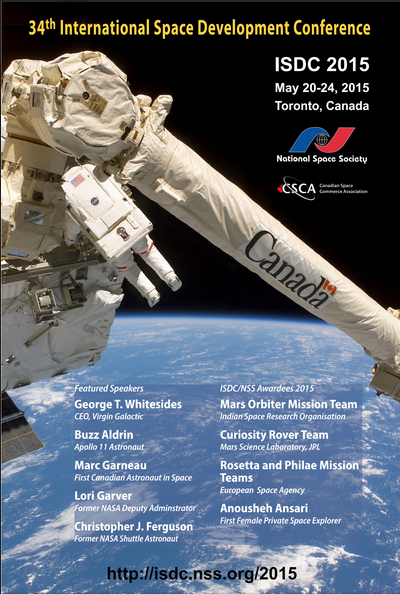
ISDC 2015 literature. Graphic c/o CEC Global Events. 
For the second time in under a year, a major international space conference is setting up shop in Toronto.

Hot on the heels of very successful 65th International Astronautical Congress (IAC 2014) comes the National Space Society's International Space Development Conference (ISDC 2015) which will be held in Toronto, ON from May 20th - 24th, 2015.

The annual ISDC is considered "the keynote event" of the U.S. based National Space Society (NSS), and brings together over 1000 leading managers, engineers, scientists, educators, and business people from civilian, military, commercial, entrepreneurial, and grassroots advocacy space sectors to discuss a variety of topics related to space and space activism.

Recent speakers have included Aerospace Corporation principal engineer William Ailor (2014), ATK Aerospace business development VP Jim Armor (2014), space tourist and entrepreneur Richard Garriott (2014), XCOR Aerospace CEO Jeff Greason (2014), Air Force Rapid Capabilities Office (AFRCO) director Dave E. Hamilton (2013), Center for the Advancement of Science in Space (CASIS) director Brian Harris (2013), Indian ex-president and scientist/ engineer A.P.J Abdul Kalam (2013), space solar power advocate and Artemis Innovation Management Solutions president John Mankins (2013 - 2014), SpaceX CEO and CTO Elon Musk (2014), meteorite "man" Geoffrey Notkin (2014), PricewaterhouseCoopers Canada director of business development and global markets Sandra Pupatello (2013), US representative and vice chairman of the science of the congressional space and technology committee Dana Rohrabacher (2013), Moon Express co-founder & CEO Robert Richards (2013 - 2014), Mars Society president Robert Zubrin (2013 - 2014) and several hundred others.

The current line-up for 2015 includes retired astronaut and second man on the Moon Edwin "Buzz" Aldrin, Jr., the first female "space tourist" Anousheh Ansari, former Canadian Space Agency (CSA) president/ astronaut and current Liberal MP for Westmount--Ville-Marie Marc Garneau, the current general manager of the Air Line Pilots Association, International (ALPA) and former deputy administrator of NASA Lori Garver and even a few people who still work in the space industry, such as former NASA astronaut and current director of crew and mission operations for the Boeing commercial crew program Christopher J. Ferguson and Virgin Galactic CEO George T. Whitesides.

According to CEC Global Events (CEC) director Aggie Kobrin, several dozen more speakers are expected to be announced over the next little while to fill out the program. CEC is the organizer of the event for the NSS and is working in conjunction with the Canadian Space Commerce Association (CSCA) which is functioning as the local organizing committee.
For more information on the event, check out the ISDC 2015 website at http://isdc2015.nss.org/. 

The Hyatt Regency Toronto will be hosting the 2015 International Space Development Conference from May 20th - 24th, 2015. For more information, please check out the Hyatt Regency website at https://aws.passkey.com/event/11486046/owner/1460357/home. The hotel is also one of the hubs of the Toronto International Film Festival (TIFF). Graphic c/o Hyatt.

Sunday, January 18, 2015

Is Jay Aspin Canada's First "Real" Space Politician?

          by Chuck Black

Canada's most space industry friendly politician might no longer be the Liberal member of parliament (MP) for Westmount - Ville-Marie. At least that's the impression Conservative MP Jay Aspin is attempting to convey as he winds up his first tour as chair of the newly created parliamentary "space caucus."

Kirkland Lake Mayor Bill Enouy and Nipissing-Timiskaming MP Jay Aspin shoveling. As outlined in the December 12th, NorthernNews.ca 2012 article, "Sod turned for new $35 million waste water plant," the two were breaking ground for a new $35 million waste water treatment facility which subsequently opened for business in October 2014. Photo c/o NorthernNews.ca.

As outlined in the January 17th, 2015 BayToday.ca article, "Aspin leads space caucus tour," the ambitious Federal representative for the riding of Nipissing-Timiskaming, (who also acts as vice-chair of the parliamentary aerospace caucus) led a tour of caucus members to Cambridge, ON based Com Dev International and the Brampton, ON robotics and automation division of Richmond, BC based MacDonald Dettwiler (MDA) on Friday.

“The purpose of the Space Caucus is to give parliamentarians a first-hand appreciation of Canada’s space industry,” said Aspin.

As outlined in the November 30th, 2014 post, "Ambitious MP Announces Canadian "Space Caucus" Focused on the Economics and Business of Space," the space caucus is just one of a series of activities which Aspin hopes will cement his hold on the riding in time for the upcoming Federal election, later on this year.

Aspin initially finished just 14 votes ahead of Liberal incumbent Anthony Rota in the 2011 election, which triggered an automatic judicial recount but eventually confirmed his tight 18 vote final victory.


It's even possible that Aspin might not be just blowing in the wind when it comes to making promises to the space industry.

As outlined in the June 30th, 2014 post, "Canadore College Testing New European Space Plane Design," Aspin helped organize the November 2013 North Bay Aerospace Forum, which was attended by many of the world's aerospace heavyweights. These included Boeing, Bombardier, Dassault, Lockheed Martin, and Pratt & Whitney. The meeting led directly to a contract to perform drop testing of a European designed suborbital space plane at the Jack Garland Airport in North Bay.

More recently, as outlined in the January 13th, 2015 Nugget.ca article, "Funds available for collaborative aerospace projects," Aspin participated in a session at Canadore College, along with North Bay Mayor Al McDonald and Ontario Centres of Excellence (OCE) director of business development Richard Worsfold.

The talk focused on the recently-created Consortium for Aerospace Research and Innovation in Canada (CARIC), which has about $4Mln CDN in available funding and will soon begin receiving proposals for collaborative research and technology development projects.

Which is certainly more than Liberal MP Marc Garneau has been able to accomplish for the Canadian space industry over the last little while. But is Aspin simply the newest "flavor of the month" for the Canadian space industry? Or is he in the midst of becoming a player?

That's likely something which will only become apparent after the next Federal election. Stay tuned. 

Monday, January 12, 2015

Meet Canadian Space Agency Interim President Luc Brûlé

          by Brian Orlotti

Luc Brûlé. Photo c/o CSA.
Interim Canadian Space Agency (CSA) president Luc Brûlé has kept a low profile thus far in his tenure, much like he has for most of his career, which has made it difficult to get any sense of either his interests or the CSA's future direction.

Of course, this might be for the best, given that Brûlé is essentially a "place holder" until Industry Minister James Moore announces the next, official CSA president, an action not currently expected to occur anytime soon.

But a presentation given by Brûlé at the 2011 International Geoscience and Remote Sensing Symposium (IGARSS 2011), which was organized by the Institute of Electrical and Electronics Engineers (IEEE) and held in Vancouver, BC, does shed some light on both his area of expertise and potential CSA future plans related to Earth observation (EO).

As part of the presentation, Brûlé laid out three key roles for the CSA in future EO development:
  • Supporting the development of new concepts for Canadian and international EO instruments and missions.
  • Fostering participation of Canadian scientists and companies in Canadian and international EO missions.
All of which sound not a lot different from what CSA is currently involved with. As outlined most recently in the August 9th, 2014 post, "Industry Minister Allocates $6.7Mln to Develop Space Apps," the CSA continues to encourage the development of domestic expertise in this area.

A fuzzy screen shot from IGARSS 2011, showing Luc Brûlé, the then CSA Director General of Space Utilization presenting on the topic of "The Evolution of Space Observation in Canada: A Perspective." A video recording of the presentation is available online at http://www.ustream.tv/recorded/16241019. Screen capture c/o ustream TV.

Brûlé then outlined the CSA's three main EO projects:
  • A collaboration between Canada's RCM and the ESA's Sentinel-1 Earth imaging satellite, which uses a C band SAR satellite constellation similar to RCM. Sentinel-1's first satellite was launched in April 2014 and a the second is scheduled for 2016. 
  • The Polar Communications and Weather (PCW) mission, a 2016 Canadian government mission to place a constellation of satellites in high orbit above the Canadian arctic for communications, space weather monitoring and maintaining arctic sovereignty.  
  • SCISAT-1, an atmospheric-monitoring satellite developed by the CSA in cooperation with several Canadian universities, which was launched in 2003 
Oddly enough, this also seems a reasonably accurate assessment of current CSA activities.


And finally, Brûlé discussed three Canadian government programs for sharing EO data:
Of course, the presentation didn't discuss the CSA astronaut program, likely because this area isn't part of Brûlé's publicly acknowledged expertise. But it's worth noting that CSA currently has no Canadian astronaut scheduled to visit the International Space Station (ISS) and likely won't have one before 2018. 

Brian Orlotti.
It's also worth noting that the presentation power-points are available online and in video form. Check them out for the useful insights they provide into the mind of our current CSA head.
____________________________________________________________

Brian Orlotti is a Toronto-based IT professional and a regular contributor to the Commercial Space blog.


A Space "Socio-Economic Impact Statement," a COM DEV Conference Call, more Telesat Sale Snags & Lego Astronauts

          by Chuck Black

Here are a few of the unfolding Canadian space stories currently being tracked by the Commercial Space blog.

The space sector, particularly its legislative component, has always been known for studies and reports and Canada is no exception in this area. As outlined in the October 27th, 2014 post, "Free OECD Report on Space Economy Provides Guidance for Upcoming Paid CSA Report," a Canadian Space Agency (CSA) contract valued at $285,000 CDN to undertake a "comprehensive socio-economic impact assessment" of the Canadian space sector, should be complete and ready for presentation by January 30th, 2015.

However, there is so far no advance word on whether the upcoming report (compiled by the North American subsidiary of Paris, France based Euroconsult) will supplement or supersede existing documents, such as the annual State of the Canadian Space Sector Report (which is typically released during the December/ January period) and no suggestion that the report might ever be released to the public.

Of course, the private sector is often perceived of as being more forthcoming with information. As outlined in the January 8th, 2015 press release, "COM DEV Announces Details of Fourth Quarter and Year End Fiscal 2014 Conference Call," Cambridge based COM DEV International will be releasing its Q4 and year end financial results, plus hosting an investor conference call to discuss them, on Thursday, January 15th, 2015.

With 1200 employees, the firm is a global provider of space hardware and services with annual revenues of $216Mln CDN, and facilities in Canada, the United Kingdom and the United States. As outlined in the December 15th, 2014 post, "COM DEV Buys a Scottish Microwave Equipment Manufacturer," the company has just concluded the first of a promised series of international acquisitions intended to grow the company and gain access to foreign markets.

And, as discussed in the January 10th, 2015 Bloomberg post, "Canada Funds’ Bid for Telesat Said to Hit Financing Snag," the ongoing attempt by Loral Space & Communications Inc. (LORL) to sell its Telesat shares to the Ontario Teachers’ Pension Plan and the Public Sector Pension Investment Board, has been delayed again.

This time, the sale stalled amid a "regulatory clampdown on the leveraged-loan market." As outlined in the December 3rd, 2014 Wall Street Journal article, "Private-Equity Firms Adapt to Regulatory Clampdown," the use of borrowed assets to fund purchases, which boost immediate overall returns to an acquirer, could also potentially burden the acquired company with too much debt to ever return to profitability after the purchase.

LEGO minifigure versions of Expedition 42 crew members Terry Virts, Anton Shklaperov, and Samantha Cristoforetti are seen on the International Space Station. Lego Chris says hi. Photo c/o NASA.
But in an industry generally assumed to be at least as much about encouraging the efforts of "boys with toys," it's refreshing to find an actual toy company bearing gifts for real space geeks. As outlined in the Yahoo News UK article, "Astronauts Get Their Own LEGO Minifigures on Space Station," LEGO mini-figures customized to look like NASA astronaut Terry Virts, Roscosmos cosmonaut Anton Shklaperov and European Space Agency (ESA) astronaut Samantha Cristoforetti were among the gifts the crew exchanged on New Year's Day.

According to the article, the LEGO was a gift from Cristoforetti, who received them from a ESA training instructor, who commissioned them from the UK-based company Minifigs.me.

Tuesday, January 06, 2015

Is the US Patent System Broken?

          by Chuck Black

Two recent stories, one of which relates directly to the space industry, illustrate the legal difficulties involved with commercializing new innovations under the US patent law system while a third article, posted on the Canadian based Ridout and Maybee law firm website, argues that US patent law makes Canada "a more attractive jurisdiction for initial patent filings."

In the US, landing a spacecraft on a surface ship might just be subject to patent protection. Artwork c/o Dmitry Vishnevsky.

Taken together, they illustrate the complexity and confusion surrounding current legal thought in the area.

The first story, the January 5th, 2015 Wired article, "Our System Is So Broken, Almost No Patented Discoveries Ever Get Used," discusses the US patent system and how the current patent process is "a market so constricted by high transaction costs and legal risks that it excludes the vast majority of small and mid-sized businesses and prevents literally 95 percent of all patented discoveries from ever being put to use to create new products and services, new jobs, and new economic growth."

According to the article:
If we’re honest with ourselves, we must admit that the patent system today has lost much of its original democratic character. Sure, anyone with a good inventive idea (and at least $20,000 for legal and other fees) can get a patent. But what can you do with that patent? More than likely, you won’t be able to put it to good use unless you have the multi-million-dollar resources required to launch a startup, secure a licensing deal with a big corporation or, if necessary, litigate to stop an infringer. 
Perhaps the most effective example of this state of affairs is the recent lawsuit between Space Exploration Technologies (SpaceX), which will attempt to soft land a Falcon-9R first stage on an ocean going platform during its next launch attempt, and Blue Origin LLC, which was issued a patent on the processes related to just that sort of activity a few years back and seeks claims against SpaceX for infringing on its patent.

Part of the supporting documentation for the Blue Origin filed U.S. Patent Application No. 12/815,306, entitled “Sea Landing of Space Launch Vehicles and Associated Systems and Methods” with a priority date of June 15, 2009 which became US Patent No. 8,678,321 in March of 2014.

According to the January 5th, 2015 IP in Space post, "Intervening Rights: How the Blue Origin SpaceX Patent Dispute May Evolve," the eventual result of the lawsuit may depend less on the fact of the case and more on the deep pockets of SpaceX, which would likely end up insulated from any claims relating to activities undertaken before the patent case can be decided:
SpaceX has several first stage cores on hand at any given time and its factory is built to produce up to forty annually, representing substantial preparation, stock on hand and investment. SpaceX has also invested a considerable amount to bring its reusable Falcon 9 program to fruition, monies that will likely take a significant amount of time to recoup (before any potential Blue Origin claims would be supported by the court)...
In essence, any successful claim against SpaceX will be mitigated by the size of the investment SpaceX made in the program before the claim can be resolved in court. This is something a smaller and less well financed company could not reproduce and goes a long way towards explaining why larger companies have an advantage in patent litigation.

The 1998 paper "Re-entry and Terminal Guidance for Vertical-Landing TSTO (Two-Stage to Orbit)" which is readily available online and contains many of the core concepts relating to US Patent No. 8,678,321 from March of 2014, but predates it by 16 years. Graphic c/o Aerospace Research Central.

However, the core of the SpaceX defence against the Blue Origin lawsuit isn't the amount of money its spent on the program; it's the counter claim that Blue Origin’s patent “treads on technology that existed way before Blue Origin filed for the patent application,” and should therefore be struck down.

As outlined in the September 24th, 2014 Space News article, "SpaceX Bringing the Right Stuff to Patent Slog with Blue Origin, Expert Says," the SpaceX defence references a variety of publications to bolster this point, including the paper “Re-entry and Terminal Guidance for Vertical-Landing TSTO (Two-Stage to Orbit),” which was published in 1998 by the American Institute of Aeronautics and Astronautics (AIAA).

Why does this point to a problem with the US system?

That's simple. The US system makes the attempt to focus on the rights of the first to invent rather than the first to file a claim. In the case of Blue Origin, while it was certainly the first to file for the patent, any indication that someone else had actually made the invention would certainly invalidate any patent protection claimed by Blue Origin. 

And this is what SpaceX is attempting to do. It's just a shame that the company needs so much cash for lawyers and inventory to keep the wheels on the bus in motion until the claim is settled.

But if you really want to get confused over the way the US system works, a Canadian law firm is offering an alternative. The undated article on the Ridout and Maybee law firm website, "Upcoming Changes to US Patent Law Make Canada a More Attractive Jurisdiction for Initial Patent Filings," suggests that recent changes in US patent law have changed the system from one which protects the "first to invent" to one which protects the "first to file," at least in the case of a foreign filing claim, from places like Canada.

All of which makes it even more confusing for small firms and inventors to compete with larger companies. Maybe Blue Origin should have filed its patent in Canada?

Sunday, January 04, 2015

The Right Way to Crowd Fund

          by Brian Orlotti

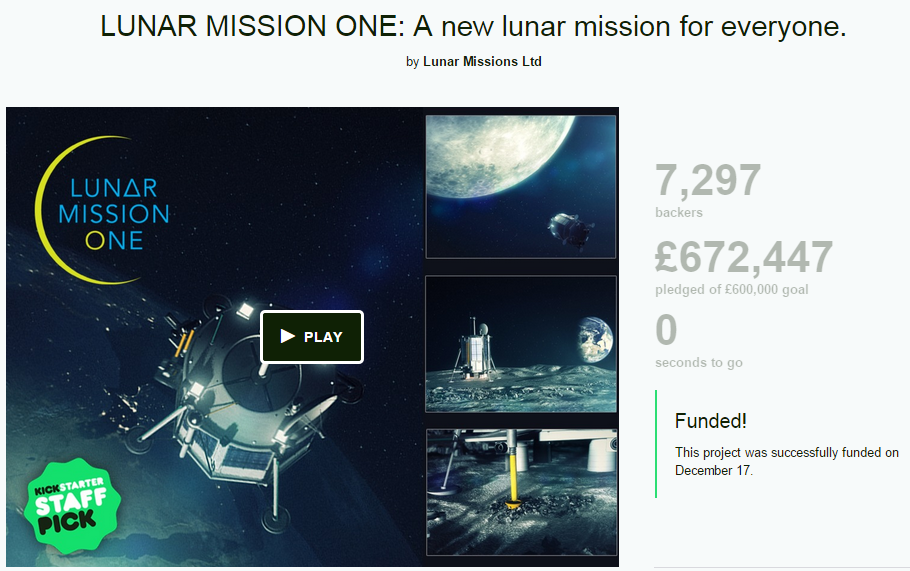
A private UK-based group that aims to land a probe on the lunar surface by 2024 has successfully raised over £672,447 GBP ($1.2Mln CDN) via crowd funding.


The ambitious Lunar Mission One (LMO) project seeks to land a drill-equipped probe on the Moon capable of drilling to a target depth of 100 m beneath its surface. The drill will penetrate down to unexposed rock and extract core samples for transport back to Earth. In addition to collecting rock samples, the probe will deploy thermal sensors that will measure heatflow through the moon's core as well as a seismometer that will measure moon quakes and meteor impacts. The samples and sensor data will provide greater insight into the Moon's origins as well as provide data that can be used to plan future missions, including long-term projects such as a crewed lunar base/spaceport.

Besides achieving these scientific objectives, LMO will also pursue a more connected goal. Inside the borehole, the probe will place a time capsule containing a record of life on Earth.

Backers who pledged more than £60 GBP (approx $108 CDN) will receive their own "digital memory box" to be buried in the time capsule. Backers can fill their "box" with personal messages, photos, audio or video. They can can even send a strand of their hair if they want their DNA on the moon. The group will continue selling the digital memory boxes even though the crowd funding campaign has ended.

The LMO kickstarter crowd funding website on December 18th, 2014. Graphic c/o Kickstarter.
As of Wednesday, Dec. 17th, 2014 (the campaign's end date), LMO had raised enough money to fund the project.

The project is managed by the Lunar Missions Trust, a UK-based not-for-profit group whose board includes engineers, investment advisers and space scientists. The probe will be built by RAL Space, a space R&D group that operates out of the Harwell Oxford Science and Innovation Campus, located in Oxfordshire, UK.

The project has assembled an impressive list of partner organizations from across UK academia, industry and government including the British Interplanetary Society, international law firm Fieldfisher Waterhouse LLP, the Imperial College London, the Open University, the Pagefield independent communications consultancy, the Science & Technology Facilities Council and the University of Oxford.


In addition to bringing professional scientific, financial, marketing and legal talent on board, LMO has also waged an aggressive social media campaign with endorsements from such notables as:
  • United Kingdom Member of Parliament Adam Afriyie, who chairs the UK Parliamentary Space Committee
LMO, by harnessing the skills of a broad pool of talent, gained a support base from multiple organizations and crafted a clear and focused message by offering a personal connection (via the memory boxes) to provide the ideal template for space-related crowd funding.

Brian Orlotti.
With such a firm support base, the odds for success increase...breeding further success.

Others would do well to watch and learn.
____________________________________________________________

Brian Orlotti is a Toronto-based IT professional and a regular contributor to the Commercial Space blog.

Monday, December 22, 2014

2014: The Year in Space for Canada

          by Chuck Black

With regards to both Dickens and cursing Chinese philosophers, 2014 was certainly the "best of times," the "worst of times," and perhaps even the "most interesting of times" for the Canadian space industry, although the specifics mostly depended on whether you worked at the Canadian Space Agency (CSA) or somewhere else.

So, with that in mind, here are some of the high and low points for the Canadian space sector in 2014.
______________________________________________________________________________

The year began, as outlined in the January 23rd, 2014 post "Canadian Space Industry Shrinks While International Markets Grow, with indications that Canada could no longer "punch above its weight," at least when it came to the commercialization of space derived technology. As described in the article, the Canadian share of the fast expanding international space marketplace was shrinking, both as a percentage of the overall market and in absolute terms.

Of course, it wasn't as if the Federal government under Prime Minister Stephen Harper was unaware of the situation.

After a slow start assessing the recommendations of the November 2012 David Emerson led Aerospace Review (which was highly critical of the CSA and led directly to the February 2013 resignation of CSA president Steve MacLean), the Harper government continued on its glacial way with a series of incremental announcements marinated in hyperbole, which at least reflected Emerson and could perhaps become the core of an effective job creation strategy during the lead-up to an expected fall 2015 federal election.

Minister Moore. Photo c/o CTV.
The first of these announcements was the  January 7th, 2014 release by Industry Minister James Moore of "Canada's Space Policy Framework," which defined five principles of Canadian space policy ("Canadian interests first," "positioning the private sector at the forefront," "progress through partnerships," "excellence in key capabilities" and "inspiring Canadians") and three areas of action ("commercialization," "research and development" and the "exploration of space") without really going into a lot of detail about what the phrases actually meant.

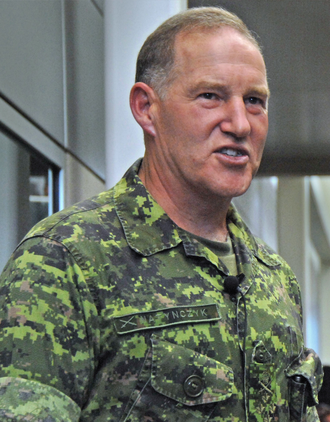
Gen. Natynczyk. Photo c/o Wikipedia.
Meanwhile, a beleaguered CSA, under the semi-serious leadership of MacLeans' official successor, retired Canadian Forces general Walt Natynczyk, attempted to explain why CSA employees should continue to come to work.

The big problem, as outlined in the February 9th, 2014 post, "Conservatives Form Committees; NDP Says "Incompetence Crippling Space Sector," was the Aerospace Review's recommendation to create two external committees; the first tasked with outreach functions and the second tasked with fiscal oversight and policy making.

This shrinking of the CSA mandate would normally clear the way for re-assignment and lay-offs of CSA employees whose roles would be essentially "outsourced" to the committees, which is likely why the opposition New Democratic Party (NDP), with its close ties to various unions representing federal government employees, initially objected.

However, as outlined in the February 27th, 2014 post on "The "Casablanca" of Space Conferences," it was becoming obvious, even without the spectre of immediate layoffs, that most CSA employees would prefer to be somewhere else and, by the end of the year, most of those who could leave, did.

Among them, as outlined in the November 2nd, 2014 post "Hello, I Must Be Going: CSA President Natynczyk Transferred to Veterans Affairs," was Walt Natynczyk.

Also by the end of the year, and as outlined in the November 19th, 2014 post, "Industry Minister Moore Announces Space Advisory Board Members," the Federal government had finally announced the membership of one of the previously announced committees, a daring, but long overdue step which should give plenty of time to make several more auspicious announcements unencumbered by the need for actual results, as part of the run up to the next election.

CSA employees preparing the Near Earth Object Surveillance Satellite (NEOSSat) for thermal vacuum testing at the David Florida Laboratory in Ottawa, ON sometime before its launch in February 2013. As outlined in both the July 7th, 2014 post "NEOSSat Not Up to the Job; Government Report Blames Contractor," and the July 28th, 2014 follow-up post, "Customers vs Project Managers: The Real Truth about NEOSSat," an unusual public feud between the CSA and NEOSsat prime contractor  Microsat Systems Canada Inc. (MSCI) highlighted project management failures at the CSA and raised questions about whether the satellite would ever function according to specifications. As of December 2014, NEOSsat was still not fully operational. Photo c/o CSA. 

Throughout the year, politics remained a key driver influencing Canadian space activities. The April 7th, 2014 post "The Crimean Crisis and Canadian Aerospace Activities," discussed sales losses in at least two Canadian aerospace firms (MacDonald Dettwiler and Bombardier) deriving from Federal government decisions made in protest against Russian activities in the Crimea.

The April 28th, 2014 post "M3MSat and the Politics of Dancing in the Crimea," discussed the announcement that the Federal government "has decided not to proceed" with the planned June 2014 launch of the Maritime Monitoring and Messaging Micro-Satellite (M3MSat) technology demonstrator from the Baikonur Cosmodrome in Kazakhstan and the subsequent Russian allegations of the M3Msat's possible "military" uses.

But while, as outlined in the June 24th, 2014 post "Two More Canadian Satellites Launched on Russian Rocket: Another Scheduled," Russia did end up launching at least a few more Canadian built satellites over the summer, the writing was on the wall for fall.

Hadfield abroad. Photo c/o Donald Weber / Crown Prince Court/ Abu Dhabi.
By then, as described in the September 29th, 2014 post, "No Visas for Russian and Chinese Space Delegates to Attend IAC 2014" the situation was such that the Harper government wasn't even expected to provide a public justification for its actions, although some of the background on the Chinese decision was discussed in the November 9th, 2014 post "PM Signs Agreement with China a Month After Rejecting Chinese Delegation Attending IAC2014."

Fortunately, these restrictions do not seem to have hindered Canadians such as Chris Hadfield from travelling abroad, a situation discussed in the September 14th, 2014 post, "Hadfield in China for International Planetary Congress; PM to Follow in November."

As outlined in the August 11th, 2014 post "Hadfield in Emirates, Russia in Lather & UrtheCast in Orbit," Canada's most famous astronaut also visited the Middle East, where he publicly stated his interest in helping the United Arab Emirates (UAE) set up its own space agency and launch a Mars probe.

A graphic showing the Rosetta spacecraft, the Philae lander and a timeline for the European Space Agency (ESA) Rosetta mission. As outlined in the November 16th, 2014 post, "ESA's Perspective on Rosetta + Canada's Contributions & Bruce Willis," the substantial Canadian contributions to the mission included software (via the AGDA Group Canada), the three ground stations used to communicate with the spacecraft (built by SED Systems) and at least two Canadian expatriates who had to live abroad in order to work on the program. Graphic c/o Graphic News/ ESA.

Of course, the essential core of domestic Canadian space policy and political activism remained the ability to announce new space focused funding for appropriately receptive communities. In this area at least, the Federal government remained without peer throughout 2014.

Funding announcements for space agency projects picked up over the summer and were discussed in the July 21st, 2014 post, "Federal Government Hypes OSIRIS-REx Mission," the August 9th, 2014 post, "Industry Minister Allocates $6.7Mln to Develop Space Apps," the August 18th, 2014 post, "Canadian Space Agency Gears up to Fund More Rovers," the August 24th, 2014 post "Space Agency Seeks Insight into Space Industry," the September 8th, 2014 post "Space Agency Funds Training for RADARSAT Researchers," and quite a number of others.

But, as outlined in both the June 30th, 204 post, "Canadore College Testing New European Space Plane Design," and the follow-on November 30th, 2014 post, "Ambitious MP Announces Canadian "Space Caucus" Focused on the Economics and Business of Space," at least some of the government gifts were less about money and more about influence.

Conservative MP for Nipissing-Timiskaming Jay Aspin in his riding office on March 25th, 2014. As outlined in the March 26th, 2014 North Bay Nugget article, "Aspin mum on details," the loyal conservative was even then "awaiting new aerospace-related tenants in North Bay." Aspin is currently the deputy chair of the parliamentary aerospace caucus and the chair of the recently announced parliamentary space caucus. Photo c/o Nugget.ca.

But even with all the federal funding flowing about, Canadian space companies showed an increasing reluctance to wait for the government to support their projects.

As outlined in the January 28th, 2014 post, "UrtheCast Cameras Reinstalled on ISS," Vancouver-based UrtheCast Corporation spent the year repairing and re-installing Earth imaging cameras aboard the International Space Station (ISS), before eventually partnering with US based, privately held NanoRacks to install additional cameras on the NASA segment of the ISS.

Earth image c/o Blackbridge.
In May, Lethbridge, Alberta based BlackBridge, which already quietly controlled one of the larger privately owned satellite constellations in the world, secured additional funding to expand its network. As outlined in the May 30th, 2014 post, "BlackBridge Secures $22 Million for New Satellite Constellation," the funding was supplied the traditional way, through the very business oriented Bank of Montreal (BMO) and the Business Development Bank of Canada (BDC).

Throughout the year, several space start-ups attempted kickstarter campaigns designed to raise funds for future activities.

However, as outlined in both the September 7th, 2014 post, "Open Space Orbital Post Mortem: Lessons Learned & Moving Forward," and the December 8th, 2014 post "Engineering Expertise, Marketing Knowledge & Business Acumen Each Needed for "Beaver" Crowd Funding," the learning curves for these new funding mechanisms are every bit as daunting as traditional methodologies.

But others, like the University of Toronto Institute for Aerospace Studies (UTIAS) Space Flight Laboratory (SFL) were more successful. UTIAS-SFL managed to launch five satellites in two weeks over the summer, a number never matched by the CSA, even in its heyday.

These included two Canadian BRIght Target Explorer (BRITE) satellites for studying luminous stars from orbit, which were launched on June 19th, 2014 on a Dnepr rocket from Yasny; the CanX-4 and CanX-5 formation flying satellites, which were launched on June 30th 2014 on PSLV-C23 from Sriharikota, India; and AISSat-2, a Norwegian owned and funded but Canadian built satellite for ship tracking, which was launched on July 8th 2014 on board a Soyuz 2-1B from the Baikonur Cosmodrome in Kazakhstan.

The Russian launches were especially problematic given the Federal government's previously discussed stance on Russian activities in the Crimea. But, as outlined in the July 7th, 2014 post, "BRITE Montreal Satellite Fails to Deploy after Launch; Presumed Lost," all but one of the satellites achieved orbit and operational status.

University of British Columbia (UBC) professor Jaymie Matthews with the Microvariability and Oscillations of STars (MOST) telescope, sometime prior to its launch in 2003. Although officially de-funded by the CSA in September 2014, the satellite, under professor Matthews' direction, remains fully functional and available for use on a rental basis. As outlined in the December 18th, 2014 National Post article, "Its funding may have been eliminated, but that didn’t stop a Canadian satellite from co-discovering new planet," its even managed to contribute to new scientific discoveries. 

As for the major Canadian space players, as outlined in the June 14th, 2014 post, "The "Three Kings" of CDN Commercial Space Prepare for Changes," they mostly just sat and pondered their future.

As outlined in the September 22nd, 2014 post, "MacDonald Dettwiler Now a Commercial Satellite Powerhouse," it's slowly dawning on Canadians that the future of large domestic space companies might rest in the international arena.

And, as outlined in the December 15th, 2014 post, "COM DEV Buys a Scottish Microwave Equipment Manufacturer," Cambridge, Ontario based COM DEV International (COM DEV) has decided on the first of a promised series of international acquisitions in order to grow the company and gain access to foreign markets.

What's going to happen next year in space for Canada? Tune in beginning January 6th, 2015 to find out.

Thursday, December 18, 2014

Roscosmos is Assessing its Future Programs

          by Brian Orlotti

Oleg Ostapenk. Photo c/o NASA.
A series of recent, and often contradictory news reports, originating from Russian media outlets and picked up by western media, are only the latest signs that the Russian space industry is jockeying for position in anticipation of updates to its long-term space exploration plan.

This new plan is expected to be formally released in time for the 2015 International Aviation and Space Salon (MAKS2015), which will be held in Moscow from August 25th - 30th, 2015.

The most recent articles, as outlined in the December 15th, 2014 Sputnik Today post "Plans to Create Russian National Orbital Station Confirmed," and the December 16th, 2014 Russia Beyond the Headlines post "Roscosmos: Russia to prioritize studies of Moon, Mars, response to asteroid threat in 2016-2025," focused on a series of public comments from Russian Federal Space Agency (Roscosmos) head Oleg Ostapenk, who was quoted as "keeping all doors open" for new programs within the context of three major options:
  • Designing and building a brand new, Russian led, space station in a low Earth orbit at an orbital inclination of 64.8 degrees, using surplus modules originally designed for the ISS, but never attached. The slightly higher orbital inclination, when compared to the ISS (which has an orbital inclination of 51.6 degrees) will allow the proposed station to image more northerly Russian territory. 
  • Designing and building a brand new, Russian led, space station in low Earth orbit with an orbital inclination of 51.6 degrees, the same as the ISS, in order to simplify transfers between the two stations. 
Of course, a number of other options are also on the table. These include a potential high altitude space station, which could serve as a base of operations for a revived Russian manned lunar program and a new, super heavy Russian rocket.


Ostapenk also said that the “Roscosmos budget will not be cut, despite all financial difficulties. But I’m not going to make the sum public until it gets approval.” As outlined in the October 4th, 2014 Economist article, "On the edge of recession," the Russian economy has been contracting for some time. The 2014 budget for Roscosmos was 165.8Bln rubles ($3.5Bln CDN) which already compares poorly with NASA's 2014 budget of $17.6Bln US ($20.4Bln CDN).

Of course, it's unlikely that Russia and Roscosmos will embark in a completely new direction. For example, the December 16th, 2014 Russia Today article, "US Orion, Russia’s future spacecraft ‘to be compatible for safety," discussed the recent agreement between Russian spacecraft producer RSC Energia and US aerospace firm Lockheed Martin, to develop a compatible docking so that "Russian and American space explorers can help each other in an emergency."

As outlined on the Russian Space web article, "Russia details its grand space strategy in 2010s; New deep-space ships, big rockets and nuclear space tugs are promised at the Moscow air show," the last official Russian space plan, released to the public as part of the 2013 International Aviation and Space Salon (MAKS2013), set out a 30-year road-map in which human space exploration expanded outwards from the ISS to a crewed outpost at one of the Lagrangian points near the Moon.

The plan would have then forked into two paths: one leading to a crewed Lunar base followed by visits to asteroids by the 2030s---the other reaching the same goals, but in reverse order. Both paths would have culminated with a human landing on Mars by around 2040.


Roscosmos, envisioned the LaGrange and Lunar outposts as joint projects with other space-faring nations, including the US, Canada, and the EU. Unfortunately, soured relations between Russia and the West over issues like the Syrian Civil War, Iran, and Russia's annexation of the Crimea have led to increasing calls (in both Russia and the US) for a return to fully independent national space programs.

Whether Russian and Western governments are willing to provide funding increases to their respective space programs for independent missions to the Moon and Mars remains an open question. Although Russia has capitalized on an oil-fueled economic boom to boost funding of its space program over the last few years, the recent drop in global oil prices may put the brakes on this revival.

We now see in both the US and Russian space programs a common pattern. Governments lay down ambitious space goals, companies then vie with each other for lucrative contracts to achieve these goals, only to have governments cancel programs and shift goals years later. This pattern becomes a self-perpetuating cycle whose result is always the same: humanity remaining an Earth-bound species.

Brian Orlotti.
Perhaps the Russian and US space programs are now more alike than either would care to admit.
____________________________________________________________

Brian Orlotti is a Toronto-based IT professional and a regular contributor to the Commercial Space blog.
Monday, December 15, 2014

US and French Politicians Demand Domestic Launch Providers

          by Chuck Black

A scandalized sénateur Gournac. Photo c/o LUDOVIC/REA/LUDOVIC/REA.
Unlike Canada, where we officially outsource our space launches to the lowest bidder, politicians from both France and the United States have publicly rebuked any suggestion that they shouldn't "buy local," when it comes to their launch providers, even if the cost of launch ends up being much, much higher.

As outlined in the December 12th, 2014 SpaceNews article "Airbus Upbraided for Shopping SpaceX," French senator Alain Gournac, a veteran member of the French Parliamentary Space Group, called the very thought of launching a French telecommunications satellite on a US built SpaceX Falcon 9 rocket “scandalous" and "unacceptable.”

The article also suggested that competition from SpaceX is more than a little responsible for "single-handedly" causing the ESA to invest €4Bln euros ($5.8Bln CDN) into the new Ariane 6 launch vehicle in order to effectively compete with the SpaceX offering.

The satellite in question is part of the European Data Relay Service (EDRS), a planned constellation of geosynchronous orbit (GEO) communications satellites which will relay information and data between other spacecraft, unmanned aerial vehicle's (UAV), and ground stations. EDRS is being implemented as a public private partnership (PPP) between the twenty nation European Space Agency (ESA) and private partner Airbus Defence & Space with Airbus holding responsibility for deciding on the launch provider.

Initial rumours suggested that Airbus was approaching a variety of low cost providers such as SpaceX. but Airbus issued a press release later on the same day, Airbus responded to the rumours by indicating that it had not signed a contract with SpaceX for EDRS, and would soon enter negotiations with ESA and with French based Arianespace for the launch.

US president Obama. Photo c/o Forward Progressives.
Also on that same day, the American's were busy defending the long term viability of their domestic launch capability. 

As outlined in the December 12th, 2014 Los Angeles Times article "Congress OKs bill banning purchases of Russian-made rocket engines," the US Senate "voted 89-11 to approve a bill Friday that would ban the Pentagon from awarding future rocket launch contracts to firms using Russian engines."

The article also said that, "the ban is a blow to the Boeing-Lockheed venture called United Launch Alliance (ULA), which has relied on using the (RD-180) Russian (rocket) engines under an exclusive and expensive deal it has had with the Air Force since 2006."

But while the measure had already passed the US House of Representatives and was expected to be signed into law by US president Barack Obama, ULA did succeed at weakening the bill to allow the use Russian engines already in its inventory. ULA had purchased a number of RD-180 rocket engines from the Russians, which it says is enough for military launches over the next two years, and wanted to expend its existing inventory before building a domestically produced replacement. 

Curiously enough, the bill is perceived of as being another victory for Hawthorne, CA based SpaceX, which wants at least some of the US Air Force's satellite launching business. As outlined in the December 11th, 2014 Bloomberg article, "Musk’s SpaceX Closer to Certification for Launches, U.S. Says," SpaceX CEO Elon Musk is close to winning the certification his company needs to begin launching satellites for the US military.

Musk is a South Africa-born, Canadian American business magnate, engineer and investor who received his Canadian citizenship in 1988 at the age of 17 and attended Queens University in Kingston, ON for two years before transferring to the University of Pennsylvania in 1992 and becoming an American citizen in 2002.

Given the circumstances, this would seem to have been a smart choice. No one sane in this industry ever seems to stay in Canada.

Support our Patreon Page