Tuesday, August 11, 2015

MEOSAR Project Funded & CCMEO Gets Free TerraSAR-X and TanDEM-X Satellite Imagery

          By Chuck Black

Two recent announcements highlight the growing Canadian demand for global positioning and Earth imaging technology.

Connected by a constellation of satellites and rescue assets, today's modern, highly accurate GPS-equipped Emergency Position Indicating Radio Beacons (EPIRBs) and personal locator beacons (PLB), which were developed as part of the International Cospas-Sarsat programme, could be your lifesaver in an emergency. MEOSAR will integrate into this system  using a series of search and rescue (SAR) transponders aboard Europe's Galileo satellite navigation system, the Russian Glonass space based navigation system and the US Global Positioning System (GPS) satellite constellation to report signals through Cospas-Sarsat search and rescue beacons in the 406.0–406.1 MHz band. Graphic c/o Boat.U.S.

As outlined in the August 3rd, 2015 Space News article, "Canada Finds its Way To Providing GPS 3 Search and Rescue Repeaters," funding has finally been approved for a resumption of a project to provide repeaters for the Medium Earth Orbit Search and Rescue (MEOSAR) satellite system.

According to the Department of National Defence (DND) website on the MEOSAR program, the project "will deliver a space segment, comprising up to 24 Search and Rescue (SAR) repeaters that will piggy-back on the satellites of the United States Air Force's (USAF) next-generation GPS III constellation," along with "a ground segment comprising satellite ground stations in Canada with specialized satellite tracking software and information processing systems."

According to the article:
The Canadian government first announced the MEOSAR project in 2013, awarding COM DEV International (COM DEV) of Cambridge, Ontario, an initial contract worth $4.7Mln CDN for research and design work on the repeaters. COM DEV successfully completed that phase and had expected a follow-on contract to proceed with the MEOSAR project...
Unfortunately, right after the initial announcement, further funding for the program was put on hold. One of the reasons for the delay might just have been the give and take between the DND and other Canadian government departments over who would fund the repeaters.

PSC seems to be the go-to website for issues the Federal government would like to address outside of traditional channels. The department has a broad mandate encompassing a wide variety of matters.  Graphic c/o PSC website

Public Safety Canada (PSC) eventually stepped up to the plate. As outlined in the July 24th, 2015 Federal government press release, "Government of Canada announces improvements to Canada's Search and Rescue system," PSC will be taking over investment in the MEOSAR program, and will provide "up to $249 million (in additional funding), as identified in the 2015 Defence Acquisition Guide."

But more importantly, the program will be transferred from DND to PSC, since PSC is supposedly covering the cost.

MEOSAR, is an add-on to the International Cospas-Sarsat programme of satellite-based search and rescue (SAR) system established by Canada, France, the United States and the former Soviet Union in 1979. The Secretariat of the International Cospas-Sarsat Programme is based in Montréal, PQ.

TerraSAR-X and TanDEM-X. The satellites use phased array synthetic aperture radars (SAR) operating in the X-band (31 mm, frequency 9.6 GHz) to acquire high-quality images of the Earth for environmental planning, land use and natural resource exploration, disaster relief, insurance and defence applications. They operate together, using a HELIX satellite formation, in a close polar orbit at 514 km altitude. Graphic c/o Airbus.

But MEOSAR isn't the only program moving forward.

As outlined in the August 5th, 2015 Airbus press release "Free Provision of TerraSAR-X and TanDEM-X Data for Government Studies and Professional Training in Canada," Airbus Defence and Space has signed an agreement with the Canada Centre for Mapping and Earth Observation (CCMEO) in order to provide Canadian governmental and institutional data users free access to TerraSAR-X and TerraSAR-X add-on for Digital Elevation Measurement (TanDEM-X) satellite imagery for "pre-operational use."

The main goal of the agreement, according to the press release, is to "support current efforts of Canadian agencies working on the development of operational monitoring concepts that exploit the benefits," of paring the data collected by Canada's existing C-band SAR (utilized by the various RADARSAT missions) and the German X-band SAR utilized by TerraSAR-X and TanDEM-X for maritime surveillance, disaster management and environmental monitoring.

Given that the CCMEO mandate is to provide access to satellite image data and products to both government and public users, it seem reasonable to believe that some of this new data will eventually begin filtering out into the private sector.

Chuck Black
Then the real development can begin.
_____________________________________________________________

Chuck Black is the editor of the Commercial Space blog.

Saturday, August 08, 2015

Building Bridges in Space

         By Brian Orlotti

NanoRacks LLC, a private Texas-based firm, has signed a contract with a Chinese research institute to fly an experiment on the International Space Station (ISS). The agreement is a historical milestone and a small first step towards greater space cooperation between China and the US.

A screenshot from a March, 2014 Nanoracks' promotional video. The company provides standard rack-mounted laboratory facilities and micro-gravity space access to commercial customers looking to preform experiments on-board the ISS. Screenshot c/o Nanoracks.

As outlined in the August 3rd, 2015 Houston Chronicle post, "For the first time Chinese research to fly on NASA's space station," the deal entails delivery of a Chinese experiment to the US portion of the ISS in a SpaceX Dragon spacecraft and berthing it in NanoRacks' orbital laboratory facilities. The Beijing Institute of Technology (creators of the experiment) will pay NanoRacks approx $200,000 USD ($262,680 CDN) for its services.

The experiment will investigate the effects of space radiation on human DNA, and the rate at which human DNA mutates in space. Such knowledge will be crucial in the planning of long-duration human missions beyond Earth orbit.

NanoRacks has taken care to structure the deal in a way that bypasses a law passed by the US Congress forbidding all cooperation between NASA and the Chinese government.  No space hardware will be transferred from the US to China; only experimental data and tissue samples. In addition, the Beijing Institute of Technology routinely publishes its work in Western scientific journals, and so the experiment's data will be  shared with the global scientific community. NanoRacks believes that these precautions will forestall any objections from the US Congress.


The China prohibition was devised in 2011 by then-US Representative Frank Wolf; a product of his fear of Chinese theft of US space technology as well as his supposed concerns over China's human rights record. Despite the US Congress' stance,  NASA has given the venture its (unofficial) blessing.

This dissonance with US policy is unsurprising considering that many in NASA (including NASA administrator Charlie Bolden himself), the scientific community, the NewSpace industry, space advocacy groups and various political commentators have sharply criticized the China prohibition. Critics of the policy argue that working closely with the Chinese in space would help ease tensions and promote understanding between the two superpowers on Earth, just as it did between the US and the Soviet Union (and later, Russia).

Of course, that doesn't mean that the US is going to change its existing policy.

Entrepreneur Elon Musk (left) at the National Press Club in December, 2011 discussing competition in the International launch market. According to Musk, "As an American, I am happy that China is competing with us for space... Competition is where you see the most technological advancements....example: US and the USSR during the cold war... But that's okay, I think we'll win." Screenshot and video c/o National Press Club.

As outlined in the August 7th, 2015 NASAwatch post, "NASA's New Policy For Excluding Certain Foreign Nationals," it's a policy that seeks to exclude a great many non-US citizens from NASA activities, and even affects Canadian citizens.

There is much to be said for the U.S government moving away from moralistic posturing given the massive potential economic gains of a joint expansion into space and certainly in light of its own human rights record of late, which includes war, torture, rendition and near-unchecked surveillance of its citizens, allies and even its own government. A more moderate stance would do much to restore US prestige.

Brian Orlotti.
In this sense, the NewSpace industry has taken on a new role; that of unofficial mediator. NewSpace seems poised to build a bridge not only to the untapped riches of other worlds, but also between the peoples of this one.
______________________________________________________________

Brian Orlotti is a network operations centre analyst at Shomi, a Canadian provider of on-demand internet streaming media and a regular contributor to the Commercial Space blog.

Thursday, August 06, 2015

Part 4 of The Empire Strikes Out - Canada's Defence & The Commonwealth Space Program

Britain follows Canada's Lead; Rearming the RCAF and the Commonwealth Space Symposium


1959 Hawker Siddeley ad promoting Commonwealth Space.
By Robert Godwin
The general confusion during the late 1950s about the merits of missile defence led to several questionable strategic decisions made by the Governments of Canada and the United Kingdom. 
The possibility of a third contestant in the Space Race, in the form of a Commonwealth space program hinged on the sharing of technology and financing amongst the various invested nations, but more significantly on the political choices made regarding the future defensive postures of Canada, the United States and the United Kingdom.
Just two weeks after the announcement of the joint US/Canadian satellite venture, and ignoring the recommendations of the team at Hatfield, the British government decided to hedge their bets. Before they would consider an all-British space program they would test British experiments using rented space on American Atlas and Thor missiles; in essence following Canada's lead.[1]

About a month later, on June 13th 1959, the United States Congress began talking about cutbacks to the Bomarc missile program. Just two days after that James Floyd, the genius engineer who had built the first civilian jet airliner in North America and whose career had spanned everything from the legendary Lancaster bomber, to the CF-100 fighter, to the Avro Arrow, decided to return to England. Where he took up the role of Chief Engineer at the Hawker Siddeley Advanced Projects Office.

Under some pressure, two weeks later on June 29th the British Prime Minister Harold MacMillan formally announced the desire of his government to pursue an all Commonwealth Space Program. The pundits assumed that Canada would, and should, play a major role.[2]

Rearming the RCAF

Meanwhile, Crawford Gordon, the tempestuous head of A.V. Roe Canada had resigned. His relationship with Diefenbaker was known to be somewhat less than cordial so his departure was expected to clear the way for a new start at the troubled company; particularly since the government in Ottawa was still faced with the same unresolved problem that it had faced almost a decade earlier - what to do with Canada's Air Force. The CF-100 and the F-86 Sabres on-station were obsolete and no match for the latest generation of Soviet fighters.

Several choices were considered by the cabinet: buy the new Mirage from France; purchase an experimental aircraft from Lockheed; or allow A.V. Roe to build its parent company's own brand-new experimental Hawker 1127. On July 3rd the interested parties were told that the government had chosen the Lockheed deal despite not having conducted a single test flight of the aircraft.

The parliamentary opposition accused the government of buying an untested aircraft which didn't meet Canada's requirements. The highly modified Lockheed F-104G fighter,customised to be all things to all services,would never live up to any reasonable expectations. It became known as the Widowmaker, killing pilots at an alarming pace over the next four years; with an accident rate over seven times the average across the service.[3] [4]

The Lockheed Starfighter (its real name) was also almost useless for patrolling the vast expanse of Canada's north...


To Continue Reading Part 4 of 
"The Empire Strikes Out - Canada's Defence & The Commonwealth Space Program"


Your $5.00 CDN monthly subscription will help to support both the Space Library and 
the Commercial Space blog.
_________________________________________________________________________________

Robert Godwin.
Robert Godwin is the owner and founder of Apogee Space Books. He is also the Space Curator at the Canadian Air & Space Museum

He has written or edited over 100 books including the award winning series "The NASA Mission Reports" and appeared on dozens of radio and television programs in Canada, the USA and England as an expert not only on space exploration but also on music. 

His books have been discussed on CNN, the CBC, the BBC and CBS 60 Minutes. He produced the first ever virtual reality panoramas of the Apollo lunar surface photography and the first multi-camera angle movie of the Apollo 11 moonwalk. His latest book was written with the late Frederick I Ordway III and is called "2001 The Heritage and Legacy of the Space Odyssey" about the history of spaceflight at the movies.

Footnotes

1. Daily Express May 4 1959
2. Toronto Star Jun 29 1959
3. Globe and Mail Oct 3 1963
4. Toronto Star Aug 21 1976

Last Week: "A 50th Anniversary; Rocket Interceptors; Buy American & Blue Streak," in part three of "The Empire Strikes Out - Canada's Defence & The Commonwealth Space Program."

Next Week: "Replacing the Squadrons: the Arrow: its Cancellation and the Reasons Behind the Decision," as part five of "The Empire Strikes Out - Canada's Defence & The Commonwealth Space Program" continues!

Tuesday, August 04, 2015

A Reminder that Politics is More Difficult than Physics

          By Chuck Black

Canadian Prime Minister Stephen Harper's Sunday decision to dissolve Parliament and begin the formal 78 day campaign culminating in an October 19th, 2015 Federal election will immediately end any further announcements of Federal funding being channeled into local constituencies, at least until after the campaign concludes and the voters have spoken. 

PM Harper handing out hearty meals to Canadian troops during the Calgary Stampede in July 2015. For an interesting discussion of what will happen as the unofficial election campaign transitions into the formal campaign, it's worth checking out the July 31st, 2015 CBC News article, "Federal election 2015: 5 things that change when the campaign (really) starts." Photo c/o Jeff McIntosh/Canadian Press.

With that in mind, here is a short listing of some of the space and aerospace related Federal funding announcements over the last few days:
Several of the announcements have focused on the Canadian arctic, an area of particular interest to the Federal conservatives. 
Aerial view of the ISSF. Photo c/o NRCan.
An example, as outlined in the July 31st, 2015 CBC News post, "Canada announces first satellite antenna in Inuvik," is the allocation of $3.7Mln CDN to build a road to access to the Inuvik Satellite Station Facility (ISSF), a series of antennas in Inuvik, NWT., built to  track and receive data in real-time from polar-orbiting satellites for scientific, mapping, weather, surveillance and other purposes. 
The facility is administered by the Canada Centre for Mapping and Earth Observation (CCMEO), a part of Natural Resources Canada (NRCan) and was constructed in 2010 by the Government of Canada (GoC) in collaboration with the German Aerospace Centre (DLR) and PrioraNet Canada (PNC), now a subsidiary of the Swedish Space Corporation (SSC). 
Other announcements, such as the one profiled in the July 29th, 2015 Air Force Technology article, "Canada announces new measures to improve SAR capabilties," which discussed a $249Mln CDN investment in a satellite system to enhance detection of activated emergency beacons, were targeted at bolstering Canadian military capabilities and winning favor from Canadian soldiers. The July 24th, 2015 Kelowna News article, "Best defence, good offence," which describes a series of Federal grants for "expanding the presence of Canadian defence companies internationally," is a second example of this strategy.
MP Ambler. Photo c/o gc.ca.
But other announcements focused on new manufacturing technologies and allocated funds to specific ridings. 
As outlined in the July 31st, 2015 Federal government press release, "Minister Holder and MP Ambler Announce New Research Facility to Boost Canadian Advanced Manufacturing," the National Research Council of Canada (NRC) has allocated $25Mln to build an Advanced Materials Manufacturing Centre in Mississauga, ON., in collaboration with Xerox Corporation
The announcement was made by Federal Minister of State Ed Holder and Stella Ambler, the Federal member of parliament (MP) for Mississauga South, where the facility is expected to be located. 
MP Saxton. Photo c/o gc.ca.
The Feds also kicked in some money to support the angel investor community, or at least to see if they could find a few new people to bolster the existing club. 
As outlined in the July 30th, 2015 Federal government press release, "Government of Canada Investment to Support Growth of Angel Investor Community in Western Canada," $1.5Mln CDN from the Western Diversification Program has been allocated to the National Angel Capital Organization (NACO), in order to implement a "three year initiative aimed at growing the angel investor community in Western Canada.
The announcement was made by North Vancouver MP Andrew Saxton, on behalf of Michelle Rempel, the Federal minister of state for western economic diversification. 
And coincidentally, the very next day, at least as outlined in the July 31st, press release "Government of Canada Supports North Vancouver Museum and Archives," Saxton found an additional $2.2Mln of Federal government funding to support the relocation of the North Vancouver Museum to a larger facility within his riding.
The very capable MP Aspin. Photo c/o BayToday.ca.
There are certainly more funding announcements which have slipped through the fingers of the various news organizations and are helping to bolster the chances of incumbent conservative MP's.

And some politicians, like Jay Aspin, the ambitious MP for of Nipissing-Timiskaming, (who acts as vice-chair of the parliamentary aerospace caucus and chair of the space caucus), even seem to feel comfortable enough with their Federal gifts to incorporate them into their campaign platforms.

As outlined in the August 3rd, 2015 Northbay Nugget article, "Marathon of an election," Aspin claims to be "proud" of the $173Mln CDN "that has been brought into his riding since he took office from the Liberals in the last federal election."

Back in the 1946, famed theoretical physicist Albert Einstein, when asked “Dr. Einstein, why is it that when the mind of man has stretched so far as to discover the structure of the atom we have been unable to devise the political means to keep the atom from destroying us?” responded with this useful quip;
That is simple, my friend. It is because politics is more difficult than physics.
Chuck Black
Nuff said...
_____________________________________________________________

Chuck Black is the editor of the Commercial Space blog.

Sunday, August 02, 2015

‘Space is Hard’ Did Not Cause SpaceShipTwo Crash

          By Glen Strom

Whenever a space-related accident happens, people chant “space is hard.”

Not this time. Virgin Galactic’s (VG) SpaceShipTwo (SS2) did not disintegrate and crash on October 31st, 2014 near Koehn Dry Lake, California because space is hard. A July 28th, 2015 public meeting at National Transportation Safety Board (NTSB) headquarters in Washington, DC made that clear.

One of a series of frames taken over a period of three seconds by a camera on one of the tail booms of SS2, the VSS Enterprise, during its disintegration over the Mojave Desert on October 31st, 2014. This frame shows cracks forming on the outboard root fairings and the lightweight “taco” area. The high definition file also shows the kapton foil failing in the upper left hand corner of the frame, the area near the leading the edge of the left boom structure. The full series of frames is part of the July 29th, 2015 Parabolic Arc post, "The Breakup of SpaceShipTwo Frame by Frame From the Tail Boom" and was originally extracted from NTSB documentation on the crash. Photo c/o Scaled Composites/NTSB.  

The NTSB's main conclusion was that SS2 broke up over the desert and crashed due to failings in planning, design, training, and certification. They didn’t mention unrealistic expectations from impatient know-nothings, but they could have.

Note that the written report, released as part of the minutes of the meeting under the title, "In-Flight Breakup During Test Flight, Scaled Composites SpaceShipTwo, N339SS, Near Koehn Dry Lake, California October 31, 2014," doesn’t include the NTSB’s reasons for its findings. The full report is coming soon.

As outlined in the July 28th, 2015 VG blog post on "The end of NTSB’s investigation and the future of Virgin Galactic," this photo shows VSS Enterprise pilot Pete Siebold with his arm up in the air to show everyone he was “alive and well” after his craft came apart on October 31st, 2014. But other sources suggest that he was unable to raise his right arm due to the severe injuries he suffered which would make him alive, but hardly well. Photo c/o Mark Greenberg/Virgin Galactic.

The NTSB said the accident happened because SS2’s co-pilot, Michael Alsbury, unlocked the feathering system too soon.

The feathering system moves the tail assembly of SS2 to a position that increases drag to slow down the ship during re-entry. Although moving the assembly is a separate action from unlocking it, the aerodynamic load at that point in the flight overwhelmed the unlocked assembly, causing it to move prematurely. The resulting drag increased the aerodynamic load to the point where the ship broke up and crashed.

Some people will see “pilot error” and think that’s the main reason for the accident. The co-pilot, although an experienced and competent flyer, made a fatal mistake. The history of aviation is filled with similar stories. Blaming the co-pilot alone, though, is misguided.

Wayne Hale, a former NASA space shuttle program manager and flight director explains in his July 29th, 2015 blog post, “Pilot Error is Never Root Cause,” that pilot error is the end result of systemic failures. Mr. Hale says, “Pilot error is never ever a root cause.” 

The NTSB report clearly states that Scaled Composites (SC), the company that built SS2 for Virgin Galactic, should have put in design features to prevent the co-pilot’s mistake. Instead, they ignored human factors entirely in their risk assessment and assumed the pilots would do everything perfectly.


Then there’s the performance, or non-performance, of the the Federal Aviation Administration (FAA).

Doug Messier at Parabolic Arc wrote an excellent article on August 1, 2015 about the FAA’s role in the accident, “Experts: FAA Review Process for SpaceShipTwo Flawed, Subject to Political Pressure." It’s a good read about an ugly situation. Expect to hear more about this.

According to veteran space writer Alan Boyle in his July 29th, 2015 Geekwire article “NTSB’s SpaceShipTwo findings put more pressure on FAA in commercial space,” a number of companies besides Virgin Galactic are also preparing their vehicles for testing. The FAA seems to be ill-equipped to deal with the situation without significant changes to their procedures.

An undated image of a replacement SS2 under construction in Mojave, CA. The new design will include a safeguard to prevent the pilot from deploying the feathering mechanism early. Photo c/o Virgin Galactic.  

The report may even have convinced flamboyant billionaire and Virgin Galactic chairman Richard Branson, to stop spin-doctoring facts and making rash promises about things he doesn’t understand. 

Well, mostly...

Based on his comments in a July 28th, 2015 blog post at VG’s website, “The end of NTSB’s investigation and the future of Virgin Galactic,” our flamboyant billionaire thinks the NTSB report concludes the design of SS2 is sound. But at least two NTSB members, Chairman Christopher Hart and board member Robert Sumwalt, say otherwise.

Although the report doesn’t find evidence of structural, system, or engine failures, what Branson overlooks is that a single point of failure due to human error is a design flaw. Both Mr. Hart and Mr. Sumwalt say so in a July 28, 2015 CBC News article, “Virgin Galactic didn't prepare for human error ahead of SpaceShipTwo crash, NTSB.”

It does seem that Branson has gotten most of the message. In a document called “VG & TSC NTSB Investigation Press Release,” under recommendations on page 6 it says the company will “Conduct a comprehensive internal safety review of all SpaceShipTwo systems to identify and eliminate any single-point human performance actions that could result in a catastrophic event.”

Under Status it says, “An initial assessment was completed and modifications to SS2-002 are in progress. Virgin Galactic will continually evaluate and improve System Safety throughout SpaceShipTwo’s lifecycle.”

Richard Branson at Mojave in 2010. Behind him, the original SS2 hangs from the twin-fuselage mother ship, WhiteKnightTwo. The November 13th, 2014 Inc. article, "Virgin Catastrophic: How Richard Branson's Galactic Ambition Backfired," made the case that "the billionaire's manic drive and bold promises played a role in the crash of SpaceShipTwo." Photo c/o Jonas Fredwall Karlsson/ Vanity Fair.

Going forward, if the recommendations of the NTSB report are acted on industry-wide, experimental commercial space flight should be safer.

For those who still aren’t convinced that “space is hard” didn’t cause the SpaceShipTwo accident, perhaps a quote from NTSB Chairman Hart at the hearing will do the trick. The quote appears in the previously referenced CBC News article:
Glen Strom.
Many of the safety issues that we will hear about today arose not from the novelty of a space launch test flight, but from human factors that were already known elsewhere in transportation.
_____________________________________________________
Glen Strom is a freelance writer and editor with a background in business and technical writing. He's also the editor of The Gazette Weekly, the newsletter of the Canadian Space Society.

Friday, July 31, 2015

Part 3 of The Empire Strikes Out - Canada's Defence & The Commonwealth Space Program

A 50th Anniversary; Rocket Interceptors; Buy American & Blue Streak


Hugh Dryden and Herbert Ribner in February 1959.
By Robert Godwin
The general confusion during the late 1950s about the merits of missile defence led to several questionable strategic decisions made by the Governments of Canada and the United Kingdom. 
The possibility of a third contestant in the Space Race, in the form of a Commonwealth space program hinged on the sharing of technology and financing amongst the various invested nations, but more significantly on the political choices made regarding the future defensive postures of Canada, the United States and the United Kingdom.
Just three days after the termination of the Avro Arrow interceptor program James C. Floyd, chief engineer for the cancelled aircraft, was scheduled to speak in Montreal at a Canadian Aeronautical Institute conference. The event was to celebrate the 50th anniversary of flight in the Commonwealth. Floyd was supposed to chair the Space Flight session where he would introduce Hugh Dryden (Deputy Administrator of the brand-new American National Aeronautics and Space Agency) who had come to Canada to explain the workings of the American space program.

Dryden was considered to be one of the world's top aeronautics experts, and in 1954 he had chaired a hearing between the Canadian National Research Council (NRC) and the management of A.V. Roe. The NRC had questioned Avro's performance predictions for the Arrow and had been quietly put in their place by Dryden who stated that Floyd's numbers were probably conservative and that as far as he was concerned the Avro team had no peers anywhere in the world. Not surprisingly Floyd didn't appear at the dinner in Montreal due to the chaos back at Avro, a sad irony almost certainly not lost on Dryden.

With Floyd unavailable the position of host fell to Dr Herbert Ribner.[1] Born in 1913 in Washington Ribner had been an acclaimed aerodynamicist at the National Advisory Committee for Aeronautics before moving to Canada and taking a position at the University of Toronto.[2] Dryden had been Ribner's boss at the NACA all through the late 1940s.

Ribner shared the chairmanship of the Canadian Aeronautical Institute's Astronautics Division with David Bogdanoff, a fellow American from Michigan who was head of the rocket research arm of Canadair and had played a major role in the Velvet Glove program. At the event Dryden made a dazzling presentation of American space assets showing the enormous array of projects in progress at that time.[3]

Solid Fueled Rocket Intercepters

The very next day Canada's largest rocket program began. The first firing of the new Canadian propellant took place on February 24th 1959 at the CARDE facility in Valcartier Quebec. The burn would output 20,000 pounds of thrust for 20 seconds, which was about 25% better than the standard Skylark.[4] Black Brant would be launched for the first time seven months later, on September 5th 1959, at the USAF-operated Churchill Rocket Range facility in Manitoba Canada.

Despite its military origins and funding Black Brant would never become an interceptor...


To Continue Reading Part 3 of 
"The Empire Strikes Out - Canada's Defence & The Commonwealth Space Program"


Your $5.00 CDN monthly subscription will help to support both the Space Library and 
the Commercial Space blog.
_________________________________________________________________________________

Robert Godwin.
Robert Godwin is the owner and founder of Apogee Space Books. He is also the Space Curator at the Canadian Air & Space Museum

He has written or edited over 100 books including the award winning series "The NASA Mission Reports" and appeared on dozens of radio and television programs in Canada, the USA and England as an expert not only on space exploration but also on music. 

His books have been discussed on CNN, the CBC, the BBC and CBS 60 Minutes. He produced the first ever virtual reality panoramas of the Apollo lunar surface photography and the first multi-camera angle movie of the Apollo 11 moonwalk. His latest book was written with the late Frederick I Ordway III and is called "2001 The Heritage and Legacy of the Space Odyssey" about the history of spaceflight at the movies.

Footnotes

1. Canadian Aeronautical Journal Apr 1959.
2. Graduate of Cal Tech, NACA alumni, Professor at the University of Toronto and Chairman of the Canadian Aeronautical Institute's Astronautics section
3. Recent Trends in Aeronautics and Space Research in the United States - Hugh Dryden - CAI Journal October 1959
4. Globe and Mail Feb 25 1959

Last Week: "Cancelling the Arrow; A Government Not Interested in Space; Sounding Rockets, 
the Black Brant & Velvet Glove," in part two of "The Empire Strikes Out - Canada's Defence & The Commonwealth Space Program."

Next Week: "Britain follows Canada's Lead; Rearming the RCAF and the Commonwealth Space Symposium," as part four of "The Empire Strikes Out - Canada's Defence & The Commonwealth Space Program" continues!

Tuesday, July 28, 2015

"Up to $18.4Mln" More for the Downsview Aerospace Hub

          By Chuck Black

Finance Minister Oliver. Photo c/o Twitter.
After almost five years of "official" campaigning and a further fifteen years of preliminary proposals and politicking, the still not built Downsview Park aerospace hub and its centerpiece, the new Centennial College Aerospace campus, have been offered up more money.

Maybe this time, the facilities will even get built.

As outlined in the July 22nd, 2015 Canadian government press release, "Canada's Aerospace Industry to Reach New Heights in the GTA," Finance Minister Joe Oliver made the announcement that "up to" $18.4Mln CDN would be made available for Centennial College's Downsview Park Aerospace Campus under the Infrastructure Canada New Building Canada Plan.

Reaction to the announcement has been decidedly mixed.

The July 22nd, 2015 Toronto Star article, "Feds promise money for Centennial College aerospace hub," considered the announcement to be simply the latest in a series of similar announcements intended to sway the electorate in advance of the upcoming federal election, currently expected sometime on or before October 19th, 2015.

Ontario Premier Kathleen Wynne (left) tours a Centennial College aviation/avionics labs with Centennial College President Ann Buller. As outlined in the March 2014 Site Canada article, “Cultivating Ontario’s Aerospace Future at Downsview Park,” the provincial government, city leaders and an assortment of economic development entities then stood firmly behind the venture. Photo c/o Queens Printer.

And the July 22nd, 2015 Globe and Mail article, "Ottawa’s funding announcement for Tory riding blindsides Ontario," goes even further by quoting Ontario liberal government representatives as stating that that the new funding was "unanticipated" and "bypassed Ontario’s infrastructure wish list."

The article also quoted Ontario Economic Development Minister Brad Duguid as stating that it's not clear from the announcement when or how the money will be distributed. Duguid also called into question “whether they (the conservatives) are actually making a real commitment (to the plan).”

Downsview Park, part of the York Centre federal electoral district which was once considered one of the safest of Federal Liberal seats, is currently held by conservative MP Mark Adler

Perhaps the real mover and shaker behind the plans for a Downsview aerospace hub is Andrew Petrou. The co-founder of the Downsview Aerospace Cluster for Innovation and Research (DAIR) and the special projects officer to the president's office at Centennial College, is shown here presenting plans for the DAIR Research Hub at Downsview Park in February 2014. As outlined in the November 14th, 2014 OMX blog post, "The Upcoming Downsview Aerospace Hub," it's "only been recently that we’ve been able to put together the major players needed to get a facility of this nature off the ground in Canada." According to Petrou, "up until now, the players have been trapped in silos and unable to engage in the cross pollination and communication necessary to build a true innovative culture.” In part, this may still be the case. Photo c/o Alex Urosevic/MEDTE.

Of course, it's not as if the current provincial government under Liberal Premier Kathleen Wynne is totally against the project. After all, as outlined in the January 22nd, 2014 Centennial College press release, "Centennial's Aerospace Centre cleared for take-off," her government also contributed $26Mln CDN in the not so distant past.

And, as outlined in the September 11th, 2011 post, "Canadian Aerospace Heritage or Hockey Rink?," Downsview Park was also once the home of the Canadian Air and Space Museum, which would certainly add to the current confusion over plans for any new faculties on the property. Until a home for the museum is found, there will be those wishing to return it to its original location.

Chuck Black
Taken together, these items are strong suggestions that the political ducks are not yet properly aligned to move potential plans forward.

Until they are, don't expect any movement on this front.
_____________________________________________________________

Chuck Black is the editor of the Commercial Space blog.

Saturday, July 25, 2015

This Week in Space History: July 28th - August 3rd

          Compiled by Matt Heimbecker

Here are a few of the more noteworthy entries in the Space Library covering the week of July 28th - August 3rd:

  • July 28, 1969 - NASA Jet Propulsion Laboratory (JPL) engineers sent signals to Mariner VI to turn on its TV camera and scientific experiments that would measure Mars surface characteristics and atmosphere. The spacecraft (launched on February 24th as part of the first "dual mission" to Mars along with Mariner VII) would begin taking the first of 33 far-encounter pictures 771,500 miles from Mars beginning early July 29th. Full-disc photos would be received at JPL on July 29th.
  • July 29th, 1993 the team behind the Array of Low-Energy X-ray Imaging Sensors (ALEXIS) satellite, which was launched into orbit April 25th on board an Air Force Pegasus rocket for the Los Alamos National Laboratory in New Mexico, announced that scientists now expect to get much of the data they seek from the damaged satellite. Officials at the New Mexico laboratory had hoped to demonstrate that they could handle space missions faster, better, and cheaper than NASA. However, one of the satellite's four solar panels was damaged during the launch, and the satellite was deemed a loss. Unmanned satellites frequently diagnose their own maladies, make adjustments needed to survive, and allow themselves to be reprogrammed in orbit. This is what happened to ALEXIS, which on July 5th was brought under control and a week later conducted its first experiment. The craft used six telescopes to capture x-rays that could reveal evidence of weapons proliferation, and it carries an experiment designed to determine how Earth's atmosphere distorts radio signals.

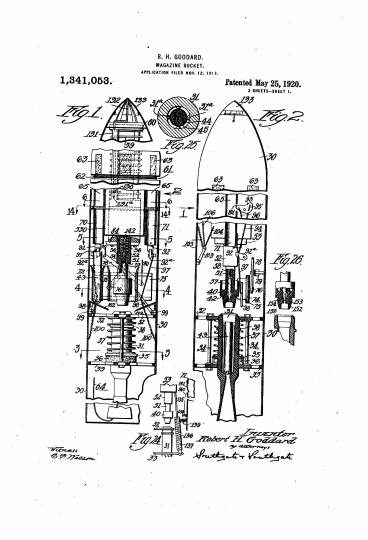
Page one of an eleven page document which rocket pioneer Robert H. Goddard created in order to receive US patent #1341053 for a "magazine rocket" in 1920. The document is one of many available in electronic format at The Space Library

  • July 30th, 1982 - Cosmonauts Anatoly Berezovoy and Valentin Lebedev made a space walk from the orbiting station Salyut 7 to disassemble and partially replace worn out equipment on the station's exterior and study opportunities for doing various jobs outside it. After they donned space suits, Lebedev left the station for the "zone" of operations, while Berezovoy remained in the open manhole to film his walk for television. They dismantled and passed into the station a micrometeorite-measuring instrument and some panels with optical and various structural materials that had been outside the station since its launch April 19th.
  • July 31st, 2008 - A team of scientists led by Robert H. Brown of the University of Arizona, Tucson, announced in the journal Nature that NASA’s ESA spacecraft had gathered evidence that Saturn’s moon Titan has at least one lake of liquid hydrocarbons. The discovery made Titan the only known celestial body, besides Earth, to have liquid on its surface. Data from previous fly-bys had shown that Titan has several features that appear to be lakes, but scientists had been unsure whether these bodies contained liquid or solid material.
  • August 1st, 1963 - The MARINER II interplanetary space probe completed its first orbit of the sun, after traveling approximately 540,000,000 mi. Launched Aug. 27th, 1962, the spacecraft passed within 21,648 mi. of Venus Dec. 14th, 1962, and provided 111 million bits of information on Venus and interplanetary space.
  • August 2nd 1991 - The scheduled launch of Atlantis on August 1st was delayed by a false alarm over a pressure valve and then by bad weather, the media reported. The launch was then rescheduled for August 2nd. The astronauts' first task after takeoff was to launch the $120Mln USD ($156.5Mln CDN) Tracking and Data Relay Satellite, which was done successfully.

The first page of a three page 1936 German patent issued to Rudolf Nebel, a spaceflight advocate active in Germany's amateur rocket group, the Verein für Raumschiffahrt (VfR – "Spaceflight Society") in the 1930s and in rebuilding German rocketry following World War II. The document one of many available online at The Space Library.

  • August 3rd, 1975 - The Philadelphia Inquirer reported  space expenditures resulted in tangible economic benefits, according to a report, "The Economic Impact of NASA R&D Spending," being prepared for NASA by Chase Econometric Associates, Inc. Using methods developed for regular national economic forecasts, Chase predicted that, if NASA's research and development budget were increased by $1Bln USD ($1.3Bln CDN) for the 1975-84 period, the US gross national product (GNP) would swell by $23Bln USD ($30Bln CDN) or 2% over the normal rate of growth. Labor productivity in the non-farm areas of the economy would rise more than 2% over the normal growth rate, and more than one million jobs would be created, reducing the unemployment rate by nearly 0.4% by 1984.
The Space Library, designed and built by the people at Burlington, Ontario based Apogee Books, is currently in beta test but even now contains 6,656 documents and over thirty thousand pages of first generation source materials from NASA and others covering almost the entirety of humanity's expansion into the high frontier.

Access to all the documents contained within the The Space Library is only $5.00 CDN a month. For more information, please click on the links below.


Your $5.00 CDN monthly subscription will help to support both the Space Library and 
the Commercial Space blog.

Friday, July 24, 2015

Space Economy Now $330Bln US Annually, Says Report

          By Glen Strom

After years of steady, respectable growth hovering around 7% per annum, the global space industry appears to be on the cusp of a new era of rapid expansion in both capabilities and customers. At least those are the conclusions embedded within The Space Report 2015: The Authoritative Guide to Global Space Activity.

The eighty five page report, prepared by the Colorado Springs, CO based Space Foundation (a nonprofit organization that advocates for the global space industry) with input from the not-for-profit European trade association Eurospace, was released earlier this month.

According to the report, in 2014, the global space economy grew slightly more than 9%, reaching a total of $330Bln USD ($430.5Bln CDN). 

Commercial space activities such as telecommunications and Earth imaging made up approximately 76% of the total. 

From 2005 - 2014, the industry as a whole demonstrated a compound annual growth rate (CAGR) of 7%, nearly doubling in size over the course of the decade.

One of the more interesting items in the annual Space Report is the ability to compare the budgets of the national space agencies. For example, according to this chart, on page 22 of the 2015 Space Report, the Canadian Space Agency (CSA) funding grew by 11.8% between 2013 and 2014 which compares quite well with other space agencies and puts the CSA in fourth place behind the United Kingdom (with a 31.4% budget increase during that same period), South Korea (a 29.9% increase) and Japan (an 18.8% increase). But a second chart on page 26 of the report indicated that CSA funding for 2015 will be expected to drop back to  $410.3Mln CDN in 2015 and $360.3Mln CDN in 2016. The source for the second chart is the Canadian Space Agency 2014-15 Report on Plans and Priorities. Graphic c/o Space Foundation.

The report noted that the global space industry was attracting new customers just learning to make use of space assets like satellite imagery to enhance their businesses. Some of these industries provide communication and lifestyle products and services that a rapidly growing number of people use in their day-to-day lives.

The report even went into detail concerning the benefits of using space assets to deliver products and services to government organizations, private commercial companies, industry, law enforcement and public education organizations. Given that the report was compiled by two space advocacy organizations, this seems like a perfectly reasonable addendum to the main report.

The international space industry is a $330Bln per annum behemoth which receives slightly less than one quarter of its revenue from national governments through agencies like the CSA, the European Space Agency (ESA), NASA and the National Oceanic and Atmospheric Administration (NOAA). Source Space Foundation.

Other highlights of the report include:
  • Satellite launches during 2014 increased 38% over 2013, with cube satellites accounting for a large part of the increase. The sector lost 13.6% of its value, though, due to the reduction of high-value military launches.
  • Almost 80% of satellites launched were placed in low Earth orbit (LEO).
  • Ground stations and equipment made up 94% of the commercial infrastructure and support sector within the space industry.
  • Broadcasting is a major part of the growth of the space industry with direct-to-home television accounting for US$95Bln USD ($124Bln CDN), or 77% of the market’s estimated revenues in 2014.
  • In the United States, the space industry workforce continued to shrink by about 6,000 people. It also grew older, with the average age at about 46 years old.
  • Although NASA is shrinking, Europe's space workforce has grown by 7,600 employees since 2005. The growth in Europe is not spread evenly, though. France, Germany and Spain saw growth—the other countries saw a decrease
  • Support industries like insurance, data analysis and basic research and development activities are joining more traditional areas such as launch vehicles and satellite design, manufacturing and testing as significant generators of revenue and new jobs. 
Glen Strom.
Although the data is skewed toward the United States, The Space Report 2015: The Authoritative Guide to Global Space Activity offers a good overview of the world’s growing space economy.

The report, and the additional data available by subscription, can be a useful addition to an organization’s short and long-term planning.
_____________________________________________________
Glen Strom is a freelance writer and editor with a background in business and technical writing. He's also the editor of The Gazette Weekly, the newsletter of the Canadian Space Society.

Thursday, July 23, 2015

Part 2 of The Empire Strikes Out - Canada's Defence & The Commonwealth Space Program

Cancelling the Arrow; A Government Not Interested in Space; Sounding Rockets, 

the Black Brant & Velvet Glove


January 1959 CAS submission to Prime Minister Diefenbaker.
By Robert Godwin
The general confusion during the late 1950s about the merits of missile defence led to several questionable strategic decisions made by the Governments of Canada and the United Kingdom. 
The possibility of a third contestant in the Space Race, in the form of a Commonwealth space program hinged on the sharing of technology and financing amongst the various invested nations, but more significantly on the political choices made regarding the future defensive postures of Canada, the United States and the United Kingdom.
On January 12th 1959 Phil Lapp and the members-in-council of the Canadian Astronautical Society (CAS) sent a brief to Canadian Prime Minister John Diefenbaker urging him to support Canada’s involvement in a Commonwealth Space Program. In part the brief said, "Canadian participation in the program would be of great value toward sponsoring and maintaining in this country a nucleus of scientists and engineers proficient in the vital space research frontier, and at the same time permit this country to take its rightful place in the astronautical field."

The brief then went on to urge the government of Canada to send up to four scientists to London to attend the already-planned Commonwealth space summit. The response from Diefenbaker was swift and essentially said that he was deferring to his Defence Minister; Victoria Cross winner, General George Pearkes. On February 6th Pearkes replied that the government was not in a position to be sending either participants or observers from the CAS or from any other organisation to either the symposium or the IAC in London.[1]

Surprisingly the Defence Minister showed no interest in sending anyone to learn the latest information about missiles, which was, of course, what everyone would be discussing at IAC. This was all the more remarkable considering what happened two weeks later. On February 20th the Government of Canada withdrew their support for the CF-105 Avro Arrow fighter interceptor program, in favour of missiles; specifically the Boeing Bomarc-B medium range surface-to-air nuclear missile.


A Government Not Interested in Space

The day before replying to the CAS Pearkes had been in a secret cabinet meeting at which his own Chief of Air Staff had told him that in his opinion, regardless of the geopolitical state at that moment, Canada would still need 100 to 115 top-notch interceptors with which to defend itself.[2] But at the exact moment when Pearkes was discarding his fighters and committing Canada to missiles he seems to have chosen to disregard the potential importance of missiles for space research...


To Continue Reading Part 2 of 
"The Empire Strikes Out - Canada's Defence & The Commonwealth Space Program"


Your $5.00 CDN monthly subscription will help to support both the Space Library and 
the Commercial Space blog.
_________________________________________________________________________________

Robert Godwin.
Robert Godwin is the owner and founder of Apogee Space Books. He is also the Space Curator at the Canadian Air & Space Museum

He has written or edited over 100 books including the award winning series "The NASA Mission Reports" and appeared on dozens of radio and television programs in Canada, the USA and England as an expert not only on space exploration but also on music. 

His books have been discussed on CNN, the CBC, the BBC and CBS 60 Minutes. He produced the first ever virtual reality panoramas of the Apollo lunar surface photography and the first multi-camera angle movie of the Apollo 11 moonwalk. His latest book was written with the late Frederick I Ordway III and is called "2001 The Heritage and Legacy of the Space Odyssey" about the history of spaceflight at the movies.

Footnotes

1. Proceedings of the CAS Vol 1 No 1 Feb 1959
2. Minutes of Cabinet Defence Committee Feb 5th 1959

Last Week: "The Beginning; How to Build a Space Program & the Canadian Astronautical Society," in part one of "The Empire Strikes Out - Canada's Defence & The Commonwealth Space Program."

Next Week: "A 50th Anniversary; Rocket Interceptors; Buy American & Blue Streak," as part three of "The Empire Strikes Out - Canada's Defence & The Commonwealth Space Program" continues!

Support our Patreon Page