By Chuck Black
 It's almost summer, a time when even the hardest working among us carves out a little time to connect with family members, recharge our batteries and get a little sun.
With that in mind, here is the latest and greatest of the power-point presentations, books and websites focused around space exploration, politics, science and technology.
Enjoy...
_______________________________________
 2001: The Heritage and Legacy of the Space Odyssey by Frederick I Ordway III and Robert Godwin - Despite over 30 years of advances in space flight and movie-making, it is still 2001: A Space Odyssey which most fans, film makers and critics use as the yardstick against which all other space films are measured. Take a trip through more than eleven decades of space films to learn just how far this movie pushed the state of the art and how it continues to affect motion pictures today.
 2001: The Lost Science and 2001: The Lost Science Volume 2 by Adam Johnson - 2001: A Space Odyssey is an almost flawless scientific façade constructed by Kubrick, Clarke, Ordway, Lange and the hundreds of engineers and scientists who contributed to the production. Author and engineer Adam Johnson has spent years accumulating information, once believed to have been long since destroyed, to create a detailed and unprecedented analysis of the technology envisioned in Kubrick’s masterpiece.
 50 Years of European Co-operation in Space: A presentation to the 57th session of the Committee on the Peaceful Uses of Outer Space (13 June 2014) - Not many know that the collaborative European space effort was officially born 50 years ago, when two leading scientific statesmen, Pierre Auger of France and Edoardo Amaldi of Italy, made the first steps towards establishing a significant European presence in space. This presentation provides context for their first meetings and shows how they helped create the current European Space Agency (ESA).
 Aerospace Marketing Management - Whether you want to build rockets, planes or something else, you'll need to know how to fund, promote and market your project. This book provides an overall picture of both B2B and B2C marketing strategies, concepts and tools used throughout the aeronautics sector. It includes useful discussions of trends such as social marketing, customer orientation strategies, project marketing, concurrent engineering strategies, the tactics of "coopetition" or co-operative competition within organizations and many other useful methodologies. A ready reference for professionals and graduates from both engineering and business schools interested in aerospace and "spaaace!"
 Aerospace Projects Review - The classic "journal of unbuilt aircraft and spacecraft projects" including detailed schematics for aircraft and spacecraft designs such as Saturn V S-IC derived flyback boosters, the Helios nuclear-pulse propulsion program, the incredible Project Orion interplanetary battleship along with various predecessors of the X-20 Dyna Soar, the Space Shuttle, the International Space Station (ISS) and many others.
 After Apollo: Richard Nixon and the American Space Program by John M. Logsdon - After the success of the Apollo 11 mission the question became, 'What do you do next, after landing on the Moon?' It fell to President Richard M. Nixon to answer this question. The book chronicles his successes and failures in this area and suggests reasons why people are still asking this question, over forty years later.
 America's Space Futures: Defining Goals for Space Exploration by Eric R. Sterner - Focused on "the ongoing debate about space policy, the American space program and the human destiny in space." With a plethora of knowledgeable contributors including James Vedda, a senior policy analyst at the Center for Space Policy & Strategy, Scott Pace, a professor of international affairs at the George Washington University and many others, there's no better place to learn why the American space program is adrift, uncertain about the future and unclear about the purpose it serves.
 The Atomic Rockets of the Space Patrol website - Inspired by Robert Heinlein, Arthur C. Clarke and Jerry Pournelle and designed to provide everything you need to know about designing and building spaceships. The site is especially useful for its discussions on engines, realistic spacecraft designs and a standalone section on "Rocketpunk and MacGuffinite."

 Canada in Space by Chris Gainor - A short history of Canada's contributions to space research and discovery including the development of the Canadarm and Canadarm2, the Alouette I ionospheric research satellite, the Canadians who engineered key components for NASA's Mercury, Gemini, Apollo and shuttle programs the birth of Canada's commercial satellite industry and much much more.

 Creating A Robust Canadian Space Research Exploration & Development Industry - The Canadian Mineral Industry Flow-Though Share Analog by John Chapman, Nadeem Ghafoor, Christian Sallaburger and Frank Teti - A paper originally presented at the 2008 Canadian Space Summit, which suggested that private capital would flow into the space industry if the government gave the space industry the same tax breaks as the mining industry. Became the basis for the second of three Canadian Space Commerce Association (CSCA) submissions to the 2012 Canadian Aerospace review under the title "Using Tools from the Mining Industry to Spur Innovation and Grow the Canadian Space Industry."
 Defence and Discovery: Canada's Military Space Program, 1945-74 by Andrew B. Godefroy - A comprehensive examination of the origins, development, and impact of Canada's space program. Drawing on declassified archival sources and a wealth of secondary material, Canada's early space research is put into context along with the central role of military enterprise in these early endeavours. The technological, political, and strategic implications of the country's early innovation in space-research technology are also discussed, as is the country's subsequent turn from this arena.
Encyclopedia Astronautica - A comprehensive catalog of vehicles, technology, astronauts and information from most countries that have had an active rocket research program, maintained by space enthusiast and author Mark Wade. Part of the Space Daily network.
 Friends of the CRC – An association of alumni of the Communications Research Centre (CRC), the government department responsible for most of Canada’s early satellite launches. The site provides multiple articles on early Canadian efforts by some of the people who were actually there. Authors include Bert Blevis ("The Pursuit of Equality: The Role of the Ionosphere and Satellite Communications in Canadian Development" and "The Implications of Satellite Technology for Television Broadcasting in Canada" with M.L. Card), Gerald Poaps ("Gerald Poaps' Scrapbook") and others.
 Archived presentations from the Future In-Space Operations (FISO) Working Group - These are archived and peer reviewed studies (some with audio visual and power-points) for a variety of NASA approved concepts related to future in-space operations and activities.
 The Handbook on Measuring the Space Economy - From the Organisation for Economic Co-operation and Development (OECD), which grew out of the post WW2, US-financed Marshall Plan to provide "a forum in which governments can work together to share experiences and seek solutions to common problems." The publication provides a summary of the key methodological issues surrounding indicators and statistics on the space sector and the larger space economy and is meant to be complementary to another publication, the Space Economy at a Glance 2011. Both publications, along with many others including the more recent Space Economy at a Glance 2014, are available from the OECD website.
 The High Frontier by Gerard K. O'Neill and Freeman Dyson - A classic work on the practicality and economics of the human colonization of space. But for all its worth, when the first edition was published back in the mid 1970s, the author likely assumed that some of us would be living in orbit by now. Maybe one day that will change.
 Historical Analogs for the Stimulation of Space Commerce - A book examining how to apply six models of government support for commercial space activities and how the lessons learned from them could apply to developing the commercial space industry. Part of the NASA History Series of publications.
 The Online Journal of Space Communication - Since 2001, this scholarly publication has bridged the world of the professional and the world of the academic, two worlds in desperate need of bridging. The publication examines a broad range of issues and events in space and satellite communication, including their historical, technological, economic, policy, cultural and social dimensions.
 The Orbital Express Project of Bristol Aerospace and Microsat Launch Systems by Geoffrey V. Hughes - An important case study for those wishing to study the technology and business development issues surrounding a small satellite launch vehicle.


 Space Chronicles: Facing the Ultimate Frontier by Neil deGrasse Tyson - One of our foremost thinkers on all things space, illuminates the past, present, and future of exploration and reminds us why NASA matters now as much as ever.
 The compilation of Space Law Documents for 2013 - Edited by P.J. Blount, an adjunct professor in air and space law at the University of Mississippi School of Law, who also edited the Res Communis Blog (which ran from 2007 until 2014), this three volume set covers state (volume one), federal (volume two) and international (volume three) documents of interest in this area. Now if only someone will bring this the documents up to date.

The Space Review - An online publication devoted to in-depth articles, commentary, and reviews regarding all aspects of space exploration: science, technology, policy, business, and more. Edited by Jeff Foust, an aerospace analyst who wrote the Space Politics blog from 2004 - 2014.
 The Ultimate Guide to 3D Printing and Space Exploration - An online guide to the techniques and terminologies surrounding 3D printing, selective laser sintering and how these techniques and technologies are expected to change the manufacturing, aerospace and space industries over the next few years. Part of the DIY Space Exploration website.
 Upper Atmosphere and Space Programs in Canada by J.H. Chapman, P.A. Forsyth, P.A. Lapp and G.N. Patterson – Canada is today an international leader in the fields of communications and remote sensing because of John Chapman (1921-1979) who was senior author of this report, written in 1967 and now known simply as the “Chapman Report.” It recommended using Canadian satellite and space technology for commercial activities such as communications and resource management instead of focusing only on scientific research. Over time, the report became “Canada’s Original Blueprint” for space activities and still contains lessons for policymakers today.
 Vision Restoration - A fascinating time capsule on NASA, ESA and America's past and future in space focused around the February 2004 NASA Vision for Space Exploration but full of lessons related to the current Space Launch System (SLS) debate and large, government funded space programs in general. Active from 2009 - 2014.
 Who Owns the Moon?: Extraterrestrial Aspects of Land and Mineral Resources Ownership by Virgiliu Pop - An investigation into the viability of property rights on the celestial bodies, particularly the extraterrestrial aspects of land and mineral resources ownership. In lay terms, it aims to find an answer to the question “Who owns the Moon?”
 Why Where Matters: Understanding and Profiting from GPS, GIS and Remote Sensing by Bob Ryerson and Stan Aronof - A useful, highly readable primer on the business applications surrounding geomatics, the study of geographic and/or spatially referenced images which are used by various industries for planning and resource management.
A comprehensive listing of Worldwide Launch Schedules from Spaceflight Now - A regularly updated listing of planned missions and rocket launches around the globe. Dates and times are given in Greenwich Mean Time.
___________________________________________________________
Chuck Black is the editor of the Commercial Space blog.

With that in mind, here is the latest and greatest of the power-point presentations, books and websites focused around space exploration, politics, science and technology.
Enjoy...
_______________________________________
2001: The Heritage and Legacy of the Space Odyssey by Frederick I Ordway III and Robert Godwin - Despite over 30 years of advances in space flight and movie-making, it is still 2001: A Space Odyssey which most fans, film makers and critics use as the yardstick against which all other space films are measured. Take a trip through more than eleven decades of space films to learn just how far this movie pushed the state of the art and how it continues to affect motion pictures today.2001: The Lost Science and 2001: The Lost Science Volume 2 by Adam Johnson - 2001: A Space Odyssey is an almost flawless scientific façade constructed by Kubrick, Clarke, Ordway, Lange and the hundreds of engineers and scientists who contributed to the production. Author and engineer Adam Johnson has spent years accumulating information, once believed to have been long since destroyed, to create a detailed and unprecedented analysis of the technology envisioned in Kubrick’s masterpiece.50 Years of European Co-operation in Space: A presentation to the 57th session of the Committee on the Peaceful Uses of Outer Space (13 June 2014) - Not many know that the collaborative European space effort was officially born 50 years ago, when two leading scientific statesmen, Pierre Auger of France and Edoardo Amaldi of Italy, made the first steps towards establishing a significant European presence in space. This presentation provides context for their first meetings and shows how they helped create the current European Space Agency (ESA).Aerospace Marketing Management - Whether you want to build rockets, planes or something else, you'll need to know how to fund, promote and market your project. This book provides an overall picture of both B2B and B2C marketing strategies, concepts and tools used throughout the aeronautics sector. It includes useful discussions of trends such as social marketing, customer orientation strategies, project marketing, concurrent engineering strategies, the tactics of "coopetition" or co-operative competition within organizations and many other useful methodologies. A ready reference for professionals and graduates from both engineering and business schools interested in aerospace and "spaaace!"Aerospace Projects Review - The classic "journal of unbuilt aircraft and spacecraft projects" including detailed schematics for aircraft and spacecraft designs such as Saturn V S-IC derived flyback boosters, the Helios nuclear-pulse propulsion program, the incredible Project Orion interplanetary battleship along with various predecessors of the X-20 Dyna Soar, the Space Shuttle, the International Space Station (ISS) and many others.After Apollo: Richard Nixon and the American Space Program by John M. Logsdon - After the success of the Apollo 11 mission the question became, 'What do you do next, after landing on the Moon?' It fell to President Richard M. Nixon to answer this question. The book chronicles his successes and failures in this area and suggests reasons why people are still asking this question, over forty years later.America's Space Futures: Defining Goals for Space Exploration by Eric R. Sterner - Focused on "the ongoing debate about space policy, the American space program and the human destiny in space." With a plethora of knowledgeable contributors including James Vedda, a senior policy analyst at the Center for Space Policy & Strategy, Scott Pace, a professor of international affairs at the George Washington University and many others, there's no better place to learn why the American space program is adrift, uncertain about the future and unclear about the purpose it serves.
The Archimedes Institute - An international not-for-profit organization focused on issues of private property claims in space, which was active from 1997 to the early 2000's, a period during which many early legal claims in this area began to flow through the court system. The site was organized and maintained by Professor Lawrence D. Roberts, a legal academic specializing in science and technology policy, and David Kantymir.
 Arms and the Man; Dr. Gerald Bull, Iraq, and the Supergun by William Lowther - A short history of flawed Canadian genius Dr. Gerald Bull, a passionate and driven ballistics visionary responsible for the design of many of the worlds deadliest artillery cannons, who initially hoped to build "superguns" able to send small satellites into space, but ended up attempting to fund his dream by dancing with the devil through the political machinations of the middle east.
 Arrows to the Moon; Avro's Engineers and the Space Race by Chris Gainor - While most know about the German rocket engineers led by Wernher von Braun, who helped put Apollo astronauts on the Moon, very few have heard about the Canadian engineers like Jim Chamberlin, John Hodge, Owen Maynard and others who top NASA officials called a "godsend" to the US space program in its early years. This is their story.
 Arthur C. Clarke: A Life Remembered by Fred Clarke - Written by his brother, this book provides a rare insight into Arthur's early life, and into the people he met and influenced during his own personal odyssey. The book also includes a unique collection of photographs from the Clarke family, some of which have never been published before.
Arms and the Man; Dr. Gerald Bull, Iraq, and the Supergun by William Lowther - A short history of flawed Canadian genius Dr. Gerald Bull, a passionate and driven ballistics visionary responsible for the design of many of the worlds deadliest artillery cannons, who initially hoped to build "superguns" able to send small satellites into space, but ended up attempting to fund his dream by dancing with the devil through the political machinations of the middle east.Arrows to the Moon; Avro's Engineers and the Space Race by Chris Gainor - While most know about the German rocket engineers led by Wernher von Braun, who helped put Apollo astronauts on the Moon, very few have heard about the Canadian engineers like Jim Chamberlin, John Hodge, Owen Maynard and others who top NASA officials called a "godsend" to the US space program in its early years. This is their story.Arthur C. Clarke: A Life Remembered by Fred Clarke - Written by his brother, this book provides a rare insight into Arthur's early life, and into the people he met and influenced during his own personal odyssey. The book also includes a unique collection of photographs from the Clarke family, some of which have never been published before.The Atomic Rockets of the Space Patrol website - Inspired by Robert Heinlein, Arthur C. Clarke and Jerry Pournelle and designed to provide everything you need to know about designing and building spaceships. The site is especially useful for its discussions on engines, realistic spacecraft designs and a standalone section on "Rocketpunk and MacGuffinite."
Becoming Spacefarers: Rescuing America's Space Program by James A. Vedda - All you ever wanted to know about the US space program with extra political intrigue, spicy historical analogies and ideas that challenge conventional wisdom added for seasoning. Written for those who know that what we should be doing next in space is heavily dependent on what we've been doing up until now.
Canada in Space by Chris Gainor - A short history of Canada's contributions to space research and discovery including the development of the Canadarm and Canadarm2, the Alouette I ionospheric research satellite, the Canadians who engineered key components for NASA's Mercury, Gemini, Apollo and shuttle programs the birth of Canada's commercial satellite industry and much much more.
Canada’s 50 Years in Space: The COSPAR Anniversary by Gordon Shepherd and Agnes Kruchio – Provides a thorough description of the parallel growth of the Canadian space science program and the international activities of the Paris based Committee on Space Research (COSPAR) from 1958 up until the 50th Anniversary of COSPAR in 2008. For those who think we need to know more about our history and plan on not making the same mistakes.
The Canadian Science Writers Association - A national alliance of professional science communicators who "cultivate excellence in science writing and science journalism" in an effort to increase public awareness of science in Canadian culture.
Canadian Space Directory – The Canadian Space Agency’s (CSA) listing of Canadian private and public organizations who have been and/or are engaged in space related activities.
 Canadian Spacewalkers: Hadfield, MacLean and Williams Remember the Ultimate High Adventure by Bob MacDonald - What's it really like to step into that abyss; to leap out into space with only the thin fabric of your suit between you and the universe? Find out in this compilation of perspectives from three Canadian spacewalkers starting from the beginning of their training right through to the moment when they opened the hatch and stepped outside into the cold blackness of space. The book is lavishly illustrated with stunning NASA photos.
 The Case for Space Solar Power by John Mankins - A must-read primer on the topic of space based solar power providing context and history on the topic with outlines of proposed concepts, objectives and hurdles still to be overcome plus an explanation of possible future development timelines all presented in an organized and easy-to-digest manner.
The Centre for Spatial Law and Policy - This Virginia based think tank does focus on the legal and policy issues associated with geo-spatial data and technology, which is of some use to the Canadians who are currently ranked as leaders within this growing field.
 Cold War Tech War; The Politics of America's Air Defense by Randall Whitcomb - Explores the geo-political, technical and economic aspects of the Avro Canada story by revealing, for the first time anywhere, several exciting design proposals of the Avro company while putting the company and its technology into an international context. Global intelligence angles are explored from pre-WW II through the Cold War period. Focus is on bi-lateral issues with the Americans, with some pertinent American statesmen and industrialists receiving special attention for their roles.
The Canadian Science Writers Association - A national alliance of professional science communicators who "cultivate excellence in science writing and science journalism" in an effort to increase public awareness of science in Canadian culture.
Canadian Space Directory – The Canadian Space Agency’s (CSA) listing of Canadian private and public organizations who have been and/or are engaged in space related activities.
Canadian Spacewalkers: Hadfield, MacLean and Williams Remember the Ultimate High Adventure by Bob MacDonald - What's it really like to step into that abyss; to leap out into space with only the thin fabric of your suit between you and the universe? Find out in this compilation of perspectives from three Canadian spacewalkers starting from the beginning of their training right through to the moment when they opened the hatch and stepped outside into the cold blackness of space. The book is lavishly illustrated with stunning NASA photos.The Case for Space Solar Power by John Mankins - A must-read primer on the topic of space based solar power providing context and history on the topic with outlines of proposed concepts, objectives and hurdles still to be overcome plus an explanation of possible future development timelines all presented in an organized and easy-to-digest manner.The Centre for Spatial Law and Policy - This Virginia based think tank does focus on the legal and policy issues associated with geo-spatial data and technology, which is of some use to the Canadians who are currently ranked as leaders within this growing field.
Cold War Tech War; The Politics of America's Air Defense by Randall Whitcomb - Explores the geo-political, technical and economic aspects of the Avro Canada story by revealing, for the first time anywhere, several exciting design proposals of the Avro company while putting the company and its technology into an international context. Global intelligence angles are explored from pre-WW II through the Cold War period. Focus is on bi-lateral issues with the Americans, with some pertinent American statesmen and industrialists receiving special attention for their roles.Creating A Robust Canadian Space Research Exploration & Development Industry - The Canadian Mineral Industry Flow-Though Share Analog by John Chapman, Nadeem Ghafoor, Christian Sallaburger and Frank Teti - A paper originally presented at the 2008 Canadian Space Summit, which suggested that private capital would flow into the space industry if the government gave the space industry the same tax breaks as the mining industry. Became the basis for the second of three Canadian Space Commerce Association (CSCA) submissions to the 2012 Canadian Aerospace review under the title "Using Tools from the Mining Industry to Spur Innovation and Grow the Canadian Space Industry."Defence and Discovery: Canada's Military Space Program, 1945-74 by Andrew B. Godefroy - A comprehensive examination of the origins, development, and impact of Canada's space program. Drawing on declassified archival sources and a wealth of secondary material, Canada's early space research is put into context along with the central role of military enterprise in these early endeavours. The technological, political, and strategic implications of the country's early innovation in space-research technology are also discussed, as is the country's subsequent turn from this arena.Encyclopedia Astronautica - A comprehensive catalog of vehicles, technology, astronauts and information from most countries that have had an active rocket research program, maintained by space enthusiast and author Mark Wade. Part of the Space Daily network.
Friends of the CRC – An association of alumni of the Communications Research Centre (CRC), the government department responsible for most of Canada’s early satellite launches. The site provides multiple articles on early Canadian efforts by some of the people who were actually there. Authors include Bert Blevis ("The Pursuit of Equality: The Role of the Ionosphere and Satellite Communications in Canadian Development" and "The Implications of Satellite Technology for Television Broadcasting in Canada" with M.L. Card), Gerald Poaps ("Gerald Poaps' Scrapbook") and others. The Handbook on Measuring the Space Economy - From the Organisation for Economic Co-operation and Development (OECD), which grew out of the post WW2, US-financed Marshall Plan to provide "a forum in which governments can work together to share experiences and seek solutions to common problems." The publication provides a summary of the key methodological issues surrounding indicators and statistics on the space sector and the larger space economy and is meant to be complementary to another publication, the Space Economy at a Glance 2011. Both publications, along with many others including the more recent Space Economy at a Glance 2014, are available from the OECD website.The High Frontier by Gerard K. O'Neill and Freeman Dyson - A classic work on the practicality and economics of the human colonization of space. But for all its worth, when the first edition was published back in the mid 1970s, the author likely assumed that some of us would be living in orbit by now. Maybe one day that will change.Historical Analogs for the Stimulation of Space Commerce - A book examining how to apply six models of government support for commercial space activities and how the lessons learned from them could apply to developing the commercial space industry. Part of the NASA History Series of publications.
Historical Investment Financing of Exploration for New Worlds, Current Analogies to Other Industries, and Ideas for the Future by Eva Jane Lark - Essential reading for understanding how exploration has always been financed, written by a Canadian banking executive.
 Several presentations on space mining including the Importance of Mineral Exploration and Mining to Humans in their Space Development Activities by John A. Chapman (presented to the BC Geophysical Society in February 2013); A Lunar Geosciences Database – The Earth’s Map Place Analog by Gerald G. Carlson, John A. Chapman and Ward E. Kilby (presented at the 2007 European Geosciences Union General Assembly); and Development and Operation of a Surface Mine in a Remote Location - South Polar Region of the Moon by John A. Chapman and Marc Schulte (presented at the 8th International Lunar Exploration Working Group (ILEWG) Conference on Exploration and Utilization of the Moon in July 2006).
 ISRU Info: The Home of the Space Resources Roundtable - A non-profit corporation promoting the development of space resources. Recent meetings have been held in conjunction with the Planetary & Terrestrial Mining Sciences Symposium (PTMSS).
 Inside 3D Printing (3DP) - Background information and stories on the techniques and methodologies used in the growing additive manufacturing revolution, and how those new techniques will revolutionize the space industry. Recent stories include the April 27th, 2015 article, "3D Printing Will Revolutionize Space Travel," and the April 21st, 2015 article, "3D Printing On The Moon and Beyond."
 Janes Space Systems and Industry 2015/2016 - A pricey but comprehensive listing of the thousands of commercial and military space systems in service and under development around the world. Designed to provide aerospace and defence businesses with "critical independent technical and market intelligence" to support effective business and products development and provide military and security organizations with the intelligence they need to support critical analysis, planning and procurement activities.

Several presentations on space mining including the Importance of Mineral Exploration and Mining to Humans in their Space Development Activities by John A. Chapman (presented to the BC Geophysical Society in February 2013); A Lunar Geosciences Database – The Earth’s Map Place Analog by Gerald G. Carlson, John A. Chapman and Ward E. Kilby (presented at the 2007 European Geosciences Union General Assembly); and Development and Operation of a Surface Mine in a Remote Location - South Polar Region of the Moon by John A. Chapman and Marc Schulte (presented at the 8th International Lunar Exploration Working Group (ILEWG) Conference on Exploration and Utilization of the Moon in July 2006).Janes Space Systems and Industry 2015/2016 - A pricey but comprehensive listing of the thousands of commercial and military space systems in service and under development around the world. Designed to provide aerospace and defence businesses with "critical independent technical and market intelligence" to support effective business and products development and provide military and security organizations with the intelligence they need to support critical analysis, planning and procurement activities.
LEO on the Cheap by Lt. Col. John R. London III - A fascinating read on methods to achieve drastic reductions in launch costs. It serves as a useful companion piece to the 1993 John Walker article "a Rocket a Day Keeps the High Costs Away."

A Man on the Moon: The Voyages of the Apollo Astronauts by Andrew Chaikin - In-depth interviews with twenty-three of the twenty-four moon voyageurs, as well as those who struggled to get the program moving. The book conveys every aspect of the Apollo missions with breathtaking immediacy and stunning detail. Includes an introduction by Tom Hanks, an actor who has played an astronaut in movies and is therefore assumed to know what he's talking about.
 Marketing the Moon: The Selling of the Apollo Lunar Program by David Meerman Scott and Richard Jurek - Why did a government program whose standard operating procedure had always been secrecy turn its greatest achievement into a communal "brand experience" with top media ratings and high public approval? Read this book and find out.
The Microsat Way in Canada by Peter Stibrany and Kieran A. Carroll - A formative paper written by two of the people involved in the design and development of the Microvariability and Oscillations of STars (MOST) space telescope, discussing how micro-satellite manufacturing methodologies will change the economics of space applications and reduce the barriers to entry for new companies. These discussions eventually became the basis for the methodologies in use today at the University of Toronto Institute for Aerospace Studies (UTIAS) Space Flight Laboratory (SFL).
NASA E-books - A fascinating list of NASA books, podcasts, galleries' apps, ringtones and information relating to the US space program.
Marketing the Moon: The Selling of the Apollo Lunar Program by David Meerman Scott and Richard Jurek - Why did a government program whose standard operating procedure had always been secrecy turn its greatest achievement into a communal "brand experience" with top media ratings and high public approval? Read this book and find out.The Microsat Way in Canada by Peter Stibrany and Kieran A. Carroll - A formative paper written by two of the people involved in the design and development of the Microvariability and Oscillations of STars (MOST) space telescope, discussing how micro-satellite manufacturing methodologies will change the economics of space applications and reduce the barriers to entry for new companies. These discussions eventually became the basis for the methodologies in use today at the University of Toronto Institute for Aerospace Studies (UTIAS) Space Flight Laboratory (SFL).
NASA E-books - A fascinating list of NASA books, podcasts, galleries' apps, ringtones and information relating to the US space program.
The Orbital Express Project of Bristol Aerospace and Microsat Launch Systems by Geoffrey V. Hughes - An important case study for those wishing to study the technology and business development issues surrounding a small satellite launch vehicle.
The Plundering of NASA: An Expose by Rickey D Boozer - An interesting expose which attempts to lift the veil of Congressional politics which force NASA to do the bidding of regional interests that cripple the nation’s capabilities in both exploring outer space and exploiting its enormous economic potential.
 Proceedings of the 48th History Symposium of the International Academy of Astronautics (IAA) edited by Marsha Freedmann - Volume 46 of the American Astronomical Society (AAS) series on the History of Rocketry and Astronautics. Includes a DVD supplement containing a 2014 interview with long-time International Academy of Astronautics (IAA) member Prof. Iván Almár and the paper, "One Hundred Years of Aerospace History in Canada: From McCurdy to Hadfield," by Robert Godwin, Phil Lapp and Chuck Black, which was serialized on the Commercial Space blog, beginning with the February 7th, 2015 post, "Verne, The Fur Country, G.Y. Kaufman, Baldwin, McCurdy & Balfour Currie."
 Proceedings of the Princeton Conferences on Space Manufacturing - Abstracts from thirteen conferences from 1975 until 2001, which focused on the challenges and opportunities of space based manufacturing. The original events were organized in cooperation with the Space Studies Institute, a not-for-profit organization which grew out of the interest generated by Gerard K. O’Neill’s vision of human colonies in space.
 Quest, The History of Space Flight Quarterly - A combination of learned journal and mass market publication which captures stories related to the people, projects, and programs that have been part of the last fifty years of civil, military, commercial, and international space activities.
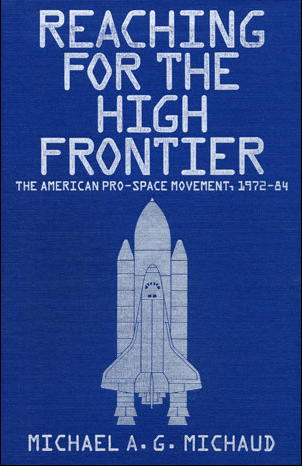 Reaching for the High Frontier: The American Pro-Space Movement, 1972-1984 by Michael A. G. Michaud - Exceptional reading for background on the various space advocacy groups which grew out of the 1972–1984 period of stagnant space activities. The book provides many useful lessons on advocacy and a PDF is available online at no charge.
 Russia in Space: The Past Explained. The Future Explored by Anatoly Zak - This comprehensive history of the Russian space program is a unique attempt to visualize the future of astronautics through the eyes of Russian space engineers and describe the processes which went into a nation's planning in space over the past several decades. A large format, full colour and well illustrated book bolstered by almost 700 footnotes.
 Safe is Not an Option: Overcoming the Futile Obsession with Getting Everyone Back Alive that is Killing our Expansion into Space by Rand Simberg - Since the end of Apollo, US space operations have ostensibly emphasized safety first. Simberg argues that this has been a mistake, and we must change if we are to continue to "boldly go" back to the Moon and Mars. Simberg makes a cogent argument that our focus on safety doesn't really increase safety but instead acts as a "barrier to entry" for new companies and protects the profits of large, politically connected "dyno-space" companies.
 Sex and Rockets by John Carter (author) with an introduction by Robert Anton Wilson - For those of us who think rocket science is boring, here's the incredible but true story of scientist, poet, and self-proclaimed anti-christ, Jack Parsons, who co-founded the NASA Jet Propulsion Laboratory (JPL), led the Agape Lodge of Aleister Crowley's Ordo Templi Orientis (OTO) and even bore more than a passing resemblance to Iron Man's father. Scary, scary stuff...
Proceedings of the 48th History Symposium of the International Academy of Astronautics (IAA) edited by Marsha Freedmann - Volume 46 of the American Astronomical Society (AAS) series on the History of Rocketry and Astronautics. Includes a DVD supplement containing a 2014 interview with long-time International Academy of Astronautics (IAA) member Prof. Iván Almár and the paper, "One Hundred Years of Aerospace History in Canada: From McCurdy to Hadfield," by Robert Godwin, Phil Lapp and Chuck Black, which was serialized on the Commercial Space blog, beginning with the February 7th, 2015 post, "Verne, The Fur Country, G.Y. Kaufman, Baldwin, McCurdy & Balfour Currie."Proceedings of the Princeton Conferences on Space Manufacturing - Abstracts from thirteen conferences from 1975 until 2001, which focused on the challenges and opportunities of space based manufacturing. The original events were organized in cooperation with the Space Studies Institute, a not-for-profit organization which grew out of the interest generated by Gerard K. O’Neill’s vision of human colonies in space.Quest, The History of Space Flight Quarterly - A combination of learned journal and mass market publication which captures stories related to the people, projects, and programs that have been part of the last fifty years of civil, military, commercial, and international space activities.Reaching for the High Frontier: The American Pro-Space Movement, 1972-1984 by Michael A. G. Michaud - Exceptional reading for background on the various space advocacy groups which grew out of the 1972–1984 period of stagnant space activities. The book provides many useful lessons on advocacy and a PDF is available online at no charge.Russia in Space: The Past Explained. The Future Explored by Anatoly Zak - This comprehensive history of the Russian space program is a unique attempt to visualize the future of astronautics through the eyes of Russian space engineers and describe the processes which went into a nation's planning in space over the past several decades. A large format, full colour and well illustrated book bolstered by almost 700 footnotes.Safe is Not an Option: Overcoming the Futile Obsession with Getting Everyone Back Alive that is Killing our Expansion into Space by Rand Simberg - Since the end of Apollo, US space operations have ostensibly emphasized safety first. Simberg argues that this has been a mistake, and we must change if we are to continue to "boldly go" back to the Moon and Mars. Simberg makes a cogent argument that our focus on safety doesn't really increase safety but instead acts as a "barrier to entry" for new companies and protects the profits of large, politically connected "dyno-space" companies.Sex and Rockets by John Carter (author) with an introduction by Robert Anton Wilson - For those of us who think rocket science is boring, here's the incredible but true story of scientist, poet, and self-proclaimed anti-christ, Jack Parsons, who co-founded the NASA Jet Propulsion Laboratory (JPL), led the Agape Lodge of Aleister Crowley's Ordo Templi Orientis (OTO) and even bore more than a passing resemblance to Iron Man's father. Scary, scary stuff...
A Short History of Private Space Development by Clark S. Lindsey- Useful historical context from the person who edits both the long-running HobbySpace blog and the NewSpace Watch commercial site.
Small Satellites and their Regulation - This short interdisciplinary book covers the legal challenges relating to small-sats including technical standards, removal techniques or other methods that might help to address current problems. Also included are discussions of regulatory issues and procedures to ameliorate problems associated with small satellites, especially mounting levels of orbital debris and noncompliance with radio frequency and national licensing requirements, liabilities and export controls.
 Soviet Space Culture: Cosmic Enthusiasm in Socialist Countries by Eva Maurer, Julia Richers, Carmen Scheide & Monica Rüthers - An interesting historical examination of the Soviet space program as a unique cultural phenomenon, which united communism and religion to the utopian and atheistic during the period from the first Sputnik launch to the mid 1970's.
 The Space Business Blog – A series of useful case studies of the economics of space based businesses, written by a Lockheed Martin financial analyst between 2010 and 2013.
 The Space Library - A repository of primary resource materials (and quite a number of Commercial Space blog posts) from retired NASA astronauts and employees, the Canadian Space Agency (CSA), the European Space Agency (ESA), the British Interplanetary Society and others. Curated by Robert Godwin, the owner of Apogee Books.
Soviet Space Culture: Cosmic Enthusiasm in Socialist Countries by Eva Maurer, Julia Richers, Carmen Scheide & Monica Rüthers - An interesting historical examination of the Soviet space program as a unique cultural phenomenon, which united communism and religion to the utopian and atheistic during the period from the first Sputnik launch to the mid 1970's.The Space Business Blog – A series of useful case studies of the economics of space based businesses, written by a Lockheed Martin financial analyst between 2010 and 2013.The Space Library - A repository of primary resource materials (and quite a number of Commercial Space blog posts) from retired NASA astronauts and employees, the Canadian Space Agency (CSA), the European Space Agency (ESA), the British Interplanetary Society and others. Curated by Robert Godwin, the owner of Apogee Books.The compilation of Space Law Documents for 2013 - Edited by P.J. Blount, an adjunct professor in air and space law at the University of Mississippi School of Law, who also edited the Res Communis Blog (which ran from 2007 until 2014), this three volume set covers state (volume one), federal (volume two) and international (volume three) documents of interest in this area. Now if only someone will bring this the documents up to date.
Space Mission Analysis and Design (SMAD) by James R Wertz and Wiley Larson - A textbook quality publication for engineering and space activities providing what you need to speak the language of space.
Space Prizes - From 2006 until 2015, this was the unofficial "publication of record" for tracking prizes related to space technology with listings, updates and status reports on 100's of international student, scientific and commercial contests. Currently inactive.
 Space Vehicle Design Second Edition by Michael D Griffin and James R French - Described as ""the best, the most comprehensive, the most up-to-date resource for today's engineering challenges in space systems design."The second edition links and integrates many disciplines relevant to the field of space systems engineering and contains an additional chapter on reliability analysis, new technical material and numerous homework problems.
 The Space Report Online – The “authoritative guide to international space activities” published by the Space Foundation, one of the world’s premier nonprofit organizations supporting space activities, education and space professionals. This online repository of data related to the worldwide space industry also contains copies of the annual 2006 - 2015 editions of the Space Report, the annual publication which serves as the basis of the current repository.
Space Prizes - From 2006 until 2015, this was the unofficial "publication of record" for tracking prizes related to space technology with listings, updates and status reports on 100's of international student, scientific and commercial contests. Currently inactive.
Space Vehicle Design Second Edition by Michael D Griffin and James R French - Described as ""the best, the most comprehensive, the most up-to-date resource for today's engineering challenges in space systems design."The second edition links and integrates many disciplines relevant to the field of space systems engineering and contains an additional chapter on reliability analysis, new technical material and numerous homework problems.The Space Report Online – The “authoritative guide to international space activities” published by the Space Foundation, one of the world’s premier nonprofit organizations supporting space activities, education and space professionals. This online repository of data related to the worldwide space industry also contains copies of the annual 2006 - 2015 editions of the Space Report, the annual publication which serves as the basis of the current repository.The Space Review - An online publication devoted to in-depth articles, commentary, and reviews regarding all aspects of space exploration: science, technology, policy, business, and more. Edited by Jeff Foust, an aerospace analyst who wrote the Space Politics blog from 2004 - 2014.
The Ultimate Guide to 3D Printing and Space Exploration - An online guide to the techniques and terminologies surrounding 3D printing, selective laser sintering and how these techniques and technologies are expected to change the manufacturing, aerospace and space industries over the next few years. Part of the DIY Space Exploration website.Upper Atmosphere and Space Programs in Canada by J.H. Chapman, P.A. Forsyth, P.A. Lapp and G.N. Patterson – Canada is today an international leader in the fields of communications and remote sensing because of John Chapman (1921-1979) who was senior author of this report, written in 1967 and now known simply as the “Chapman Report.” It recommended using Canadian satellite and space technology for commercial activities such as communications and resource management instead of focusing only on scientific research. Over time, the report became “Canada’s Original Blueprint” for space activities and still contains lessons for policymakers today.Vision Restoration - A fascinating time capsule on NASA, ESA and America's past and future in space focused around the February 2004 NASA Vision for Space Exploration but full of lessons related to the current Space Launch System (SLS) debate and large, government funded space programs in general. Active from 2009 - 2014.Who Owns the Moon?: Extraterrestrial Aspects of Land and Mineral Resources Ownership by Virgiliu Pop - An investigation into the viability of property rights on the celestial bodies, particularly the extraterrestrial aspects of land and mineral resources ownership. In lay terms, it aims to find an answer to the question “Who owns the Moon?”Why Where Matters: Understanding and Profiting from GPS, GIS and Remote Sensing by Bob Ryerson and Stan Aronof - A useful, highly readable primer on the business applications surrounding geomatics, the study of geographic and/or spatially referenced images which are used by various industries for planning and resource management.A comprehensive listing of Worldwide Launch Schedules from Spaceflight Now - A regularly updated listing of planned missions and rocket launches around the globe. Dates and times are given in Greenwich Mean Time.
 |
| Chuck Black. |
___________________________________________________________
Chuck Black is the editor of the Commercial Space blog.