Sunday, April 16, 2017

Part 5: A History of the Canadian Space Program - Policies & Lessons Learned Coping with Modest Budgets

Winding up the 1970's, The Canada Centre for Remote Sensing, Spar Aerospace, 

MacDonald Dettwiler, a Seminal 1974 "Canadian Policy for Space" & the Canadarm


By Graham Gibbs & W. M. ("Mac") Evans

This paper, first presented at the 65th International Astronautical Congress, which was held in Toronto, Ontario from September 29th - October 3rd, 2014, is a brief history of the Canadian space program, written by two of the major participants.


The 1970's, Part 3

The 1970’s also saw the  beginning of Canada’s interests in using satellites for observing the earth. During the 1960’s, NASA had launched several weather satellites, including the Television Infrared Observation Satellite (TIROS) and the NIMBUS satellites. Canadian scientists, primarily at the National Research Council (NRC) and the Meteorological Services of Canada (MSC), had participated in using these satellites on an experimental basis. In 1971, the MSC set up a Satellite Data Laboratory at its new headquarters in Downsview, Ontario. 
Canadian scientists, primarily with the Geological Survey of Canada (GSC), had become active in pursuing the possibilities of remote sensing satellites to monitor events on earth.  
In 1969 they established the Interdepartmental Committee on Resource Satellites and Remote Airborne Sensing to oversee Canada’s growing interest in this area. In 1971 the scientists were able to convince the government to establish the Canada Centre for Remote Sensing (CCRS) within the Department of Energy Mines and Resources (EMR), now Natural Resources Canada, to be the lead agency in coordinating remote sensing activities in Canada.
An agreement was concluded for a joint experimental program with NASA using the first remote sensing satellite to be launched, the Earth Resources Technology Satellite (ERTS) 1, launched in 1972 and later renamed LANDSAT 1. DOC agreed to convert the Prince Albert Radar Laboratory so it could receive data from LANDSAT 1 and let a contract to a start-up firm in Vancouver called MacDonald Dettwiler and Associates (MDA) for a quick-look facility for rapid processing of the data from the satellite. 
MDA produced a world-leading processor which allowed Canada to process the first images from LANDSAT 1 before the Americans did. MDA would go on to be the world leader in the supply of ground receiving and processing systems for remote sensing satellites.
Around 1974 NASA commenced planning for a satellite (called SEASAT) that would carry a radar instrument to provide images of the earth, by day, or by night and through clouds (the LANDSAT satellite carried an optical instrument that could only take images in sunlight and on cloudless days). This was of great interest to CCRS and an agreement was signed with NASA that allowed Canada to receive SEASAT data upon its launch in 1978. 
An advanced digital processor built by MDA under contract from CCRS allowed Canada to produce the world’s first digitally processed image from a satellite. The MDA processor became the world standard. SEASAT failed a few months after launch and when NASA announced that it had no intentions of replacing the satellite, CCRS and the scientific community in Canada launched a study program (called SURSAT) to investigate the possibilities for a Canadian radar satellite. 
In the midst of this rapid growth in interest in space by a number of government departments, the Ministry of State for Science and Technology (MOSST) issued in 1974 a “Canadian Policy for Space.” This was a seminal document that set the guidelines for the future of the Canadian Space Program. 
The Policy stipulated that Canada’s primary interest in space would be to use it for applications that contribute directly to the achievement of national goals. This provided the policy support for the recommendation in the 1967 Chapman Report (previously discussed in part two of this series) that Canada’s space program should move away from science towards applications, particularly in communications and remote sensing. 
Some government policies enjoy broad bipartisan support across party lines over the decades. Such is the case with the 1974 “Canadian Policy for Space,” which defined Canada’s primary focus in space as the development of applications that "contribute directly to the achievement of national goals." Those goals were reiterated as recently as the May 2007 "Mobilizing Science and Technology to Canada’s Advantage Report" and the June 2009 "Mobilizing Science and Technology to Canada’s Advantage Progress Report." It's quite likely that this policy will be reiterated again in June 2017, when the current Federal government is scheduled to unveil an updated Canadian space policy. Graphic c/o Ic.gc.ca.
The Canadian Policy for Space specifically identified the need to support the development of the Canadian space industry by moving government space research and development out into industry, by using government purchasing policies to encourage industry development and by requesting departments to submit plans to ensure that Canada’s satellite systems are designed, developed and constructed in Canada by Canadians, using Canadian components. 
This latter part of the Canadian Policy for Space led to the development of the Prime Contractor Policy adopted by the government in 1976 as the primary means for supporting the development of the Canadian space industry. 
The Prime Contractor Policy supported the creation in Canada of a single company, SPAR Aerospace, (which purchased the space assets of RCA and Northern Electric in 1976) capable of producing complete satellite systems. 
The government supported this effort through various means including: the expansion of the David Florida Laboratories to provide the facilities required to integrate and test complete satellites before launch; negotiating progressively higher Canadian content provisions in future Telesat satellite procurement's which helped SPAR become the prime contractor for the ANIK D series of satellites; paying the so-called premium for Canadian content on the ANIK C and ANIK D satellites; and creating a contracted-out space technology development program.
George Page, the deputy-director of the Kennedy Space Centre (on right) and Claus Wagner-Bartak (with mustache and glasses), along with other employees from North York's Spar Aerospace Ltd., Ottawa's National Research Council and CAE giving the thumbs up to the Canadarm they developed for the U.S. space shuttle in 1981. The 1970's was a tough time for Spar, which was formed in 1967 when the Canadian managers of De Havilland's Special Products and Applied Research Division, bought the division and renamed it. But the Federal governments decision to support a single Canadian company capable of creating complete satellite systems and other large space projects gave Spar a role it held until 1999, when that role was taken over by MDA. Photo c/o Toronto Public Library.
In direct contradiction to the recommendation in the Chapman Report that called for a central coordinating and contracting body for space, the Canadian Policy for Space directed that the utilization of space systems should be through activities proposed and budgeted by departments within their established mandates. This effectively put a stake in the heart of those proposing the creation of a national space agency. It is interesting to note that about a decade later, this same Ministry of State prepared the proposal for, and got government approval for, the creation of a centralized Canadian Space Agency (CSA).
The Canadian Policy for Space recognized the importance of international cooperation to Canada’s space program (most of the programs noted above were international cooperative efforts) and encouraged the further participation of Canada in international space activities. This policy supported the underlying rationale for Canada becoming a Closely Cooperating State of the European Space Agency (ESA) in January 1979. 
Finally, the Canadian Policy for Space noted that “Canada will continue to rely on other nations for launch vehicles and services and we should enhance access to such services by participating in the supplying nation’s space program.” This was the policy rationale for Canada undertaking the Canadarm program for the US Space shuttle system.

In response to NASA’s invitation for foreign involvement in their “Post Apollo” program (i.e. the space transportation system now known at the Space Shuttle); Canada decided to contribute the remote manipulator system (eventually named the "Canadarm"). This decision was based in part upon an unsolicited proposal for the design and development of a robotic arm for the shuttle received from a consortium of Canadian industries led by SPAR Aerospace. After considerable debate in the Interdepartmental Committee on Space (ICS) it was decided to assign responsibility for the program to the NRC.
This decision can be seen as another reflection of the dictate of the Canadian Policy for Space that space activities should be conducted by departments within their established mandates. This decision broke the hegemony of the Department of Communications as the only department capable of putting hardware into space. 
In 1974 a Project Office was established in NRC to manage the program and on July 18, 1975, a Memorandum of Understanding (MOU) was signed between NASA and NRC for a cooperative program for the development and procurement of a Space Shuttle Attached Remote Manipulator System (later to be called Canadarm). 
Under the terms of the MOU, Canada undertook to develop and deliver to NASA one arm and NASA agreed to procure at least an additional three arms. Consistent with the directive of the Canadian Policy for Space to support Canadian industry, NRC contracted the design and construction of the first arm to SPAR. The technical challenges of building the world’s first space robot were formidable and had the added complexity of being associated with a human flight program. But once again, as in the Alouette days, Canadian engineers from both government and industry were up to the challenge. 
The 1970’s saw the most dramatic development in the history of the Canadian Space Program. It was the most prolific period in the development of space policies culminating in the Canadian Policy for Space announced by Madame Jeanne Sauvé, the Minister of State for Science and Technology in 1974. 
The program shifted from being science based to being based on the pursuit of applications to meet national needs. Canada became the first country in the world to have its own domestic satellite communications system operating in geosynchronous orbit. Development of the Canadian space industry became a major priority resulting in the emergence of the industrial capability to produce complete satellite systems. 
During the decade, Canada had more satellites launched than at any other period before or since. The government’s annual space budget grew from less than $20Mln CDN in 1970 to more than $90Mln CDN by the end of the decade. More departments were becoming interested in participating in the program and by the end of the decade, DOC’s share of the government’s space expenditures had fallen from its domination in 1970 to less than 40%. Major new players on the scene were NRC (with Canadarm) and the Department of Energy Mines and Resources (with its remote sensing activities).
The decade ended with the untimely death in 1979 of Dr. Chapman, the chief architect of the Canadian Space Program.
________________________________________________________________________

Graham Gibbs & Mac Evans. Photos c/o MyCanada & CSA.
Graham Gibbs represented the Canadian space program for twenty-two years, the final seven as Canada’s first counselor for (US) space affairs based at the Canadian Embassy in Washington, DC. 

He is the author of "Five Ages of Canada - A HISTORY from Our First Peoples to Confederation."

William MacDonald "Mac" Evans served as the president of the Canadian Space Agency (CSA) from November 1991 to November 2001, where he led the development of the Canadian astronaut and RADARSAT programs, negotiated Canada’s role in the International Space Station (ISS) and contributed to various international agreements that serve as the foundation of Canada’s current international space partnerships.

He currently serves on the board of directors of Vancouver, BC based UrtheCast.

Last Week: "More of the 1970's, "Equal Access" to Communications, "Improved Industrial Capability" and the Hermes Communication Satellite," in part four of "A History of the Canadian Space Program: Policies & Lessons Learned Coping with Modest Budgets."

Next Week: "The 1980's, A "National Space Agency," Canadarm's Rollout, The Second Three Year Space Plan & Canada's First Astronauts" as part six of "A History of the Canadian Space Program: Policies & Lessons Learned Coping with Modest Budgets," continues.

Monday, April 10, 2017

Goldman Sachs is Bullish on Asteroid Mining

          By Brian Orlotti

Marquis US investment firm Goldman Sachs has released a report revealing its bullish outlook on asteroid mining. The report highlights investors’ changing attitudes towards an endeavour that has long suffered from the "giggle factor."

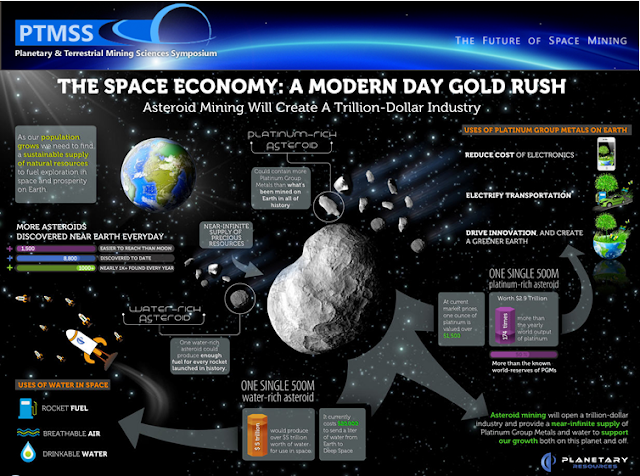
Rumour has it that most of the major movers and shakers involved with the nascent asteroid mining industry will be attending the 8th Joint Planetary and Terrestrial Mining Sciences Symposium and Space Resources Roundtable, which will be held in conjunction with the annual Canadian Institute of Mining (CIM) 2017 Convention at the Palais des Congres de Montreal in Montreal, Quebec from April 30th - May 2nd, 2017. Commercial Space blog editor Chuck Black will be there to report on the various announcements expected to be made at the event for both the Commercial Space blog and Resource World Magazine. Graphic c/o Deltion Innovations & Planetary Resources

As outlined in the April 6th, 2017 Business Insider post, "Goldman Sachs: space-mining for platinum is 'more realistic than perceived,'" the full 98 page report, prepared for Goldman clients by analyst Noah Poponak and his team, argue that recent advances in technology are now making space asteroid mining financially viable, with enormous profit potential.

The report specifically points to falling launch costs made possible by reusable launch vehicles from Hawthorne, CA based SpaceX and Kent, WA based Blue Origin. This is in addition to recent advances in low-cost satellite manufacturing through the use of 3D-printing, commercial-off-the-shelf (COTS) components and open standards.

Another factor making asteroid mining more attractive to investors is the increasing setup cost of Earth-based mines. The Goldman team references a variety of reports, such as the undated Mission 2016 Future of Natural Resources post, "The Process of Mining REEs and other Strategic Elements," to show that from-scratch startup costs for rare earth metal mines are generally upwards of $1Bln USD ($1.33Bln CDN).

Asteroid mining startups like Redmond, WA based Planetary Resources and Mountain View, CA based Deep Space Industries plan to build prospecting spacecraft for tens of millions of dollars and, ultimately, on-asteroid mining and 3D-printing systems in the hundreds of millions or low billions.

These costs are well within the range of both venture capital and traditional investors.

Goldman considers asteroid mining as a highly disruptive venture, both technologically and economically. Water extracted from asteroids could be easily converted into rocket propellant and stockpiled in low earth orbit (LEO) fueling depots, further cutting the cost of space access. Platinum-group metals (ruthenium, rhodium, palladium, osmium, iridium, and platinum) from asteroids would vastly bolster humanity’s supply of these strategic materials, used in everything from electronics to automobiles to industrial equipment.


The Goldman report even has the honesty to foresee one likely consequence of off-world mining; the  meltdown of Earth’s platinum market.

According to MIT’s undated Mission 2016 study, "Mission 2016: Strategic Mineral Management," a single 500-meter-wide asteroid could contain nearly 175 times Earth’s entire output of platinum-group metals.

With the advent of cost-cutting technologies and the newfound support of capital, space mining is finally poised to fulfill its decades-long promise.
Brian Orlotti.
  ______________________________________________________________

Brian Orlotti is a regular contributor to the Commercial Space blog.

General Fusion, exactEarth's Missing (But Insured) Satellite, More CSA Rovers & ULA Drops Launch Costs

          By Henry Stewart

For the week of April 10th, 2017, here are a few of the stories we're currently tracking for the Commercial Space blog:

July 29th, 2014 video overview of General Fusion. Screenshot c/o General Fusion.

  • Burnaby, BC based General Fusion has claimed a breakthrough in plasma technology. 
As outlined in the April 3rd, 2017 The Province post, "General Fusion introduces new leadership group as company claims plasma breakthrough," the alternative energy firm "claims to have succeeded in sustaining plasma fuel with a small, prototype injector just 40 centimetres in diameter, a significant technical hurdle."
The announcement was made last week by new CEO Christofer Mowry who, as outlined in the article, "is taking the reins at Burnaby’s General Fusion as the company is poised for a great leap forward."
According to Mowry, "GF now plans to proceed with building a larger plasma injector and a working prototype of its unique, compression-based reactor."
General Fusion and its partners, which include Chrysalix Energy, GrowthWorks Capital, Cenovus Energy, Amazon and Blue Origin CEO Jeff Bezos and the sovereign wealth fund of Malaysia, have already sunk about $100Mln CDN into the project. 
The company was last referenced in these pages in the May 25th, 2015 post, "Three Small Fusion Companies Approaching a Critical Funding Mass."

  • The exactEarth EV-5 satellite is missing. As outlined in the April 6th, 2017 exactEarth press release, "exactEarth Provides Update on EV5 Satellite," communication were originally lost with the satellite on February 3rd, 2017 and subsequent efforts to make contact were not successful. 
But the company quickly filed a claim "for the full insured value of the satellite," with an undisclosed insurance company and has received $3.5Mln CDN to cover the loss.
The insurance claim could even end up assisting in the growth of small-sat insurance coverage. As outlined in the April 6th, 2017 Insurance Business post, "Influx of orbital satellites could burst open cosmic insurance sector," with "about 80-90 rocket launches every year, and with that number set to grow massively," the space insurance business is "an interesting, well, space to be."
As outlined in Gunther's Space Page post on, "LatinSat A, B, C, D / AprizeSat 1, ..., 10 / exactView 3, 4, 5, 5R, 6, 11, 12, 13," the EV-5 satellite is one of a series of similar designed satellites, operating under different names and out of different corporations and jurisdictions, but intended to function together as "a constellation of small Low-Earth-Orbit satellites (64 satellites planned) to achieve a global communication system of data transmission and fixed and mobile asset tracking and monitoring (GMPCS)."
The loss of one satellite is not considered critical to the performance of the constellation. 
Two recent CSA rover designs, being taken for a ride by Innovation Minister Navdeep Bains in May 2016. With him are Ontario Drive and Gear (ODG) space and robotics manager Peter Visscher and Canadian astronaut David Saint-Jacques. ODG has build many rovers for the CSA and is likely to win at least one of the newly announced RFP's. Photo c/o CSA.
As outlined in the April 5th BuyandSell.ga.ca government procurement website posting under the title, "Lunar Surface Mobility Concept Study (C3P-CS-04) (9F050-16-0980/A)," the Federal government, under its Public Works and Government Services Canada (PWGSC) department and on behalf of the CSA, is seeking "proposals for a concept study aimed at developing a potential solution for lunar surface mobility." 
The request for proposal (RFP) builds on previous CSA work in this area, beginning in 2009, when the Federal Conservative government under then Prime Minister Stephen Harper allocated $110Mln CDN in funding to the CSA as part of its 2009 Economic Action Plan to cover rover development, a "next generation Canadarm" and other smaller projects.
Because of the CSA's heritage work in this area, any new intellectual property generated through the RFP's will vest with the government. This should make the RFP a difficult proposition to any robotics firm which hasn't worked with the CSA before.
The government expects to issue two contracts, worth up to $450K CDN each (excluding applicable taxes) and are expected to fund six months worth of work.
As originally outlined in the October 20th, 2012 post, "Lots and Lots of Rovers Looking for Missions," Canadian rovers don't typically sell well on the international markets. Some of the reasons for that state of affairs are discussed in the September 26th, 2016 post, "The REAL Reason Why Canada Won't Be Participating in the NASA Resolve Mission Anytime Soon, Probably!"
The announcement is also the latest in what should have been a series trumpeting new areas of research and funding for the CSA. However, as outlined in the April 3rd, 2017 post, "The Canadian Space Agency is "Very" Cautious About Its Post ISS Role," most of the items supported under the new programs are items the CSA and its partners have been dealing with in some way, shape or form for a very long time.
As outlined in the April 4th, 2017 Reuters post, "United Launch Alliance cuts Atlas rocket price amid competition," ULA’s cost reductions include "trimming its payroll. The company last year said it planned to cut as many as 875 jobs, or about one-quarter of its workforce, before the end of 2017."
In March 2017, ULA lost a US Air Force global positioning satellite launch contract to SpaceX, which bid $96.5Mln US ($129Mln CDN) for the work. 
Typical ULA pricing, at least until now, has started at $109Mln US ($145Mln CDN), though satellite operators can make up at least half that cost by getting more favorable insurance rates and other factors, including an on-time launch, ULA has said.
ULA is currently heavily dependent on the Russian RD-180 rocket engine, a hot potato in US political circles, but has promised to develop a domestically produced and lower cost engine over the next few years. 
However, as outlined in the April 7th, 2017 Space News post, "RD-180 provider seeks additional ULA engine order," the new CEO of the US-Russian joint venture that provides RD-180 engines to ULA has indicated that he "hopes" to win at least one further order for the Russian engine in the near future. 
For more, check out our upcoming stories in the Commercial Space blog.
_______________________________________________________________________

Henry Stewart is the pseudonym of a Toronto based aerospace writer.

Sunday, April 09, 2017

Part 4: 150 Years of Canadian Aerospace History

Radar, Better Radar (of the "Synthetic Aperture" Variety), Project Quill, 

CARDE, Velvet Glove & Black Brant


Galileo and his telescope. Graphic c/o National Geographic.
         By Robert Godwin
Canada's aerospace raison d'être has always derived from its immense size, its location in the far north as a vast, barely-tracked wilderness of incalculable resources and the logical requirements relating to defence, communications, utilization and exploration which naturally follow from its size and location.
It could be argued that the first person to engage in remote sensing was Galileo Galilei back in 1609. He didn't invent the telescope, but he seems to have been the first to realise that it could reveal previously unattainable information from impossibly remote distances.

A few decades later Sir Isaac Newton discovered that a simple prism could unfold the secrets of light, no matter how distant the source. More than a century later William Wollaston discovered that the spectrum which had been revealed by Newton's prism contained dark lines; this was the birth of the spectrometer.

But the next major breakthrough in true remote sensing would have to wait until the Second World War with the intense development of "radar." The idea for "radio detection and ranging" had been around for several decades but it would take the great conflict of the 1940s to accelerate the technology into practical use.

By the end of the war every government in the world was aware of radar, although most people had little understanding that it worked by bouncing a pulse of radio waves off a distant target and then collecting the echo. It could do this through any weather.


At the end of the war the Douglas Aircraft Company in California formed the RAND group to study the potential of an earth-orbiting satellite. Their secret 1946-47 reports clearly outlined the use of satellites for weather forecasting, observation and communications. The prime military value in such a project was being able to study the ionosphere (to better understand communications interference) and to see bomb crater damage after a nuclear strike. However, an onboard radar transmitter wasn't even considered by RAND because the technology was still too big and primitive to be mounted in their proposed satellite, which only had a payload capacity of 10lbs, so they suggested using a powerful optical camera or possibly a television camera.

One of the fundamental truths about radar is that the amount of detail in the image is affected by the physical size of the antenna that sends out the original pulse. A bigger antenna means more detail. In 1953 Kurt Stehling seems to have anticipated many of the problems associated with using radar from space, including the need for a large antenna and suitable equipment to transmit the data to the ground.

In 1951 an engineer at Goodyear working on the top secret Atlas ICBM had proposed the idea that a radar antenna might be able to operate while in motion, effectively simulating a much bigger array. Six years later, just such a device, installed on an aircraft flying in a straight line at a constant altitude, was able to create an image of an airport in Michigan. The image was crude and distorted because the aircraft was never truly flying straight, but the engineers who were involved knew that given enough advances in computing power, this was a problem that could be solved by mathematics.


The value of this new "synthetic aperture radar" (SAR) was that it had the potential to collect huge swathes of data in extreme detail. However, before computers could catch up and begin to compensate for all of the variables in this system, it was realised that a satellite is not buffeted by winds and its course is much more predictable. Almost immediately the United States Air Force began a secret project named "Quill" which would place a primitive SAR in the nose of an Agena booster and place it into orbit. Its goal was, like the RAND proposal, to see if it could detect the location of nuclear bomb craters and report that information quickly to the ground. Quill was launched in December of 1964 and worked perfectly.

While radar was finally beginning to peer through the haze, atmospheric interference was still a major problem for communications and the Canadian government soon recognised the potential to use rockets for studying the upper atmosphere.

The Canadian Armament Research and Development Establishment (CARDE) in Valcartier, Quebec was chosen as the central R&D clearing house for this new technology. CARDE was part of the Defense Research Board (DRB) which operated as a fourth arm of the military establishment. The DRB was a post-WWII offshoot of the much older National Research Council (NRC). From 1916 until 1947 the NRC had been responsible for both civilian-industrial scientific research and military research. After 1947 the DRB took over the solely military programs and the NRC reverted to its role of aiding civilian industrial and academic research.


Today the DRB is known as Defence Research and Development Canada (DRDC). By giving this important new technology to CARDE it clearly shows that the rocket was, even in Canada, considered first and foremost as a weapon.

One of the first advanced rocket programs undertaken at CARDE was an air to air missile named "Velvet Glove" which was to be used on Canadian fighter planes. Canadair, a major aircraft manufacturer in Montreal had initially been designing this advanced missile to be used on the CF-100, but soon plans were announced for a supersonic fighter and the Velvet Glove was to be reassigned to this new aircraft.

However, in 1954 the Velvet Glove program was cancelled in favour of an as-yet untested American built missile. This cancellation put many engineers' jobs at risk in Montreal and alerted the government to the need for more high-technology work in the aerospace sector.

A high powered oxygen hydrogen gun had also been installed at CARDE for firing projectiles at speeds of up to 14,000 feet per second. Gerald Bull was using this gun to fire different shapes of projectiles to test their flight qualities and also to see how different materials reacted to extremely high temperatures. One of the purposes of this was to see if an anti-missile missile could be designed and built.


The same year that Velvet Glove was cancelled a new large sounding rocket named the Raven was being developed in England to send payloads out into space and bring them back at high speed. The Bristol Aircraft Company was asked to adapt this missile for Canada's specific needs. A new fuel was developed at CARDE and the rocket was renamed the "Black Brant."

Canada was on the front edge of ABM technology and the Black Brant was one of the missiles being proposed for this purpose, but it would never be fired in anger. It was adapted by Albert Fia of Alberta to probe the upper atmosphere with a host of instruments in an attempt to get a better understanding of why long-range radio communications could still be interrupted by space weather from the sun. The Black Brant family of rockets would become one of Canada's most important aerospace products.
Robert Godwin.
_____________________________________________________________

Robert Godwin is the owner and founder of Apogee Space Books, the Space Curator at the Canadian Air & Space Museum and an American Astronautical Society History Committee Member.
He has written or edited over 100 books including the award winning series "The NASA Mission Reports" and appeared on dozens of radio and television programs in Canada, the USA and England as an expert not only on space exploration but also on music.  
His books have been discussed on CNN, the CBC, the BBC and CBS 60 Minutes. He produced the first ever virtual reality panoramas of the Apollo lunar surface photography and the first multi-camera angle movie of the Apollo 11 moonwalk. His latest book was written with the late Frederick I Ordway III and is called "2001 The Heritage and Legacy of the Space Odyssey" about the history of spaceflight at the movies.
Last Week, "Rockets, Mosquitoes, Lancaster's, UTIAS, and the Cold War" in part three of "150 Years of Canadian Aerospace History."

Next Week, "The International Geophysical Year, the Avro Arrow & Jetliner, Lapp, Stehling, Bull & Blue Streak," as part five of "150 Years of Canadian Aerospace History" continues.

On sale now, at Apogee Books.

Part 4: A History of the Canadian Space Program - Policies & Lessons Learned Coping with Modest Budgets

More of the 1970's, "Equal Access" to Communications, "Improved Industrial Capability" and the Hermes Communication Satellite 


The Hermes communications satellite. Graphic c/o CSA.
By Graham Gibbs & W. M. ("Mac") Evans

This paper, first presented at the 65th International Astronautical Congress, which was held in Toronto, Ontario from September 29th - October 3rd, 2014, is a brief history of the Canadian space program, written by two of the major participants.


The 1970's, Part 2

During the 1970, the Department of Communications (DOC) had been conducting studies of advanced satellite communications concepts with a view to using the newly approved 14/12 GHz band to provide direct communications services via satellite to low cost ground terminals. 
The motivation for these studies was the government’s stated policy that Canadians, no matter where they lived, should have equal access to the rapid evolution in communications services.
The newly approved frequency band for communications satellites offered the potential for the ubiquitous provision of telephone, television, tele-education, tele-medicine and a variety of other applications using ground terminals no more than 0.6 metres in size. But the technologies for using this new band were not yet available, and no satellite had yet been designed to take advantage of this new potential.
After extensive negotiations with NASA and considerable debate in government, DOC concluded a memorandum of understanding (MOU) with NASA in April 1971 for the Communications Technology Satellite Program (CTS) as a replacement for the cancelled ISIS III satellite. 
The common objectives for the program were: 
  • To advance the state of the art by developing a satellite communications system to operate at higher powers and higher frequencies than existing systems, thus making possible direct communications with low-cost ground terminals in individual homes and communities; and 
  • To conduct communications and technology experiments to evaluate the economic, social and political impacts of the future introduction of new services such as two-way tele- education and tele-medicine, direct broadcasting via satellite, and special community services.
Canada was to design, build and operate the spacecraft while the US was to provide the high-power tube for the satellite and launch the satellite. Use of the satellite was to be shared equally between the two countries. 
Canada had an additional objective stemming from the industrial setback of the Telesat procurement decision (as discussed in part three of this series). The government saw the CTS program as the vehicle for improving our industrial capability to design and manufacture complete communications satellites and subsystems for the domestic and export markets.
To accomplish this in such a high risk advanced technology development program, DOC established a unique program management structure that integrated the skills and expertise of government and industrial personnel into one team. This ensured that responsibility for the program clearly rested with DOC and that the development of project management skills and technological expertise occurred in industry. 
As will be shown later, this unique structure was fundamental to the rapid growth of the Canadian space industry in the late 1970’s and 1980’s. There is no doubt that the CTS program became one of the most significant tools in the development of an internationally competitive space industry in Canada.
CTS was launched on January 17, 1976 and named Hermes. The satellite was operated until contact with the satellite was lost in November 1979 (almost two years after its design life). At the time of its launch, it was the most powerful communications satellite ever launched, and was the first to operate in the new 14/12 GHz band. The communications experiments conducted on Hermes pioneered direct broadcasting of TV to homes and demonstrated the feasibility of providing a host of new services to rural and remote communities. 
The ANIK-B1 dual-band telecommunications satellite. As outlined on the Gunther's Space Page post on the satellite, it was built under an arrangement between Telesat Canada and the federal government and built by the RCA Astro-Electronics Division. Photo c/o ESA.

As a result of the success of Hermes, the Canadian government arranged with Telesat to include 14/12 GHz transponders on its Anik B satellite which was being built to replace the ageing Anik A satellites. As a result, Anik B1, launched on Dec. 15, 1978, was the first satellite in the world to operate in both the 6/4 GHz and the 14/12 GHz bands. 
For Hermes’ accomplishments in the field of television broadcasting and its applications, the Communications Research Centre and NASA received EMMY awards from the National Academy of Television Arts and Sciences in 1987.
________________________________________________________________________

Graham Gibbs & Mac Evans. Photos c/o MyCanada & CSA.
Graham Gibbs represented the Canadian space program for twenty-two years, the final seven as Canada’s first counselor for (US) space affairs based at the Canadian Embassy in Washington, DC. 

He is the author of "Five Ages of Canada - A HISTORY from Our First Peoples to Confederation."

William MacDonald "Mac" Evans served as the president of the Canadian Space Agency (CSA) from November 1991 to November 2001, where he led the development of the Canadian astronaut and RADARSAT programs, negotiated Canada’s role in the International Space Station (ISS) and contributed to various international agreements that serve as the foundation of Canada’s current international space partnerships.

He currently serves on the board of directors of Vancouver, BC based UrtheCast.

Last Week: "The 1970's, A Canadian Space Industry, Telesat, ANIK and a "Canadian Content Premium," in part three of "A History of the Canadian Space Program: Policies & Lessons Learned Coping with Modest Budgets."

Next Week: "Winding up the 1970's, The Canada Centre for Remote Sensing, Spar Aerospace, MacDonald Dettwiler, a Seminal 1974 "Canadian Policy for Space" & the Canadarm" as part five of "A History of the Canadian Space Program: Policies & Lessons Learned Coping with Modest Budgets," continues.
Monday, April 03, 2017

UofT Undergraduate Satellite Builders Raise Almost $500K to Build & Launch a Microsatellite in 2019

          By Brian Orlotti

Katie Gwozdecky. Photo c/o UTAT.
A student group at one of Canada’s top universities has hit upon a unique funding method for a micro-satellite. The group’s success is an example of what grassroots efforts can achieve when capably led and possessed of a true unity of purpose.

In a recent interview with the Commercial Space blog, Katie Gwozdecky of the University of Toronto Aerospace Team (UTAT), revealed that the student group has succeeded in raising almost $500K CDN to build a micro-sat for the Canadian Satellite Design Challenge (CSDC).

To raise these funds, UTAT, rather than appealing to the university’s administration or the Canadian government, chose to circulate a petition to add a small levy to the tuition of some 40,000 UofT students over two years.

UTAT began in 2004 as a five-member after-school project team building gliders to compete in the annual Canadian Aeronautics and Space Institute (CASI) Free-Flight Competition.

As the team matured and steadily rose through the competition’s ranks, they sought additional challenges. In 2006, their focus shifted to the Society of Automotive Engineers (SAE) International Aero Design Competition, where the team designed and built radio-controlled aircraft under various constraints and continue doing to this day.

Currently at 100 members, UTAT is organized into 5 divisions; Rocketry, Aerial Robotics, Space Systems, UAV and Outreach. As its ethos, UTAT places value on both generalists and specialists, believing they can learn from each other. This pragmatic mindset enables the group to draw from a broad talent pool of engineering, arts and science students. UTAT’s cohesion and inclusiveness stand in stark contrast to the endless division and parochialism of traditional space advocacy groups.


UTAT’s microsat, competing in the CSDC, will be based on the California Polytechnic State University, San Luis Obispo’s (Cal Poly) Cubesat standard. Studying the behaviour of micro-organisms in space,  the satellite will serve as a prototype open-source platform for student experiments.

According to Gwozdecky, a mechanical engineering undergrad and UTAT’s the Director of Space Systems, the group’s members canvassed vigorously (and mostly on personal time) to gain the needed number of signatures. The levy ($2.77 CDN per student per semester), will be used to fund the construction of the satellite, perform testing and certification as well as purchase space on a launch vehicle.

When asked why UTAT chose this novel funding method for its satellite, Gwozdecky cited a variety of reasons:
  • A generally negative attitude towards the funding of student clubs/projects at UofT.
  • The lack of Canadian Space Agency funding for student projects (as compared to NASA, for example).
  • The high cost of testing the three iterations of their satellite required.
With this influx of funds, Gwozdecky said that UTAT will bring 3rd parties onboard to aid in project management, including Toronto-based satellite startup Kepler Communications, which was last profiled in the February 20th, 2017 post, "Those Pesky Kids at Kepler Communications."

UTAT expects to be able to launch their satellite by the third quarter of 2019. It's success proves both the effectiveness of its culture and the power of grassroots efforts to effect change in the face of indifference.
Brian Orlotti.
  ______________________________________________________________

Brian Orlotti is a regular contributor to the Commercial Space blog.

As God & John W. Campbell Intended: SpaceX Launches and then Lands a Used SpaceX Rocket

          By Henry Stewart

As if to celebrate the March 30th, 2017 launch and safe landing of its reused Falcon-9 rocket, Hawthorne, California based SpaceX has just announced hundreds of job openings within the company.


As outlined in the April 3rd, 2017 Futurism post, "Elon Musk’s SpaceX Just Announced Hundreds of Open Positions," Elon Musk's space travel company SpaceX, "is hiring nearly 500 new employees across a variety of departments and locations. The boost is likely thanks, at least in part, to the successful launch of a reusable Falcon 9 rocket last week."

The rocket first launched in April 8th 2016 with the Dragon CRS-8 spacecraft full of supplies for the International Space Station before landing on the ocean barge 'Of Course I Still Love You.'

As outlined in the March 30th, 2017 Space.com post, "Used SpaceX Rocket Launches Satellite, Then Lands in Historic 1st Reflight," a SpaceX Falcon 9 rocket "soared off a seaside launch pad at NASA's Kennedy Space Center here today (March 30) on an unprecedented second mission to deliver a spacecraft into orbit, proving the booster's reusability."

As outlined in the April 3rd, 2017 Inverse post, "SpaceX Will Launch its First Spy Mission for America on April 16," the company's next mission will be to launch a “classified spacecraft payload” for the US National Reconnaissance Office on April 16th.
_______________________________________________________________________

Henry Stewart is the pseudonym of a Toronto based aerospace writer.

The Canadian Space Agency is "Very" Cautious About Its Post ISS Role

          By Chuck Black

The Canadian Space Agency (CSA) has posted an "advanced notice" (AN) plus a "letter of interest" (LOI) on the Canadian government Buy and Sell procurement website indicating that it "is exploring" post International Space Station (ISS) activities & other new areas.

If only that were truly so.


As outlined on the March 31st, 2017 BuyandSell.gc.ca post, "Potential Post-ISS Human Spaceflight Contributions Portfolio, and Planetary Exploration and Space Astronomy Preparatory Activities (9F050-20161006)," all the work in the AN is described as "concept studies" and/or "phase 0 work."

Phase 0 work and concept studies in CSA parlance generally includes the very beginning of the design and development process, but that's not always reflected in the items the CSA seems to want to focus on.

Items to be explored include:
  • An Advanced Crew Medical System (ACMS) requirements study - which would be "based on a concept of medical autonomy and relevant design reference mission," and would "identify and quantify a prioritized list of medical conditions for which medical autonomy must be provided" during space missions. As outlined in the CSA page devoted to operational space medicine projects (which was last updated on November 19th, 2012), the CSA already has items on the go in this area.
  • Various Cislunar Mission Contribution Studies - to "solicit alternative Cislunar contribution concepts." Up to five studies could be proposed by Canadian organizations. Successful proposals would be pitched to prime contractors of cislunar missions such as Orbital ATK and SpaceX.
  • Various Deep Space Telecommunications (DST) RF and Optical Technology Studies - including one request for proposal (RFP) to study radio frequency (RF) communications in cislunar space and one RFP to study optical communications in cislunar space. As outlined in the January 29th, 2017 post, "Canada's Contribution to the European SpaceDataHighway," Canada is already contributing to the Copernicus Sentinel program, which utilizes optical communications. 
  • Lunar Surface Rovers Architecture Concept Studies - which would include up to two parallel studies to develop a detailed Lunar Surface Mobility (LSM) architecture useful for other projects. As outlined in the July 4th, 2011 post, "Ground Control to Marc Garneau!," the CSA has been interested in funding rover technology since Marc Garneau was CSA president, in the early 2000's.
  • A Lunar Surface Science Maturation Study - which will be "awarded to evolve potential science objectives, instrument and science operations requirements, and a plan for associated potential analogue activities, as Canadian science inputs to inform further development of an international Lunar Demonstration Mission concept using the PHASR rover technology."
  • New Deep-Space Exploration Robotics (DSXR) arms, likely similar to a scaled down Canadarm or the Special Purpose Dexterous Manipulator (SPDM), which are already in operation on the ISS - As outlined in the document, "this Phase 0 will address a robotic arm capability and likely include not only the robotic arm, but also tool caddy, grappling tools, and ground station requirements to validate mission objectives and stakeholder needs, develop a mission concept design and concept of operations, and develop mission requirements." 
  • A Relative Navigation System (RelNav System) - The intent of this phase 0 program is to develop a concept and mission requirements for a relative navigation system, an item which has already been the subject of much academic and practical considerations.
  • Space Exploration (SE) Secondary Payloads and Nanomissions - A program to "develop concepts for Canadian micro or nanomissions that piggyback on planetary flagships and other anticipated launch opportunities." Not that there's anything wrong with this. It's just that microsat's, like the one discussed in the April 3rd, 2017 post, "UoT Undergraduate Satellite Builders Raise Almost $500K to Build & Launch a Microsatellite in 2019," have been piggybacking on other peoples rockets and missions for decades.
  • A Mars Sample Return Mission -  Of course, this is not a complete mission. It's a program designed to position "Canada for a possible contribution related to the Fetch rover element of Mars Sample Return." The Fetch rover "will retrieve samples from the Martian surface and return them to a Mars Ascent Vehicle for return to Earth."
  • Space Exploration: planetary & space astronomy concept studies - An "opportunity for up to 4 independent study contracts for new planetary and astronomy concepts or instrument contributions for potential future missions consistent with community priorities.
An overview of JAXA space science missions, including the LiteBIRD mission. Graphic c/o JAXA.
  • A Space Astronomy: LiteBIRD concept study - A study designed to define "potential Canadian instrument and science contribution" to the Japan Aerospace Exploration Agency's (JAXA) light satellite for the studies of B-mode polarization and Inflation from cosmic background radiation detection (LiteBIRD), which was selected as "one of 28 highest-priority large projects by the Science Council of Japan," way back in 2008.
  • Space Exploration: planetary and space astronomy studies - Which is expected to cover "up to 5 Science Maturation Studies for planetary and space astronomy community priorities."
  • Space Astronomy: CASTOR Canadian led space telescope concept - A "science maturation study" to revise and add to previous CSA concept studies on the proposed Cosmological Advanced Survey Telescope for Optical and UV Research (CASTOR) wide field space telescope, which has been kicking around since November 2006, when more than a hundred astronomers from across Canada gathered at CSA headquarters in St. Hubert, QC, to participate in the 2006 Canadian Space Astronomy Workshop (CSAW).
Taken together, these concept studies and phase 0 design studies give a good indication of what the CSA thinks it should be doing when the the ISS shuts down, sometime after 2024.

In only the CSA didn't seem to be spending so much of its time revisiting earlier projects.


Oddly enough, the March 31st, 2017 CSA post came only two days after a far less ambitious announcement.

As outlined in the March 29th, 2017 National Post article, "Canada looking to contribute to ‘deep space habitat’ orbiting moon and eventual Mars mission," the CSA issued a LOI on March 29th, 2017 on the Buy and Sell procurement website for the "Development of enabling space technologies for future international Human Spaceflight collaborations (9F063-160957/A)."

According to the LOI, the CSA is also interested in developing four component technologies for a proposed "deep space gateway" which NASA announced last week that it intends to build on or near the Moon when the International Space Station (ISS) is decommissioned after 2024.

The four technologies listed in the LOI are:
    Screenshot c/o Buyandsell.gc.ca.
  • A Deep-Space Exploration Robotics (DSXR) mechanical interface plate validation, which builds on a "previously developed common robotics interface (MIPS) prototype that will be used to perform robotic mating and de-mating to validate the design and requirements as a robotics interface for DSXR." 
  • A Deep Space Exploration Robotics (DSXR) autonomy software framework (ASF) which "will define, implement, and test an autonomy software framework to improve (a set of existing CSA developed tools) and provide a functional standard that supports both executing and planning functions (i.e., executive and deliberative models) to enable autonomous control on future space hardware such as robotic arms, rovers, scientific instruments, satellites, etc."
  • A Surface Mobility Technology - Mobility & Environmental Rover Integrated Technology (MERIT), which is essentially described as being another CSA rover, except that it is not actually a full sized rover, but is instead "a smaller (medium) scale prototype that will clearly demonstrate and validate the integrated technologies and components while outlining the path that would lead to these rovers."
  • A Lunar Rover Prototyping of Scalable Wheels & Advanced Rover Motion (SWARM), which is essentially a series of experiments to "improve and test current wheel designs"for use in the Precursor to Human And Scientific Rover (PHASR) and the Lunar Pressurized Rover (LPR) programs.
The priority technologies will be funded for between twelve and eighteen months for amounts varying from between $450K CDN (for SWARM) to $1.25K (for MERIT) and cover the incremental efforts required to improve already existing technologies to the point where they can be used by NASA.

The funds may also be targeted at the companies which preformed the initial work on these technologies, in an effort to maintain their involvement with the CSA.


Overall, while its good that the CSA is looking for a role other than Earth observation (EO), the programs listed above (which include a new set of rover wheels) suggest that our space agency is still exceedingly cautious and maybe not up to the job of guiding our industry towards the 21st century opportunities which will arise from the high frontier.

Of course, NASA's plans relating to its future activities aren't all that congruent with the existing funding either. NASA still needs the approval of the Trump administration to move forward.

Without funding, everyone can still dream but no one will actually accomplish anything.
Chuck Black.
___________________________________________________________

Chuck Black is the editor of the Commercial Space blog.

Sunday, April 02, 2017

Part 3: 150 Years of Canadian Aerospace History

Rockets, Mosquitoes, Lancaster's, UTIAS, and the Cold War


Downsview in the 30's. Photo c/o CASM.
         By Robert Godwin
Canada's aerospace raison d'être has always derived from its immense size, its location in the far north as a vast, barely-tracked wilderness of incalculable resources and the logical requirements relating to defence, communications, utilization and exploration which naturally follow from its size and location.
Along with rockets that could now pierce the edge of space, the war had also brought the need to accelerate other technologies, particularly in the fields of aviation, communications and navigation.

De Havilland's factory in Downsview mass-produced fighters like the Mosquito, while just down the road in Malton Ontario the Victory Aircraft Company churned out hundreds of heavy Lancaster bombers. One engineer from Toronto named Edward Fox who had kept his eye on the pulse of this work during the war wrote a book titled Stratosphere Flying, about the future of aviation and how to use the stars for navigation. By the end of the war Fox had written another 80,000 word manuscript about how to fly in space, but it seems this was never published. For his work on these books he won an award from King George.

While Kurt Stehling and Edward Fox were off fighting the Axis, another University of Toronto student named Hillel Diamond founded the Canadian Rocket Society (CRS). At the end of the war Stehling and Fox returned home and shortly thereafter they joined forces with Diamond to work towards their mutual dream of spaceflight. Fox, who had been an engineer since the 1920s, immediately took their cause to the media and conducted radio interviews and frequently appeared in the newspapers. He claimed to have become interested in the whole subject when he read the works of Jules Verne as a child.

One of those who supported the CRS was a brilliant engineer named Gordon Patterson, who had spent much of his life working in England, Australia and the United States on advanced aeronautics work. In his youth Patterson was one of a new breed of young engineers who spent their "off hours" conducting aerial surveys of Canada's remote regions. Mapping Canada's resources and remote geography was still an enormous unfinished task. In 1947 Patterson returned to his alma mater, the University of Toronto, where he established the the Institute for Aerophysics (UTIA), which eventually became the Institute for Aerospace Studies (UTIAS).  This institution remains at the forefront of Canada's aerospace research until the present day.

UTIAS today. As outlined in the history page of the University of Toronto Institute for Aerospace Studies website, Gordon Paterson "insisted, as a condition of his coming to U. of T. (in 1947), that a separate department of aeronautics be established, and after some equivocation, and resistance within the Faculty of Applied Science and Engineering, the University complied." Photo c/o UTIAS.

One of the most important developments at UTIAS was the construction of an advanced and extremely powerful wind tunnel. This was installed not far from the de Havilland factory in Downsview Ontario. Many of the next generation of top Canadian aerospace engineers would work at this establishment including a young man named Gerald Bull who was destined to make important advances in the future.

In early 1948 Stehling introduced engineers across Canada to the potential of the rocket when, as President of the University of Toronto Rocket Society, he wrote a paper entitled "Rocket Propulsion." He concluded his report with, "from a defensive and scientific viewpoint it will be necessary for Canadians to interest themselves in this useful and portentous science. Why shouldn't we use our native initiative and do more original work, instead of imitating or improving on the work of other countries?"

Stehling would win an award from the Engineering Institute of Canada for this paper. Despite some post-war difficulties finding employment, which he attributed to his German background, he soon found himself in-demand, lecturing on rockets and the intricacies of atomic energy. By the end of 1948 Stehling and Fox were willing to debate anyone on the feasibility of spaceflight.

Just down the road from the UTIAS wind tunnel, at the de Havilland factory, many iconic aircraft were now being manufactured, including the legendary "Beaver" and "Chipmunk." These planes were ideally suited for Canada's unique conditions and the Beaver's distinctive design would soon become an iconic image to all Canadians. The ability to land the Beaver on water allowed unprecedented access to some of Canada's remote regions.


By 1949 the Cold War was in full swing. Victory Aircraft in Malton had been taken over by the A.V. Roe Company (Avro) and it was now also building and developing some of the best aircraft in the world. The market for a civilian jet transport seemed obvious and in 1949 Avro delivered the C-102 "Jetliner." Thousands of man-hours had gone into the design of what could easily have been remembered as the world's first civilian jet transport, but technically it flew just two weeks behind Britain's de Havilland "Comet."

At the same time the CF-100 all-weather fighter was being developed for deployment in Europe and many squadrons were to be spread across Canada, waiting to be called up in case of a Soviet invasion from across the arctic. The Korean War soon became the front line and Avro were asked to drop the Jetliner program and concentrate their efforts on war materiel.

The early 1950s brought with it the beginning of the global race to perfect ballistic missile technology and the engineers at De Havilland in both England and Canada opened their own special missile divisions. This new field required an entirely new breed of engineers, and many young men from the University of Toronto travelled further afield to learn these special skills.

Kurt Stehling chose to accept a job at Bell Aerospace in Buffalo New York, where some of the German rocket scientists from World War II were now working. Wilfred Dukes also moved from Avro to Bell and became the deputy chief of engineering, where he wrote some of the first serious papers on hypersonic flight. Another young engineer from Toronto named Phil Lapp chose to go to MIT in the United States to learn more about missile guidance.


In 1951 Stehling wrote to American scientist James van Allen urging him to consider Canada as the perfect location for launching rockets into the high stratosphere. The wide open spaces were the precise kind of location for testing dangerous new hardware which might unexpectedly fall from the sky. Stehling proposed using high altitude balloons for the first stage, to save fuel. One of the locations he suggested for these launches was Churchill Falls in Manitoba.

Now that he was a paid-up member of the American Rocket Society, in January 1953, Stehling delivered a seminal paper called "Earth Scanning Techniques for Orbital Rocket Vehicles" in which he outlined the special work which an orbiting satellite could do to study ground based resources, and to monitor coastlines, by using either microwaves or visible-light scanning equipment.

This paper would lay the groundwork for the whole field of remote sensing from space and especially many of Canada's future space projects. Stehling's paper was based on non-classified information and suggested using a conventional paraboloidal "sweeping" radar antenna, the only kind known to operate in aircraft at that time. 
Robert Godwin.
_____________________________________________________________

Robert Godwin is the owner and founder of Apogee Space Books, the Space Curator at the Canadian Air & Space Museum and an American Astronautical Society History Committee Member.
He has written or edited over 100 books including the award winning series "The NASA Mission Reports" and appeared on dozens of radio and television programs in Canada, the USA and England as an expert not only on space exploration but also on music.  
His books have been discussed on CNN, the CBC, the BBC and CBS 60 Minutes. He produced the first ever virtual reality panoramas of the Apollo lunar surface photography and the first multi-camera angle movie of the Apollo 11 moonwalk. His latest book was written with the late Frederick I Ordway III and is called "2001 The Heritage and Legacy of the Space Odyssey" about the history of spaceflight at the movies.
Last Week, "The International Polar Year, the Silver Dart, Canada's First Air Show and Aerospace Becomes Serious Business" in part two of "150 Years of Canadian Aerospace History."

Next Week, "Radar, Better Radar (of the "Synthetic Aperture" Variety), Project Quill, 
CARDE, Velvet Globe & Black Brant," in part four as "150 Years of Canadian Aerospace History" continues.

On sale now, at Apogee Books.

Part 3: A History of the Canadian Space Program - Policies & Lessons Learned Coping with Modest Budgets

The 1970's, A Canadian Space Industry, Telesat, ANIK and a "Canadian Content Premium"


Anik A. Photo c/o Telesat Canada
By Graham Gibbs & W. M. ("Mac") Evans

This paper, first presented at the 65th International Astronautical Congress, which was held in Toronto, Ontario from September 29th - October 3rd, 2014, is a brief history of the Canadian space program, written by two of the major participants.


The 1970's, Part 1

The Act of Parliament that created Telesat Canada stipulated that Telesat “shall utilize, to the extent practicable and consistent with its commercial nature, Canadian research, design and industrial personnel, technology and facilities in research and development connected with its satellite telecommunication systems and in the design and construction of the systems.” 
Before Telesat could purchase any satellite or ground system, the Act required Telesat to obtain the approval of the Minister of Communications that he or she was satisfied that the procurement would result in “a reasonable utilization of Canadian design and engineering skills and the incorporation of an appropriate proportion of Canadian components and materials.” 
A reminder that, the more things change, the more they stay the same. This short CBC radio segment from December 1st, 1971 under the title, "The Anik satellite and northern Canada," discussed the advantages and disadvantages of the new communications technologies being rolled out with the three Anik satellites is well worth comparing to the July 18th, 2016 post, "Arctic Satellites Should Serve Northerners According to Nunatsiaq Online." Graphic c/o CBC.

It is clear that the government saw Telesat as an instrument of industrial policy wherein Telesat procurement's would be used as much as possible to assist the development of the Canadian space industry. 
In the debates in Parliament that led to the creation of Telesat, the then Minister of Communications made it clear that Canadian industry would play a major role in building Telesat’s satellites.  
In the period leading up to the creation of Telesat, the government run Satellite Project Office in 1969 had let major competitive study contracts to two Canadian companies, RCA Limited in Montreal (the prime contractor for the ISIS spacecraft) and the Northern Electric Company in Ottawa. Upon completion of these studies, Telesat proceeded to enter into negotiations with RCA to build two satellites. 
However, in the middle of these negotiations, Hughes Aircraft in the United States (builder of the first satellites for Intelsat) submitted to Telesat an unsolicited proposal for the construction of three satellites, based on a flight proven design, at a price considerably lower than the RCA price and with a shorter construction schedule. The Hughes offer included a much smaller Canadian content (from Northern Electric and SPAR) than the RCA bid. 
An image of the Anik A, "a forerunner of the Boeing 376 satellite,"" from Boeing Images, the external licencing arm of the Boeing Corporation. The Anik's were a part of the Hughes HS-333 generation of spin stabilized communication satellites, which later evolved into the popular Boeing 376 satellite line now in use around the world. Hughes was purchased by Boeing in 2000 and became Boeing Satellite Systems. Graphic c/o Boeing Images.

Thus the ink was hardly dry on the Telesat Canada Act when one of its key provisions (Canadian content) faced a significant challenge. Except for Canadian content, the Hughes bid was substantially better than the RCA bid in all respects (cost, risk, and schedule). In essence, the Hughes bid established a benchmark to measure the extra cost of including significant Canadian content in Telesat’s first series of satellites. 
The issue of this so-called “Canadian Content Premium” became the subject of considerable debate in the House of Commons. In the end, in 1970 the Minister of Communications authorized Telesat to proceed with Hughes Aircraft for the construction of three Anik A satellites. 
The Anik A1 satellite was launched by NASA on November 9, 1972 and Canada became the first country to have a domestic satellite system in geosynchronous orbit. Anik A2 followed shortly afterwards in April 1973 and Anik A3 was launched in May 1975. 
The satellites operated in the 6/4 GHz bands and each provided 12 channels capable of carrying either one television program or 960 one- way telephone conversations. Telesat’s Anik system revolutionized communications in Canada and for the first time ever, reliable telephone services and television programming were available to most of the rural and remote areas of Canada. 

The failure of Canadian companies to win the contract for the Anik satellites had a profound impact on the government’s space program. 
The setback of the Anik procurement decision clearly showed that the Canadian space industry was not yet internationally competitive. In the wake of the Telesat procurement decision, and with the wind down of the ISIS program, it was clear that another major space program would be needed if Canada’s fledgling space industry was to survive. 
Fortunately, as a result of the government’s decision in 1969 to transform planning for the ISIS III spacecraft into planning for a communications technology satellite, the government was in a position to act swiftly.
________________________________________________________________________

Graham Gibbs & Mac Evans. Photos c/o MyCanada & CSA.
Graham Gibbs represented the Canadian space program for twenty-two years, the final seven as Canada’s first counselor for (US) space affairs based at the Canadian Embassy in Washington, DC. 

He is the author of "Five Ages of Canada - A HISTORY from Our First Peoples to Confederation."

William MacDonald "Mac" Evans served as the president of the Canadian Space Agency (CSA) from November 1991 to November 2001, where he led the development of the Canadian astronaut and RADARSAT programs, negotiated Canada’s role in the International Space Station (ISS) and contributed to various international agreements that serve as the foundation of Canada’s current international space partnerships.

He currently serves on the board of directors of Vancouver, BC based UrtheCast.

Last Week: "The 1960's, Alouette, ISIS, Chapman & Telesat," in part two of "A History of the Canadian Space Program: Policies & Lessons Learned Coping with Modest Budgets."

Next Week: "More on the 1970's,"Equal Access" to Communications, "Improved Industrial Capability" and the Hermes Communication Satellite," as part five of "A History of the Canadian Space Program: Policies & Lessons Learned Coping with Modest Budgets," continues.

Support our Patreon Page