Monday, February 08, 2016

Part 1: A Short History of COM DEV International

John Hansen, Samuel Singer and Michael Valentine O'Donovan


By Robert Godwin 
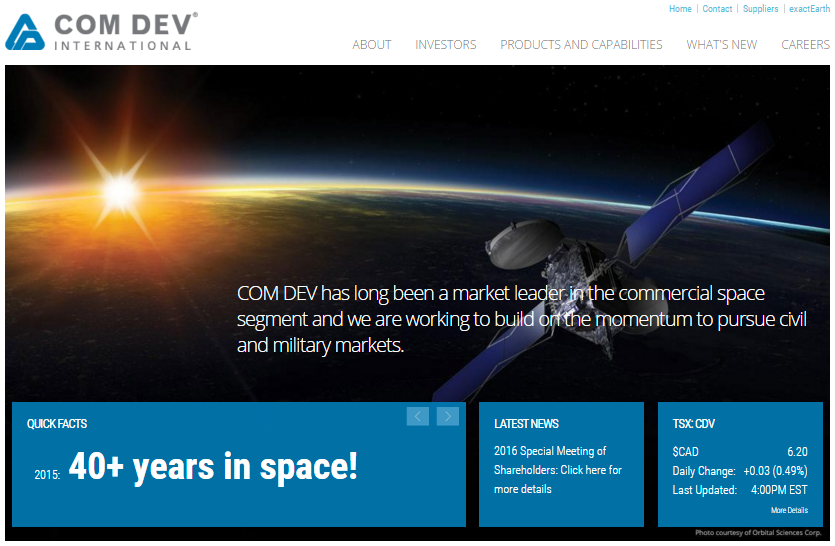
The COM DEV website on February 8th, 2016.
We have grown accustomed to the fact that some of our industries are protected from being swallowed whole by foreign interests. 
For example we don't allow foreign ownership of our chartered banks and in exchange for that quasi-monopoly our banks have acceded to some relatively stringent regulations. This had the fortunate side effect of cushioning our economy from the worst vicissitudes of the global meltdown of 2008. In 2009, we also refused to allow BC based MacDonald Dettwiler (MDA) to be purchased by US based Alliant Techsystems (ATK).
In this new age of mega-data, information and incessant global security fears, it would simply seem prudent to establish safeguards to protect our high tech industry. 
However, the only safeguard which seems to exist is an arbitrary market cap of $600Mln CDN before the baleful eye of the Ottawa regulator is stirred from its repose and a review is triggered under the Investment Canada Act (ICA).

COM DEV International (COM DEV), primarily based in Cambridge Ontario, has just been purchased by Honeywell, an American super corporation, and the reaction from Ottawa has been to keep calm and carry on. Any concerns about national security were essentially considered moot by the newly established Trudeau government.

As outlined on the February 5th, 2016 Wall Street post, "COM DEV Details TSX Delisting, exactEarth to List Feb 9 (TSE:CDV)," common shares of COM DEV will be delisted from the Toronto Stock Exchange (TSX) by the close of trading on February 8th. As a result of the sale, COM DEV subsidiary exactEarth would be spun off into a separate, publicly traded company beginning on February 9th. Screenshot c/o Wallstreet.org.

So what is COM DEV and what did it represent to Canada's interests? Should we be up in arms about losing this company to the United States or should we follow Ottawa's lead and just carry on?

O'Donovan's 1962 paper. Graphic c/o Space Library.
If we were to take a truly genealogical approach to any analysis we would find that COM DEV was formed in 1971 in Montreal by John Hansen and Samuel Singer, two ex-RCA Canada employees. They were spurred by the opportunity to cash in on the promise of Canada’s new ISIS satellite program, and created their company near the Montreal railway yards to sell parts for satellite tracking stations.

But these founders wouldn't play any meaningful role in the story of the company they created.

In 1962 at Pye Electronics in Cambridge, England, a young Irishman named Michael Valentine O’Donovan described a method for creating a branching system for microwave radio relays that allowed multiple transmitters and receivers to use the same aerial. Tellingly it also described his construction of a prototype at Pye. He articulated his design in a paper in May of that year entitled “Microwave branching systems,” It would be published a year later and won O’Donovan a prize.

A few months later he spotted a newspaper advertisement, typical for the time, inviting qualified engineers to come to Canada. In this case the job opportunity was with RCA in Montreal. RCA Canada was a division of RCA of New York, the company that built the world’s first geosynch satellite Syncom 1. RCA Canada had carved out a worthwhile role for itself, but it wouldn’t have existed at all without its quasi-government parent in the USA.

In November 1963 O’Donovan and his pregnant wife took a chance and headed for Canada and a job with RCA. By 1965 O’Donovan was made group leader for microwave devices and sub-systems and in this role he developed microwave components and subsystems for the Canada Wide Radio Relay network and the first generation of satellite earth terminals in Canada.


Between 1971 and 1973 his team created the microwave payload for the Canadian government-funded experimental Communications Technology Satellite (CTS), also known as Hermes, which would be the first demonstration of direct television to remote places on the ground.

O'Donovan's book. Graphic c/o Space Library.
That same year O’Donovan and his team wrote a patent for RCA, “Metal Plated Body Composed of Graphite Fibre Epoxy Composite.” This innocuous title disguised a very clever idea for creating lightweight microwave filters out of the burgeoning new composites technology. Their device could lower launch costs due to its light weight and it had the ability to still maintain its shape while remaining an efficient conductor. The patent was issued to RCA in the United States in 1976.

By 1974 Hansen and Singer were making little progress growing COM DEV and were apparently arguing most of the time. O’Donovan offered to buy Hansen’s 40% of the company for $5000, making him an equal partner with Singer, with the remaining 20% held by another RCA man, Kenneth Flood.

This change of venues didn’t come without an added perk. RCA didn’t want to lose O’Donovan, so he agreed to keep working for them if they in turn agreed to give COM DEV a fair shot at bidding on satellite contracts.

Astonishingly, they consented to this extraordinary arrangement. At the end of 1974 O’Donovan and another of RCA’s scientists, Chandra Kudsia, wrote a book together entitled “Microwave Filters for Communications Systems.” All of O'Donovan's ideas distilled down to a few simple goals. Make satellites communicate more efficiently using lighter components.

Robert Godwin.
In 1975 he made what he considered to be one of his best decisions, to hire engineer Keith Ainsworth as a project manager. Ainsworth would go on to run the company for most of the next 30 years and would be involved in many of the future key decisions.
_____________________________________________________________

Robert Godwin is the owner and founder of Apogee Space Books. He is also the former space curator at the Canadian Air & Space Museum and the curator of the The Space Library, an online repository of 30,000+ pages of space information and papers. 

Please consider subscribing to the library for only $5. Your contributions help to support new research and the maintenance of the existing repository.

Next Week: O'Donovan Grows His Team (and his Company) as part 2 of "A Short History of COM DEV International" continues!

Sunday, February 07, 2016

2016 Could Be a Big Year for Space: Is Ottawa Paying Attention?

          By Glen Strom

Is the space business really growing? A group called Space Angels Network says it is.

A December 3rd, 2013 BBC News panel discussion on investing profitably in NewSpace start-ups with Virgin Galactic founder and chairman Richard Branson (on the left, connecting "via satellite") and Space Angels Network managing director Chad Anderson (right). Not shown in the photo was Satellite Applications Catapult CEO Stuart Martin, who also participated in the discussion. To see the entire interview, please click on this link. It's also worth noting that, as outlined in the December 14th, 2015 post, "UK Space Policy Follows US Down the "NewSpace" Path," both the UK and the US have implemented public policy designed to encourage large increases in private sector space activities. These new policies are creating a business environment in which Canadian companies cannot currently compete. Screenshot c/o Space Angels Network.

The organization describes itself this way:
Space Angels Network is a global network for angel investors, offering insider access to the emerging private space industry and sophisticated investment opportunities across diverse market segments, with the expertise and network connections to cultivate stellar returns on investment. We are the largest community of space investors and entrepreneurs in the world.
A January 21, 2016 article at their website, “2015 An Epic Year for the Space Industry,” makes the case that 2015 was a big year for space activities and 2016 will be even better.

The first half of the article is a summary of the events that took place in space in 2015. It’s the second half of the article, starting with the heading, “Record Levels of Investment,” that’s of real interest.

According to the Space Angels website, the network has funded 29 companies during its eight years of existence. These include Astrobotics (presently contracting for private sector Moon missions), Nanoracks (which places small science experiments on board the International Space Station), Planetary Resources (focused on outer space resource gathering) Ursa Space Systems (geospatial imagery) and XCOR Aerospace (currently building the Lynx rocket plane). Co-funders and sponsors include venture capital firms Draper Fisher Jurvetson, Founders Fund, Data Collective (focused around funding data scientists) and First Round Capital. Graphic c/o Space Angels Network.

Here’s a summary of what that part of the article says:
  • The compound annual growth rate (CAGR) for commercial space activities between 2012-2015 was 180%.
  • In the last 10 years over $20Bln USD of non-governmental money has been invested in commercial space companies.
  • In 2015 the level of non-governmental investing in commercial space was $3.3Bln USD, with most of it coming from corporations. A majority of this money went to launch systems and satellites.
  • Acquisitions of space assets in 2015 totaled nearly $4Bln USD.
A July 24, 2015 post, “Space Economy Now $330Bln US Annually, Says Report,” examines the numbers in a report from the Space Foundation, a US based non-profit organization that advocates for the global space industry. They agree that a breakthrough year is likely. The data in the report on European space activities comes from Eurospace, the trade association of the European space industry, which also thinks that way.

The 2015 State of the Satellite Industry Report, a 32-page PDF document produced by the Satellite Industry Association (SIA), shows that the satellite communications area has the most potential in the near term. That’s an area where Canada does well.

Canada’s federal government has made a big deal about promoting technology. When it comes to space, though, so far the only announcement was about Neptec Design Group getting $1.7Mln CDN to design a damage detection system for the International Space Station. This contract had already been announced in November 2015, as outlined in the January 10th, 2016 post “Innovation Minister's Latest Announcement a Rehash of November 2015 Announcement.”

As outlined in the February 5th, 2016 Business Insider post, "A tiny European country just made an unprecedented move in the space mining business," crazy American based entrepreneurs aren't the only ones making large bets on the future of the space industry. As outlined in the article, the tiny country with a well deserved reputation as a tax haven, has followed down the same path as the US  by securing property rights for commercial companies intending to utilize rare and precious resources from asteroids. For some background on the US initiative and why Canada should also follow down this legislative path, it's worth checking out the November 26th, 2015 post, "Say Hello to the New US Commercial Space Launch Competitiveness Act." Screenshot c/o Business Insider.

Commercial space is picking up speed. What should the Canadian government be doing to get us a piece of that action?

If you’re about to say create more projects for space companies, forget it. Canada’s economy is slow, the dollar is down and the government will likely run deficits for a few years. It’s unlikely that they’ll put a lot more money into government space projects.

Here’s what they can do:
  • Stabilize the Canadian Space Agency (CSA). As recommended by Emerson, give it a clear mandate and the funding it needs to carry out that mandate.
  • Create an environment that helps space companies grow through initiatives like tax breaks and access to financing. 
  • Promote the Canadian space industry internationally. The government has been promoting Canadian technology, as Prime Minister Justin Trudeau did at the recent 2016 World Economic Forum (WEF), but more focus on space is needed.
  • Create an environment where more young Canadians can get their space dreams off the ground while they’re still in university. Some schools, the University of Waterloo in Ontario (most recently profiled in the September 4th, 2015 post "What Waterloo Engineering Dean Pearl Sullivan Really, Really Wants!") being one example, are doing well at this on their own, but promoting entrepreneurship needs to be done at a national level.
Glen Strom.
If the growth trend in 2015 continues, 2016 will be a strong year for commercial space. Let’s hope the Canadian government is paying attention and puts some effort into promoting our space industry.

Commercial space is the future and we need to carve out our place in it.
_____________________________________________________

Glen Strom is a freelance writer and editor with a background in business and technical writing. Follow him on Twitter @stromspace for the latest on Canadian space stories.

Saturday, February 06, 2016

How Ed Mitchell Expected to be Remembered

          By Chuck Black

The sixth person to walk on the Moon, American naval officer, astronaut and explorer Edgar Dean "Ed" Mitchell passed on Thursday, after a long, adventurous and fruitful life.

In August 2000, Mitchell talked with author, publisher and Space Library curator Robert Godwin at the Airport Marriot Hotel in Chicago, Ill. During the interview, which Godwin recorded, Mitchell discussed how he expected to be remembered. 

Ed Mitchell, at the Marriott Hotel Chicago on August 27th, 2000. For a sampling of the interview, please click on this link. Screenshot c/o The Space Library.

Mitchell said that his life has been "that of exploration," initially of the atmosphere and of outer space.

But over the last thirty years, he had also explored inner-space, "and consciousness and the studies of the cosmology of mind and consciousness (and) how did all of this come to be," According to Mitchell:
I have a suspicion that I'm likely to be remembered more for the latter than the former.
The work we have been doing for thirty years now is very, very significant. We have re-addressed the old questions and used all the tools of science to help try to understand it.  
The ancient questions that every generation has asked; Who are we and how did we get here and where are we going and what is this all about...
To learn more, check out this free clip at the Space Library. 

And, if you'd like to listen to the entire forty-seven minute interview with Mitchell, please consider signing up for a monthly membership in The Space Library.

It's only $5 CDN a month and helps to keep the website online.

Membership also entitles you to over 33,000 other pages of primary first generation source materials, visuals, audio and video files covering the complete history of space exploration.

Recent posts include the article "Willy Ley – Berliner, Raketenpionier, Weltraumhistoriker" by Wolfgang Both and a new history of the German Rocketry Society by Frank H. Winter, the retired Curator of Rocketry of the National Air and Space Museum in Washington, DC. 

Chuck Black.
Best of all, your funds will help to support not just the work being done through the Space Library but will also help to support the Commercial Space blog.

So be awesome. Help us get the word out.
___________________________________________________________

Chuck Black is the editor of the Commercial Space blog.

Tuesday, February 02, 2016

Washington "All Fired Up" Over Russian Rocket Engines

          By Henry Stewart

John McCain. Photo c/o Brietbart.com. 
There's no finer example of the money to be made from building rockets than the current battle in Washington between US Senator John McCain and United Launch Alliance (ULA) over the purchase of Russian built rocket engines to power ULA built rockets. 

As outlined in the January 27th, 2016 Verge article, "John McCain is trying to stop the military from using Russian rocket engines again," ULA CEO Tory Bruno doesn't so much need the Russian engines to provide ongoing access to orbit for US military payloads as he needs them to compete with SpaceX and its Falcon family of multi-use rockets for lucrative US military contracts. 

The US Congress had initially banned the use of Russian rocket engines for US national security launches under the National Defense Authorization Act (NDAA) in 2015 in reaction to Russia’s 2014 incursion into neighboring Ukraine. But the ban exempted five Russian RD-180 rocket engines that were already on order and were needed for ULA to comply with existing contracts. Exceptions covering four additional RD-180 engines were included in the 2016 US Defence Authorization bill, for much the same reasons and after much debate.

But the 2016 exemptions, as championed by McCain in his role as chair of the House Armed Services Committee, limited ULA to "far fewer Russian-made engines than the company says it needs to stay viable in its core national security market," at least according to the September 30th, 2015 Space News post, "Defense Bill Curbs ULA Use of Russian Engines but Draws Veto Threat."

The bill was also expected to end the Evolved Expendable Launch Vehicle (EELV) program covering Atlas-5 and Delta-4 launch services not covered under their standard contracts. 

ULA critics have long argued that that these additional contracted funds, which are officially intended to assure access to space for Department of Defense and other United States government payloads, are only ever paid to ULA and are therefore simply an additional subsidy for ULA launch operations.

,
The RD-180 rocket engine, derived from the Russian RD-170 rocket engine used on the side boosters of the Soviet era Energia launch vehicle, is built by the Russian company NPO Energomash and sold to ULA under contract. As outlined in the July 17th, 2014 SpaceFlight Insider article, "With continued turmoil over RD-180, ULA mulls new rocket engine," ULA has been exploring options for alternatives to the RD-180 since almost the beginning of the crisis in the Ukraine. Under RD Amross, a joint venture between Pratt & Whitney (P&W) and NPO Energomash, P&W is licensed to produce the RD-180 in the United States, although this has never occurred. Photo c/o NASA.

Given that, and as outlined in the October 2nd, 2015 Space News post, "Bruno Says ULA Can’t Bid on GPS 3 Launch," ULA began to refuse to bid on new launch contracts, citing it's inability to compete for contracts against Space-X without the Russian rocket engine.

And, although McCain initially succeeded in getting a limit of nine Russian engines included in the FY16 DoD authorization bill, an additional provision added to the bill last week seems to have voided that limit.

Tory Bruno, looking hungry. Photo c/o SpaceNews/Tom Kimmell.
So now ULA can buy as many Russian rocket engines as it wants, maybe.

In response, and as outlined in the January 27th, 2016 Space News article, "US Air Force evaluating early end for ULA’s $800 million in yearly support," the US Air Force is now renewing efforts for the early termination of the estimate $800Mln USD annual EELV launch capability contract after ULA refused to bid on the service’s first competitive launch contract in over a decade.

The article also quoted McCain as stating that he would introduce legislation to reinstate a ban on  the US military’s use of Russian rocket engines, a move that would again limit  ULA to nine RD-180 engines for upcoming competitions for Air Force launch contracts.

The article also quoted ULA spokeswoman Jessica Rye that it is “critical that ULA is able to continue to provide the reliable, affordable launch services our customers depend on while the new, American engine is being developed.” 

ULA is working with Blue Origin on the methane-fueled BE-4 engine that would power the main stage of Vulcan, ULA’s proposed Atlas 5 successor. They just don't want to give up on the revenue they'd lose on the lead up to the roll-out of the new rocket. 

Perhaps the US government will end up throwing them a new bone. 
_________________________________________________________________________________

Henry Stewart is the pseudonym for a Toronto based aerospace writer. 

Monday, February 01, 2016

A New, Smart Manufacturing Hub for Kitchener/ Waterloo

          By Chuck Black

It's common knowledge that SpaceX houses its office space, mission control, and vehicle factory in a single, three story facility in Hawthorne, California. Canadian companies will soon have the option of locating in a very similar sort of "all in one" manufacturing facility at the centre of Canada's technology triangle.

The current ex-Kumpfort Zone warehouse will become the Catalyst 137 IoT manufacturing facility sometime in 2017. Current plans include a managed innovation space for smaller companies (with suites as small as 2,000 square feet available for rent) and a variety of "maker spaces" for on-site rapid prototyping, 3D printing, RF testing/ certification lab plus an indoor test environment for drones and other physical objects, plus government, legal, import-export, venture capital, retail and health facilities. Photo and graphic c/o Myvisuallistings.com and catalyst137.com. 

At least that's the plan behind the Catalyst 137 smart manufacturing campus, currently scheduled to open in Kitchener, Waterloo, in early 2017. The 475,000 square foot facility will be the largest of the"smart" manufacturing, Internet of Things (IoT) and "maker space" operations in North America.

"I think it's going to become the place to be in Canada for the development of hardware," according to Michael Bierstock, the president of Pierpoint Developments, and one of the people responsible for moving the project forward.

Bierstock considers the current generation of manufacturing "ill served" by cubicle farms where people have traditionally developed software applications. "With the current generation of tech being embedded into machinery, cell phones and even sneakers, we need to develop facilities from a manufacturing perspective, with physical storage and places to tinker and test real objects."

In essence, the new facilities are necessary in order to support the revolution in manufacturing just now getting underway.

Michael Bierstock, at Communitech, a Kitchener/ Waterloo industry-led innovation centre which supports nearly 1,000 local tech companies,where he spoke as part of the Catalyst137 Launch Party on January 29th, 2016. According to Bierstock, 137 isn't just the address on Glasgow Street in Kitchener where the facility is located. It's also a mystical and scientific number. As outlined on the Richard Feynman tribute website "Friends of Tuva," the "mysterious number 137," it was even once suggested that electrons captured by the as yet undiscovered "element #137" would move at the speed of light. According to Bierstock, "we hope to grow our companies at about that same speed." Photo c/o Chuck Black.

As outlined in the January 27th, 2016 The Record article, "Catalyst 137 smart manufacturing campus to open in 2017," the new facility should have room for thirty-five or more companies, with space ranging from 2,000 to 50,000 square feet for each tenant.

According to Miovision CEO and co-founder, Kurtis McBride, "the vision with Catalyst is basically to kind of give the hardware cluster a home or a brand it can attach to.” McBride feels that it's also important to try to bring on-site the sort of infrastructure that help firms to get their products to the market faster.

Miovision, a local Kitchener/ Waterloo success story founded in 2005 by three classmates from the University of Waterloo Systems Design engineering program, will serve as the anchor tenant for the campus.

The third partner in the Catalyst 137 project is Voisin Capital CEO Frank Voison. Voison began his real estate investment company in 2010 and it has since grown to include holdings across southwestern Ontario. His firm specializes in adaptive reuse projects, when an old site or building is re-purposed for a use other than which it was originally built or designed for.

The concept of a "new manufacturing economy," enabled by digital technologies and wrapped around a highly trained and knowledgeable workforce, has always been the "pot of gold" for city councils looking to improve upon the low paying service industry and contract jobs which so many of their current voters are saddled with.

Chuck Black.
Here's hoping the Kitchener/ Waterloo area a great success with Catalyst 137.
___________________________________________________________

Chuck Black is the editor of the Commercial Space blog.

Tuesday, January 26, 2016

Tony Lacavera Has a New $100Mln Venture Capital Fund

          By Chuck Black

Tony Lacavera. Photo c/o Linked-In.
Anthony ("Tony") Lacavera, the entrepreneur who created Wind Mobile (Canada’s fourth-largest wireless carrier), once acted as chairman of the board for NewSpace company UrtheCast and currently serves as chairman of Globalive Holdings (a privately held Canadian communications and investment company), is raising money for a new venture capital fund.

As outlined in the January 21st, 2016 Financial Post article, "Wind Mobile founder Tony Lacavera returns to tech investing with $100M venture capital fund," Lacavera made five local investments in the last year into companies such as Kira Talent (an online video talent screening platform), Revlo (a "fan engagement platform" for Twitch users) and ChargeSpot (a wireless charging solution for cellphones and small electronics).

The new fund, being raised through Globalive, is expected to close in 2016 and would be used for follow-on investments to bolster existing stakes, but would also plug a strategic hole in the Canadian start-up landscape, by providing mid-level funding rounds of between $5 - $25Mln CDN.

According to Lacavera, Canada has plenty of support for entrepreneurs just starting out, and once they make it big, U.S. venture firms or investors like Toronto-based OMERS Ventures are there to write checks in the tens of millions of dollars. Between those stages there’s a funding desert, which his new fund intends to exploit.

One of Lacavera's recent investments includes the ChargeSpot wireless power charger for cellphones and small electronics. It uses electromagnetic induction principals originally discovered by Michael Faraday and tested by Nicola Tesla, in order to charge cell phones and other electronic instruments without a physical connection to the power source. Graphic c/o ChargeSpot.

From 2012 - 2103, Lacavera was also the chairman of the board of Vancouver BC based UrtheCast.

Chuck Black.
As outlined in the June 10th, 2013 post "UrtheCast Proceeds with Takeover and Funding for ISS Camera's," he resigned as part of the firms reverse-takeover (RTO) of publicly traded Longford Energy Inc. in 2013.
___________________________________________________________

Chuck Black is the editor of the Commercial Space blog.

Sunday, January 24, 2016

Did the Government Let COM DEV Go Because They Have Bigger Fish to Fry?

          By Glen Strom

The Canadian government is being criticized for not reviewing the sale of COM DEV International one of Canada’s biggest space companies, to American giant Honeywell International.

Screen shot of the COM DEV website taken on January 24th, 2016. As outlined in the January 21st, 2016 CNW press release, "COM DEV shareholders approve Arrangement with Honeywell," shareholder approval for the purchase was given at a special meeting of COM DEV shareholders held in Cambridge, Ontario on Thursday. For background on how the deal was structured, it's worth checking out the November 7th, 2015 post, "Should the proposed COM DEV sale to US based Honeywell trigger the Investment Canada Act." Graphic c/o COM DEV. 

A January 11th, 2016 blog post at Canadian Space, “Trudeau Government Fails First Big Space Test,” said that the government failed taxpayers who have invested tax dollars in COM DEV and workers in the aerospace industry who might lose jobs.

A January 21st, 2016 article at the Toronto Star, “The troubling shrinking of Canada’s space industry,” said the sale could affect the economy, as well as being a national security issue.

Although the sale didn’t trigger an automatic review under the Investment Canada Act because it fell below the $600Mln CDN cutoff point, the government could have launched a review within a 45-day period, but didn’t.

You’ll hear plenty of theories about why the feds did nothing. Here’s one more: the government is fine with the COM DEV sale because the company isn’t critical to Canada’s long-term economic development.

Times change. This photo shows exactEarth president Peter Mabson, with then COM DEV CEO John Keating,  FedDev  Southern Ontario minister Gary Goodyear, conservative MP Stephen Woodworth and  COM DEV COO Mike Pley (who would replace Keating as company CEO in 2010) at an event celebrating the $5.2Mln CDN FedDev funding awarded to COM DEV by FedDev Ontario in 2009  As outlined in the November 29th, 2009 FedDev Ontario post, "Announcement will strengthen Ontario's position as a world leader in micro-satellite technology," the award was "funded under the Southern Ontario Development Program (SODP), which will allow COM DEV to launch the first generation of its micro-satellites and establish Ontario as a world leader in this emerging industry." the Photo c/o Canadian Press.

COM DEV generates significant money and jobs in Canada. But they’re a first generation space company.

First-gen companies make hardware. COM DEV is a leader in making hardware for satellites. It’s a good market and will continue to be so. The 2015 State of the Satellite Industry Report, a 32-page PDF document produced by the Satellite Industry Association (SIA), showed 4% revenue growth for the satellite business between 2013-2014. The report also noted that the satellite services category (which includes TV, broadband, mobile, Earth-observation) is growing faster than satellite manufacturing.

On top of that, satellite services has a wild card: the Internet of Things (IoT). As noted in the November 20, 2015 post “exactEarth’s Big Bet on The Internet of Things:”
...by 2020 approximately 250,000 vehicles will be on our roads and also connected to the internet; by 2020 the food and beverage industry could annually save up to 15% of their current costs through the adaption of IoT methodologies and the IoT will add between $15 - 20 trillion USD's to global GDP over the next twenty years.
If the predictions come true, the need for satellite data and onnectivity will be huge. It’s the second generation space companies like UrtheCast and exactEarth that will benefit the most from that demand.


The government’s economic strategy has been clear from the start. Minister of Innovation, Science and Economic Development (ISED) Navdeep Bains outlined that strategy in the November 27th, 2015 Globe and Mail article, “Trudeau cabinet’s voice of business aims to bridge needs of old and new economies.”

Minister Bains said that, as part of his “innovation agenda,” his goals included encouraging research and development and helping businesses scale up and go global. He stressed that manufacturing was still important, but innovation was key even to old-economy industries.

Innovation is front and centre globally. The theme of the 2016 World Economic Forum (WEF), which ran from January 20th - 23rd in Davos, Switzerland, was the Fourth Industrial Revolution. As the January 14th, 2016 article at the WEF website, “The Fourth Industrial Revolution: what it means, how to respond,” explained:
The First Industrial Revolution used water and steam power to mechanize production. The Second used electric power to create mass production. The Third used electronics and information technology to automate production. 
Now a Fourth Industrial Revolution is building on the Third, the digital revolution that has been occurring since the middle of the last century. It is characterized by a fusion of technologies that is blurring the lines between the physical, digital, and biological spheres.
Canadian futurist Don Tapscott, a Forum attendee, drove home this outlook in a January 23rd, 2016 article at the Toronto Star, “Canada must focus on innovation economy to thrive in digital age.”

Tapscott was at a lunch for about 60 people in Davos discussing Canada’s future. The talk among business and government leaders was all about innovation, stimulating entrepreneurship, research and development, and job creation in the digital age.


Emerging technologies powering companies that are built for the digital revolution will drive the government’s economic plans.

COM DEV isn’t one of those new economy companies although exactEarth, soon to be spun off as part of the Honeywell deal, and UrtheCast are.

The question remains, how much might the COM DEV sale hurt Canada’s economy?

In the January 21st, 2016 article at TheRecord.com, “Com Dev shareholders approve sale to Honeywell,” COM DEV CEO Mike Pley said that Honeywell will invest in its space business in Canada.

Time will tell if they do.

Glen Strom.
Maybe, just maybe, the government is fine with letting go of COM DEV because their interest has gone from nuts and bolts space companies to those dealing with big data, the new big fish to fry.
_____________________________________________________

Glen Strom is a freelance writer and editor with a background in business and technical writing. Follow him on Twitter @stromspace for the latest on Canadian space stories.

Sunday, January 17, 2016

Rocket Reusability and Holy Grails

          By Glen Strom

Reusability is the holy grail of rocketry.

How often have you heard that? Lots, no doubt. Everybody from journalists to space analysts to space company presidents toss out that one when the talk gets around to reusing rockets. By now somebody has probably taught a parrot to squawk it.

A damaged SpaceX Falcon-9 rocket after a landing strut broke while making a hard landing on the drone ship "Just Read the Instructions." The rocket had just completed launching the US-European Jason-3 ocean monitoring satellite into orbit on January 17th, 2016. As outlined in the January 13th, 2016 Motherboard post, "Why SpaceX's 'Next Few Missions' Will Attempt to Land a Rocket at Sea," SpaceX will continue to attempt soft landings on drone-ships down-range from the launch pad because it requires less fuel than having the rocket fly back to the launch pad before landing. Photo c/o @elonmusk.

If you got a dollar every time a news article said that reusability is the holy grail of rocketry, you’d need a wheelbarrow to move the money (Keep in mind that Canada has a one dollar coin instead of a paper bill).

Jeff Bezos. Photo c/o EuropeanCEO.
For example, Blue Origin, the space company owned by Amazon.com billionaire Jeff Bezos, successfully landed their New Shepard rocket in November. In the November 24th, 2015 Seattle Times article, “Bezos says Blue Origin landing achieves ‘Holy Grail of rocketry’,” Mr. Bezos referred to reusability as “the holy grail of rocketry.” In all fairness, despite the headline, he didn’t say Blue Origin had achieved it, but that reusability would make make spaceflight less expensive. 

Recently SpaceX, the company owned by billionaire Elon Musk, landed a first stage booster on a landing pad, as seen in the December 21st, 2015 YouTube video, "Historic Landing of Falcon 9 First Stage at Landing Zone 1." In an earlier undated video interview that Mr. Musk did for the website Space.com, he also used the term holy grail in reference to rocket reusability.

Yes, they say that reusability will lower the cost of launching payloads by allowing launch companies to reuse the booster rather than building a new one from scratch.

Elon Musk. Photo c/o Reuters/Stephen Lam.
There’s only one teeny weeny problem with that idea: nobody has proven it yet.

Jean-Yves Le Gall, President of the French space agency Centre national d'études spatiales (CNES) said in a December 22, 2015 article at Space Daily, “SpaceX landing is a 'feat', but not a game-changer,” that the SpaceX landing was a “technological feat” but nothing more. He went on to say that questions about the cost of refurbishing a used rocket remain. He didn’t dismiss the possible advantages of reusability but he noted that it hadn’t been proven yet.

And please don’t point out that the writer said “game-changer.” One rant at a time.

Another perspective about the difficulties of reusability is outlined in a January 9, 2015 article at the website The Conversation.com, “Explainer: why reusable rockets are so hard to make.” The author, an expert in advanced propulsion systems at Southampton University in England, talks about the problems of balancing propellant, vehicle and payload mass. He talks about the importance of keeping the refurbishing costs down as well.

(A side note: he also used the term holy grail. It must be some kind of virus going around.)

Tory Bruno. Photo c/o ULA.
Salvatore “Tory” Bruno, the president of American launch company United Launch Alliance (ULA) and SpaceX’s main competitor, has talked about his company’s plans to incorporate reusability into their rockets.

In an April 13, 2015 article at Spaceflight Now, “ULA plans to introduce new rocket one piece at a time,” ULA will try a more conservative approach to reusability by recycling parts rather than the entire booster. Mr. Bruno also said that an internal ULA study showed it would take 15 flights before a refurbished booster would save money over single-use boosters.

Until a number of successful launches are made with a reusable booster and people get a chance to analyze the numbers, we won’t know if reusability really will bring down the cost of launching rockets, or if it’s just over-hyped wishful thinking.

Glen Strom.
In the mean time, maybe people can ease up on that holy grail squawk.

Right now the only holy grails are a religious symbol and a Monty Python movie.

Time will tell if there’s a third.
_____________________________________________________

Glen Strom is a freelance writer and editor with a background in business and technical writing. Follow him on Twitter @stromspace for the latest on Canadian space stories.

Thursday, January 14, 2016

Canadian Company Building Integral Molten Salt Reactor

          By Brian Orlotti

A Canadian company has secured $10Mln CDN in funding to develop an unusual type of nuclear reactor. Oakville, Ontario based Terrestrial Energy will use the funds to develop an integral molten salt reactor (IMSR) for industrial and commercial markets.

The general layout of an IMSR plant. As outlined in the Stopping Climate Change page on the "Terrestrial Energy Integral Molten Salt Reactor (IMSR)," the design is a small modular reactor (SMR) design based closely on a DMSR design from the Oak Ridge National Laboratory, but also incorporates elements found in the small, modular, advanced, high temperature reactor (SmAHTR), a later design from the same laboratory.  Graphic c/o Terrestrial Energy.

As outlined in the January 8th, 2016 Next Big Future post, "Terrestrial Energy gets funding for development for Game Changing Molten Salt Nuclear Reactor," IMSR reactors promise nuclear power that is far cheaper and greener than traditional methods.

IMSRs differ from traditional fission-based nuclear reactors in that they use fuel (in this case, denatured uranium) which has been dissolved in a molten liquid salt. Because an IMSR’s fuel is in liquid form, it functions as both fuel and coolant, transporting heat away from the reactor as it circulates. Thus, an IMSR cannot go into meltdown because a loss of coolant (the traditional cause of meltdowns) would also mean a loss of the fuel needed to drive the reactor.

In addition to being "melt down proof," IMSR technology offers other advantages:
  • With the fuel and cooling systems essentially combined, IMSRs are a much simpler design than traditional fission reactors and so can be made smaller and cheaper.
  • IMSRs use denatured uranium, a fuel that does not require extensive processing (i.e. lower fuel costs) and cannot be used to build nuclear weapons (no proliferation risks).
  • IMSRs require only 1/6th the fuel needed annually by traditional reactors (lower operating costs).
  • IMSRs can use recycled fuel.
For all of these advantages, IMSRs would still produce radioactive waste. However, this waste would be at far lower volume (kilograms versus tonnes) and be far shorter-lived (200-300 years versus millennia) when compared to traditional reactors.

Salt water reactors aren't new. From 1961 to 1965, this Tupolev-95LAL Russian bomber, using conventional engines and fuel, but also carrying a Russian designed and fully operational molten salt water reactor, performed a series of test flights designed to ascertain whether a nuclear reactor could be used to power an aircraft. The American equivalency was the Convair NB-36H "Crusader" program, created under the US aircraft nuclear propulsion program (ANP) to demonstrate the greatly extended range possible with nuclear-powered aircraft when compared to conventional designs. Both programs were cancelled as the benefits of ballistic missiles became clear. Photo c/o Stopping Climate Change.

Terrestrial Energy's IMSR builds upon research done in the 1960’s in the US at Oak Ridge National Laboratory (ORNL), where the molten salt reactor experiment test reactor operated from 1965 to 1969 and the denatured molten salt reactor was designed. In January 2015, Terrestrial Energy announced a collaboration with ORNL to commercialize its IMSR design. The design phase is scheduled for completion in 2017, with the company intending to have its first power plant commissioned somewhere in Canada in the 2020s.

Brian Orlotti.
With the debates over global warming and energy independence reaching a new crescendo, and off-world resource extraction steadily overcoming the giggle factor, Canada’s homegrown nuclear expertise could prove a great asset.
______________________________________________________________

Brian Orlotti is a network operations centre analyst at Shomi, a Canadian provider of on-demand internet streaming media and a regular contributor to the Commercial Space blog.

Tuesday, January 12, 2016

The Pentagon, NASA & DARPA All Go to Comic-Con

          By Chuck Black

It's well known that the US military employs a cadre of "entertainment liaison officers" to glad-hand Hollywood executives and help decide which projects get Pentagon support, expertise, equipment, location permits and sometimes even funding.

Actor, producer and space enthusiast Seth Green moderates a Comicon 2014 panel discussion with Dr. Jim Green (NASA's division director of Planetary Science), Apollo 11 astronaut Buzz Aldrin, current NASA astronaut Mike Fincke and "Mohawk Guy" Bobak Ferdowsi, a NASA-JPL Engineer involved with the Curiosity and Europa Missions. Screenshot c/o NASA JPL.

It's less well known that NASA, the Defense Advanced Research Projects Agency (DARPA), the National Academy of Sciences (NAS) and quite a few other organizations, often connect entertainment industry professionals with top scientists, engineers, military expertise and even funding in order to create a synergy between science and story lines.

Not that there's anything wrong with that. It's a promotional tool which Canadian space scientists and entrepreneurs might consider copying.

The NAS even has a Science and Entertainment Exchange, which recently celebrated its "1000th consult," on films such as "Big Hero 6, The Amazing Spiderman, The Avengers, Battleship, Iron Man 2, Prometheus, Thor, and Tron: Legacy, as well as hit television programs like Castle, Covert Affairs, Criminal Minds, Agents of S.H.I.E.L.D, Fringe, The Good Wife, and House."

As outlined in the January 7th, 2015 post on the Spy Culture website under the title, "The Pentagon, NASA and Comic-Con," NASA has recently begun to attend events like the San Diego Comic-Con.

According to the article, the "combination of nerds and sci-fi fanatics has proven too alluring to ignore and so one of the world’s biggest scientific institutions has joined the world’s largest military organisation in exploiting this opportunity."


Of course, while NASA is a latecomer to comics culture, the organization has been involved in other aspects of the media almost since its inception.

Chuck Black.
For a list of some of the programs NASA has been involved with recently, check out the December 17th, 2015 post on the Spy Culture website under the title, "NASA Public Affairs/Media Liaison Documents."
___________________________________________________________

Chuck Black is the editor of the Commercial Space blog.

Sunday, January 10, 2016

Innovation Minister's Latest Announcement a Rehash of November 2015 Announcement

          By Henry Stewart

The Wednesday announcement by innovation minister Navdeep Bains, that the Canadian Space Agency (CSA) had allocated $1.7Mln CDN to Kanata, Ontario based Neptec Design Group for the creation of a new damage detection system for close-up surface inspection on the outside of the International Space Station (ISS), was nice.

But it wasn't the first time the program had been announced. In November 2015, the CSA also announced $1.9Mln CDN funding for the same program and to the same company, but called it "phase A" funding for the design concept, after which a competitive bidding process would be initiated to decide upon the final contractor.

Canadian astronaut Jeremy Hansen with innovation minister Bains at the John H. Chapman Space Centre in Longueuil, PQ, on January 7th, 2016. As outlined in the January 7th, 2016 government of Canada press release, "The Government of Canada announces a new vision system to support the inspection and maintenance of the International Space Station,"  the minister was in town with parliamentary secretary Greg Fergus and Sherry Romanado, the Liberal member of parliament for the riding of Longueuil-Charles-LeMoyne, to announce the awarding of a contract to Neptec for the design of a "new advanced space vision system" which will be mounted on the Canadian built Special Purpose Dexterous Manipulator (SPDM) or DEXTRE, which is already installed on-board the ISS. The new unit will include a 3D laser, a high-definition camera and an infrared camera, and will be tasked with supporting "the inspection and maintenance of the ageing infrastructure" of the ISS. Photo c/o @csa_asc.

As outlined in the March 31st, 2015 post on the Buy and Sell website under the title, "Dextre Deployable Vision System (DDVS) (9F052-141026)," the original RFI was offered up for tender by the federal government well before the current Liberal government came to power in October 2015.

The final contract, as outlined in the November 25th, 2015 Buy and Sell post, "Dextre Deployable Vision System (DDVS) – Phase A (9F052-150058/001/MTD)," was announced as being awarded to Neptec on November 25th, 2015. The story was then picked up by several news services including the November 25th 2015 Spaceref.ca article, "Neptec Awarded Phase A Contract for Space Station Dextre Deployable Vision System," and the  November 25th, 2015 More Commercial Space News post, "Neptec Awarded Phase A Contract for Space Station Dextre Deployable Vision System."

The differences in cost between the November 2015 announcement and last weeks announcement from the innovation minister relate almost entirely to the inclusion of the applicable sales tax on the total amount allocated by the federal government to the program.

Slide 14 of the October 2014 presentation on the DEXTRE Deployable Vision Sensor, which is available on the NASA website.  Graphic c/o NASA.

And, as outlined in the October 2014 presentation on the DEXTRE Deployable Vision Sensor, the idea of adding extra sensing capabilities to the Canadian built DEXTRE had been floating around NASA and CSA since at least 2010, and perhaps even before then. As outlined in the presentation, the intent of the program (at least from the CSA perspective) was to add a series of "high mature technologies" to the surface inspection capabilities on board the ISS.

Neptec has been a NASA prime contractor since the 1990's, supplying operational systems to both the Space Shuttle and ISS programs. Starting in 2000, Neptec began expanding its technology to include active 3D imaging systems and 3D processing software.

So while it's good that Minister Bains is promoting CSA activities and holding press conferences about new CSA contract awards, the suggestion that there is anything especially new or innovative about this particular announcement is at best naive.

Here's hoping he'll do better next time. Maybe he'll even follow through with a competitive bidding process, instead of just announcing the winner.
Editors Note: According to Julie Simard, the CSA's acting manager for strategic communications, the initial November 25th, 2015 announcement that Neptec was awarded the contract was not intended to be an announcement, but was intended instead to be a "routine administrative procedure" performed to come into compliance with the "Government of Canada’s policy on the mandatory publication of contracts over $10,000." 
According to Simard, the real difference between a public announcement and an administrative procedure is that "a public announcement would involve press activities such as the publication of a press release or the organization of a press event (by the CSA or some other government organization), like the one that was held on January 7." 
Be that as it may, we're going to stand by our statement that the Neptec announcement (defined as simply "a written or spoken statement that tells people about something"  in the Merriam Webster dictionary), initially occurred in November 2015.
Simard also indicated that the original RFI offered up for tender by the federal government in March 2015 and expired in April, was superseded on July 7th, 2015 by a request for proposal (RFP) under the title "Système de vision déployable par Dextre (SVDD) / Dextre Deployable Vision System (DDVS)," under which the final contract to Neptec was to be awarded. 
The provided document explicitly confirmed that the current RFP is for phase A work only. Phase A work typically covers the feasibility assessment of a project under consideration and doesn't usually include any work on the project itself (that comes later in phases B, C and D). 
Simard spoke with Commercial Space blog editor Chuck Black on January 13th, 2016 and followed up the conversation with the e-mail posted in the comments section below. 
_________________________________________________________________________________

Henry Stewart is the pseudonym for a Toronto based aerospace writer. 

Support our Patreon Page