Viable commercial space activities go back at least 50 years to the 1960's when the first Early Bird satellite was successfully launched into geosynchronous orbit according to David M. Livingston in his paper, Space: The Final Financial Frontier. And Canadian companies have always been leaders in this area.
But the Canadian Space Commerce Association (CSCA), presently preparing for its 2010 annual conference on March 16th, is of far more recent vintage. The association, originally calling itself the Canadian Space Chamber of Commerce grew almost organically out of a failed attempt by a small Canadian group of volunteers to win the Ansari X-Prize for building the first privately funded suborbital spacecraft (a competition won in 2004 by US based firm Scaled Composites).
The consensus growing out of that attempt was that there was (and still is) a strong need for an industry group representing smaller, Canadian based companies, entrepreneurs and start-ups seeking to understand and improve the legal, regulatory, entrepreneurial and financial environment for Canadian space and newspace focused organizations.
The CSCA has always had an interesting and eclectic mix of speakers at their annual conferences (which are normally held at the MaRs Development District in Toronto, Ontario).
2008 conference speakers included Robert Richards (who spoke about Odyssey Moon, at the time a new firm recently incorporated on the then unknown Isle of Man), Burton Lee (who talked about lessons learned from his experience with the Space Angels Network raising money for space focused start-ups) and Peter Evans, from the MaRS Development District (who talked about venture capital, business plans and growth models).
2009 speakers were mostly CSCA members providing overviews of their businesses and included Robert Moru, president of A-Line Tools, Brian Feeney, president of the Dreamspace Group and Kevin Wong, senior partner at StoneCracker Scientific. Even I gave a short presentation in 2009 on the most recent Rideau Roundtable on Space where we discussed the need to develop a coherent Canadian space policy (a topic which I still write about on occasion).
It will be interesting to see who ends up on the 2010 schedule of speakers, which is focused on "Our Growing Canadian Commercial Space Sector." Since I'll be attending the event (I'm one of the organizers), this is the point where I extend an invitation to my readers to attend so we can meet and compare notes.
I look forward to seeing you there.
Sunday, February 21, 2010
Developing Partnerships for the Next Great Space Race
exactEarth Ltd., the data services subsidiary of COM DEV International Ltd. (TSX: CDV), today announced that it has signed a $1.4 million contract with the Canadian Space Agency (CSA) to provide space-based Automatic Identification System (S-AIS) data. exactEarth will supply the CSA with both historical data collected previously by its AIS nanosatellite (NTS) as well as with datasets to be captured at times and locations specified by the CSA through March 31, 2010.
Evidently, shy and polite Canadians are quite capable of putting together internationally capable partnerships between universities, the military, private business (both small start-ups and larger firms) and multiple space agencies which essentially mirrors relationships being developed in the United States as a result of the Obama administrations recent NASA announcements as outlined in my February 2, 2010 edition of "This Week in Space for Canada."
At the Next-Generation Suborbital Researchers Conference today, Commercial Spaceflight Federation chairman Mark Sirangelo announced the creation of a new affiliates program for universities and other research and educational institutions.
"Researchers, engineers, and educators will be among the primary beneficiaries of the new generation of low-cost commercial spacecraft, as payload opportunities to space start to grow," said Sirangelo. "We're excited to create a new category of affiliate membership to strengthen the ties between the Commercial Spaceflight Federation and the research and education community."
It looks like "good old" Canadian ingenuity is poised and prepared to take advantage of this new playing field requiring collaboration and partnerships. Perhaps Americans could learn a few lessons from their northern neighbors.
Tuesday, February 16, 2010
Feedback on "Ottawa Citizen: "Where Did That Long Term Space Plan Go?"
Naturally, my favorite feedback is completely positive but perhaps the most useful and incicive comments come from those in the space community with slightly more of a long term perspective. For example, here's a comment from Kieran A. Carroll:
Both the Ottawa Citizen article and your blog entry make the point that Steve MacLean has yet to release the new Long Term Space Plan, despite quite a long wait. Two things to keep in mind about this:
The plan has been developed, and has been widely circulated amongst the main players in the space industry (I haven't seen it myself, but I'm rather off to the side of the industry at the moment). From what I've heard, Steve has followed a very extensive consultative process in developing the plan.
Steve also made the point at an event that I attended a few months ago, that he would release the plan if he could, but that it is an input to the next federal budget, and hence is being treated the same way that all budget documents are: as a secret cabinet document. Hence, Steve cannot release details of the plan in public, without the permission of the relevant Ministers (in practice, it would likely take explicit permission from the Prime Minister to do this). I expect that the details will be released soon after the next federal budget is released, which I believe will be early in March.
In other words, you shouldn't necessarily interpret lack of public announcements regarding a plan as indicative of lack of progress in developing the plan (although Steve could certainly say at least *that* much in public---maybe the Citizen article will prompt him to do so.
The above is certainly fair comment and makes two points.
It provides an indication of when the details of the document are likely to be released that isn't really all that far in the future.
It reminds us that while the CSA can collect the information needed to make policy recommendations and certainly controls policy implementation, the policy must also be approved and funded at the federal government level before implementation can proceed. At some point, we might need to start talking directly to our local MP's if we really want a new Canadian long term space plan.
Steve McLean is going to give a public talk at Western on April 12th - hoping we'll hear something about this elusive long-term space plan.....we'll see.
With a little luck, perhaps there might be further comments over the next little while.
Monday, February 15, 2010
Ottawa Citizen: "Where did that Long Term Space Plan Go?"
It's nice to see the traditional press finally stepping up to the plate and asking important questions relating to the future of our Canadian space focused industrial, entrepreneurial and academic infrastructure. This is what happened today at the Ottawa Citizen in their editorial "Rocket Science" which finally got around to asking the obvious question:
Now, where did that Long-Term Space Plan go?
Canada doesn't have one. Three such blueprints in the past have guided Canada through exciting times, during which we invented telecom satellites, built Canadarms, created instruments that measure land, air and oceans from hundreds of kilometres above, and built part of a mission to Mars. And, of course, we sent astronauts into orbit.
But Canada hasn't had a new plan since 1994. Scientists and engineers now wonder: Are they supposed to work on satellites, or Mars missions, or space medicine for astronauts?
According to the article, Canadian Space Agency (CSA) President Steve MacLean was given two months by then Industry Minister Jim Prentice when he was named the new president of the CSA in "the late summer of 2008" in order to write a new long-term space plan and told that "time is of the essence."
Evidently, the Honorable Minister was incorrect since, according to the article "17 months later, there's no plan in sight, and no expected date for it."
Readers of this blog who remember my various posts on the lack of a Canadian long term space plan (starting with the May 29th, 2009 post "A Short Backgrounder on Canadian Space Policy") should not be surprised that these issues are finally being picked up and exposed to a wider audience.
Essentially, if Canada does not define a long term space plan, private business and academia will soon go about creating their own as outlined in my previous post UK & US Governments Developing Space Plans. Dr. MacLean might need to respond to these rising calls for a long term space plan soon, or else risk becoming irrelevant to the debate.
Sunday, February 14, 2010
UK & US Governments Developing Space Plans
Meat Loaf (born Marvin Lee Aday) was one of the iconic singers of the 1970's with his first album "Bat Out Of Hell" containing some of the most memorable tunes of that era (although he has since fallen from favor among the dwindling record buying public). One of this biggest hits on the album was the song "Two out of Three Ain't Bad."
The lyrics refer to wanting and needing but not loving and suggests that "two out of three ain't bad."
The UK thus joins Canada (with a much delayed update to our Canadian space policy commissioned originally when Steve MacLean became head of the CSA in September 2008 but so far not released) and the United States (with the Augustine Committee presently meeting in Washington) as essentially not knowing what to do with their space program.
It's eight months along with the Augustine Final Report long released (and the 2011 NASA budget recently announced by the Obama administration) so the way forward for the US now seems clear (except perhaps for the inevitable political and economic casualties).
The British committee has also moved forward, if perhaps at a slower pace. They've recruited Richard Branson and his Virgin Galactic company as consultants, set up a website as SpaceIGS and begun to release at least portions of their final report. Of special interest is their executive summary which states:
The UK Government is already a significant investor in — and beneficiary of — Space, but it could obtain more value from its investment and at the same time use Space to deliver more services to its citizens. Space is a diverse sector resilient to fluctuations in economic growth; it has high growth potential, it produces advanced technology, has low carbon credentials and strong scientific foundations. The UK should, therefore, allocate a disproportionately higher share of industrial funding to capitalise on the opportunities for growth that Space offers.
However, the executive summary also issues this warning:
We are at a crossroads in terms of the strategic direction for the UK. The UK’s share of the world Space market in 2007 was around 6%. This substantial figure is about twice the size of many other major UK industrial sectors, but less than that of our leading industries. However, if we take a positive decision to go for growth, we can raise the market share significantly. But, if we fail to step up our efforts there is a strong likelihood that the sector will slide back to around the 3% mark. This might prompt the departure of some of the large multi-nationals which have chosen to invest in the UK’s Space sector. It would certainly wipe out much of the UK’s past investment in intellectual capital with a consequent loss of our existing strengths.
The statement that a lack of government support could result in "the departure of some of the large multi-nationals" suggests interesting parallels to the aborted sale of portions of Canadian based Macdonald Dettwiler and Associates (MDA) to American-owned Alliant Techsystems (ATK) in April 2008 which highlighted national security issues and economic infrastructure components the UK committee is obviously familiar with.
It's also interesting to note that both the US and the UK reports have focused on developing a "space industry" rather than a government operated, funded and traditionally styled "space program." As well, while these reports seem to have been both "wanted" and "needed" in their respective jurisdictions, there seems to be little love attached to them because of their focus on commercial space issues.
Whatever the parallels, these respective UK and US committees have acted and presented at least some indication of a way forward for space focused activities in their respective jurisdictions. Like the song says, two out of three "ain't bad."
Unless perhaps, you're a Canadian space focused company, scientist, engineer or advocate waiting patiently for CSA President Steve MacLean to release his report. Our space focused "way forward" still hasn't been released and isn't expected to be until later this year (at a date, still to be determined).
Canada could also use a way forward and while we might not see our space focused industry shrink like the UK document suggests is possible (and my current edition of "This Week in Space For Canada" indicates that the opposite could be happening) we should note that it's always a useful activity to plan ahead, whether you're managing a household budget, planning R&D expenditures or running a space agency.
Meat Loaf is expected to release a new album this year (his eleventh). Lets hope the CSA is as diligent with releasing their policy document.
Wilfred So, a Patent Agent with the Intellectual Property Group at Blake, Cassels and Graydon LLP.will be speaking on the topic of "Protecting Any Invention under the Sun and Beyond – The Basics of Patents and Their Role in Space Activities." Mr. So's background includes R&D for landing gear, life support systems for the F-22 Raptor and visual inspection equipment for the Canadarm. He was also exposed to various other industries in a consulting role, including tire manufacturing, production of heavy tractors, textile manufacturing, chemical production and electrical turbine production.
Dr. Wade Cherrington, a physicist and consultant in the fields of computer-aided engineering and scientific computation working with Continuum Aerospace and their computer-aided engineering division, Continuum Simulation & Design will be speaking on the topic of "The Evolution of Computer-aided Engineering for Aerospace."
According to Cherrington, virtual prototyping through simulation-based design is a powerful tool for creating great products in less time, and this is particularly important in designing for aerospace and space applications. In his talk, he will describe some of the practices developed at Continuum Aerospace for achieving an appropriate mix of commercial and non-commercial tools in the simulation work-flow, with a view to achieving the greatest impact for a given budget. He'll also provide an overview of current limitations and some exciting new trends in simulation-based design that promise to be transformative in the years ahead.
More speakers will be announced shortly. For more information on the event please check out the website at http://spacecommerce.ca/agm2010.
Friday, February 05, 2010
Feedback on "The Men Who've Sold the Moon."
Daniel Faber is an ex-president of the Canadian Space Society, an ex-employee of one of the finest small suppliers of hardware, software, training and expertise to the spacecraft community (Canadian based Sinclair Interplanetary) and, as near as I can tell, also an ex-Canadian since he recently returned to his Australian home to work on their changing space program (some of those changes are discussed in the ASICC Newletter #1 for December 2009, published by the Australian Space Industry Chamber of Commerce).
So now that we've made a list of his "exes" we should perhaps also note what he is one of the most knowledgeable and thoughtful upcoming amateur experts on the potential economics likely to surround our new space age.
He also sometimes reads my blog and at this specific time has quite a bit of feedback on my post "The Men Who've Sold the Moon." This is what he thinks:
Everyone wants to own the moon...
Even Alexander the Great, on learning that there are countless orbs in the universe, wept saying "Do you not think it a matter worthy of lamentation that when there is such a vast multitude of them [worlds], we have not yet conquered one?" (Pultarchus, c. 46-120, IV).
Dennis Hope is only the most recent/successful in a long and growing list of people purporting to own and/or sell the moon.
An excellent review of the legal aspects of this practice is given by Virgiliu Pop ("Who Owns the Moon? Extraterrestrial Aspects of Land and Mineral Resources Ownership", Space Regulations Library, Volume 4). His list of claimants to the moon and other celestial bodies includes A.D. Lindsay (USA, 1936), J.T. Mangan (USA, 1948), the "Elves', Gnomes' and Little Men's Science Fiction, Chowder and Marching Society" (USA, 1952), J.G. Vera (Chile, 1953), Planet Mars Development Corp. (USA, 1954), R.R. Coles (USA, 1955), Japan Astronomical Society (Japan, 1956), Oklahoma City Council (USA, 1965), Deer Park City Council (USA, 1965), 35 citizens of Geneva (USA, 1966), and Dennis Hope (1980).
Today I , Daniel Faber will also claim the Moon. Therefore, as per my decree, on this date in the year 2010, it is mine!
But of course, my claim changes nothing, just as most of the previous claims to the Moon have also changed nothing. Anyone of us can claim anything we want but a simple claim all by itself doesn't necessarily make it so.
For example, I could claim the television in your living room. Unfortunately for me, your own claim to that television can be backed up by the courts and the police, and you can exclude me from using it. This is what Dennis Hope and other would-be owners of celestial bodies are lacking - a court with jurisdiction over the territory, backed by executive powers (ie. police) to enforce those decisions. The 1966 United Nations Outer Space Treaty, by prohibiting national appropriation by any means, effectively prohibits the courts of any country from having the jurisdiction to hear the case.
As outlined in Virgiliu Pop's book, the treaty defines the Moon as belonging to "everyone and no-one" with the UN possessing the legitimacy and soft power through the Outer Space Treaty (and it's signatories) to allow for any nation to defend it's "rights" as defined in the treaty in UN sanctioned international courts.
So everyone, and not just Dennis Hope, can use the Moon, and can change it in any way, but they can not restrict others from using it. Importantly, anything extracted from the moon, such as rocks or minerals, can be treated like fish from the sea and become the property of whoever extracts them. You can mine the moon. You can operate a business. You can own your equipment and the things you extract - just not the real estate itself.
This community ownership has a definite appeal. We all own it and we can all use it! However the world is never quite so simple, and our well being is not so easily served. A lot of effort is needed before things returned from the moon start improving people's lives.
For example, at present, if you wish to raise a couple of hundred million dollars to characterize an ore body on the moon and prepare a mine plan (not an unusual price for such activities on the earth, before starting to construct a mine), you have no guarantee that someone will not jump in and build a mine on that spot while you are still trying to raise the necessary billion dollars or so to build your own mine. You can't hide something on that scale - everyone will know where the riches are. The usurper's business plan will look much better than yours, having saved those hundreds of millions of exploration costs. If I were an investor I know where I would put my money, and no court in the world could help you.
The result is that you will never get the hundreds of millions for the initial exploration.
So as presently structured, the only funding that will go into mineral exploration on the moon under this regime will be from governments and philanthropists. Progress will be painfully slow. Contrast this with most countries on Earth where the government grants exclusive mining rights to get investment happening, thus creating jobs, collecting taxes and keeping the price of metals low around the world. Thankfully history has a number of examples that show how the implementation of appropriate ownership rights over a communally owned environment can effect this process.
For example, the "Inclosure Acts" in the UK in 18th and early 19th centuries gave exclusive farming rights to individuals in what had previously been a communally owned environment. This meant that the traditional rights that all people once held to graze animals on these areas were denied. However, the incentive to the remaining farmers to improve their lands through drainage, cropping and management resulted in an explosion in agricultural productivity, reducing hunger and associated illness and allowing the population of Britain to increase 5 fold in 100 years.
Similarly in 1975 in Sichuan, China, the assigning of production contracts to individual households (which disband the previous existing commune system) led to a 25% increase in agricultural output within three years and an abatement of the famines that had devastated China in the preceding two decades. All the data supports Benjamin Franklin's assertion that "Mine is better than ours".
This is the economic reality produced by the legal reality. Every country in the world now subscribes to the capitalist system as the most efficient method of improving the economic well being of its citizens. This system requires the creation of "mini monopolies" to justify using up the resources (ie. cash) needed to make those improvements. The size and duration of the mini-monopoly needed to "incentivize" investment is commensurate with the risk and the size of the investment; typically twenty years for technology (patents), greater than a generation for farming, an indefinite period for land/ buildings and "until you stop exploring/mining" for minerals.
These are the legal and economic mechanisms, the organs and the "warts" that make the system work. We are comfortable with them in our own countries and our own backyards. Expanding our economy to the higher orb, warts and all, will bring benefits we have not started to imagine.
Wednesday, February 03, 2010
A Canadian Perspective on NASA Changes
The cat is finally out of the bag with the Monday release of the Obama administrations budget proposal for FY2011 and various Canadian pundits and self appointed experts have already begun to weigh in on whether the changes are good news or otherwise.
The Rakobowchuk article, perhaps the most comprehensive in the Canadian mainstream press, includes comments from Claude Lajeunesse, CEO of the Aerospace Industries Association of Canada ("a great opportunity for Canadian companies"), Carole Duval, a spokesperson with the Canadian Space Agency (who is quoted as saying the agency is reviewing the Obama budget and will speak to NASA "to see how we can work together on these initiatives), Christian Sallaberger, VP and Director of space exploration at Macdonald Dettwiler and Associates (who says his company "can definitely support the plan.") and even me again (I think I'm becoming a pundit).
The general consensus (mine included) is that Canadian space focused business and the CSA are well prepared for what's happening in the US.
But what about Canadian scientists and science policy makers? After all, a lot of the science we do in Canada is in cooperation with others and some of those people (especially in space) are Americans doing work for NASA.
Are scientists and policy makers in Canada prepared for that "quick right turn toward the Europeans" as predicted by Paul Delaney?
Evidently they're not. Perhaps the only disappointment over the last few days is the complete lack of editorial comment in science focused media such as the Science Canada blog, the Science Media Centre of Canada (SMCC) website or even the science policy news section of the Canadian Science Policy Centre (CSPC).
Of course he's just a grad student so perhaps we shouldn't be too harsh even though his lack of voice is typical of the Canadian science focused blogsphere.
But the biggest disappointment simply has to be a total lack of any kind of coverage whatsoever in the science policy news section of the CSPC. The site (which grew organically out of the 2009 Canadian Science Policy Conference) doesn't even mention the changes at NASA or how this will effect hundreds of researcher presently working under CSA contracts or for other major Canadian players who subcontract to NASA or other US firms involved in space focused activities.
These are obvious errors that the people interested in science policy in Canada should be addressing.
Monday, February 01, 2010
The Men Who've Sold the Moon
As a child growing up in Winnipeg Manitoba, one of my fictional hero's was Delos D. Harriman, the Robert Heinlein character in the novel "The Man Who Sold the Moon."
Written in 1949 and published in 1950 it tells the story of the first (at that time fictional) landing on the Moon by private companies controlled by Harriman, "the first of the newrobber barons," who is determined to reach and control the Moon.
He tells his business partner he "would cheat, lie, steal, beg, bribe — do anything to accomplish what we have accomplished." His determination was rooted in a childhood desire to travel to the moon himself, but the responsibilities of running his financial empire make this dream impossible (at least until the sequel, "Requiem").
I never thought I ever meet a person who actually raised money selling the Moon but that was before I heard about Dennis Hope and his Lunar Embassy. Hope has been selling deeds to small parcels of land on the Moon since 1980 based on what he perceives to be a loophole in international law allowing him to claim full sovereignty of the moon as an individual (countries are specifically forbidden from claiming the Moon under the 1967 Outer Space Treaty, which was ratified by 98 UN member countries, including the United States).
Hope estimates that he has made $9 million selling one acre lots of land in outer space and claims that he, alone, has the legal authority to do so. He figures that the UN and other appropriate world bodies would have contacted him by now if he was doing something illegal, but no one has.
Only time will tell if his figuring is correct but at this point his views may or may not carry as much weight as those who attended the Space Security Index 2009, focused on the "Status and Future Trends in Space Security" at Canadian Embassy on January 21st.
For example, according to the summary of the event (available online here) Clay Mowry, President of Arianespace, speaking on the topic of the commercial sector in the context of space security discussed:
the health of the satellite manufacturing and services industries and the launch industry that feeds upon them. He pointed out that these industries seem immune to the current global economic crisis, though he did mention that recent cancellation of a key U.S. military communication satellite program, continued strict application of International Traffic in Arms Regulations (ITAR) and a reemergence of artificially low Chinese launch prices will have negative impacts on the space industry.
This might be a reasonable list of statements on how things are but it's certainly not comprehensive and it's not in anyway a list of suggestions on how things are going to be.
Plus, even as a statement of how things are, major players are missing including RSC Energia, new players Space-X and Virgin Galactic or any of the two dozen plus private spaceflight companies currently offering or planning to offer equipment and services geared towards spaceflight, both robotic and human spaceflight. In essence, the Secure World Foundation has simply forgotten about a whole subset of growing space focused private industry that it needs to include in order to discern accurately any emerging trends in space.
It seems obvious that international experts are not only ignoring people like Dennis Hope who continues to sell pieces of the Moon to anyone looking for cheap land off the beaten track. They've also forgotten a whole bunch of real life future Delos P. Harriman's, presently running firms offering or intending to offer spaceflight related services.
Here comes the next great historical wave of "robber barons."
Saturday, January 30, 2010
Can Capitalism Survive in Space?
Watching the Americans figure out what they're going to do with their broken, bleeding and bankrupt national space program is turning into a series of useful lesson for Canadians and others interested in developing space focused industries.
But few are aware that the present situation follows logically from a series of past decisions and historical events and the best way to learn about these events is from one of the people who influenced and contributed to those decisions.
Jeffery Manber, is one of those people. According to Wikipedia, Manber has been involved in several of the key breakthrough commercial space projects, principally those revolving around the commercialization of space assets as well as the integration of the Russian space industry into major space programs, including that of the International Space Station.
Here's a talk he gave recently at the University of Michigan on the topic of whether capitalism can survive in space.
The most interesting point he makes is that while private companies can certainly survive and thrive in space, they can only do so only if the government is not opposed to such ventures. In the 1980's and the 1990's the US government and NASA were opposed to commercial space activities and so no independent space focused industry developed in the US.
However, some interesting lessons were learned and space focused businesses did develop in (of all places) Russia. Now the US plays catch-up and Manber provides useful insight into why this is so (for example, he doesn't think NASA was terribly helpful).
The Canadian government, the Canadian Space Agency, the various organizations administering and contributing to Canadian science policy might want to take note of these interesting historical lessons.
Sunday, January 24, 2010
CSCA to Discuss "Growing Canadian Space Sector" at Upcoming Toronto Meeting
As those who follow this blog and my companion column on SpaceRef.ca (titled "This Week in Space for Canada") are aware, the Canadian Space Agency released their 2008 State of the Canadian Space Sector Report late last year with conclusions reflecting consistent double digit growth for Canadian space focused firms. According to this report, the top ten highest earning Canadian space focused companies each showed double digit real growth ranging from 12% to 48%.
With recent news reports indicating that major Canadian space component manufacturers are “moving up the food chain” in order to build complete satellites and with strong indications of a global satellite market remarkably unaffected by the global economic crisis, the time is right for a comprehensive discussion focusing on the state of the Canadian space sector including strategies for taking advantage of upcoming opportunities, avoiding obvious pitfalls and comparing the Canadian business environment to other jurisdictions.
This is exactly what the Canadian Space Commerce Association intends to do at their up coming 2010 Annual General Meeting, scheduled for March 16th in Toronto, Ontario at the MaRs Development District. As secretary/ treasurer of this organization, I'm extending an invitation to my readers to attend and participate in this discussion of the business opportunities available right now in the high frontier.
I hope to see many of my readers there. We're at the very beginning of the next big "gold rush" or maybe even a maslow window as promoted by the people over at 21st Century Waves and Canadians are well placed to take advantge of these new opportunities.
Thursday, January 14, 2010
Profitable Upcoming Events and Useful Places to Be
Here's an interesting list of upcoming space, aerospace, venture capital and business focused events occurring over the next couple of months. Think of it a basic list of profitable places to go, interesting people to meet and useful organizations to connect with. Some of these events are even in Canada.
In order of occurrence (but not necessarily of importance) they are as follows:
The National Angel Capital Organization is holding one of their business breakfast sessions on the topic of Raising Cash from Angels and VC's on January 20th in Mississauga, Ontario. This is a great event for business owners and entrepreneurs whether or not they they work in newspace, aerospace or some other sort of traditional space.
The Lunar and Planetary Institute is holding it's Next Generation Suborbital Researchers Conference in Boulder Colorado on February 18-20th focusing on opportunities that next-generation suborbital vehicles like Virgin Galactic's SpaceShipTwo, Blue Origin's New Shepard, XCOR's Lynx and others offer for research, education and public outreach.
The American Conference Institute is holding an ITAR Bootcamp in San San Diego, California on February 24-25th mostly for American firms needing comprehensive, practical information on upgrading in-house ITAR compliance programs but also quite useful as background information for Canadian firms looking to grow their US business.
The 2010 Canadian Space Commerce Association Annual General Meeting is being held in Toronto, Ontario on March 16th and is focused on the growing Canadian commercial space sector.
The next Space Investment Summit is being held in Chicago, Illinois on May 28th in conjunction with the annual International Space Development Conference (being held on May 26-28th) and will focus on prominent space focused business investors and and pre-qualified space-related business plans.
The Space Frontier Foundation's conference on NewSpace 2010 is being held at the NASA's Ames Research Center in Mountain View, California on July 17-20th. The four day conference will explore public and private partnerships, small satellites and commercial space initiatives.
COSPAR (the Committee on Space Research) is having it's 38th Annual Scientific Assembly in Bremen, Germany on 18-25 July 2010. This event is generally the biggest interdisciplinary conference on space science worldwide and well worth attending.
The venture focused events are likely going to be the most boring but over the long run they might also be the most important connections that business owners and recent graduates need to make if they're truly looking to grow existing space focused businesses or fund a new space focused start-up.
The music, written and performed by a band called CalmInSight is almost as fast as the rockets.
Sunday, January 10, 2010
Changing Paradigms and the Rise of Hacker Ethics
For many space advocates around the world, our glorious and near mythological Apollo centric past remains front and center within the various large and small space focused organizations and lobby groups as they continue to champion giant macro-engineering projects with billion dollar plus budgets spread over decades as being the best (perhaps the only) way to open up the final frontier. Examples include space solar power advocates (including many who attended the November 2009 Space Canada Conference in Toronto), those in favor of colonizing the Moon or Mars (such as Robert Zubrin and Richard Wagner in their book "The Case for Mars") and space elevator advocates.
Even within our only tangible legacy of that era, the US based National Aeronautics and Space Administration (NASA) large and complex macro-engineering programs (such as the Constellation project) with ever growing price tags continue to be promoted even amidst the growing perception that NASA can be best understood as simply a massive public works project.
While popular science writers typically describe the benefits to be derived from their favorite very large space development project in detail, their treatment of the crucial initial capitalization of such projects is typically sparse or implausible. Capitalization is a crucial problem for these projects because the total capital investment required is very large and the investment takes a very long time before producing economic returns. “Chunky” investments are unattractive to most private investors and lenders.
According to Edward Miller, this bias towards the large and complex is part of an unstated but also unquestioned belief in the need for "major public transportation projects, global supply chains, large scale social programs and economies of scale" when dealing with almost any current problem.
... have become so integral to our way of life, that they are hardly ever questioned. Granted, Wal-Mart is often used as a public target for venting our frustrations at these things, but virtually all business nowadays is conducted using global supply chains, economies of scale, and so forth. Thus, our political discourse usually revolves around ways to prop up these very systems, since these are the only ones we know.
Miller believes that centralized structures are able to create artificial scarcities and this invariably leads to corporatism, regulatory capture, secrecy and something he calls rent seeking which eventually stifles further progress and often results in the development of centralized and repressive hydraulic type empires where scientific advancement (and most growth of any kind) essentially ends.
This might not be the society space advocates envisioned when when they made the original demand for their pet mega-projects.
Miller suggests that the government role should be to encourage self contained and local scale invariant projects "like the hyper-local RepRap project which is allowing production right in your living room" to foster a "new urbanism" where production takes place in vertical farms, factories, and community hackerspaces.
According to Miller:
We need to incentivize open and collaborative production. For example, creating prizes for contributing to the Commons. In 2007 there was a proposed bill called the Medical Innovation Prize Act which sought to incentivize patent-less medical inventions. If only it was this sort of mentality that guided us for the past few decades, then we wouldn't have ever had such a monstrosity of a healthcare system. The same mentality could guide any industry. A useful exercise would be to think how it could guide the industry you are currently involved in.
This is the core of what people are beginning to refer to as the hacker ethic, but how does this new way of thinking relate to Canadian aerospace and space focused businesses and industries?
According to the article, ten clear directions for future Canadian space activities are slowly emerging. These are astrobiology, advanced life support, Mars atmospheric studies, operational space medicine, planetary geology and geophysics, radiation effects on humans, solar terrestrial science, space astronomy, space life science and space physical sciences. The report states that Canadians are already making significant contributions in some of these areas.
Some of these areas also seem tailor made for small organizations operating on tiny budgets subscribing to the hacker ethic of sharing, decentralization and open access. Some might even be appropriate areas to start the development of the small self contained and local scale development organizations focused around the "hacker ethic."
This could be just what is needed to grow Canadian space focused industry at a fraction of the cost of traditional industrial development projects.
Maybe someone should start the process and build a hackerlab (perhaps using the existing Toronto based Hacklab.to as a model) in order to assist with some of these new CSA directions. After all, we don't want the CSA to end up like NASA, as "a massive public works project."
Sunday, November 22, 2009
Time to Take a Coffee Break
Anyone who knows me also knows that I'm addicted to coffee and over the next few weeks, I plan to take a short break from the Commercial Space blog to drink some coffee and also watch some television, go on a date, read the newspaper (before they disappear altogether) and generally recharge my batteries.
I'm also going to see if it's possible to turn this blog into a revenue generator. There are certainly some interesting ideas that I've come across over the last little while that might be practical and worth a second look.
These ideas include fund raising and financing opportunities relating to crowd sourcing and crowd funding and the development of aerospace specific community installations such as hackerlabs and business incubators. I'm also going to learn a little more about the Canadian venture capital and angel investor communities and their various criterias for funding different projects.
The Commercial Space blog will return in January 2010 with all new posts on the 2010 Canadian Space Commerce Association annual general meeting plus more newspace and aerospace related news and maybe even a few opportunities to make a little money off the high frontier.
We'll see you then.
Tuesday, November 17, 2009
Preparing for the Next Great Canadian Gold Rush!
Today John Chapman sits at his desk in J A Chapman Mining Services where he provides general engineering and mine economics consulting for a variety of mining companies, but he started out in the field doing exploration, development and operations work for bigger firms including Placer Dome and Manalta Coal (then Canada's largest coal company) where he developed strong technical, managerial and administrative skills and learned how to operate major mining equipment such as loaders, dump trucks, bulldozers, graders and scrapers.
At one point, he even acted as a welder on the Distant Early Warning (DEW) Line high up in the Canadian Arctic.
But all this practical expertise might just make him a bit of an anomaly in his other role as an advocate focused on the commercial development of useful space technologies. This is an area of expertise heavily populated by narrowly focused academics and scientists who often seem more comfortable writing well crafted abstracts for theoretical symposiums than going out in the field and getting their fingernails dirty operating heavy machinery.
Chapman is perhaps a little more modest regarding his capabilities. For example, according to an open letter he wrote to Canadian Space Agency (CSA) President Steve MacLean on October 30th, 2009:
I am a semi-retired mining engineer that for the past nine years has invested in the space industry and at the same time worked to raise the Western Canadian awareness of the importance of space science and technology to Canada and to society in general. I have authored and presented several papers on mineral exploration, mining and finance at space conferences in China, Europe and Canada. In 2008 I was the lead organizer and sponsor of the Return to the Moon event at the BCIT Aerospace Campus in Vancouver that featured Harrison Schmitt, Tom Jones and Robert Richards (see www.bcit.ca/returntothemoon). As the "space champion" on the UBC Thunderbird Robotics Advisory Board I am pleased to report that the Team just returned from placing sixth at the NASA Centennial Challenges, Regolith Excavation Challenge at the Ames Center in California. They used UBC students that were US citizens in order to qualify in the Competition.
Why would someone write an open letter to the CSA President? According to Chapman:
…the reason for me writing this letter is to seek your support in creating a system of prizes for Canadian universities, business and individuals, similar to the NASA Centennial Challenges in the USA. It is my opinion that a Canadian system of prizes will yield greater and faster returns for government and private space investors.
I quote from this week's Economist in the Science and Technology Section, "…provided ample demonstration of the effect, long known in technology-prize circles, that the money and effort invested in winning far exceed the financial value of the prize itself….in the right context, and with right design, prizes can work. Their other advantage is that – in contrast to the fat government contracts on which much of the aerospace industry thrives - the money is handed out only when the goals are achieved. That is a lesson in incentives that governments would do well to remember".
So far there has been no response to the letter by CSA officials but Chapman believes that “someone needs to be the Western Canadian champion” for this sort of activism to train the next generation of mining engineers, experts and space focused entrepreneurs.
He also believes there are lessons to be learned from financing mechanisms used in the mining industry where the high up-front costs, expected long lead times before generating a profit and adverse physical conditions create surprisingly similar financial and technical constraints no matter where the mine happens to be located.
Even if that mine is located on the Moon, states Chapman unequivocally.
He cites financial tools and tax credits used specifically to build the Canadian mining industry as tools which can also be used to build aerospace and newspace focused Canadian business. One of his suggestions is to expanding the use of something called “super” flow-through shares and related investment tax credits to include space focused investments. He recently co-authored (along with several executives from MacDonald Dettwiler and Associates) the paper titled “Creating a Robust Canadian space research exploration and development industry” which focused on these investment tax credits and was presented at the 2008 Canadian Space Summit.
But both financial and educational processes and procedures need to be in place in order to grow Canadian opportunities and that’s why Chapman always talks about both mining the moon and funding student prizes to teach people the necessary and practical skills needed to do this successfully.
Chapman is on the Advisory Board of The UBC Thunderbird Robotics TEAM TREAD that was recently profiled in the November 2009 issue of Resource World along with a second article titled “Mining on the Moon Revisited” by author Jennifer S. Getsinger. Previous articles in the publication have profiled astronaut Harrison Schmitt and mining helium 3 on the moon (June 2008).
The goal of the Summit is to engage industry, decision-makers and the public in an open and positive discussion of the future of space exploration and development through lectures by invited speakers, panel sessions and networking opportunities.
The speaker list and schedule for the Summit is posted on the Canadian Space Society (CSS) website here and, according to CSS President Kevin Shortt, "things really look like they are shaping up for a great conference."
Jacquie Perrin from CBC Newsworld has agreed to be our host for a talk show-style question and answer period with all the session chairs during the Friday night registration session.
Of course, not all media coverage is from the mass media. Social media users like Jay Daily have also posted comments and information on the Space Summit of sites like facebook, twitter and others.
According to the report, the Canadian space sector employed 6,742 people in 2008 with increasing revenues to $2.79 billion which is a 17.8% increase over the previous year. The top ten highest earning space companies each showed double digit real growth ranging from 12% to 48%.
It is however, a slight shame that CSA President Steve MacLean seems to be taking total credit for all this growth when he states in his "Message from the President" on page five that:
2008 was a year marked with success for the Canadian space sector, where commendable accomplishments were only possible through the collaboration between the CSA and the Canadian space sector.
Maybe some (or even perhaps quite a bit) of the growth in our national market over the last year could be reasonably attributed to CSA "seeding", guiding or otherwise developing opportunities and collaborating on new developments.
But certainly the recent success by Telesat, MDA and others in the international marketplace is the results of efforts by the companies themselves and not directly related to any specific or ongoing CSA activities.
The 2008 Canadian Space Sector Report, prepared by the CSA Policy and External Relations Directorate is available on the CSA website for download, along with copies of the previous years reports.
Sunday, November 08, 2009
Satellite Market "Remarkably Unaffected" by Global Economic Crisis
According to the article "Space markets post strong growth, defy economic crisis" which was posted yesterday on the SpaceFlight Now web page, markets for commercial communications satellites, Earth observation spacecraft and their launchers are all "remarkably unaffected by the global economic crisis" and continue to soar ever higher with yearly double digit growth.
The article is based on recent report from a variety of sources, including consulting firms Northern Sky Research, Euroconsult, Futron Corporation and Forecast International and include assessments of commercial satellite supply and demand plus growth in the world market for expendable launch vehicles, both of which are expected to continue along their existing strong growth trajectory for at least next several years.
...very little of this new business will be launched from the world's foremost spaceport. Without new Presidential direction on human space goals, KSC is seemingly "moon stuck," facing major layoffs as the shuttle program ends.
And the growth is also detouring around Cape Canaveral's expendable boosters because the United Launch AllianceAtlas 5 and Delta 4 largely priced themselves out of the commercial market, now better satisfied by Europe's Ariane, the Russian Proton and Chinese boosters in emerging markets.
Recently, four commercial satellite services providers (EchoStar, Intelsat, SES and Telesat) formed the Coalition for Competitive Launches, an organization aimed at officially enhancing worldwide competition in the provision of commercial satellite launches but which unofficially seems to be focusing primarily on American launch providers.
The company, previously best known as the first to develop a commercially available fully solid state broadcast transmitter, can certainly point to a history of successful technology commercialization to back up the current claims.
According to the article:
A new NASA rocket engine, designed partly in Canada, raises the revolutionary possibility that a manned trip to Mars could take less than three months instead of two years.
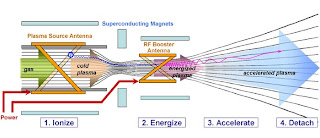
Although the expected thrust of the system isn't high enough to overcome planetary gravity and it must be launched into orbit using conventional rockets, the continuous (if low powered) thrust of the VASIMR system allows for the build up of velocities which substantially decreases overall travel time between planets.
VASIMR is one of a dozen or so ion or "plasma type" propulsion systems currently on the drawing board, according to the Atomic Rockets list of potential engines for spaceflight which includes some basic VASIMR schematics. According to the website, one of the main advantages of the systems is it's ability to "shift gears" and "trade exhaust velocity for thrust."
Until recently however, VASIMR was considered one of the least likely plasma propulsion systems to ever become commercially viable given that quite a few different plasma designs have been ground tested and a few (including Hall effect thrusters, arcjets and ion thrusters) are either already operational as part of existing satellite propulsion/ steering systems or else have been at least successfully tested in the space environment.