Showing posts with label Robert Richards. Show all posts

Monday, June 05, 2017

Only Seven Years after Bob Richards Left Canada, His Rover is Going to the Moon

          By Brian Orlotti

With the recent launch of New Zealand-based Rocket Lab’s Electron rocket, the path is now open for the first private lunar mission later this year. This mission, led by US-based Google Lunar X-Prize team Moon Express (MoonEx), is a sobering example of Canadians being both leaders and laggards in the NewSpace industry.

MoonEx co-founder and CEO Richards shows off an early model of the MX-1 lunar lander in 2013. As outlined in the October 1st, 2015 Geekwire post, "Moon Express and Rocket Lab make deal for lunar landings in 2017," Moon Express had "reserved three lunar lander launches from a startup called Rocket Lab starting in 2017, with an eye toward putting robots on the moon’s surface and winning the lion’s share of the $30Mln US ($40Mln CDN) Google Lunar X Prize." Last weeks successful launch of the first Rocket Lab Electron rocket, as outlined in the May 29th, 2017 post, "Rocket Lab Launches "Orbital Class" Rocket From a Private Launch Pad," suggests that the original plan is moving forward. Photo c/o Moon Express via You-Tube.

MoonEx was co-founded in 2010 by Dr. Robert "Bob" Richards, a Canadian expat entrepreneur with an extensive resume in the space sector, including a stint as director of the space division at Toronto, ON based Optech Incorporated which, as outlined in the April 30th, 2015 Teledyne Dalsa press release, "Teledyne Acquires Remaining Interest in Optech," is now known as Teledyne Optech, and specializes in laser-based imaging (i.e. LIDAR).

While in Canada, Richards also co-founded the International Space University (ISU), Singularity University and Students for the Exploration and Development of Space (SEDS).

MoonEx’s business plan is centered around providing robotic transportation to the Moon's surface as well the sale of lunar data. The company’s long term goal is the extraction of lunar resources, such as rare-earth elements (like niobium, yttrium and dysprosium) as well as water (for making rocket fuel).

To achieve these goals, the company has developed the MX-1 spacecraft.

As outlined in the June 2nd, 2017 Popular Mechanics post, "First Private Moon Landing Gears Up for Launch by Years End," Moon Express and Rocket Lab have only a tiny launch window before the end of 2017, when the the deadline to win the Google's Lunar X Prize competition expires. As outlined in the article, "a lot needs to happen to pull off the moon landing before the close of 2017," including two more test flights, and then two commercial flights (for other paying customers) before the Moon Express launch in December. Screenshot c/o Popular Mechanics.

The MX-1 robotic spacecraft platform is a toroidal (doughnut-shaped) design powered by solar cells and having an engine that uses both hydrogen peroxide and kerosene fuels. Moon Express envisions the MX-1 as a flexible, multi-role spacecraft platform that can perform a variety of tasks cheaply and cost-effectively.

In addition to lunar exploration, the company foresees the MX-1 platform fulfilling roles in earth observation, space debris cleanup, satellite refueling, cube-sat deployment and as a space tug. Moon Express’ lunar lander is now based on the latest iteration of the platform, the MX-1E.

The MX-1E lander will be carried by Electron rocket to low-Earth orbit. The spacecraft will then fire its thrusters, cruise through space, conduct a braking burn to enter lunar orbit, and finally complete descent and landing burns.

After touchdown on the Moon, the MX-1E will begin brief observations with its suite of five science instruments. After a minute of observation, the MX-1E will fire its rocket engines again and fly to a new location. In addition to completing one of the Lunar X Prize requirements, this hopping from place to place will enable the lander to collect the most science data possible.

Bob Richards discussed his reasons for relocating to Silicon Valley on the December 20th, 2010 edition of "The Space Show with David Livingston." In the interview, Richards said that he felt that “the place to be for commercial space is the United States at this point in time, and the epicenter of commercial space is the west coast of the United States.” He also said that, while one of his most rewarding periods was made possible through the backing of the Canadian Space Agency (CSA) for his work on the Phoenix Mars Mission, “if you take a look at the (CSA) budget, it’s only a small fraction of what NASA gets.” Besides, in 2010 Canada was simply “not a good place” to build a commercial space company. MoonEx was co-founded by Richards, Naveen Jain and Barney Pell out of Mountainview, CA in August 2010. Screenshot c/o The Space Show with David Livingston.

One of the instruments on the first mission will be a small experimental telescope from the International Lunar Observatory Association (ILOA). The public will be given the opportunity to select targets for viewing. ILOA ultimately aims to construct a large optical/radio telescope at the Moon’s south pole, granting them an unobstructed view of the deep universe, with MoonEx’s MX-1E platform quite possibly doing the heavy lifting.

Bob Richards and his team are to be commended for their patience and perseverance which have enabled them to nearly reach their goal. However, it is tempting to wonder what Richards (and other expats) could have achieved in Canada if our country’s investment and regulatory climates enabled space entrepreneurs to thrive.
Brian Orlotti.
  ______________________________________________________________

Brian Orlotti is a regular contributor to the Commercial Space blog.

Sunday, January 22, 2017

If Justin Trudeau Wants " Moon Shots," He Should Look to the Moon!

          By Chuck Black

As outlined in both Federal government literature and in a recent editorial in the Toronto Star, Prime Minister Justin Trudeau is looking for "Moon Shots."

Prime Minister Justin Trudeau is supposedly pursuing every available option to build actual policies around the concept of "Canada's innovation agenda." As the Friendly Giant once used to say, perhaps the PM should, "Look up - Way up!"  Photo's c/o Singularity Hub & Hollywood Life.

The Federal government's website on "Canada's Innovation Agenda, Innovation for a Better Canada, What you Told Us," provides some context for the type of "Moon Shots," the Canadian PM is interested in. 

As outlined on the website:
In a previous generation, the United States was inspired to put a man on the moon. 
That mission launched breakthroughs and inventions that went well beyond the space program and fueled decades of innovation driven by science and technology. 
Canadians yearn for a similar kind of vision and leadership. Many called for government to take a proactive role in sponsoring "moon shots" that would keep Canada at the forefront of science and technology.
"Moon shots" were also the topic of the January 13th, 2017 Toronto Star post, " Should Ottawa be aiming for a 'moonshot?'" which was written by author Paul Wells and focused on a report compiled for the Trudeau government by east coast based market research company Corporate Research Associates (CRA).

CRA was commissioned to run focus groups and collect data for Canada's Innovation Agenda, the long promised, but so far mostly aspirational, Trudeau government policy platform being developed to "make Canada more innovative." 

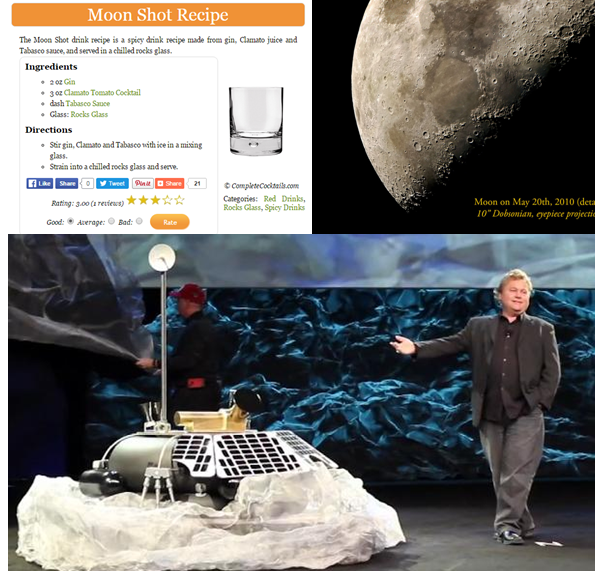
Three types of "Moon shots" not covered by Federal government sub-contractors organizing focus groups on "Moon shots" include the mixed drink, the photograph and Moon Express CEO Robert Richards with the rover his company expects to use to land on the Moon. As outlined in the January 17th, 2017 Orlando Business Journal post, "Moon Express Secures $20M for Lunar Mission," the Canadian born Richards, who moved to the US  six years ago in order to fund his dream, is currently the CEO of the first private company to have gained permission from the US Federal Aviation Administration (FAA) to land on the Moon. Now that's a "Moon shot." Graphics c/o Complete Cocktails, Astrophotography Tonight & The Orlando Business Journal.

However, when it came to defining a "Moon shot," or putting the concept into terms the average focus group could understand, the pollsters at the CRA, seem to have drawn a blank. 

As outlined in the article:
... it's hard to believe the pollster came up with the examples that were focus grouped (and considered as "Moonshot's"). 
Internet balloons, self-driving cars and drone delivery... they're all projects being developed by X, the long-term research branch of Google. 
Perhaps in the next round of testing the feds should define a moonshot, as 'something Google wants.'
The article also stated that, "Stephen Harper spent $705 million on three Radarsat satellites that aren’t even scheduled to launch before 2018. Trudeau wanted to be different. He seems to be getting shaky advice on what “different” would look like."

Interesting January 2017 tweets from Toronto Star author Paul Wells and MacDonald Dettwiler (MDA) public affairs director Leslie Swartman (later re-tweeted by CSA Director General for Space Exploration Gilles Leclerc) on past Canadian accomplishments which might reasonably qualify as "Moon shots" and could certainly be discussed in focus groups. Screenshot c/o Twitter.

Another problem with the current concepts surrounding the idea of "Moon shots" is simply that large governments are no longer perceived as being the go-to organizations for fundraising and fulfillment on "Moon Shot" style projects.

Graphic c/o QuoteHD.com.
And why should they be?

Private sector corporations such as SpaceX, Moon Express, Planetary Resources, Deep Space Industries and others are currently the ones planning trips to the Moon and Mars and developing the technologies needed to exploit those voyages.

Government organizations such as NASA, the European Space Agency (ESA) and the Canadian Space Agency (CSA) have programs which have slowly become far more expensive and far less inspirational, with longer time-frames, and with a great deal of "tentativeness," "hyperbole" and cost overruns attached to their ultimate goals.

The future of "Space shots," at least from the current public's perspective, may essentially rest with the private sector.

The concept of the Trudeau government seriously contemplating the idea of "Moon shots" without even once referencing the reality of our current capabilities (where small, privately held start-ups like Moon Express can consider actual trips to the Moon), is an obvious error.

Maybe the next time the Trudeau government funds a survey of potential "Moon shots," they could include a couple of options related to the Moon, or rockets, or rocket science or even something simply related to "space," like the Canadarm or the various RADARSATs.

They could then more effectively determine if the true role of the Trudeau government, at least in this case, is to "lead, follow or get out of the way."
Chuck Black.
___________________________________________________________

Chuck Black is the editor of the Commercial Space blog.

Monday, February 15, 2016

ISU Wants an American Campus

          By Brian Orlotti

The Strasbourg, France based International Space University (ISU), founded in 1987 by X Prize Foundation founder and chairman Peter Diamandis, human space exploration advocate Todd Hawley and serial space entrepreneur Robert D. Richards, is seeking bids from American educational institutions to establish a permanent US based campus.

ISU founders Diamandis and Richards celebrating its 25th anniversary in 2012. In the beginning, at least according to Richards, "the first "I" in "ISU" was Canadian," although, as outlined in more recent reports such as the June 18th, 2012 post "Canadian Space Agency "Pulling Financial Support" for International Space University," the statement is less accurate these days. Todd Hawley, the third ISU co-founder died in 1995 from complications from AIDS. His ashes were later shot into space along with the ashes of Gene Roddenberry, Timothy Leary and 21 other founding thinkers and supporters of space exploration. Screen shot c/o ISU.

As outlined in the February 9th, 2016 press release, "ISU Seeking US partners to Compete to Host New Space Entrepreneurship Institute," the new campus location, to be called the Robert A. Heinlein Institute for Space Entrepreneurship & Space Innovation (after the acclaimed and controversial science fiction author) will offer training, conduct research and host events pertaining to the emerging global commercial space industry.

The move is a considerable broadening of the ISU's mandate that promises to bring new players and new perspectives to the space sector.

The ISU is an unaccredited educational institution that serves as a global nexus for space scientists and engineers. The ISU offers a Master of Science in Space Studies (MSS) degree as well as its flagship Space Studies Program (SSP), a multidisciplinary professional development workshop held every summer at various locations around the world. Supported by various national space agencies and other organizations from around the world, the ISU's faculty currently stands at 100 members. Over 4,000 students from over 100 countries have graduated from the ISU.

ISU 2016 poster. Graphic c/o ISU.

The rise of NewSpace companies like SpaceX, Blue Origin, Bigelow Aerospace and Planet Labs highlight the evolution of space from a static government dominated sector to a growing  business-oriented one. This evolution has spurred a need for skill-sets outside of science and engineering.

A similar evolution occurred in the information technology sector. In its first decades, the computer industry comprised only a few firms and a small, narrowly focused workforce. Later, as computer technology became democratized and widespread, the computer industry grew and diversified (even subsuming other industries like telecommunications).

The more evolved information technology industry required skill-sets beyond the traditional programming and hardware design. With growth came new jobs and new career specializations like web development, network design and operations support. A new duality emerged; those who created new technologies and those who built and maintained new infrastructures that utilized them.

According to Commander William T. Riker (played by actor Jonathan Frakes, on the right) in the Star Trek: The Next Generation  episode, "The Royal," when the train comes in, "everybody rides!" Photo c/o Startrek.com.

The Robert A. Heinlein Institute for Space Entrepreneurship & Space Innovation could become both industry incubator and training ground for the next generation of space workers. A virtuous cycle may emerge; a growing space industry acquiring a growing labour force would wield greater influence both in government and society at large. The space startups of today could grow into the Googles, Apples and Facebooks of tomorrow.

Interested US institutions have until February 29th, 2016 to submit their bids using these request for statements of interest documents.

Brian Orlotti.
The ISU will make their final selection for the Heinlein Institute in September.
______________________________________________________________

Brian Orlotti is a network operations centre analyst at Shomi, a Canadian provider of on-demand internet streaming media and a regular contributor to the Commercial Space blog.

Tuesday, October 06, 2015

Moon Express & Rocket Lab Partner on Google Lunar X-Prize

          By Brian Orlotti

On October 1st, Moon Express, a California-based firm competing for the $30Mln USD ($39.3Mln CDN) Google Lunar X-Prize, announced that it has signed a contract with startup Rocket Lab Inc. for five launches on its innovative new Electron rocket, with the first launch scheduled for 2017.

December 2013 Moon Express info-graphic showing the various missions of the MX-1.  As outlined in the DEcember 8th, 2013 Gizmag article, "Moon Express reveals design for its MX-1 lunar lander," three-quarters of the (600 kg /1,320 lb) launch mass of the MX-1 will be fuel for its main rocket engine, in order to propel the spacecraft toward the Moon, and then soft land on the lunar surface. Graphic c/o Moon Express.

The deal is a milestone for the NewSpace industry, bringing together the pieces needed for its first venture beyond Earth orbit.

The Electron rockets will carry Moon Express' MX-1 landers to the Moon on a series of missions, which will entail evaluation of the lander's systems, fulfillment of the Google Lunar X-prize goals (which include capturing high-definition video/images as well maneuvering a rover on the lunar surface) and, ultimately, acquiring lunar soil and rock samples and returning them to Earth.

XM-1 and Bob Richards. Photo c/o Gizmag.
Moon Express was co-founded in 2010 by Dr. Robert (Bob) Richards, a Canadian entrepreneur with an extensive resume in the space sector, including a stint as director of the space division at Optech Incorporated (a Toronto, Ontario based firm specializing in laser-based imaging i.e. LIDAR) and is co-founder of the International Space University (ISU), Singularity University and Students for the Exploration and Development of Space (SEDS).

The company's business plan is centred around providing robotic transportation to the Moon's surface as well the sale of lunar data. Moon Express' long term goal is the extraction of lunar resources, such as rare-earth elements (like niobium, yttrium and dysprosium) as well as water (for making rocket fuel).  To achieve these goals, the company has developed the MX-1 spacecraft.

The MX-1 robotic spacecraft platform is a toroidal (doughnut-shaped) design powered by solar cells and having an engine that uses both hydrogen peroxide and kerosene fuels. Moon Express envisions the MX-1 as a flexible, multi-role spacecraft platform that can perform a variety of tasks (the “iPhone of space,” according to the company's website) cheaply and cost-effectively.

In addition to lunar exploration, the company foresees the MX-1 platform fulfilling roles in earth observation, space debris cleanup, satellite refueling, cube-sat deployment and as a space tug.

Info-graphic showing the features and functionality of the innovative design. As outlined in the September 19th, 2015 Nanalyze article, "Rocket Lab: Carbon Fiber Rockets Powered by 3D Printing," Rocket Lab’s competitive advantage over other rocket launch systems is their rocket itself which is "91% cheaper to launch than current methods." According to the article, "the company expects their first commercial launch this year with the first 30 rocket payloads being fully booked. Online bookings extend out over the next four years and some launches as far out as 2019 are already fully booked." Graphic c/o Rocket Labs.

The MX-1 landers will travel into space aboard Electron rockets manufactured by Rocket Lab Ltd, a New Zealand-based firm founded in 2007 by engineer Peter Beck and backed by investors that include venture capital firms Khosla Ventures and Bessemer Venture Partners (backers of such firms as LinkedIn, Pinterest, Skype, Verisign and Yelp) as well as US aerospace leviathan Lockheed Martin.

Rocket Lab's Electron rockets are 1.2m wide, two-stage, liquid-fuelled vehicles designed to deliver a 150 kg payload to a sun-synchronous orbit 500 kilometres above Earth. Though not yet in service, the Electron will make use of several innovations that, if successful, promise to both lower the cost and increase the reliability of launch.

Rutherford engines on Electron rocket next to Peter Beck  Photo c/o Rocket Lab.
Firstly, 3D printing is used extensively in the manufacture of the Electron. The rocket's structure is made of 3D-printed carbon composites, which both harnesses carbon fibre's immense strength and low weight and dramatically lowers manufacturing time and cost. Secondly, the Electron utilizes a unique engine named the Rutherford (in honour of New Zealand-born physicist Ernest Rutherford).

The Rutherford Engine is a liquid oxygen/kerosene engine that, in contrast to traditional rockets, uses electrical turbo-pumps. The Rutherford engine also utilizes 3D-printing for its main components, including the thrust chamber, fuel injector, pumps and main valves. These innovations combine to give the Electron rocket an extremely competitive price of just $4.9Mln USD ($6.4Mln CDN). For comparison, the price of a SpaceX Falcon 9 rocket is $61.2Mln USD ($80.2Mln CDN).

Moon Express and Rocket Labs share impressive pedigrees. But with an unproven rocket and competition from other Lunar X-Prize teams, (such as Pittsburgh-based Astrobotic Technology Inc, which plans to deploy its own lunar lander in 2016 aboard a SpaceX Falcon 9 rocket), victory remains far from certain.
Editors note: As per the October 7th 2015 Space.com article, "Private Moon Race Heats Up with 1st Verified Launch Deal," Israeli based SpaceIL has also announced a launch deal agreement with Spaceflight Industries, an American space company which recently purchased a SpaceX Falcon 9 launcher. The company will manifest SpaceIL’s spacecraft as a co-lead spot, which will sit in a designated capsule inside the launcher, among a cluster of secondary payloads.
Brian Orlotti.
Whichever team succeeds, a return to the Moon will signal the next logical step in the evolution of both humanity and the NewSpace industry.   
______________________________________________________________

Brian Orlotti is a network operations centre analyst at Shomi, a Canadian provider of on-demand internet streaming media and a regular contributor to the Commercial Space blog.

Thursday, May 14, 2015

Measuring the Space "Industry" in Canada

          By Chuck Black

According to the Space Economy at a Glance 2014:
Canada has a well-developed space industry, including about 200 private companies, in addition to research institutions and universities, some of which have some commercial activities. 
The ten biggest companies accounted for almost 88% of revenues and 64% of employment (Canadian Space Agency, 2013). Space manufacturing is mainly located in Ontario (more than half of the workforce) and in Quebec (19% of workforce). Some 7 993 people were employed in the space sector in 2012, an increase compared to 2011, with more than half defined as “highly” qualified’ (engineers, scientists and technicians). 
Total Canadian space sector revenues amounted in 2012 to CAD 3.3 billion (USD 3.3 billion), a 4.5% decrease as compared to 2011 (Canadian Space Agency, 2013). Satellite communications applications and services generated the largest revenue share, followed by the earth observation sector. The applications and services segment generated two thirds of total revenues...
Of course, the data used in the OECD publication had to come from somewhere and most of the OECD numbers were referenced from the 2012 State of the Canadian Space Sector Report, the last publicly available document in what used to be an annual Canadian Space Agency (CSA) inventory of Canadian commercial space activities.

All of which suggests that there is a great deal of scope to do further research on the topic, and the generally acknowledged best way to begin this research is to explore something called the Handbook on Measuring the Space Economy.

The free for download publication is designed to provide a summary of the key metrics surrounding the indicators and statistics on the space sector and the larger space economy.

It's also meant to be complementary to the Space Economy at a Glance, which is updated every few years and published through the same Paris, France based organization, the Organisation for Economic Co-operation and Development (OECD).

The CSA certainly respects the methodologies contained within the OECD publications.

As outlined in the August 24th, 2014 post, "Space Agency Seeks Insight into Space Industry," the CSA even explicitly referenced the Handbook the last time it solicited bids of up to $250,000 CDN from "qualified suppliers," able to undertake a "comprehensive socio-economic impact assessment" of the Canadian space sector.

The final deliverable for that CSA contract, originally expected to be completed in January 2015 by winning bidder Euroconsult-EC, has so far not been released for public consumption.

Of course, there are others who also track the aerospace and space industry.

In July 2014, the Aerospace Industries Association of Canada (AIAC) and Industry Canada jointly released an 18 page document called the State of the Aerospace Industry: 2014 Report, which contained an overview of the Canadian aerospace and space industry, using updated "GDP estimates developed by Industry Canada based on different Government Statistical and Tax Agencies as well as from the Canadian Space Agency Annual Space Survey, 2014."

This new report, scarcely more than a power-point presentation and certainly far smaller than the annual CSA report it will seemingly replace, will supposedly cover the far larger and more comprehensive Canadian aerospace industry (where the space industry is a subset) and is also expected to be released annually.

Perhaps...

But for those who don't want to wait for the next government report to tell us what's going on, and are willing to learn a little more about the appropriate methodologies, here's a partial list of business and entrepreneur focused organizations, which are either involved directly or else help support the space industry in Canada.
_________________________________________________________________________________

The Aerospace Industries Association of Canada (AIAC) - A not-for-profit business association advocating on aerospace policy issues that have a direct impact on aerospace and space companies and jobs in Canada. Heavily involved in the November 2012 Aerospace Review, the second volume of which was focused almost entirely on the Canadian space industry. AIAC executive vice-president Iain Christie was recently elected president of the Canadian Aeronautics and Space Institute (CASI) for 2014 - 2015. The organization has also been heavily involved, in partnership with the Consortium for Research and Innovation in Aerospace in Québec (CRIAQ) with the development of the Consortium for Aerospace Research and Innovation in Canada (CARIC).

The Alberta Space Program - A listing of Alberta space imaging, science and business activities "attracting international investment" at the University of Alberta Institute for Space Science, Exploration and Technology (ISSET). Contains links to the Alberta government website on the provincial aerospace and defense industry which "contributes $1.3 billion in revenue annually to the provincial economy, is home to 170 aerospace and aviation companies, and employs over 6,000 highly skilled Albertans."

The Canadian regional chapter of the Association of Manufacturing Excellence (AME) - A part of the larger Association of Manufacturing Excellence, with chapters across the US, the UK and Australia. Whether on Earth or in space, things still need to be manufactured and AME is the leading industry-diverse community with more than 4,000 professionals dedicated to enterprise excellence, continuous improvement, lean methodologies and kaizen techniques in manufacturing. Now, if only someone could bring them up to speed on open design concepts3D-printing and what's going on at places like Hacklab.TO.

The Canadian Advanced Technology Alliance (CATA Alliance) – The largest hi-tech association in Canada. Originally focused on software and telecommunications, CATA provides good background materials on government programs related to innovation, such as the Federal government Scientific Research and Experimental Development (SR&ED) tax credit, the CATA Innovation Nation National Campaign (designed to boost Canada’s competitiveness and innovation rankings) and other initiatives.

The Canadian Aeronautics and Space Institute (CASI) - A nonprofit technical organization for aeronautics, space and remote sensing. The organization hosts a variety of events including the recently concluded 65th International Astronautics Congress (IAC), which was held in Toronto from September 29th - October 3rd, 2014 and the bi-annual CASI Aero and CASI Astro events.

The Canadian Aerospace Industries Capability Database - A once comprehensive listing of 60,000 Canadian aerospace businesses tracked by capabilities and expertise created over a decade ago with input from a variety of provincial and federal aerospace associations in cooperation with Industry Canada. The database was a logical follow-on to the 2002 Federal government paper on Canada's Innovation Strategy, which led over the next few years to the 2005 Canadian Aerospace Partnership (CAP), which led almost immediately to the 2005 National Aerospace and Defence Framework which was eventually superseded by the 2012 Aerospace Review, although the database remains. For those who can't follow the process without a scorecard.

The Canadian Association of Business Incubation (CABI) – Dedicated to the development of new enterprises and supporting the growth of new and emerging businesses, this organization has access to over 60+ Canadian business incubators and accelerators with a broad range of expertise.

The Canadian Association of Defense and Security Industries (CADSI) – The “voice” the Canadian defense and security industries and organizers of the annual CANSEC defence trade shows.

Canadian Solar Industries Association (CanSIA) - An industry lobby group representing 500 solar energy groups throughout Canada formed in 1992 from the amalgamation of the Canadian Solar Industries Association (CSIA) and the Canadian Photovoltaic Industries Association (CPIA).

The Canadian Space Commerce Association (CSCA) – A registered Canadian not-for-profit industry organization existing to advance the economic, legal and political environment for space and aerospace focused companies. Organizes intimate bi-monthly meetings and larger national events for the hobbyist and (sometimes) entrepreneur.

The Canadian Start-up Financing Landscape – An annual assessment from start-up marketer Marc Evans, on where to go to get funding and support for your Canadian start-up. The list is divided up into angel investors, business incubators and accelerators, plus seed, series A and series B funding sources.

The Canadian Venture Capital & Private Equity Association (CVCA) – With over 2000 members with over $105 billion in capital under management, the CVCA represents the majority of private equity companies in Canada. Focused on venture capital (investment in early stage, mostly technology based companies), mezzanine financing (subordinated debt or preferred stock with an equity kicker) and buyout funding (risk investment in established private or publicly listed firms that are undergoing a fundamental change in operations or strategy).

CANEUS International - A unique non-profit organization of professionals involving public/private partnership, serving primarily the needs of aeronautics, space and defense communities by fostering the coordinated, international development of micro-nano technologies (MNT) for aerospace and defense applications.

The Centre for Commercialization of Research - A member of the International Commercialization Alliance (ICA) and one of the Ontario Centres of Excellence (OCE) focused on commercializing research from public institutions.

The Center for Space Entrepreneurship (eSpace) – Although not a Canadian example, this Boulder, CO based 501(c)(3) non-profit organization supports the creation and development of entrepreneurial space companies, the commercialization of the technologies they create, and the workforce to fuel their growth. Well worth using as a model for further Canadian development.

The Commercial SpaceFlight Federation (CSF) – Another non-Canadian example worth emulating. The 40 businesses and organizations who are members of the CSF provide a comprehensive snapshot of the emerging international NewSpace industry. Canadian members include MacDonald Dettwiler (MDA) and others.

The Consortium for Aerospace Research and Innovation in Canada (CARIC) – CARIC is a joint initiative of the Aerospace Industries Association of Canada (AIAC) and the Consortium for Research and Innovation in Aerospace in Québec (CRIAQ) to create "a national research and technology network that unites stakeholders from industry, universities, colleges and research institutions" across Canada. Uses the CRIAQ, funding and collaborative model.

The Delta-V Space Accelerator - Australia's first space start-up, industry led accelerator is a partnership between Saber Astronautics Pty LtdLaunchbox Pty Ltd, the Australian Centre for Space Engineering Research (ACSER) at the University of New South Wales (UNSW) and the SpaceNet group at Sydney University. Focused on developing start-ups building  lightweight, 3-D-printed nanosats, low-cost, re-usable launch systems, smart sensors, machine learning, big data and/ or autonomous robot development.

Deltion Innovations – Billed as "Sudbury's first aerospace company" and focused on the design and fabrication of terrestrial and space mining systems, the organization also helps to organize the annual Planetary and Terrestrial Mining Sciences Symposium. Originally part of the Northern Centre for Advanced Technology (NORCAT).

The various European Space Agency (ESA) Business Incubation Centres (ESI) and the European Space Incubators Network (ESINET) – The ESA spends a lot of time and effort supporting small and innovative space focused firms. The work done through these two organizations is well worth investigating for lessons which are also applicable for Canada.

The Intellectual Property Institute of Canada (IPEC) – A national association comprised of over 1,700 members from Canada and abroad. Members include patent agents, trade-mark agents and lawyers specializing in intellectual property. This is the first stop on the line if you're a rocket scientist looking to protect your trade, and any other of the secrets you might need, to run a business. 

The Information Technology Association of Canada (ITAC) - Not especially space related (unless you're familiar with the partnerships developed in Great Britain between the IT and space advocacy communities, which led to the creation of the UK Space Agency in 2010), but heavily involved in much the same issues of government procurement, innovation and commercialization. Even better, many of the entrepreneurial leaders in the current NewSpace community (Elon Musk and Jeff Bezos, for example) started in IT. The panel chair of the 2012 Review of Federal Support to Research and Development (the "Jenkins panel," which directly effected Industry Canada (IC) and Canadian Space Agency (CSA) activities) was Tom Jenkins, then the executive chairman and chief strategy officer of Waterloo based Open Text Corporation, a member in good standing of ITAC.

Kentucky Space – Another of those international examples which ambitious Canadians need to learn more about. This US based non-profit consortium comprising the University of Kentucky, Morehead State University, the NASA Kentucky Space Grant Consortium and EPSCoR Programs plus Belcan Corporation (a Cincinnati, OH based engineering headhunting firm) is focused on the research and development issues of small entrepreneurial and commercial space solutions. Managed by the Kentucky Science and Technology Corporation.

The MaRS Discovery District – A Toronto business incubator focused on the medical and IT industries but open to new ideas. Maintains the MaRS Funding Sources Directory, a listing of provincial, national and international funding sources suitable for Ontario companies in both the public and private sectors.

Mitacs – A national, not-for-profit research organization focused on building "partnerships between academia, industry, and the world – to create a more innovative Canada." Offers a suite of research and training programs "which enable companies to connect with top Canadian and international researchers."

The MoneyTree Report on Venture Capital investment in the United States - A quarterly report compiled by PriceWaterhouseCoopers (PWC) and the US based National Venture Capital Association (NVCA) which tracks venture capital activity in the United States by region, industry, funding stage, financing sequence, investing fund and receiving firm.

The National Angel Capital Organization (NACO) – An organization of Canadian angel capital investors. NACO connects individuals, groups, and other partners that support angel-stage investing; provides intelligence, tools and resources for its members; facilitates key connections across networks, borders and industries and helps to inform policy affecting the "angel asset-class."

National Crowd Funding Association of Canada (NCFA) - An organization billing itself as "Canada’s crowd funding hub," the NCFA works closely with industry groups, government, academia, other business associations and affiliates to create a strong and vibrant crowd funding industry and voice across Canada. 

NewSpace Global – Provides accurate and critical information on international NewSpace focused organizations and opportunities. NSG publishes a variety of items for subscribers, including the always up to date NewSpace Watch online news service and the Observer company database, which tracks the top international NewSpace companies. Subscribers include Fortune 500s, universities, government agencies, small and large corporations, and space industy investors.

The Ontario Aerospace Council - One of several regional, not for profit associations of aerospace firms across Canada tasked with enhancing industry competitiveness. Others include Aero Montreal, the Aerospace Industry Association of British Columbia (AIABC), the Manitoba Aerospace Association and the Unmanned Vehicle Systems Canada (UVS).

The Space Angels Network – an American based network of angel investors that also accepts investors and clients from Canada and Europe. Sponsored by the Center for the Advancement for Science in Space (CASIS), Spaceflight Services (a one stop shop for manifests, certification and integration of small satellites into a network of established and emerging launch and space transportation vehicles), the Habif, Arogetti and Wynne accounting firm, SpaceNest (an Israeli based space incubator) and the Jones Day law firm. Strategic partners include the Space Foundation ( a Colorado-based nonprofit "advocate" for the global space industry), the Space Frontier Foundation, the UK based Catapult Satellite Applications Corporation, the Australian based Delta-V Space Accelerator and venture fund Gust.

The Space Frontier Foundation - US based advocacy group which believes that the barriers to space exploration are "primarily found in the bureaucratic status-quo of the government space program," and that change must come externally, through entrepreneurship. Organizers of the annual NewSpace business plan competition

Space Works Commercial – A US based aerospace engineering and design incubator focused on next-generation space transportation systems, future technologies, human and robotic exploration of space, emerging space markets and their applications.

Start-Up Canada – Entrepreneur led, national movement to enhance the nation’s competitiveness and prosperity by supporting and celebrating Canadian entrepreneurship.

The TechConnex Hub - Typical of efforts across Canada (although perhaps more successful), this association acts as an industry-directed hub for small and mid-size tech businesses throughout the greater Toronto area.

TheFunded.com – An online community of over 20,000 CEOs, founders and entrepreneurs who get together to discuss fundraising, rate and review angel investors and venture capitalists, and exchange ideas for strategies to grow start-up businesses. A part of the Founder Institute.

Support our Patreon Page