Showing posts with label Funding "rocket science". Show all posts

Tuesday, October 23, 2018

Those New Maple Leaf Brand Rockets

          By Brian Orlotti

Propulsion engineer Adam Trumpour has unveiled the Launch Canada Rocket Innovation Challenge, Canada’s first major rocket competition. The contest will offer Canadians the opportunity to build a home grown space launch capability, in turn fostering a vibrant private launch industry.


The announcement was made on October 18th, 2018 at the Montreal Space Symposium.

Launch Canada seeks to enable Canada's growing student rocketry community to take their activities to the next level by embracing the idea of ‘grassroots rocketry.’ Referring to the success of firms like Hawthorne CA based SpaceX, Kent Washington based Blue Origin and Huntington Beach CA based Rocket Lab, Trumpour made the point that groups initially made up of amateurs have achieved success and are now building sophisticated spacecraft and pushing the envelope of a host of technologies. It is this success that he wishes to replicate in Canada.

Trumpour’s motivations behind the contest are varied, but include the desire to reverse the decline of  Canada’s space sector, undoing Canadians’ self-limiting colonial mindset, diversifying Canada’s economy and creating new opportunities for Canada’s workforce. 

Adam Trumpour. Photo c/o CSCA.
The Launch Canada Challenge will consist of three prize categories meant to encourage the development of Canadian rocketry talent and launch vehicle technologies:
  • Beginner Launch Challenge – A more accessible challenge intended for less experienced teams to build their expertise and interact with the larger Canadian rocketry community. It will involve building and launching a rocket to an altitude of 10,000 feet. The use of off-the-shelf hobby rocket motors will be permitted.  Points will be awarded for reaching the target altitude as well for demonstrating a useful payload.
  • Subsystem Design Challenge - This challenge will allow teams to develop and demonstrate rocket technologies at the component or subsystem level. Adopting a ‘Dragon’s Den’ style approach, teams will make a pitch to a panel of judges, outlining potential business cases for their technology amidst the broader competitive landscape,
  • Advanced Launch Challenge - This challenge involves the successful launch of student-developed rocket vehicles to high altitudes. The emphasis will be on overall systems engineering, incentivizing the use of innovative technologies and concepts as well as the development of reusable launch vehicles.
Launch Canada is intended to be a recurring annual competition (beginning in Summer 2019) with prize money allocated as a percentage of donations raised from industry. The current prize purse, consisting of donations from several Canadian rocket engineers, is $30,000 CDN.

Trumpour is modelling Launch Canada on the Base 11 Space Challenge, an ambitious $1Mln US ($1.3Mln CDN) competition for the first student-built liquid-propellant rocket to reach space. Trumpour currently sits on the Base 11 Space Challenge’s Safety Committee, conducting rocketry safety training for all teams and several Canadian teams are competing in the Base 11 challenge.


The Launch Canada Rocket Innovation Challenge comes at a branch-point in Canadian history.

The United Sates’ behavior during the recent NAFTA renegotiation, culminating in US President Donald Trump’s repeated threats to the Canadian economy, have made clear the need for Canada to protect its homegrown talent and diversify its trade. An independent Canadian space launch industry would offer greater opportunity, keep Canadian talent at home and protect our nation’s space activities from foreign interference.   

Perhaps, on a day not far from now, maple Leaf-bearing rockets could propel us away from America’s grip.
Brian Orlotti.
  ______________________________________________________________

Brian Orlotti is a network operator at the Ontario Research and Innovation Optical Network (ORION), a not-for-profit network service provider to the education and research sectors.

Monday, October 15, 2018

Blue Origin Joins the US Military Rocket Building Club

          By Brian Orlotti

The US Air Force (USAF) has awarded a total $2.3Bln US ($3.0Bln CDN) in contracts to three firms to develop launch systems for national security payloads. The announcement is a watershed moment, highlighting the entry of a new player as well as new technology into the US national security launch apparatus.


The military contracts were awarded to:
As outlined in the October 10th, 2018 Ars Technica post, "The military chooses which rockets it wants built for the next decade," the contracts are part of a US Department of Defense initiative to ensure stable military access to space and end US reliance on foreign-made rocket engines, such as the ULA Atlas V rocket, which uses Russian RD-180 engines.

Blue Origin’s and Northrop’s prototype vehicles are expected to be ready to fly by late 2024 while ULA’s Vulcan rocket is to be completed by March 2025.


Blue Origin’s award is of particular note, as it is the second NewSpace firm to win a US military contract after Hawthorne, CA based SpaceX. The USAF’s selection of Blue Origin is likely the hedging of bets to avoid dependence on SpaceX or any other single firm, a situation which happened previously with ULA. 

From its formation in 2006 as a joint venture between Sunnyvale CA based Lockheed Martin Space Systems and Berkley MI based Boeing Defense, Space & Security ULA dominated and served as the sole supplier for US military space launches until 2017, when SpaceX received accreditation.

It's worth noting that SpaceX received permission to launch military payloads only after it had an operational Falcon-9 program lofting commercial satellites into orbits. The SpaceX Falcon Heavy launcher (which was funded through NASA commercial crew contracts) is already certified for all Air Force requirements and, as outlined in the June 21st, 2018 post, "Air Force certifies Falcon Heavy, orders satellite launch for 2020," SpaceX currently has outstanding military contracts for the launcher.

In essence, the new awards will each cover the substantial research and development costs needed to roll out operational versions of what are essentially design studies, something not needed in the case of SpaceX.

Besides, the SpaceX Falcon Heavy launcher (which was funded through NASA commercial crew contracts) is already certified for all Air Force requirements. As outlined in the June 21st, 2018 post, "Air Force certifies Falcon Heavy, orders satellite launch for 2020," SpaceX currently has outstanding military contracts for this operational launcher.


Blue Origin’s New Glenn is a two-stage heavy-lift orbital launch vehicle, development of which began in 2012.

With a 7-meter (23 ft) diameter, the New Glenn with a reusable first stage as well as an optional third stage. Its first stage will be powered by seven in-house designed and built BE-4 liquid methane/oxygen engines producing 17,000 kN (3,800,000 lbf) of liftoff thrust.

New Glenn will be built at Blue Origin’s Florida factory and launched from Cape Canaveral Air Force Station. In addition to commercial and military satelite launches, New Glenn will also be available for space tourism flights.

New Glenn’s first stage boosters are reusable and will be recovered downrange on the Atlantic Ocean via a ship acting as a floating landing platform in much the same way as SpaceX’s Falcon rockets.

The awarding of the USAF contract appears to have enabled Blue Origin’s further expansion. Following the USAF’s announcement, Blue Origin revealed that it will build a second launch site at Vandenberg Air Force Base in California, enabling the company to launch from both the east and west coasts.

In addition, ULA announced in September that its upcoming Vulcan rocket will be powered by Blue Origin’s BE-4 engines.

Of course, providing US government funding to launch providers to develop new rocket launchers is a service not restricted to the military. NASA is also funding an entry for the next generation of rockets with the Space Launch System (SLS), a space shuttle derived super heavy-lift expendable launch vehicle, which has been having more than its fair share of cost overruns and funding shortfalls.


Blue Origin’s entry into the realm of national security space launch is a hopeful sign that the space sector can learn from past mistakes, which include being locked into single supplier monopolies (a la ULA), cost-plus procurement contracts (which reward cost overruns) and expensive, single use launchers.

With multiple launch providers pursuing multiple markets and goals, the coming decades of space exploration will be far livelier than previous ones.
Brian Orlotti.
  ______________________________________________________________

Brian Orlotti is a network operator at the Ontario Research and Innovation Optical Network (ORION), a not-for-profit network service provider to the education and research sectors.

Tuesday, January 03, 2012

Satellite Collisions, Astronauts Grounded, Astronomy Slashed & Canada "Lost in Space"

Here's a quick listing of stories being tracked over the holiday season for future posts in the Commercial Space blog:


Space Debris from Philipp Seiffert on Vimeo.
  • According to the January 2nd, 2012 Postmedia News article "Satellites on a course to collision" the Canadian Space Agency (CSA) has needed to fire up the thrusters on Canada's $500-million Radarsat satellites five times over the last year in order to move them out of "harms way" and avoid the possibility of an orbital collision.The article quotes CSA Director General of Space Science and Technology David Kendall as stating "the numbers of near-misses are going up, rather alarmingly." According to the article, "collecting trash may not have the glory of walking on the moon, or rocketing off to the International Space Station, but it is a potential growth industry." The article mentions BC based MacDonald Dettwiler (MDA) and Ontario based Com Dev International (ComDev) as being firms well positioned to take advantage of this new market who have recently received CSA funding. However, as outlined in my November 2nd, 2011 post "Will US Allow Canada to Bid On-Orbit Satellite Servicing Contracts?" MDA has suspended its related on-orbit satellite servicing program until the company knows whether it will be allowed to bid on upcoming US government contracts, which suggests concerns over  the long-term viability of any Canadian program in this area. For a description of the CSA contracts referenced in the article, it's worth checking out my October 30th, 2011 post "Weather Sats, CSA Contracts, Isle of Mann, New Magellan Facility & John MacDonald."
Canada's "last" astronaut?
  • The December 26th, 2011 Canadian Press article “Canadian Astronauts could be grounded for years after next mission” reports that “Canadian astronauts could be stuck on the ground for years following Chris Hadfield’s space mission scheduled for 2012.” The article quotes CSA Director General of Space Exploration Gilles Leclerc as stating that "according to our agreement on the International Space Station we don't have a flight -- beyond Chris Hadfield -- before the end of the decade." According to the article, "because it helped build the space station using the giant robotic Canadarms, Canada gets "credits" for trips to the space station" but unfortunately, "Canada has no credits left after Hadfield's flight." According to Leclerc, "we're trying to negotiate a flight before 2019, obviously."

    Canadians, eh?
    Taken together, these articles paint a picture of a Canadian space program in crisis. It's certainly reasonable to expect new updates and information to come to light on these topics over the next little while, so stay tuned.

    Monday, January 02, 2012

    A REAL Trend in 2011: Hawking Products with Space

    Not quite the future?
    While space pundits pour over articles like the December 23rd, 2011 Mashable post "Top Space Stories of 2011" or the January 1st, 2012 Gizmodo story "The Best Space Stories of the Year" in order to discover whether or not the recent retirement of the US fleet of space shuttles is a more important story than the successful orbiting of the unmanned Chinese Tiangong-1 space lab, the real trend of 2011 seems to have gone almost entirely unnoticed.

    What is the real space trend of 2011?

    That's simple. After a very long decline into seeming irrelevance, space and space focused activities are slowly starting to become cool again. This rising interest has been noticed by numerous commercial companies which have incorporated the space "meme" into a variety of marketing campaigns.


    For example, take the recent viral marketing campaign for Natural Light beer, as described in the November 29th, 2011 Huffington Post article "Natural Light Is First Beer In Space, Launched By Brew's Facebook Fans."

    Richard Branson.
    Of course, the grandaddy of current efforts at incorporating the space "meme" into marketing campaigns has to be Richard Branson and his efforts to jump start an entire industry wrapped around space tourism with Virgin Galactic, a company which (almost as an afterthought) also manages to provide huge amounts of publicity for the brash British billionaire and his entire Virgin Group conglomerate of 400 travel, entertainment and lifestyle companies.

    But there are others and some of them come from the oddest of places.

    Here are a few additional examples, from the Trendhunter website, which bills itself as the most popular and largest collection of cutting edge marketing ideas on the web:


    • According to the September 6th, 2011 article "Extra-terrestrial Take Out: The Domino's Moon Base Will Serve Astronauts and Cosmic Explorers Alike," the Japanese wing of Ann Arbor, MI based Domino’s Pizza "has recently announced their intention to build an outlet on the surface of the Moon. Thus far, the company has already commissioned plans for a two-storey, dome-shaped pizzeria which would simultaneously serve pizza and house its staff." Although primarily a publicity stunt, the marketing campaign is a direct throwback to the glory day of space imagery in the 1960's when many restaurants and commercial products (like Tang, a fruit flavored drink) used real and perceived links to the US space program in order to convey positive imagery and to help sell their products.

    • Of course, man does not live by bread alone so otherworldly alcohol will also be needed to help astronauts wash down their pizza, at least according to the April 13th, 2011 article "Vostok Space Beer is Approved for Outer Space Consumption." According to the article, the beer (developed by Australian brewer 4-Pines Brewing in partnership with Saber Astronautics) has a lower carbonation level, which helps lower the chances of what the article calls "space burps" and "an enhanced flavor designed specifically to counteract the swelling of the tongue that occurs in orbit, which reduces taste sensitivity." This makes the product entirely different from the beer developed by the Sapporo Brewery and profiled in the December 4th, 2009 article "Sapporo is Selling Beer Made from Barley That Spent Time in the Cosmos" which is made using barley "directly descended" from "seeds that spend five months in space (aboard the International Space Station in 2006)." Given that the Sapporo beer was created using ingredients grown in space, there are obvious implications for long-term space habitation as outlined in the December 8th, 2008 Astro-Engine article "The Link Between Beer and the Colonization of Space." 

        • The July 27th, 2011 list of "25 NASA Inspired Creations: From Lunar LEGO to Space Explorer Duds" gives a broader idea of some of the marketing areas being co-opted by space based concepts and images. These include space ship inspired footwear, giant spaceship rides for kids, audio speakers inspired by NASA, space shuttle models made from LEGO's and quite a few others. 

        Look for this trend to expand and grow throughout 2012.After all, even American politicians running for public office have begun to talk about space.


            Monday, December 05, 2011

            The Polar Communications & Weather Mission

            According to rumours circulating around Canadian Space Agency (CSA) headquarters, impending CSA budget cuts expected to occur next March, will essentially eviscerate all new initiatives, leaving only the federally supported RADARSAT Constellation program for the CSA to administer.

            The only exception in this scenario might possibly be the Polar Communications & Weather (PCW) mission.


            As described in my July 27th, 2009 post "MDA Signs Contract For Polar Communications and Weather Mission," the PCW mission "is designed to facilitate Canadian operations in the north and support Canadian sovereignty by providing reliable and continuous space-based communications services and timely meteorological information." The mission would consist of two satellites in molniya-type orbits, supported by one northern ground station and connected to communication satellites in geosynchronous orbit with other connections to various portions of the telecommunications infrastructure.

            According to the "Polar Communication and Weather mission (PCW)" overview on the CSA website, the PCW mission will cover portions of Canadian territory which are not covered by the current crop of geostationary communications satellites (GEO) in order to ensure 24/7 communications, plus accurate short term weather and long term climate forecasts.

            According to the Defence Research and Development Canada website on the PCW program, the CSA, the Department of National Defence and Environment Canada are partnering on the PCW project.

            It will be interesting to see if the program survives the budget process.

            Saturday, November 19, 2011

            Space Based Solar Power Findings Finally Released

            The US based National Space Society (NSS) and Space Canada, an Ontario based not-for-profit organization advocating space based solar power, are jointly trumpeting recently released findings on what they call a "ground-breaking space solar power study," according to the November 15th, 2011 post on the NSS blog titled "National Space Society Hails Space Solar Power Study Findings."

            But of course, the real story isn't so much related to the findings (which were perilously close to being preordained given the longtime public advocacy of the major contributors) but instead involve the potential for international political advocacy that follows from a public report which collects together most of the major literature into a single, referenced document.


            According to the press release, this three year, ten nation study, titled "Space Solar Power — The First International Assessment of Space Solar Power: Opportunities, Issues and Potential Pathways Forward,” confirms the "possible" readiness of using space solar power technology within the decade.

            The study was conducted by the International Academy of Astronautics (IAA) and co-chaired by John Mankins, a longtime space solar power advocate and the President of ARTEMIS Innovation Management Solutions.

            Most of the Canadian contributions came out of the 2009 Space Canada Symposium on Solar Energy from Space, which included presentations from Dr. Richard Peltier, the Director of the Centre for Global Change Science at the University of Toronto; Dr. Robert Zee, the Managing Director of the Space Flight Laboratory at the University of Toronto Institute for Aerospace Studies; Dan Fortin, the General Manager of IBM Canada; Liberal MP and ex-astronaut Marc Garneau; CBC radio Quirks and Quarks host Bob Macdonald and quite a few others.

            According to Colonel M.V. "Coyote" Smith, the Director of the US Air Force Center for Strategy and Technology Project Blue Horizons and a Professor of Strategic Space Studies at the US Air Force School of Advanced Air and Space Studies (SAASS):
            The long view for Space-Based Solar Power is to develop it into a global wireless power transfer system using the concepts Nikola Tesla demonstrated even before the turn of the 20th Century. 

            With investments made now, at the turn of the 22nd Century a system of SBSP Satellites on orbit will broadcast safe, clean, electrical energy directly to all devices, vehicles, homes, and businesses on the planet — wirelessly. No wars for energy, plenty of power for desalination, a cleaner environment, fair resource sharing on the planet, and a thriving space economic sector. 

            Isn't this what government and industry should be working for?
            It's taken the major players three years to get to this point. It will be interesting to see their next step. 

            Friday, October 21, 2011

            Abu Dhabi Bullish on Virgin Galactic

            Abu Dhabi based investment company Aabar Investments has boosted its stake in space tourism company Virgin Galactic by an additional $110 million USD to bring it's total equity in the company to 37.8% from 31.8%.

            According to the October 19th, 2011 Wall Street Journal MarketWatch article "Abu Dhabi's Aabar boosts Virgin Galactic stake," Aabar made the additional $110 million investment in Virgin Galactic in July, 2011.


            The original July 2009 investment  included an Aabar commitment of $100 million USD to fund a "small satellite launch capability" plus money for construction of a spaceport in Abu Dhabi, the capital of the United Arab Emirates. Other publicly announced Virgin Galactic launch sites include:
            According to the October 20th, 2011 post in the Space Business Blog titled "Investing in Virgin Galactic" there are three possible reasons for this additional investment:
            1. Preparations for new growth ( such as nanosat launch vehicles or other new products).
            2. Paying for the delays in reaching commercial operations for its suborbital product.
            3. Building up a war chest for a rainy day (when money is available sometimes you just take it).
            Cost overruns and schedule delays seem to be a permanent fixture of space programs (check out the May 4th, 2011 post on the Parabolic Arc website titled "A Look at Cost Overuns and Schedule Delays in Major Space Programs" and the follow up October 21st, 2011 article "Is Richard Branson Hearing Footsteps?" if you believe otherwise). It's therefore likely that this additional cash infusion is simply paying for the earlier delays.

            The new  investment information was released as part of a prospectus for a planned bond sale by Aabar's parent, the International Petroleum Investment Company (IPIC).

            Monday, October 10, 2011

            Canadians and Norwegians Building Rockets

            As the Canadian student participants of the fourth session of the Canada-Norway Student Rocket Programme (CaNoRock) slowly trickle back into Canada from their October 2nd - 7th field trip to the Andoya Rocket Range (Andoya) in Norway, CaNoRock organizers have issued a call for participation in the fifth session, scheduled for January 16th - 20th, 2012.


            The exchange program is a partnership between the University of Alberta, University of Calgary, the University of Saskatchewan, the University of Oslo and Andoya which provides undergraduate university students a week at Andoya gaining hands-on experience in sounding rocket and payload instrument design. Participants earn course credit for completing the program, which is funded through the Canadian Space Agency (CSA) and the University of Alberta Teaching and Learning Enhancement Fund.

            According to the October 7th, 2011 post on the Institute of Space Science, Exploration and Technology (ISSET) at the University of Alberta website titled "CaNoRock 5," the closing date for applications for the upcoming session is October 26th.

            The intent of the program, according to the "Introduction to the CaNaRock Program" course outline, is to motivate undergraduate students to specialize in space focused technologies:
            Most countries in the western world strive to motivate young people to choose natural science and technical studies. A lack of highly educated employers can become a problem if the western countries intend to maintain a leading role in the technical development. The field of space research and space utilization is not an exception.
             

            Norway and Canada intend to be in the forefront, thus they have invested resources in a program to motivate young students to seek a career within the space research field – the CaNoRock program.
            The program also also includes background information and practical experience with other platforms such as Unmanned Aircraft Systems and Long Duration Balloons.


            Potential applicants are encouraged to check out the  ISSET website for more information.

            Tuesday, October 04, 2011

            Reality and the 100 Year Starship Symposium

            Campaigning liberal leader Dalton McGuinty.
            It's fascinating to compare the reality of the Canadian space systems industry with the Star Trek "fantasy" driving most space focused media coverage.

            The reality is best typified by the September 29th, 2011 Brampton Guardian article "Tax credit linked to jobs" and the follow-on article "Leaders hit Brampton, Again. Both articles focus on the upcoming Ontario provincial election (scheduled for October 6th) and several recent election stops made by incumbent Ontario Premier Dalton McGuinty to the MacDonald Dettwiler (MDA) Brampton facility.

            Neither article acknowledged the important role MDA plays within the Canadian space systems industry. Nor was there any mention of some of the contracts that MDA has undertaken for the Canadian Space Agency (CSA), its ambitious plans for a private on-orbit satellite servicing program in partnership with satellite services provider Intelsat (as outlined in my April 3rd, 2011 post "A Backgrounder for On-Orbit Satellite Servicing") or even of the jobs that these contracts create.

            Instead, the focus of both articles was on provincial liberal party proposals related to generic undefined jobs, generic job creation and the appropriate tax credits needed to ensure that more and more undefined and generic jobs continue to be created.

            This is the reality of the Canadian space systems industry. It's job creation (sometimes assisted by public money) just so long as no one mentions the specific type of job being created.


            Of course, the fantasy of our space future is always far more fun to contemplate and certainly the best example of that has been the recently concluded "100 Year Starship Study Public Symposium," which just finished up two days of public presentations at the Hilton Convention Center in Orlando, Florida.

            According to science fiction author David Brin, the focus of the symposium is to identify bottlenecks in future technologies which need to be addressed before interstellar travel can be seriously contemplated.

            Brin also suggests that private funding, supplied by a "new aristocracy" of billionaires such as Elon Musk (who is currently CEO/ CTO of Space Exploration Technologies), Jeff Bezos (who founded the human spaceflight startup company Blue Origin) and others will facilitate the vision outlined by the symposium.

            Which seems fair enough. Government money is drying up and some of "new aristocracy" are funding game changing new space activities now.

            But the media sees things differently. According to the NY1.com website article "100 Year Starship Symposium Considers Mankind's Next Step" it's simply a question of "whether humans will be traveling to the stars or even living on them in 100 years" which, of course, sounds far more fanciful.

            Living on the stars? That's even better than dancing with them!


            The article, in typical mass media fashion, then goes on to state that "Some may question why it’s worth spending money exploring space at a time when so many are out of work..."

            The answer to that question is obvious.

            As described in my July 25th, 2011 post " Metrics on The Canadian Commercial Space Sector Part 2: The "Three Kings" of Canadian Space Activities," the 140 companies and organizations listed in the Canadian Space Directory as being part of the Canadian commercial space sector are consistently growing faster than the economy as a whole and this growth is also reflected in the higher than average growth of the international space sector.

            Space activities create jobs and someone should mention this over and over again to our mass media representatives and our elected politicians until they get the point or are replaced by those who do.

            Then and only then, will we be in a position to really grow our Canadian space systems industry and it's international equivalents.

            Monday, September 12, 2011

            Canadian Satellite Design Challenge Moving Forward

            It's fall, school is back in session and the twelve teams participating in the Canadian Satellite Design Challenge (CSDC) will soon begin preparations for their preliminary design review.

            CSDC poster.
            Twelve teams from the University of Victoria, the University of British Columbia,  the University of Alberta in Edmonton, the University of Saskatchewan in Saskatoon, the University of Manitoba in Winnipeg,  York University in Toronto, the University of Waterloo, Carleton University in Ottawa, Queen's University in Kingston, the Royal Military College of Canada, Concordia University in Montreal and Dalhousie University in Halifax are competing for the opportunity to design, build and orbit a low-cost operational small satellite, using commercially-available and "off-the-shelf" components.

            Competing teams will have their completed satellites undergo full launch and space environment qualification with the ultimate goal of launching the winning satellite into orbit to conduct science research.

            But while the winner will be announced in October 2012, the current key deliverable is that preliminary review.

            According to a September 7th, 2011 press release titled "CSDC Teams Prepare for Preliminary Design Reviews" the review has the following components:
            The teams begin with a statement of the science mission their satellite with conduct, then outline the design of their satellite and demonstrate how it will achieve their mission’s goals, as well as the other technical requirements of the competition.  The designs will be reviewed by a team of experienced space mission professionals from across Canada. The review comments will be returned to the teams to help them refine the design and perform further analyses.
            The overall objectives of the program include fostering innovation in satellite technologies, encouraging inexpensive access to space and creating a bridge between students and Canadian space industry for future collaboration and employment opportunities.
            The CSDC estimate schedule of milestones and activities.
            Contest sponsors include a cross section of Canadian space focused firms including MITACS, MacDonald Dettwiller (MDA,) Microsat Systems Canada, Neptec Design Group, ABB Canada, Magellan Aerospace, AppSpace Solutions, Analytical Graphics, Manitoba Aerospace, NEI Software, the Canadian Space Society and quite a few others.

            Analytical Graphics has also offered its Satellite Toolkit (STK) software package for satellite mission modelling, analysis, and visualisation software for use in the competition and software developer Solidworks Corporation has provided SolidWorks 3D design, simulation, and engineering analysis software to the competing teams.

            Others have also come forward with assistance, including NEi Software (which offered up copies of NE NASTRAN advanced finite element Analysis software for competing teams) and Maya Heat Transfer Technologies (which provided copies of the FEMAP & FEMAP-TMG heat transfer simulation and analysis software).

            No doubt other companies will also come forward as the competition moves into the final phase in 2012.

            As originally discussed in my September 26th, 2010 post "Canadian Companies Sponsor Satellite Designers" the CSDC was originally developed by Richmond, BC based Geocentrix Technologies Ltd  in partnership with the Canadian Aeronautics and Space Institute (CASI).

            Monday, August 22, 2011

            Two Million People Looking to Network

            Space conferences in the 1950's
            I'd like to encourage readers of the Commercial Space blog to check out the Space Conference News blog, which I've just got up and running over the last few days.

            While the focus of the Commercial Space blog will remain on the activities of the Canadian space systems sector, the new blog will focus on the international space systems sector, the millions of people involved in this sector and the hundreds of worldwide conferences they attend to network, job hunt and remain current in the industry.

            Recent examples of these events would include:
            Almost 1.7 million students receive their first degree (generally equivalent to a bachelor’s degree) in space related engineering, science or technology fields worldwide each year, according to the 2011 Space Report.

            Most of them will eventually go looking for jobs and end up connecting with many of the approximately 14,000 government and private organizations also listed in the Space Report as being part of the international space systems industry.

            This industry generated $276.52 Billion USD last year and employs over 300,000 people throughout the world who need to connect with these students because there are quite a few new jobs being created which need to be filled. After all, as mentioned numerous times before, the space systems industry is a growing concern.

            The industry is also notoriously collaborative with narrow ranges of skills distributed widely across political boundaries. People involved essentially need to connect with others in order to fill in knowledge gaps, compare notes, exchange ideas, develop contacts and present findings for peer review or else nothing will ever move forward. 

            So most of this group of two million will end up going to one or more of the 300+ yearly conferences that have grown up over the last 20 years to cater to the people and organizations involved in this industry.


            The editorial focus of Space Conference News will be on providing an overview for the “educated, informed but not necessarily specialist” reader who works in the space sector and wishes to track conferences and activities.

            This will be done by “intelligently aggregating” content and information from a variety of sources and then “filling in the blanks” with shorter, background sidebars which insure that the reader does not get lost in dense, jargon filled, journal type articles.

            And I'll start by providing a weekly listing of upcoming and recently concluded space focused conferences and events in an easy to digest package suitable for industry, conference organizers and the “educated, informed but not necessarily specialist” reader we hope to cultivate.

            Wish me luck. There are a lot of space conferences and very few of them are being independently covered.

            Monday, August 15, 2011

            Bob Richards Rises to the Top, Again!

            Michael Doornbos.
            For those of us who like to track the progress of the teams competing for the Google Lunar-X Prize (GLXP), the EvaDot blog has become something of a "publication of record" with it's ongoing and comprehensive coverage of the twenty eight official teams competing for $30 million in prizes to be the first commercial enterprise to land an automated probe on Earths nearest neighbor.

            EvaDot uses an innovative series of criteria that founder Michael Doornbos (who also organizes the annual Space-UP DC conference) calls the "Google Lunar X PRIZE Team Scorecard / Scoreboard" and which includes judgements on team funding, technical innovations, the use of social media, team connections to the wider world and milestones achieved.

            According to Doornbos, the GLXP isn't a "technical competition." It's really a question of money and connections.

            Perhaps that's why the August 8th, 2011 post on the EvaDot blog titled "Suddenly Moon Express has become the team to beat. On the rocks, with a twist" shouldn't have been a surprise to anyone. According to the article, GLXP competitor Moon Express, "armed with a billionaire backer, deep connections in the space and tech industries, and a sudden barrage of press" has become the team most likely to win the competition.


            And one of the people providing those required key connections is Canadian born Moon Express CEO Robert (Bob) Richards, the space serial entrepreneur and ex-Optech International space services director who also managed to find time to co-found the International Space University (ISU), Singularity University (SU), Students for the Exploration and Development of Space (SEDS), the Space Generation Foundation and even GLXP competitor Odyssey Moon Ltd.

            Joining Richards as co-founders in this venture are Silicon Valley entrepreneur and former NASA R&D Manager Barney Pell, who will also serve as vice-chairman/ chief technology officer plus philanthropist/ entrepreneur Naveen Jain who is acting as chairman and "billionaire backer" as described in the EvaDot article.


            Moon Express bills itself as a privately funded lunar transportation and data services company with the people, "partners and financial resources to blaze a trail to the Moon and establish new avenues for commercial space activities beyond Earth orbit" although the primary, initial source of revenue seems to be the chance to win the GLXP.

            However, a second source of immediate revenue accrues under the terms of the $30M NASA Innovative Lunar Demonstration Data (ILDD) program. According to the October 19th, 2010 post on the Luna CI blog titled "NASA Awards Innovative Lunar Demonstration Data (ILDD) Contracts" six GLXP competitors (including Moon Express) have received NASA contracts worth up to $10 million USD for data they collect on how to operate low-cost lunar missions.

            But perhaps the real secret to the Moon Express effort is that the participants are using existing, off the shelf components in an attempt to move the questions and concerns away from the technology and towards the business case, which focuses on mining rare materials in obscure, out of the way places.

            Barney Pell.
            Just like hundreds of other mining companies throughout the world.

            As outlined in my June 20th, 2010 post "Mining as a Model for the Commercial Space Industry," the costs for deep water mining and resource collection are the same order of magnitude as space focused activities these days. As well, there are no real reason why space focused mining companies can't use the same tax credits that mining companies everywhere use to raise money, just so long as mining eventually occurs somewhere.

            Even if that somewhere eventually ends up being in space. .

            This gives Moon Express an existing and well understood "business model" which allows investors to make independent assessments into the business case and makes it more likely to attract outside investment.

            Of course, having a rich co-founder also helps (just ask Space-X CEO Elon Musk) and the analogy certainly isn't perfect. For one, the laws (as described in my February 5th, 2010 post "Feedback on 'the Men Who've Sold the Moon'") don't presently support the requirements needed to "stake a claim" for minerals in space.

            But in essence, it's good to see an old acquaintance rise once again to the top of the heap with a business idea that might, just might, begin to make a lot of business sense and help move the industry forward.

            Good luck, Moon Express.

            Sunday, August 14, 2011

            Propellent Depots the Pricey NASA Way

            According to the August 10th, 2011 article on the NASA Spaceflight.com website titled "NASA interest in an interplanetary highway supported by Propellant Depots" the National Aeronautics and Space Administration (NASA) is actively working on a potential solution to what some would describe as one of the central problems for space missions.
            The Centaur 2A upper stage of an Atlas IIA.

            In essence, NASA wants to remove the need to launch self sufficient rockets containing all the fuel required to complete the mission.

            To this end, the NASA Human Architecture Team (HAT) is actively working "on a road map towards evolvable demonstrations of propellant depots – with a potential goal of setting up an “interplanetary highway” to enable low cost exploration."

            The theory is that the use of space-based propellant depots will allow launch vehicles to lift more hardware into space and travel further in much the same way that the family automobile can travel longer distances after it stops at the local gas station to refuel.

            The only problem is that orbital propellant depots already exist. They're commonly called the "upper stages" of existing rockets.

            The article even quotes "industry sources" as pointing to the small "Centaur derived depot" as an initial leading candidate for further study in this area.

            According to Wikipedia, the Centaur rocket was the world's first high-energy upper stage, burning liquid hydrogen (LH2) and liquid oxygen (LOX). The first successful Centaur flight took place in 1965 as part of a larger Atlas rocket and the Centaur has performed hundreds of successful launches ever since.

            These days, the Centaur-3 derivative of the original Centaur continues to be used as the upper stage of the Atlas V EELV rocket, and Centaur manufacturer United Launch Alliance (ULA) continues to explore new configurations and contracts for the venerable rocket.

            Space-X Falcon-9. Not cryogenic?
            Like propellant depots.

            All you'd really need to do to configure a Centaur as a propellent depot would be to attach a spigot to the side so that the fuel could be transferred.

            This suggests to me that most of the preliminary R&D for this specific type of propellent depot has already been completed. That would indeed make the overall cost of the project cheaper, but low cost does not seem to be the primary driver for this project.

            For example, the current NASA interest is specifically related the so called high energy or "cryogenic" propellents, which NASA favors because of the higher specific impulse of the rocket exhaust. This makes for a higher change in momentum for each amount of propellant used and supposedly makes the rocket go faster and further.

            But cryogenic propulsion tanks also take a lot of work to prepare and maintain in a state of readiness both on the ground and in space.

            And cryogenic propulsion is not the only or even the most suitable rocket fuel for this sort of activity.

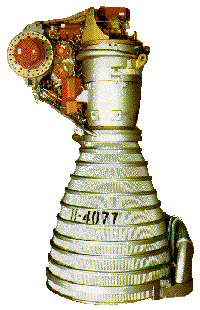
            The LOX and kerosene fueled Rocketdyne H-1.
            For example, rocket company Space Exploration Technologies (Space-X) uses a combination of kerosene (RP-1) and liquid oxygen (LOX) for fuel instead of liquid hydrogen and LOX because hydrogen (the lightest element) is difficult to cool and store as a liquid and not terribly dense even then, so the fuel tank has to be quite large and complex. Kerosene is denser and much easier to store since it can be stored at room temperature.

            In essence, most of the storage and cooling problems go away with kerosene, which provides substantial cost savings.

            LOX and kerosene are used in the lower stages of most Russian and Chinese boosters plus the first stages of the Saturn V and the Atlas V. LOX and liquid hydrogen are used in the upper stages of the Atlas V and Saturn V, the newer Delta IV rocket, the H-IIA rocket, and most stages of the European Ariane rockets. 

            But NASA generally prefers the more expensive configuration for it's propellant depots. NASA also seems to think that much research and development needs to be done before this 50 year old, already in existence and continuously in-use technology is ready to be used again.

            There are sensible arguments both for and against the extra boost provided by cryogenic fuels and perhaps NASA is right and this little bit of extra boost is needed to explore the solar system. 

            Unfortunately, they just got to be aware by now that money no longer grows on trees for NASA. It no longer even flows freely out of the mouths of their political representatives. 

            This could possibly be the more important problem for NASA. They might need to form a committee to study this very, very closely before moving forward.


            Comments (1):

            From: Clark Lindsey (www.hobbyspace.com)

            Hi Chuck,

            I enjoy your blog and your commentary about commercial space issues, especially with regard to Canada. Thanks also for the link to my blog.

            I've been meaning to comment on your recent post about fuel depots but didn't get around to it till tonight. However, either you don't allow comments or I'm failing to see how to do it. So I thought I'd just drop you an email.

            I think people like Dallas Beinhoff at Boeing and Frank Zegler at United Launch Alliance (ULA) would find it ironic that you are criticizing NASA for not realizing that the Centaur already puts cryo fuel depot capability well within reach. Those guys have been pushing NASA for years to back cryo fuel depot development on that very basis - the Centaur has already solved many of the problems and it is not a huge leap to a working depot.

            However, fuel depots at NASA have been stuck in the so-called "TRL valley of death". Their technical readiness has reach a level where an orbital demonstration or two are needed to get to the next levels that allow them to be part of a exploration mission architecture. However, orbital demos require a bump up in funding and they haven't gotten the funding because no mission architecture has included depots since they are not at sufficiently high enough TRL.

            CRYOTE in launch configuration. Photo c/o ULA.
            With the new emphasis at NASA on technology development, they may finally get across this valley. Yes, it will require some funding but not huge amounts. The CRYOTE (Cryogenic Orbital Testbed), for example, is a secondary payload that works with a Centaur to test cryogenic fluid handling hardware and techniques. See the presentations at http://spirit.as.utexas.edu/~fiso/telecon/Gravlee-Rhys_4-6-11/.

            Long term LOX storage is basically in hand but work also needs to be done to prove long term LH2 storage. However, again, this doesn't require a huge jump. There are a number of techniques, e.g. advanced insulation, sun shades, etc. that make it feasible now. It just needs a demo to prove it.

            Advantages of LOX/LH2 besides the high performance include the fact that it can be produced from in-situ water such as on the Moon and asteroids.

            It's a shame that fuel depots got so little attention in the debate the past year and half over the NASA policy changes. The potential savings of depots are tremendous. For example, no super heavy lifter would be needed for deep space exploration. Of course, much of the Congressional emphasis is on the jobs that the HLV would produce and not on the most cost-effective ways to do space exploration and development.

            Over time, though, the advantages of depots are too great to ignore. E.g. a lot of people were surprised that Doug Stanley, one of the guys who designed the Constellation architecture with Griffin, was a co-author of this paper: "Near Term Space Exploration with Commercial Launch Vehicles Plus Propellant Depot."

            For more info, see these presentations given at the Space Access conferences:
            Cheers
            Clark

            p.s. Space-X does, in fact, have a LOX/LH2 engine project on the drawing board called the Raptor. It would be used in a new high power upper stage - http://en.wikipedia.org/wiki/Raptor_%28rocket_stage%29.

            Editors Note: Clark's right and I still can't get comments to post properly so I'm putting them up manually. Send your questions, queries, concerns and comments to mr.chuck.black@gmail.com.

            Sunday, July 17, 2011

            Responding to Zubrin about VASIMR

            Just like Harold Hill in "The Music Man," author and Mars Society President Robert Zubrin sees trouble ("right here in River City") which can only be nipped in the bud by making us "aware of the caliber of disaster indicated."


            Music Man Ya Got Trouble by WarnerBrosOnline

            Zubrin, the author of "The Case for Mars: The Plan to Settle the Red Planet and Why We Must" has singled out the Variable Specific Impulse Magnetoplasma Rocket (VASIMR) electro-magnetic thruster for spacecraft propulsion, the Ad Astra Rocket Company (which is presently involved in researching and commercializing the VASIMR) plus former astronaut and current Ad Astra President/ CEO Franklin Chang-Diaz, who is credited with being the inventor of the technology.

            Robert Zubrin, sizing up the situation,
            So where's the trouble?

            According to the July 13th, 2011 Zubrin written editorial on the Space News website titled "The VASIMR Hoax" the current focus on new technologies (especially VASIMR) is postponing, not facilitating space exploration and "only useful as a smokescreen for those who wish to avoid embracing" real initiatives which could begin now, using existing technology as previously outlined by Zubrin in his May 14th, 2011 Wall Street Journal editorial "How We Can Fly to Mars in This Decade—And on the Cheap."

            Franklin Chang-Diaz has a different assessment.
            And this latest editorial doesn't just have a title packed with hyperbole.

            Zubrin also explicitly calls VASIMR a "total falsehood" which "must be exposed."

            Best of all, the only way for the truth to prevail is for the people to attend a panel discussion titled: “VASIMR: Silver Bullet or Hoax" at the next Mars Society international convention in Dallas this August.

            Say again?

            Did Bob Zubrin actually get away with free advertising for his upcoming conference in a Space News editorial? Is this why the Wall Street Journal didn't run the latest Zubrin editorial?

            Of course, the real story is far more complex

            For example, electric space propulsion systems (of which VASIMR is just one of many and perhaps not even the best) need lots and lots of electricity. Zubrin is indeed correct when he states that:
            To achieve his much-repeated claim that VASIMR could enable a 39-day one-way transit to Mars, Chang-Diaz posits a nuclear reactor system with a power of 200,000 kilowatts and a power-to-mass ratio of 1,000 watts per kilogram. In fact, the largest space nuclear reactor ever built, the Soviet (era) Topaz, had a power of 10 kilowatts and a power-to-mass ratio of 10 watts per kilogram. 
            But while Zubrin is also correct in his assessment that the current administration is "not making an effort to develop a space nuclear reactor of any kind" he omits to mention past and current efforts by the US and others, some of which are outlined in the November 3rd, 2009 Wired Science article "Russia Leads Nuclear Space Race After U.S. Drops Out."

            Of course, we can't forget that there are also substantial difficulties testing electrical propulsion units. The physics of magnetic nozzles are a complex mash-up of theory and guesswork which often provides unreliable predictions at variance from any measured, real world performance.


            For example, according to colleagues familiar with the testing requirements, a magnetic nozzle test requires a test volume that's large enough for the plasma to fully separate from the magnetic field "so as to insure that the outer fringes of the field aren't dragging on the plasma and killing most of the thrust that the inner parts of the field are producing."

            This means you need a huge vacuum chamber to perform any sort of accurate test of an electrical propulsion engine and the chamber needs to be capable of a very high vacuum during the test since even small amounts of residual gas can mess up electric-thruster testing.

            Or you could test the engine in space, which is big and has vacuum pretty much everywhere. However, the only place presently available for testing in space is aboard the International Space Station (ISS), which has been considered and hinted at by the US and NASA, but is not yet formally scheduled for the VASIMR.

            But we can't forget about the ion thruster developed for the the Japan Aerospace Exploration Agency (JAXA) "Hayabusa" mission, which is a small scale, low powered electrical propulsion engine similar to VASIMR that has demonstrated its feasibility during interplanetary flight under real world conditions for over a thousand hours of continuous use during its seven year mission to retrieve a sample from the small near-Earth asteroid 25143 Itokawa.

            An earlier battle of competing technologies.
            And Hayabusa isn't unique. The NASA launched Dawn spacecraft which has just entered orbit around the asteroid Vesta, uses xenon ion thrusters pioneered during the Deep Space 1 probes, a part of the NASA New Millennium Program focused on testing high risk technologies.

            There are others as well.

            All of which means that VASIMR is certainly not a hoax, but it does suggest that perhaps Chang-Diaz is also a bit more optimistic in his claims for this specific electrical propulsion system than the existing evidence warrants.

            In essence, both Zubrin and Chang-Diaz are exaggerated their present case. Why would they be doing this?

            When the British National Space Centre (later the UK Space Agency) bumped up against competing claims regarding the capabilities of the Reaction Engines "Skylon" pilotless, reusable space plane several years ago, they set up a series of proof-of-concept engineering assessments to validate assumptions and figure out what the actual capabilities and bottlenecks were.

            Skylon passed and ended up with increased funding but if it hadn't passed the review, then it would have lost funding, which is what should happen with grown-ups operating in the real world of science and engineering.

            But that doesn't seem to be happening in the US, where the idea of Bob Zubrin calling out Franklin Chang-Diaz for the modern day equivalent of a public gunfight at high noon for perpetrating a "hoax" doesn't seem to strike anyone as being silly.

            We seem to be entering a new era where showmanship, entertainment, political glad-handling, pork-barreling and hyperbole will each be necessary in order to suitably move forward new technologies in a world where science and engineering are starting to take a backseat to bread and circuses.

            Maybe we do have trouble.


            COMMENTS:

            From: Michael Jensen

            Hi Chuck. You bad-mouthing the circus now?  ;-)

            The way I see it, people are so bombarded these days with everything, it takes circus stuff to get their attention. Many people don't even see the point of space exploration given all the problems we have at home or when faced with whole populations dying of hunger.

            Of course, I don't want to go down on the record as somebody against space exploration, which is how that might sound, or to come across as being naive about its benefits.

            What it comes down to (as I explain to everybody I end up on this topic with) is that each individual person has some limited range of interests that truly get them fired up and it is within this range of interests that society is best served by having them occupied.

            There are plenty of people to serve every conceivable need and the rocket scientist has just as justifiable a place in society as the medicine man, the plumber, the folks providing communications equipment for pro-democracy demonstrations or even the "music man."

            So lets let Zubrin be Zubrin and the same for Chang-Diaz.

            Editors Note: I'm posting comments manually so don't be shy. Send your questions, queries, concerns and comments to mr.chuck.black@gmail.com.

            Support our Patreon Page