Monday, May 15, 2017

Space Advisory Board Meets Tomorrow, and Tomorrow and Tomorrow

          By Brian Orlotti

The notes from the first and the second Canadian Space Advisory Board (SAB) Roundtables on Canada's Future in Space, held on April 21st in Ottawa and April 28th in Halifax, have now been posted online.

A friendly reminder that rocket science very rarely has anything to do with politics (or media production). Image c/o @Cmdr_Hadfield.

At first blush, the SAB, rather than seizing the opportunity to restructure Canada’s space efforts in accord with new global realities, has simply opted for the status quo with some added drum-banging for further funding.

Notable excerpts from the SAB notes include a variety of interesting, but generally vague comments, which certainly benefit from the appropriate unpacking. For example:
In an era of fast technological advances and dynamic business models, there is no one size fits all solution.
There is a new business model emerging – often referred to as New Space – that is transformative and government policies and regulations need to adapt to this reality in order to support growth in the sector. 
It may be important to ensure that the Government is equipped to find solutions and has more modern tools (public private partnerships, purchasing services as opposed to assets)
  • This comment, from the April 21st Ottawa meeting, while acknowledging the existence of the NewSpace industry, provides little in the way of exploration of the private-sector funding mechanisms such as the Space Angels Network or Globalive Capital which could enable the Canadian space industry to operate more independently of government.
Globalive Capital, a tech angel investment firm founded in 2013 by Canadian telecom entrepreneur Tony Lacavera, has helped finance at least two Canadian NewSpace companies; Toronto, ON based Kepler Communications and Vancouver, BC based UrtheCast.  
Tony Lacavera at the MaRS Discovery District in January 2017. As outlined in the February 3rd, 2017 Mobile Syrop post, "Tony Lacavera shares the story of building and selling Wind Mobile," the core concept of entrepreneurship is the understanding and acceptance of risk. Photo c/o Mobile Syrup.  
As stated previously in the January 16th, 2017 post, "Quantum Computing Is Real; A Canadian Company Now Offers Open-Source Tools & the Chinese are Building Spacecraft," Lacavera has publicly stated his view that Canada has the potential to become a world leader in such fields as artificial intelligence, fintech, machine-learning, autonomous vehicles, and quantum computing, though its institutions must step up their efforts to do so.  
Lacavera also said that Canada’s efforts must go beyond mere presentations and broad allocations of resources; Canada must narrow its actions and focus  specifically on areas where it can win. 
A focus on developing homegrown launch vehicles, for example, would reduce the time-to-market for Canadian space products and services, protect Canada’s space industry from other nations’ punitive trade actions, and place Canada on a more competitive footing vis-a-vis emerging space powers such as China and India.
Canada is viewed as a reliable international partner; re-affirming or affirming international engagement is important for continued long term success. In addition, while collaborating with traditional international partners (NASA, ESA) remains important, there may be greater opportunities with non-traditional and new space faring nations. 
  • This comment, also from the April 21st Ottawa meeting, allows the SAB to reaffirm Canada’s traditional role as a supplier of components and systems for other nations’ space projects. 
Although the rise of new space-faring nations (i.e. China & India) is acknowledged, the SAB avoids mentioning their specific homegrown capabilities, which include domestic launch vehicles. Those indigenous capabilities (rather than the mere ability to manufacture "components") are what facilitate the independent actions these states currently enjoy.
This lack of interest in expanding Canadian space capability also seems rather myopic in light of the current political upheavals in Europe, rapidly expanding Chinese space efforts and trade-related punitive actions taken (and threatened) against both Canada and Mexico by the US’ ultra-nationalist, protectionist Donald Trump administration. 
Aerospace Industries Association of Canada (AIAC) Executive VP Iain Christie discussing the AIAC's perception of what a "balanced" space program would be like at the 2016 Space Policy Symposium, which was held in Ottawa on November 8th, 2016. As outlined in the November 22nd, 2016 SpaceQ post, "A Balanced Space Program from the 2016 Space Policy Symposium," the AIAC presentation focused on complaints about the lack of "a long term plan or vision for what Canada will be doing in space," plus concern for space companies "that rely in-part on government programs" and are “rapidly running out of short term money with no new significant programs being created." Evidently, asking for more money for the existing players is "balanced." Photo c/o SpaceQ.
There is the need for a balanced space program and for a range of activities – flagship programs (e.g. International Space Station), smaller mission activities, science, technology development and capability demonstration - necessary to provide critical flight heritage while sustaining and maintain talent/capabilities in the Canadian space sector. 
Dedicated funding to support new space activities help to grow the sector – many space firms have been created, or established through government programs, which provide important seed money...
This statement, also from the April 21st Ottawa meeting, and apart from the dubiousness of phrases like ‘balanced space program’ (which seems to suggest a hope for continued Canadian Space Agency "dominance" of the domestic space industry and the expectation of the existing players that they will continue to be funded), contains a curious error of omission 
The oversight is NASA’s stated intention to sell the ISS to the private sector by the mid-2020’s. 
As outlined in the March 23rd, 2017 Wired post, " Somebody Just Buy the ISS Already," the International Space Station (ISS) is a $70Bln US ($95Bln CDN) engineering marvel that "no one has any idea what to do with." According to the article, "spending $3 billion to $4 billion annually to keep the ISS running conflicts with NASA’s other ambitions, like visiting Mars."
Touting the ISS as a “flagship program” in which Canada should continue the status quo when NASA itself is willing to let private industry take control and move on to other challenges would seem a non sequitur at best and deceitful at worst.
There is considerable optimism and excitement regarding plans for a spaceport in the Province of Nova Scotia. 
Developing Canadian launch capabilities may provide new opportunities for economic and regional development (e.g. , jobs creation, skills and talent hub); increased access to space to deploy technologies in space; and public interest and support for the Canadian space program.
This statement, from the April 28th, 2017 Halifax meeting, refers to Maritime Launch Services’ (MLS) thus far unfunded effort to construct a commercial launch facility for Ukrainian-built Cyclone-4M rockets in Nova Scotia. MLS is essentially acting as a local agent for Ukraine-based Yuzhnoye Design Office, which had originally designed the Cyclone-4M rocket for Brazil and requires at least $100Mln CDN in cash or credits to fund any NS based facility.  
As outlined most recently in the February 6th, 2017 post, "Europe Will Fund the Prometheus Reusable Engine; Canada Pitched Cyclone-4's," the Cyclone rockets use hypergolic engines--a system in which two components (a fuel and an oxidizer) spontaneously ignite when brought into contact with each other, producing thrust. 
Once used extensively in both US and Soviet ICBMs, hypergolic engines were eventually replaced in both nations’ arsenals by solid-fuel systems. Although simple and reliable, hypergolic engines pose difficulties due to the extreme toxicity and corrosive nature of their fuels. 
Because of this, Western rocketry has largely moved away from hypergolic systems and towards higher performance liquid hydrogen/oxygen engines. 
It is a sad state of affairs indeed for Canada’s space efforts when, in an age of $5Mln US ($6.8Mln CDN) 3D-printed rockets (such as those now being made by California based Rocket Lab), hope is being placed in a company of doubtful financing flogging toxic 1970’s Soviet technology. 
Canada, the third nation on Earth to place a satellite in orbit and a pioneer of robotic, radar and lidar technologies, should demand better of itself

The first SAB Roundtable on Canada's Future in Space, held on April 21st in Ottawa, was hosted by SAB chair Marie Lucy Stojak, William MacDonald ‘Mac' Evans, and Michael Pley.

Attendees included Al Conrad (IMP Aerospace), Arthur Ruff (ISRU Tech Inc.), Sarah Goldfeder (Earnscliffe Strategy Group), Chris Kitzan (Canada Aviation and Space Museum), Christopher Dodd (Airbus Defence & Space Canada, Inc.), Daniel Goldberg (Telesat), David McCabe (Honeywell Aerospace), Eric Choi (Magellan Aerospace), Eva-Jane Lark (BMO Nesbitt Burns Midland Doherty Ltd.), Geoffrey Languedoc (Canadian Aeronautics and Space Institute), Iain Christie (AIAC), Ian Scott (Telesat), Jason Palidwar (Iridian Spectral Technologies), Jim Quick (AIAC), John Detombe (ADGA Group), Larisa Beach (Neptec Design Group Ltd.), Leslie Swartman (MacDonald Dettwiler), Lori M. Wickert (Newmont Mining Corporation), Matt Ivis (MacDonald Dettwiler), Rick Pitre (Terizons Consulting Inc.), Robert A. “Bob” Ryerson (Kim Geomatics Corporation), Ryan Alan Anderson (QShift) and Stewart Bain (NorStar Space Data).

The second SAB Roundtable on Canada's Future in Space, held on April 28th in Halifax, was hosted by Jim Drummond and Gordon Osinski.

Attendees included Bradley Farquhar (Space Generation Advisory Council), Carl Kumpic (IMP Aerospace and Defence), Desmond Power (C-CORE), Duncan McSporran (Consortium for Aerospace Research and Innovation in Canada), Harvey Doane (Nova Scotia Business Inc.), Howard Moyst (AIME Consulting Inc.), Jeff Burlock (Xplornet Communication Inc.), Luigi Gallo (St. Mary's University, Department of Astronomy and Physics), Monique Arsenault (Nova Scotia Government), Penny Morrill (Memorial University of Newfoundland, Faculty of Sciences—Earth Sciences), Rich Billiard (Atlantic Alliance of Aerospace and Defense Associations), Rob Thacker (St. Mary's University, Department of Astronomy and Physics) and Stephen Matier (Maritime Launch Services).

The SAB Roundtable is winding up its formal, semi-public meetings over the next few days, but will continue to meet at undisclosed locations and by invitation only, in preparation for the expected release of their proposal for the Canadian space industry sometime this summer.

Tomorrow, and tomorrow, and tomorrow...
Brian Orlotti.
  ______________________________________________________________

Brian Orlotti is a regular contributor to the Commercial Space blog.

Part 9: A History of the Canadian Space Program - Policies & Lessons Learned Coping with Modest Budgets

The 1990's, The Second Long-Term Space Plan, SCISAT, RADARSAT-2 & "Competitive Procurement"


The John H. Chapman Space Centre, completed in 1992. Photo c/o Treasury Board.
By Graham Gibbs & W. M. ("Mac") Evans

This paper, first presented at the 65th International Astronautical Congress, which was held in Toronto, Ontario from September 29th - October 3rd, 2014, is a brief history of the Canadian space program, written by two of the major participants.

Recognizing that the Canadian government's investment in space was going to start dropping rapidly in 1994 with the wind down of three major CSA programs, Mobile Satellite (MSAT), RADARSAT and the International Space Station (ISS), the CSA commenced planning for the next long-term space plan. Extensive consultations were held with interest groups across the country and by 1993 the CSA had developed an aggressive set of program proposals for consideration by the government. 

However, in 1993 a new government was elected that embarked on a comprehensive government wide expenditure reduction program and the CSA’s proposals never reached the Cabinet table. In its first budget in February 1994 the new government announced its intention to develop a new long-term space plan (LTSP II) and allocated $800Mln CDN of new funds for the ten year period from 1994/95 to 2003/04.

The government was extremely concerned about the rising costs for Canada’s participation in the ISS program and decided to “negotiate an orderly reduction in Canada’s current commitments to the International Space Station Program.” The government also stated, that if a satisfactory new role for Canada in the program could be negotiated, it would allocate an additional $200Mln CDN for this purpose.

Then Prime Minister Jean Chrétien with Paul Martin, his long-term Finance Minister in 1997. The 1994 Federal budget wasn't just important for Canada's space efforts. As outlined in the November 11th, 2011 Economy Watch post, "How Did Canada Turn Its Debt Crisis Around In 6 Years, 20 Years Ago?," Canada's budget had included large annual deficits since the 1960's and was widely regarded by the early 1990's as the next nation expected to default on outstanding loans. But quick action, in the form of a multi-year deficit reduction programme initiated by the incoming Chrétien government, balanced the budget and restored Canada's international credit. Photo c/o Fred Chartrand/Canadian Press.

The 1994 Budget marked a distinct change in the government’s approach to space. Prior to this budget, space program proposals were submitted to the government, and if approved, new funds to implement the program would be made available. With the 1994 budget, the government first established the amount of money that it would make available for space and then asked the CSA to develop a plan within the allocated resources. For the first time, the government established a “space envelope.”

For the next three months, an extensive series of concurrent negotiations took place with NASA regarding the ISS and with the Canadian space community regarding LTSP II. A wide-ranging agreement was reached with NASA for “Enhanced Cooperation in Space Between NASA and CSA” that reduced the final costs of Canada’s space station participation by $759Mln CDN without affecting our commitment to provide ISS robotics. The agreement also provided for one Canadian astronaut launch per year, obtained NASA’s participation in RADARSAT 2, and confirmed NASA’s participation in Canada’s SciSat program.

In June 1994, the Minister of Industry, John Manley announced LTSP II, the most comprehensive space plan in Canadian history with more than $1Bln CDN of new program initiatives.

Included in the plan were: RADARSAT 2, a follow-on to the already approved RADARSAT 1 satellite; an advanced satellite communications program that eventually resulted in an experimental payload for the next generation of Telesat satellites; a substantial increase in the space science program, including SciSat, Canada’s first science satellite since ISIS II in 1972; and augmentation of the CSA’s technology development program.

LTSP II also included a new “Space Policy Framework” approved by the government. The framework instructed the CSA to design programming “to lever the maximum possible funding from other interested parties, including the industry and the provinces.” This requirement formed the underlying principle for the agreements with Telesat on the experimental payload for Anik F2 and the agreement with Macdonald Dettwiler (MDA) for RADARSAT 2.

The current impact of the Canadian space sector in 2013 as per the March 27th, 2015 Euroconsult Report on the "Comprehensive Socio-Economic Impact Assessment of the Canadian Space Sector." Graphic c/o Euroconsult & CSA. 

The framework directed that the “implementation of the Canadian Space Program seek to foster an internationally competitive, export-oriented Canadian space equipment and services sector, open to a growing number of firms, often small and medium-sized enterprises.” This latter requirement effectively put an end to the Prime Contractor policy adopted in the late 1970’s and paved the way for a competitive procurement process for RADARSAT 2 (the first ever competitive procurement for a major government space program).

The framework also noted that the government deems space to be “essential to protect national security and to enhance Canada’s sovereignty in the new political and economic world order” and indicated its desire to see that “a growing degree of synergy will be promoted between civil and non-aggressive defence space activities with a view to contributing to world peace and security… ”. This requirement led to the establishment of liaison offices at Department of National Defence (DND) and CSA and a memorandum of understanding (MOU) outlining cooperation between the two departments.

Finally, the framework indicated the government’s expectation that Federal Departments will “take advantage of the opportunities provided by space- based technology and services to improve their short and long-term efficiency and effectiveness in meeting their mission objectives and will work with the CSA to maximize the degree to which these needs can be met from cost-competitive domestic sources.” 

This requirement provided the underlying policy for the program initiatives that the CSA was then promoting.
________________________________________________________________________

Graham Gibbs & Mac Evans. Photos c/o MyCanada & CSA.
Graham Gibbs represented the Canadian space program for twenty-two years, the final seven as Canada’s first counselor for (US) space affairs based at the Canadian Embassy in Washington, DC. 

He is the author of "Five Ages of Canada - A HISTORY from Our First Peoples to Confederation."

William MacDonald "Mac" Evans served as the president of the Canadian Space Agency (CSA) from November 1991 to November 2001, where he led the development of the Canadian astronaut and RADARSAT programs, negotiated Canada’s role in the International Space Station (ISS) and contributed to various international agreements that serve as the foundation of Canada’s current international space partnerships.

He currently serves on the board of directors of Vancouver, BC based UrtheCast and as a member of the Federal government Space Advisory Board.

Last Week: "Long-Term Space Plan I, a National Space Agency, RADARSAT, Centralization and the Dramatic Increase in Government Space Expenditures," in part eight of "A History of the Canadian Space Program: Policies & Lessons Learned Coping with Modest Budgets."

Next Week: "More on the 1990's, the CSA, "On-Going Budgets," a 3rd "Long-Term Space Plan," 
New Astronauts, More Satellites but Never Enough Funding," as part ten of "A History of the Canadian Space Program: Policies & Lessons Learned Coping with Modest Budgets," continues.

Thursday, May 11, 2017

CATAAlliance Calls for Adaption of the US Small Business Innovation Research (SBIR) Program

          By Chuck Black

The Canadian Advanced Technology Alliance (CATAAlliance), has called for the adaption of the US developed Small Business Innovation Research (SBIR) grant program, often used to fund small space focused start-ups, as a way to encourage and grow Canadian innovation.

To see the complete video, please click on the graphic above. Graphic c/o CATAAlliance.

As outlined in the May 8th, 2017 CATAAlliance press release, "A proven model for the creation of Innovative Solutions Canada," the organization cited the intent of the Federal government under Prime Minister Justin Trudeau to "provide up to $50 million, starting in 2017–18, to launch a new procurement program, Innovative Solutions Canada, modeled on the very successful US Small Business Innovation Research (SBIR) program.”

But the press release also noted that the SBIR program, as structured in the US, is funded through mandatory set-asides of departmental funds. As outlined in the press release, the US Small Business Administration (SBA) ensures that participants in the program dedicate 3.2% of their total budgets towards the SBIR program, plus an additional “set- aside” (approximately 23% in the US) for use to procure any developed goods and services from the SBIR small businesses, as required.

As outlined in the CATAAlliance press release, "the intent now is to ensure our government incorporates BOTH of these into the final legislation," to insure appropriate funding." The press release noted that the Ontario provincial Health Technologies Fund, is also based on the US SBIR model.

As outlined on the Federal Government Buy and Sell procurement website under the title, "Decision to Set Aside a Procurement under the Procurement Strategy for Aboriginal Business," this is a process fully understood by the Federal government, at least within Indigenous and Northern Affairs Canada (INAC), where INAC frequently acts as the first customer and reference site for new products.

NASA Hallmark videos feature companies and successful technologies developed through NASA's SBIR and small business technology transfer (STTR) programs. To see a sampling of the videos, simply click on the links. Image c/o NASA.  

The Canadian Space Agency (CSA) has always had difficulties wrapping its head around the concept of SBIR programs and the idea of assisting small business to grow and compete with larger, more established firms.

As outlined as far back as the July 19th, 2009 post, "Canadian Space Agency Provides "No Dedicated Programs" to Support Small Aerospace Firms," it was noted that "when compared to organizations like the National Aeronautics and Space Administration (NASA), the National Oceanic and Atmospheric Administration (NOAA), the European Space Agency (ESA) and others, the Canadian Space Agency (CSA) has 'no dedicated programs for small business.'"

Instead, and as outlined in a variety of historical articles on this blog, the Canadian government has focused on "capacity building" or building up one or two large domestic firms like Spar Aerospace, Bombardier, Nortel or MacDonald Dettwiler (MDA) into powerhouses capable of competing against large foreign firms in international markets.

Of course, mostly that doesn't work. It's hard to pick winners at the best of times. Spar and Nortel are dead and Bombardier and MDA are undergoing their own challenges.

Perhaps the Federal government will try something a little more inclusive this time. Something like the SBIR program.
Chuck Black.
___________________________________________________________

Chuck Black is the editor of the Commercial Space blog.

Monday, May 08, 2017

Steve MacLean's 2010 Long-Term Space Plan Surfaces, CSA Clarifies its Communications Policy & California's Rocket Tax

          By Henry Stewart

For the week of May 8th, 2017, here are a few of the stories we're currently tracking for the Commercial Space blog:

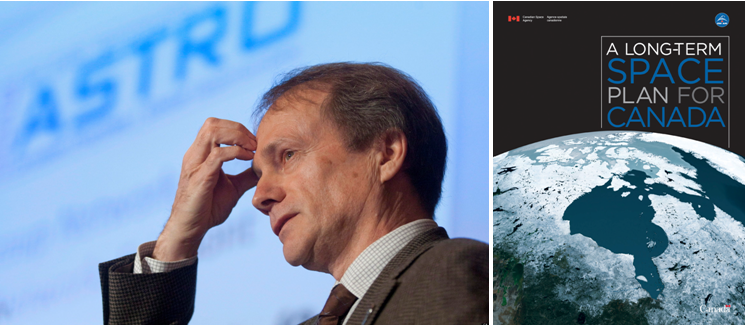
Former CSA president Steve MacLean in 2010 alongside the front cover of his 2010 "Long-Term Space Plan for Canada." Photo c/o Canadian Press and Gordon Group.

  • A never released Long-Term Space Plan (LTSP), created by then Canadian Space Agency (CSA) president Steve MacLean as part of his 2008 hiring mandate under then Conservative Industry Minister Jim Prentice, seems to have surfaced in the most peculiar of places. 
An Ottawa, Ontario based marketing and communications company called the Gordon Group, has claimed credit for its design and layout, and even posted portions of the plan on its website. 
Gordon Group website on May 8th, 2017. Screenshot c/o Author.
As outlined on the Gordon Group CSA promotional page, the CSA "has worked with Gordon Group over many years to produce a variety of reports, such as the COSPAR reports for 1998-99, 2004-05 and 2010."
"Most recently, Gordon Group designed, edited, laid out and produced the 72-page report called A Long-term Space Plan for Canada, which was submitted to the Government of Canada by Dr. Steve MacLean, President of the Canadian Space Agency."
According to the website, the Gordon Group, "designed a cover that shows a satellite view of Canada from space and grid lines that represent tangible evidence of the agency’s strategy and plans for Canada’s involvement in spaceThe blue tones of the cover design reflect the colour of space and tie in with the CSA logo. 
The promotion continues, "the inside design deliberately uses a lot of white space for a clean and crisp look. The angled lines in the keyline are reflected in the photo cropping, giving a subtle forward-looking feel. Pull quotes emphasize content and provide visual interest." 
For a bit of background on the last astronaut to head the CSA and his original mandate, check out the  January 19th, 2013 post, "Praising Steve MacLean." Screenshot c/o Author.  

Given that MacLean's report is currently being used as a sales aid for a marketing company, it seems appropriate for the current Federal government under Liberal Prime Minister Justin Trudeau to formally release the full seventy-two page document to the public.
As outlined in the April 20th, 2017 post, "Space Advisory Committee Members Announced: Various Stakeholders Release Independent Assessments, Just in Case," there are many in both government and the private sector assessing and collecting much the same data originally collected by MacLean, who could make far better use of MacLean's document than is currently the case.
As outlined in the post, several clauses in standard CSA contracts make it essentially impossible for CSA subcontractors to talk to the public without the formal approval of the CSA Directorate of Communications.
According to CSA senior communications advisor Magalie Renaud, who communicated with this blog via e-mail:
"The intention of this clause is to leverage resources by encouraging coordination of communication efforts between the CSA and contractors (for example: hold a joint announcement, develop a blog about the company promoted on our social media platforms). Our aim is also to encourage the sharing of information so we can support industry partners, especially the smaller firms that don’t have the resources to dedicate to promoting their work. This clause is not meant to prevent companies from communicating with the media or the public.

That being said, the clause was drafted several years ago and we are in the process of reviewing it. It will better reflect the CSA’s intention to encourage coordination and the sharing of information so we can highlight successes and leverage resources."
To be fair, the latest e-mail reflects at least the intention to "leverage resources" along with the acceptance that the current CSA regulations could be improved. Maybe one day, the CSA will figure out that free and open discussion without constraints (ie. "peer review") is the essence of the scientific method.
Just don't hold your breath in anticipation.
  • California wants to tax rocket launches.
As outlined in the May 6th, 2017 Quartz post, "California’s plan to tax rockets by the mile is exactly what space companies want," the California state legislature has come up with a plan to tax rocket companies, based on "how often they fly the 62 miles (100 km) from a California launchpad to the very edge of space while transporting goods or tourists."
As outlined in the article, "the proposal comes as the state’s technology sector ploughs increasing amounts of money into aerospace start-ups, and homegrown company SpaceX asserts itself as the leader in low-cost space access. California is home to highly skilled aerospace engineers and technicians, thanks to the long presence of companies like Boeing and Lockheed Martin, as well as research centers like Caltech’s Jet Propulsion Lab and NASA’s Ames research center."
The proposed rocket tax will apply mainly to just two companies (SpaceX and ULA), at least initially.  But, as outlined in the article, Virgin Galactic will also be taxed when it ramps up its operations.
All three companies have backed the new tax rule in meetings with the California government, according to government records and sources familiar with the matter, because the change would clarify their tax status.
For more, check out our upcoming stories in the Commercial Space blog or recommend stories for our various aggregation feeds by tweeting #CANSpace.
_______________________________________________________________________

Henry Stewart is the pseudonym of a Toronto based aerospace writer.

MDA Restructures For DARPA & Competition, Cuts US Workforce but Anticipates New Orders in Weak Q1 2017 Report

          By Brian Orlotti

Richmond, BC based MacDonald Dettwiler (MDA) has reported lackluster financial results, highlighting both declining revenues in its traditional line of business, but expects at least some upside from the upcoming acquisition of Colorado based DigitalGlobe and future US government contracts related to the Defense Advanced Research Project Agency (DARPA) Robotic Servicing of Geosynchronous Satellites (RSGS) program.

MDA CEO Lance and his Q1 2017 report. MDA’s condensed consolidated financial statements and management’s discussion and analysis (MD&A) for the three months ended March 31, 2017 are available online under the title, "MacDonald, Dettwiler and Associates Ltd. First Quarter Report 2017 for the Three Months Ended March 31, 2017." For a complete transcript of the Q1 conference call, check out the May 2nd, 2017 Seeking Alpha post, "MacDonald, Dettwiler & Associates' (MDDWF) CEO Howard Lance on Q1 2017 Results - Earnings Call Transcript."  Photo & graphic c/o MDA.

But MDA CEO Howard Lance, speaking during the May 2nd, 2017 quarterly conference call, also reiterated his intention to form a new, US based company, to manage contracts related to the DARPA RSGS program.

These contracts are currently managed by Palo Alto California based Space Systems Loral (SSL), an MDA subsidiary.

The new firm will be US based and MDA will not be the majority owner. The new firm will also hold title to the technology used in the US contracts and will distribute RADARSAT-2 data relating to "maritime surveillance and the detection of illegal unreported and unregulated fishing vessels in remote regions."

As outlined in the December 16th, 2016 post, "MDA says No Sale of Canadarm Technology to the US Government in NASA RESTORE-L, DARPA RSGS or "Any Other" Project," MDA spokespeople have gone on record as insisting that no Canadian technology has been used in US contracts.

MDA ten day performance quote covering the period from April 25th - May 2nd, 2017. As outlined in the May 8th, 2017 Globe and Mail Globe Investor website, "MacDonald Dettwiler and Associates Ltd is up today by $0.43 or 0.66% to $66.06. Shares have lost 0.91% over the last five days, but are unchanged over the last year to date. This security has under-performed the S&P TSX by 39.92% during the last year." Graphic c/o Globe and Mail Investor.

As outlined in the May 2nd, 2017 MDA press release, "MDA reports first quarter 2017 results," MDA’s communications satellite division has reported the following results for the first quarter of 2017:
  • Consolidated revenues of $494.3Mln CDN, down from $562.4Mln CDN for the same period last year, with the communications segment contributing revenues of $332.0Mln CDN, down from $403.2Mln CDN for the same period of last year. According to the press release, the drop reflected "lower geostationary communications satellite bookings over the past two years."
  • Operating earnings were $44.9Mln CDN, or $1.23 per share, down from $55.9Mln CDN, or $1.53 per share, for the first quarter of 2016. As outlined in the press release, the decrease "reflected lower operating EBITDA, as well as higher corporate expense, additional non-cash interest expense following the securitization of orbital receivables and a higher effective income tax rate on operating earnings."
  • Net earnings under International Financial Reporting Standards (IFRS) for the first quarter of 2017 were $5.9Mln CDN, down from $40.7Mln CDN for the same period of last year. As outlined in the press release, "net earnings were impacted by the inclusion and variability of certain large, non-operational items, particularly restructuring costs and incremental legal and other professional fees related to the acquisition of DigitalGlobe, Inc."
  • The company had total funded order backlog of $2.0Bln CDN as of March 31st, 2017, as compared to $2.5Bln CDN for the same period last year. 
  • The communications segment contributed operating EBITDA of $50.5Mln CDN compared to $59.5Mln CDN for the same period last year. 
  • The surveillance and intelligence segment contributed operating EBITDA of $38.6Mln CDN, a slight rise from last years $37.7Mln CDN, and perhaps the only bright spot in the report. The division also reported a 2% increase in revenue, to $162.4Mln CDN.
  • The company was still able to declare a quarterly dividend of $0.37 CDN per common share, which will be payable on June 30th, 2017 to "shareholders of record at the close of business on June 15, 2017."

Also on the upside, CEO Lance  anticipates orders for 12-16 geostationary-orbit telecommunications satellites in 2017 (13 were sold in 2016). However, with only one order booked thus far, MDA subsidiary SSL faces an uphill battle for US government telecom contract work against entrenched competitors including Thales Alenia Space, Airbus Defence and Space and Mitsubishi Electric.

Lance indicated that the company is reducing staff at Palo Alto, California-based SSL in the face of this market downturn although no similar layoffs have so far been announced in Canada. Canadian government work relating to the RADARSAT Constellation Mission (RCM) is slowly winding down but Lance did promise several potential, if undefined, Canadian initiatives over the coming months.

MDA has asserted that its $3.1Bln CDN purchase of US-based satellite imagery provider DigitalGlobe (currently in progress), which has a growing surveillance and intelligence business, should aid its bottom line next quarter. Lance noted that, once the DigitalGlobe acquisition is complete, telecommunications satellites will account for no more than about 15% of MDA’s total EBITDA. The sale is expected to close sometime in the second half of 2017.

Lance also tried to convince investors that the telecom satellite downturn is a result of satellite fleet operators’ “confusion” about the future direction of the industry. The market’s attention has been split between stand-alone high-throughput telecom satellites (SSL’s speciality) and large constellations of small telecom satellites (like that being built by newcomer SpaceX).


For example, on May 3rd, Hawthorne, CA based SpaceX, during a hearing of the US Senate’s Commerce Committee, detailed its plan to launch a constellation of 4,425 custom-built broadband satellites using Falcon 9 rockets beginning in 2019, deploying in phases until reaching full capacity in 2024.

As outlined in the May 8th, 2017 Phy.org post, "SpaceX details plans to launch thousands of internet satellites," the satellites will operate at altitudes ranging from 1,110km to 1,325km. SpaceX has also proposed an additional 7,500 satellites operating even closer to the ground, claiming this will boost capacity and reduce latency in heavily populated areas. However, no specific timelines have been given for this part of the project.

SpaceX's satellites will essentially operate as a mesh network and will beam directly to gateway stations and terminals at customers' homes, a strategy intended to greatly reduce the amount of ground-based infrastructure needed, particularly in rural and remote areas. Gigabit per second speeds are being promised, with different bandwidth packages being offered at various prices. Promised latencies of between 25 and 35ms would put the SpaceX network on par with terrestrial broadband connections as well as outdo traditional satellite  internet providers (600ms or greater).

Despite its effective exit from Canada, success in the US continues to elude MDA. The shifting terrain of the satellite industry will require adaptability from incumbents and newcomers alike.
Brian Orlotti.
  ______________________________________________________________

Brian Orlotti is a regular contributor to the Commercial Space blog.

Sunday, May 07, 2017

Part 8: 150 Years of Canadian Aerospace History

Stehling, Maynard, the Lunar Excursion Module, Gerald Bull, James Chamberlin & Phil Lapp


Graphic c/o NASA's Apollo Program.
         By Robert Godwin
Canada's aerospace raison d'être has always derived from its immense size, its location in the far north as a vast, barely-tracked wilderness of incalculable resources and the logical requirements relating to defence, communications, utilization and exploration which naturally follow from its size and location.

Ever since President Kennedy had proclaimed that his country was going to the moon, the many engineers and managers at NASA and elsewhere in the US military had been arguing over the best way to accomplish this seemingly impossible task. A special committee was assembled in 1961 and was given the task of choosing the method that was most likely to succeed within the President's deadline.

The three choices were:
  • "Earth Orbit Rendezvous" – which required two boosters that would meet in earth orbit before heading for the moon.
  • "Lunar Orbit Rendezvous" or LOR - which required one big booster which could take two vehicles to lunar orbit, one of which would descend and land, then hook up again before returning the crew to earth.
  • "Direct Ascent" - which required a booster big enough to fly all the way to the moon, land and then return.
The last choice was considered too expensive, the first choice too risky. "Earth Orbit Rendezvous" was about to win the day, but two members of the committee insisted that LOR was the only way to go. They were John Houbolt, who was an engineer at Langley, and Kurt Stehling who was now representing NASA headquarters. After much arm twisting Houbolt and Stehling won the argument and the massive NASA machine swung into action to build a lunar orbit rendezvous system which required a small lunar landing craft. The responsibility for this special spaceship fell to Owen Maynard of Sarnia Ontario.

Various versions of the Lunar Module (LM) from 1962 to 1969 from the June 11th, 2015 Space Rocket History webaite post, "#117 – Apollo: Lunar Module Design." Graphics c/o NASA.

Maynard presented his conceptual drawings to the heads of NASA in April of 1962. His "lunar excursion module" initially appeared as a conical spacecraft with four landing legs. Later he added a protruding helicopter bubble on the side so that the astronauts could see the ground as they approached for landing. As head of NASA's lunar landing program Maynard's drawings permeated the offices of the many contractors bidding on the contract for the vehicle. At the end of 1962 the contract was awarded to Grumman Aircraft in Long Island New York and so the story of the LM (lunar module) began.

By this time the US government had all but removed the Army from the space business. The von Braun rocket team and its massive Saturn rocket was now part of NASA and the US Air Force was responsible for the military side of space. Fort Churchill in Manitoba had become, as predicted by Kurt Stehling, a place where rockets could be launched with relative impunity and the US Air Force had now taken over the running of that facility. A large solid rocket fuel factory was built in Rockwood Manitoba and the Bristol Aircraft Company and Aerojet launched more and more rockets into the stratosphere. The aurora was still the subject of intense study and the Earth's magnetic field was slowly giving up its secrets.

The success of Alouette had spurred Canada's aerospace community to move forward on more similar satellites, which were given the (now unfortunate) acronym of ISIS. The RCA Company in Montreal was selected as prime contractor with SPAR as an associate. RCA had been involved with communications in Canada since it had supplied the microphones for early Bell telephones.

More on the ISIS program, from the  July 19th, 1996 Friends of the CRC post, "The ISIS Satellite Program." Graphic c/o Friends of the CRC.

Although the US Air Force had taken over the missile program, the US Army was still in charge of artillery. Gerald Bull's 1958 plan to use a small gun as a second stage on a space launcher had died on the vine but his devotion to space guns hadn't. He convinced the US Army that a huge ground-based gun could be used to launch payloads directly into space. Beginning in 1964 Bull's supergun went into production. It was to be called "Project HARP" for "high altitude research project."

Initially working with McGill University in Montreal HARP was to have been built and used in the arctic. But despite his considerable academic credentials and salesmanship, Bull seems to have fundamentally misunderstood what was important to Canada. His space gun, if it could be built, would have very few payloads tough enough to withstand the rigours of launch. It could certainly be used as a weapon but beyond putting inert materials into space it was not much use for anything else.

Despite this, the fact that the US government endorsed the project made it difficult for the Canadian government to not do the same. It was not the first time that US money had been fronted for a military project in Canada. A more famous instance had been an attempt to build a flying saucer at Avro for the US Air Force. A substantial amount of work went into what became known as the Avrocar, but it never lived up to its promise as a high-speed fighter; although some of its research did bring about improvements to the hovercraft.


While Bull was building his space gun in Bermuda, another Avro Arrow and University of Toronto alumnus, James Chamberlin, had been put in charge of the engineering for the United States' two-man spacecraft, the Gemini. Chamberlin was the most highly placed of the Canadians that had gone to NASA. He had seen the problems in the Mercury spacecraft design and had set about creating an improved two-man version. The end result would be a modular design which the astronauts would all call their favourite spacecraft, despite its extremely limited cabin space. While the Apollo lunar spacecraft was still taking shape, Gemini would teach Americans how to fly in space.

Coming along for the ride with Gemini was SPAR's STEM antenna. Phil Lapp had turned SPAR into a stand-alone company and the STEM was installed on both Gemini and its designated target, an unmanned docking drone named Agena, similar to the one which had flown on the ultra secret radar project Quill. The STEM was used for everything from deploying beacons, to solar panels, to dipole communications.

In 1963 the de Havilland engineers had also drafted up plans for two other uses for STEM; as an arm for grabbing spacecraft that wished to dock with a space station, and as an arm for digging up samples on the moon. These plans would have to wait. 
Robert Godwin.
_____________________________________________________________

Robert Godwin is the owner and founder of Apogee Space Books, the Space Curator at the Canadian Air & Space Museum and an American Astronautical Society History Committee Member.
He has written or edited over 100 books including the award winning series "The NASA Mission Reports" and appeared on dozens of radio and television programs in Canada, the USA and England as an expert not only on space exploration but also on music.  
His books have been discussed on CNN, the CBC, the BBC and CBS 60 Minutes. He produced the first ever virtual reality panoramas of the Apollo lunar surface photography and the first multi-camera angle movie of the Apollo 11 moonwalk. His latest book was written with the late Frederick I Ordway III and is called "2001 The Heritage and Legacy of the Space Odyssey" about the history of spaceflight at the movies.
Last Week, "A Government Lurching From 'Problem to Problem,'" in part seven of "150 Years of Canadian Aerospace History."

Next Week, "Lapp, Stehling, Chapman. His Report, Mankind's Giant Leaps and a Domestic Focus on Sensors," as part nine of "150 Years of Canadian Aerospace History" continues.

On sale now, at Apogee Books.

Part 8: A History of the Canadian Space Program - Policies & Lessons Learned Coping with Modest Budgets

Long-Term Space Plan I, a National Space Agency, RADARSAT, Centralization and the Dramatic Increase in Government Space Expenditures


RADARSAT-2. Image c/o CSA.
By Graham Gibbs & W. M. ("Mac") Evans

This paper, first presented at the 65th International Astronautical Congress, which was held in Toronto, Ontario from September 29th - October 3rd, 2014, is a brief history of the Canadian space program, written by two of the major participants.

With the space station decision now made, the government was able to issue in May, 1986 what is now called Long-term Space Plan I (LTSP I) and provided $476Mln of new funding. In addition to the space station program ($1.2Bln), the plan provided full funding ($200Mln) for the Mobile Satellite (MSAT) program in cooperation with Telesat but did not fund fully RADARSAT due to the lack of private sector interest.

In making the announcement of the new plan, the government established regional distribution targets for its expenditures, a policy that has had a major influence on the development of the Canadian space industry.

With the long-term nature of Canada’s space program settled with LTSP I, the Ministry of State for Science and Technology (MOSST) proceeded to prepare a response to the continuing requests from industry and the Science Council of Canada for the creation of a national space agency. In the end, MOSST prepared a report to the Prime Minister proposing the creation of the Canadian Space Agency (CSA).

In the speech from the Throne in October 1986, the government announced its intention to create the CSA. MOSST then undertook the task of defining the Agency, what its mandate would be and prepared the legislation that officially created the CSA on March 1, 1989. The CSA was set up to be a standalone agency of the government of Canada reporting to the Minister of Industry.

By 1989, private sector interest in RADARSAT had jelled to the point where a new company, Radarsat International (RSI) was formed by a consortium of Canadian space companies with the express objective to market internationally the RADARSAT data.

MOSST had also worked to establish provincial government interest in the program (the provincial governments are responsible for resource management, a key service of RADARSAT). An arrangement had been agreed with the US whereby they would launch RADARSAT in return for a percentage of the data. With agreements in place with the private sector, the provincial governments, and the US, the government finally agreed to proceed with the RADARSAT program at a projected cost of $500Mln.

The 1980’s saw a dramatic increase in the government’s expenditures in space. During this period, the government’s annual space budget grew from $90Mln to close to $300Mln. By the end of the decade, Canada’s space program had become substantially diversified. Communications satellite activities no longer dominated the government’s space agenda (dropping from over 50% of expenditures at the beginning of the decade to less than 10% by the end) and entirely new fields (remote sensing, space robotics, and human space flight) had become priorities.

Canada's first astronaut recruitment campaign was undertaken well before the before the Canadian Space Agency Act received royal assent on May 10th, 1990. The Canadian astronauts selected in 1983 included Ken Money, Marc Garneau, Steve MacLean, Bjarni Tryggvason, Robert Thirsk and Roberta Bondar. Photo c/o CSA.

The government moved cautiously during the decade towards a more centralized approach to its space program and by the end of the decade had created the CSA to manage its space investments.

During the decade, the Canadian space industry’s sales grew substantially from $100Mln in 1980 to almost $300Mln by the end of the decade, with more than 75% of its sales exported.
________________________________________________________________________

Graham Gibbs & Mac Evans. Photos c/o MyCanada & CSA.
Graham Gibbs represented the Canadian space program for twenty-two years, the final seven as Canada’s first counselor for (US) space affairs based at the Canadian Embassy in Washington, DC. 

He is the author of "Five Ages of Canada - A HISTORY from Our First Peoples to Confederation."

William MacDonald "Mac" Evans served as the president of the Canadian Space Agency (CSA) from November 1991 to November 2001, where he led the development of the Canadian astronaut and RADARSAT programs, negotiated Canada’s role in the International Space Station (ISS) and contributed to various international agreements that serve as the foundation of Canada’s current international space partnerships.

He currently serves on the board of directors of Vancouver, BC based UrtheCast and as a member of the Federal government Space Advisory Board.

Last Week: "The 1980's, Reagan, Space Station Freedom and the Debate Over National Needs vs. International Partnerships," in part seven of "A History of the Canadian Space Program: Policies & Lessons Learned Coping with Modest Budgets."

Next Week: "The 1990's, The Second Long-Term Space Plan, SCISAT, RADARSAT-2 & 'Competitive Procurement'" as part nine of "A History of the Canadian Space Program: Policies & Lessons Learned Coping with Modest Budgets," continues.

Thursday, May 04, 2017

The 14th Annual Space Security Working Group Workshop

          By Chuck Black

Those attending the 8th Joint Planetary and Terrestrial Mining Sciences Symposium (PTMSS) & Space Resources Roundtable (discussed in the May 1st, 2017 post of the same name) weren't the only rocket scientists in Montreal for a space conference this week.

The boardroom of the Best Western Ville Marie Hotel in Montreal, where participants at the The 14th Annual Space Security Working Group got down to business on May 2nd & 3rd. The meeting was held under Chatham House rules where, as outlined on the Royal Institute of International Affairs Chatham House website, "participants are free to use the information received, but neither the identity nor the affiliation of the speaker(s), nor that of any other participant, may be revealed." The intent is to provide anonymity to speakers and "encourage openness and the sharing of information." Photo c/o Best Western Ville Marie Hotel.

The 14th Annual Space Security Working Group Workshop also took place in Montreal on May 2nd - 3rd.

The workshop reviewed and assessed data collected from a variety of international sources for inclusion in the upcoming 2017 Space Security Index (SSI), a joint research project of the Simons Foundation, the Institute of Air and Space Law at McGill University, the Research Unit for Military Law and Ethics at the University of Adelaide, the School of Law at Xi’ian Jiaotong University, and Waterloo, Ontario based Project Ploughshares, with cooperation from the Space Policy Institute at George Washington University.

The cover of the 2016 SSI. Graphic c/o SSI.
As outlined on the Space Security Index (SSI) website, the annual SSI is:
...the first and only annual, comprehensive, and integrated assessment of space security. 
Based on seventeen indicators of space security, it provides background information and in-depth analysis on key trends and developments in the space field.
Unlike the terrestrial and space mining community, which was out in force at the PTMSS and Space Resources Roundable, the organizations involved with the SSI report are guided by a highly specific, very legalistic definition of the term "space security," which provides them with a different, but perhaps equally valid perspective, on the the high frontier.

According to the 2016 SSI executive summary:
The definition of space security guiding this report reflects the intent of the 1967 Outer Space Treaty that outer space should remain open for all to use for peaceful purposes now and in the future. 
The key consideration in this SSI definition of space security is not the interests of particular national or commercial entities, but the security and sustainability of outer space as an environment that can be used safely and responsibly by all. 
This broad definition encompasses the security of the unique outer space environment, which includes the physical and operational integrity of man made objects in space and their ground stations, as well as security on Earth from threats originating in space. 
The meeting is part of the broader program, which aims to improve transparency on space activities and provide a common, comprehensive and objective knowledge base to support the development of national and international policies that contribute to the security and sustainability of outer space.

In essence, they're mostly a bunch of space lawyers.

It's worth noting that a number of national jurisdictions have begun to legislate changes to encourage space mining companies. As outlined in the Apr 24th, 2017 Science Times post, "Asteroid Mining Campaign: Luxembourg Offers Enticing Opportunities for US Entrepreneurs From Silicon Valley,"the latest effort emanates from Luxembourg, which "is now making a proposal for worldwide companies for their futuristic Space mining Campaign." Small nations make these proposals in an effort to encourage mining companies to relocate their corporate offices within national borders where they can be taxed and contribute to a nation's gross domestic product. Screenshot c/o Sciencetimes.com

And at least one other group was also meeting in Montreal this week.

As outlined in the Space Advisory Board website, the "talented and diverse individuals from industry, the academic and research communities, and the not-for-profit sector" appointed to the Federal government Space Advisory Board and tasked to develop "a new vision for Canada’s space sector and define key elements of a strategy that will be launched this summer," are meeting in Montreal on Friday, May 5th.

That meeting, intended to take submissions from Canadians to "develop a new vision with the Canadian Space sector and define key elements of a strategy to be launched this summer." should take a look at both the structured lawyers and academics who belong to the Space Security Working Group, who are looking to create rules and regulations before we even get into space, and the cowboy space miners from PTMSS, who think that everything will work itself out just fine once someone lands on an asteroid and reminds us that "possession is nine-tenths of the law."

Here's hoping that the Federal Space Advisory Board is able to consider and assess the presentations from both groups. The future of the Canadian space industry might just depend on it. 
Chuck Black.
___________________________________________________________

Chuck Black is the editor of the Commercial Space blog.

Monday, May 01, 2017

This Week's 8th Joint Planetary and Terrestrial Mining Sciences Symposium & Space Resources Roundtable

          By Chuck Black

As the Federal government focuses on traditional funding for the usual suspects, the real future of the Canadian Space Agency (CSA), along with the space industry the agency is intertwined with, is being assessed and discussed in Montreal at the 8th Joint Planetary and Terrestrial Mining Sciences Symposium (PTMSS) & Space Resources Roundtable.

Gerald Saunders, the deputy project manager for the NASA in-situ resource utilization (ISRU) project, on the main stage of the 2017 Canadian Institute of Mining, Metallurgy and Petroleum (CIM) conference, which he shared with Michelle Ash, the chief innovation officer at Barrick Gold; Pierre Lapointe, the president and CEO of ArcelorMittal Mining Canada; Renaud Adams, the president and CEO of Richmond Mines; Daniella Dimitrov, a director at Exellon Resources and Carol Plummer, the VP of project development for the US and Latin America at Agnico Eagle Mines. Saunders presentation focused on commercial space activities and how they overlap with the activities of the mining industry. The 8th Joint PTMSS & Space Resources Roundtable is being held in conjunction with CIM 2017. Photo c/o Chuck Black

First day presentations included:
  • "Bringing the Moon into our Sphere of Economic Influence: The Importance of Lunar Resources," a presentation written by Clive R. Neal from the University of Notre Dame, which was presented by Gerald Saunders, the deputy project manager for the NASA in-situ resource utilization (ISRU) project.
  • "A Business Case Tradespace Tool for Off-Earth Mining," a presentation written by Robert Shishko from the Jet Propulsion Laboratory (JPL) at the California Institute of Technology and Joel Sercel, the founder and principal engineer at TranAstra Corporation, which was presented by Mr. Sercel. 
  • "The Space Economic Simulator: A Unifying Vision of the Future Commercial Space Economy" a presentation by Andrew Gemer from the University of Colorado at Boulder. 
  • "Leveraging Terrestrial Industry for Utilization of Space Resources," a presentation by Gerald Sanders, Diane Linne from the NASA Johnson Space Centre; Stanley Starr from the NASA Kennedy Space Center and Dale Boucher, from Deltion Innovations, which was presented by Mr. Saunders. 
Joel Sercel, during a break at the 8th PTMSS & Space Resources Roundtable on May 1st, 2017. As outlined in his presentation on "A Business Case Tradespace Tool for Off-Earth Mining," the cost of launch drives the cost of everything else in the space industry. But the use of public-private partnerships (PPP) for funding, in conjunction with the adaption of current private sector methodologies from the mining and other industries, makes space exploration and in-space resource utilization (ISRU), affordable under current national space agency budgets. According to Sercel, his company, after winning several NASA contracts worth several million dollars, is currently working with private investors to raise additional funds. Photo c/o Chuck Black. Power-point presentation c/o Joel Sercel. 

Several CSA representatives were in attendance. Rumour has it that members of the new Canadian space advisory board have also attempted to make contact with the organizers of this event.

But leave it to an outside observer to note the obvious.

As suggested by Tai Sik Lee, the president of the Korea Institute of Civil Engineering and Building Technology and a strong advocate of the PTMSS & Space Resources Roundtable, Canada simply might not be ready for the future.

Here's hoping that Lee is wrong.

The presentations continue through Wednesday.
Chuck Black.
___________________________________________________________

Chuck Black is the editor of the Commercial Space blog.

Support our Patreon Page