Showing posts with label exactEarth. Show all posts

Thursday, January 25, 2018

exactEarth Announces $33.8Mln Loss in 2017: Board Evaluating "Potential Strategic Alternatives"

         By Chuck Black

Back in the fall of 2015, Cambridge, ON based COM DEV International was being bought out by Phoenix, AZ based Honeywell International and spewing out Cambridge, ON based subsidiary exactEarth LLP as a standalone publicly traded Canadian company.


There was at least some hope that the newly elected Federal government's benign neglect towards the deal would provide exactEarth with enough"wiggle room" to maintain old COM DEV era Federal government contracts as it developed new customers for its automatic identification system (AIS).

After all, as outlined in the November 7th, 2015 post, "Should the proposed COM DEV sale to US based Honeywell trigger the Investment Canada Act?," the COM DEV sale didn't even trigger a Trudeau government review under the Investment Canada Act, although it most certainly could have.

Since then however, everything seems to have gone to "hell in a hand basket." As outlined in the May 6th, 2016 post, "Orbcomm, Skywave, exactEarth, CSA Rovers, High School Robotics, MDA, Emerson, Magellan, Honeywell & UrtheCast," the Federal government under Prime Minister Justin Trudeau subsequently slashed exactEarth revenues by rewriting the terms of a Federal contract for exactEarth down to a small $116,000 CDN sliver of what should have been an easily renewed, eighteen month contract worth $19Mln CDN.

The only thing that could be said for certain was that the company was struggling. The January 25th, 2018 exactEarth press release, "exactEarth Announces Fiscal 2017 Financial Results," contained more bad news. According to the press release, 2017 financial highlights included:
  • $12.8Mln CDN in revenue generated but a net loss of $33.8Mln CDN, which included a $26.9Mln non-cash charge related to the impairment and write-down of certain assets.
  • An adjusted Earnings Before Interest, Taxes, Depreciation and Amortization (EBITDA) of -$4.5Mln CDN.
  • A 14% increase in revenue in the commercial market over 2016.
  • A revenue backlog of $26.0Mln CDN at year-end.
  • 2017 order bookings of $17.3Mln CDN.
Cash balance was $8.1Mln CDN on October 31th, 2017.


As outlined in the press release:
Total revenue for the three- and twelve-month periods ended October 31, 2017 ("Q4 2017" and "full-year") was $2.9Mln and $12.8Mln compared to $3.3Mln and $18.9Mln in the same periods last year.  
The change in revenue for Q4 2017 was primarily due to $0.68Mln of non-cash revenue generated in Q4 2016 from an Asset Transfer Agreement with Communitech ("Asset Transfer Agreement") related to the EV9 satellite transfer. There was no revenue related to the Asset Transfer Agreement recognized in Q4 2017.
The change in revenue for the full-year period was primarily due to lower revenue generated by the Government of Canada ("GoC") contract in 2017, which accounted for $5.3Mln of the difference year-over-year, and lower non-cash revenue related to the Asset Transfer Agreement in 2017, which accounted for $2.4Mln of the difference year-over-year.  
Excluding the loss of revenue associated with the GoC contract and the Asset Transfer Agreement, total revenue would have increased 8% in Q4 2017 and would have increased 14% year-over-year.
The company also announced that former Canadian Space Agency (CSA) president William MacDonald ("Mac") Evans was joining the exactEarth board of directors. Evans (who is currently on the board of Vancouver, BC based Urthecast and a member of the Federal Space Advisory Board) and the rest of the exactEarth board will commence:
...a process to explore and evaluate potential strategic alternatives focused on maximizing shareholder value. These alternatives could include, among other things, a financing, a sale of assets, a sale of the Company or a merger or other business combination or other strategic transactions that may be available to the Company.
Overview of one month exactEarth (XCT) trading volume and price on the TSX. Will the stock drop on Tuesday? Stay tuned. Graphic c/o Globe & Mail

Whatever that might finally mean to exactEarth, the scrappy (but mostly unloved) child of Honeywell's 2015 COM DEV purchase, any final solution is likely to only become clear over the next several months.

exactEarth is currently in partnership with Melbourne, FL based Harris Corporation to build and launch 58 AIS detecting payloads to cover the worlds oceans with a low latency satellite tracking system. The company trades on the Toronto Stock Exchange (TSE) under the ticker symbol XCT.
Chuck Black.
___________________________________________________________

Chuck Black is the editor of the Commercial Space blog.

Monday, April 10, 2017

General Fusion, exactEarth's Missing (But Insured) Satellite, More CSA Rovers & ULA Drops Launch Costs

          By Henry Stewart

For the week of April 10th, 2017, here are a few of the stories we're currently tracking for the Commercial Space blog:

July 29th, 2014 video overview of General Fusion. Screenshot c/o General Fusion.

  • Burnaby, BC based General Fusion has claimed a breakthrough in plasma technology. 
As outlined in the April 3rd, 2017 The Province post, "General Fusion introduces new leadership group as company claims plasma breakthrough," the alternative energy firm "claims to have succeeded in sustaining plasma fuel with a small, prototype injector just 40 centimetres in diameter, a significant technical hurdle."
The announcement was made last week by new CEO Christofer Mowry who, as outlined in the article, "is taking the reins at Burnaby’s General Fusion as the company is poised for a great leap forward."
According to Mowry, "GF now plans to proceed with building a larger plasma injector and a working prototype of its unique, compression-based reactor."
General Fusion and its partners, which include Chrysalix Energy, GrowthWorks Capital, Cenovus Energy, Amazon and Blue Origin CEO Jeff Bezos and the sovereign wealth fund of Malaysia, have already sunk about $100Mln CDN into the project. 
The company was last referenced in these pages in the May 25th, 2015 post, "Three Small Fusion Companies Approaching a Critical Funding Mass."

  • The exactEarth EV-5 satellite is missing. As outlined in the April 6th, 2017 exactEarth press release, "exactEarth Provides Update on EV5 Satellite," communication were originally lost with the satellite on February 3rd, 2017 and subsequent efforts to make contact were not successful. 
But the company quickly filed a claim "for the full insured value of the satellite," with an undisclosed insurance company and has received $3.5Mln CDN to cover the loss.
The insurance claim could even end up assisting in the growth of small-sat insurance coverage. As outlined in the April 6th, 2017 Insurance Business post, "Influx of orbital satellites could burst open cosmic insurance sector," with "about 80-90 rocket launches every year, and with that number set to grow massively," the space insurance business is "an interesting, well, space to be."
As outlined in Gunther's Space Page post on, "LatinSat A, B, C, D / AprizeSat 1, ..., 10 / exactView 3, 4, 5, 5R, 6, 11, 12, 13," the EV-5 satellite is one of a series of similar designed satellites, operating under different names and out of different corporations and jurisdictions, but intended to function together as "a constellation of small Low-Earth-Orbit satellites (64 satellites planned) to achieve a global communication system of data transmission and fixed and mobile asset tracking and monitoring (GMPCS)."
The loss of one satellite is not considered critical to the performance of the constellation. 
Two recent CSA rover designs, being taken for a ride by Innovation Minister Navdeep Bains in May 2016. With him are Ontario Drive and Gear (ODG) space and robotics manager Peter Visscher and Canadian astronaut David Saint-Jacques. ODG has build many rovers for the CSA and is likely to win at least one of the newly announced RFP's. Photo c/o CSA.
As outlined in the April 5th BuyandSell.ga.ca government procurement website posting under the title, "Lunar Surface Mobility Concept Study (C3P-CS-04) (9F050-16-0980/A)," the Federal government, under its Public Works and Government Services Canada (PWGSC) department and on behalf of the CSA, is seeking "proposals for a concept study aimed at developing a potential solution for lunar surface mobility." 
The request for proposal (RFP) builds on previous CSA work in this area, beginning in 2009, when the Federal Conservative government under then Prime Minister Stephen Harper allocated $110Mln CDN in funding to the CSA as part of its 2009 Economic Action Plan to cover rover development, a "next generation Canadarm" and other smaller projects.
Because of the CSA's heritage work in this area, any new intellectual property generated through the RFP's will vest with the government. This should make the RFP a difficult proposition to any robotics firm which hasn't worked with the CSA before.
The government expects to issue two contracts, worth up to $450K CDN each (excluding applicable taxes) and are expected to fund six months worth of work.
As originally outlined in the October 20th, 2012 post, "Lots and Lots of Rovers Looking for Missions," Canadian rovers don't typically sell well on the international markets. Some of the reasons for that state of affairs are discussed in the September 26th, 2016 post, "The REAL Reason Why Canada Won't Be Participating in the NASA Resolve Mission Anytime Soon, Probably!"
The announcement is also the latest in what should have been a series trumpeting new areas of research and funding for the CSA. However, as outlined in the April 3rd, 2017 post, "The Canadian Space Agency is "Very" Cautious About Its Post ISS Role," most of the items supported under the new programs are items the CSA and its partners have been dealing with in some way, shape or form for a very long time.
As outlined in the April 4th, 2017 Reuters post, "United Launch Alliance cuts Atlas rocket price amid competition," ULA’s cost reductions include "trimming its payroll. The company last year said it planned to cut as many as 875 jobs, or about one-quarter of its workforce, before the end of 2017."
In March 2017, ULA lost a US Air Force global positioning satellite launch contract to SpaceX, which bid $96.5Mln US ($129Mln CDN) for the work. 
Typical ULA pricing, at least until now, has started at $109Mln US ($145Mln CDN), though satellite operators can make up at least half that cost by getting more favorable insurance rates and other factors, including an on-time launch, ULA has said.
ULA is currently heavily dependent on the Russian RD-180 rocket engine, a hot potato in US political circles, but has promised to develop a domestically produced and lower cost engine over the next few years. 
However, as outlined in the April 7th, 2017 Space News post, "RD-180 provider seeks additional ULA engine order," the new CEO of the US-Russian joint venture that provides RD-180 engines to ULA has indicated that he "hopes" to win at least one further order for the Russian engine in the near future. 
For more, check out our upcoming stories in the Commercial Space blog.
_______________________________________________________________________

Henry Stewart is the pseudonym of a Toronto based aerospace writer.

Monday, March 13, 2017

The State of the CDN Space Sector, Our "Innovation Agenda," UrtheCast, exactEarth, More Government & Orbcomm, Which is #1!

          By Henry Stewart

It's just got to be noteworthy that the "second" most important space story in Canada this week (after the ongoing selection of two new CSA astronauts) is the announcement from the Canadian Space Agency (CSA) that they have released their most recent survey of the Canadian space industry, covering the year 2014.

Yes. 2014. But there's more!

The "State of the Canadian Space Sector 2014" is a direct follow-on to the Euroconsult produced "2015 Comprehensive Socio-Economic Impact Assessment of the Canadian Space Sector," which covered 2013 and utilized methodologies developed by the Organisation for Economic Co-operation and Development (OECD). As outlined by CSA president Sylvain Laporte in the preamble, "the 2014 survey results indicate that the space sector has achieved revenues of $5.4B and a workforce of over 10,000. Upstream segment activities related to research, engineering and manufacturing account for $1B. Downstream segment operations, products and services account for $4.4B, with Satellite Communication dominating the downstream segment. Domestic, and particularly commercial, sales emerged as the most important area for growth in 2014. At the same time, export markets experienced some contraction. Overall, the space sector contributed $2.9B to gross domestic product (GDP) and helped maintain 25,000 jobs (direct, indirect and induced) in the wider Canadian economy." For a direct comparison between the OECD methodologies and the techniques used in the earlier, CSA created "State of the Canadian Space Sector 2013," check out the June 12th, 2016 post, "A Quick Conversation with Euroconsult on the 'Comprehensive Socio-Economic Impact Assessment of the Canadian Space Sector.'" Graphic c/o CSA

The 2% year over year growth rate for the Canadian space industry as reported in the new document (which was released in February 2017) is substantially lower than the 9% year over year worldwide growth rate reported in the "2015 Space Report; The Authoritative Guide to Global Space Activity," the annual publication of the Colorado based Space Foundation.

And the 2015 Space Report, which also covered 2014, was released twenty months ago, in July 2015. As outlined in the July 18th, 2015 press release, "The Space Report 2015 PDF is Now Available," the larger international based report indicated that:
... the global space economy grew slightly more than 9 percent (in 2014), reaching a total of $330 billion worldwide, up from 2013's $302.5 billion. 
Together, commercial space activities made up 76 percent of the global space economy. The industry as a whole demonstrated a compound annual growth rate (CAGR) of seven percent from 2005 to 2014, nearly doubling in size over the course of the decade.
For those who'd like something a little more current, here are a few of the other stories we're tracking for the Commercial Space blog:

  • It's hardly surprising given our first story this week, but it's worth noting that the Canadian Federal government is still in the midst of finalizing its "Innovation Agenda," and the allocation of the $800Mln CDN expected to be spent to support it over the next four years.
At least that's the story in the March 13th, 2017 Canadian Press post, "Feds still finalizing $800M innovation fund." According to the article, "an $800-million commitment central to the Trudeau government’s economic growth strategy is expected to be divvied up within the next few months among groups and companies that can persuade Ottawa they’re best positioned to help young, high-potential firms flourish." 
Ottawa hopes those companies will evolve into strong job creators able to provide Canada with an economic boost and long-term, high paying jobs. However, according to the article, "even with this month’s release of a budget billed as a plan focused on innovation, specifics on the $800-million program will likely have to wait a little longer."
Evidently, at least according to the article, there is still some questions about whether investments will be provided directly to high-growth Canadian companies or focused on funding the universities and incubators which support them.
As outlined in the January 16th, 2017 post, "The REAL Funding Opportunity Behind the Upcoming Canadian Space Agency 'Long-Term Strategy'," no one expects any major money to show up for science and space related CSA driven projects until well after June 2017, when the government said it will unveil its new "long-term strategy" for space. 
The Federal budget is expected to be released next Wednesday, March 22nd.
Some space agencies just know how to do it right. As outlined in the March 8th, 2017 NASA press release, "NASA Selects Over 100 Small Business Projects to Advance Space Innovation," NASA has "selected 133 proposals from US companies to conduct research and develop technologies that will enable NASA's future missions into deep space and benefit the US economy." The proposals, valued at approximately $100Mln US (approximately $135Mln CDN), were selected under Phase II of NASA’s Small Business Innovation Research (SBIR) program. It's unfortunate that the CSA has been publicly opposed to the US SBIR program. To learn why, it's worth taking a look at the July 19th, 2009 post “Canadian Space Agency Provides "No Dedicated Programs" to Support Small Aerospace Firms." and the July 24th, 2009 follow-up post "OK, So Maybe the CSA Does Provide Some Support for Small Aerospace Firms" Graphic c/o NASA.
  • Vancouver, BC based UrtheCast is raising money. 
As outlined in the March 6th, 2016 UrtheCast press release, "UrtheCast Corp. Announces $17 Million Bought Deal," the company has entered into an agreement with a syndicate of underwriters co-led by Clarus Securities Inc. and Canaccord Genuity Corp,, where the underwriters will purchase, on a "bought deal" basis, 11,333,340 common shares of the Company at $1.50 CDN per common share. 
Aggregate gross proceeds to the company should total just over $17Mln CDN. 
The offering is expected to close "on or about" March 23rd, 2017 and is subject to certain conditions including (but not limited to) the approval of the Toronto Stock Exchange (TSX). 
As outlined in the press release, "the securities have not been, and will not be, registered under the United States Securities Act of 1933, as amended (the "U.S. Securities Act"), or any U.S. state securities laws, and may not be offered or sold in the United States without registration under the U.S. Securities Act and all applicable state securities laws or compliance with the requirements of an applicable exemption therefrom."
The advantage of the bought deal from the issuer's perspective is that they do not have to worry about financing risk, which is assumed by the purchaser or, in this case, by the underwriters.
  • Cambridge, Ontario based ExactEarth Ltd. has reported a $2Mln CDN loss in its fiscal first quarter as revenue from a federal government contract fell sharply.
As outlined in the March 8th, 2017 Waterloo Region Record post, "ExactEarth Q1 loss doubles on lower revenue from government contract," the scrappy supplier of automatic identification system (AIS) ocean tracking services (spun off from what used to be COM DEV International before it was purchased by New Jersey based conglomerate Honeywell International in January 2016), lost only $1Mln CDN during the same period last year.
Orbcomm CEO Eisenberg. Photo c/o Orbcomm.
ExactEarth recorded revenue of $3.3Mln CDN in the three months ended January 31st, down from $6.4Mln CDN in the first quarter a year earlier. 
The company blamed the decreased revenue on a Canadian Federal government contract, which accounted for the $3.1Mln CDN difference. 
That contract was originally outlined in the February 14th, 2016 post, "Newborn exactEarth Faces its First Battle for the Worm," and revisited in the May 7th, 2016 post, "Orbcomm, Skywave, exactEarth, CSA Rovers, High School Robotics, MDA, Emerson, Magellan, Honeywell & UrtheCast," 
ExactEarth said it booked $8.9Mln CDN in orders in the first quarter, up from $4.2Mln CDN in the same period a year earlier. 
To no one's surprise, exactEarth's competition for the Canadian government contract, New Jersey based Orbcomm, trumpeted its success to all who would listen. 
As outlined in the March 2nd, 2017 Space Intel Report post, "Orbcomm: Canadian, Australian, European wins show our AIS dominance," Orbcomm CEO  Marc J. Eisenberg said "the company's recent wins of satellite-based AIS maritime vessel surveillance increase Orbcomm's AIS business to around $8 million per year," or more than half of what Orbcomm views as the total global addressable market. 
In other words, they're number one! Canadian firms will just have to wait for the next Canadian government opportunity.
For more, check out future posts in the Commercial Space blog.
_______________________________________________________________________

Henry Stewart is the pseudonym of a Toronto based aerospace writer.

Tuesday, January 24, 2017

Elon Musk, Donald Trump, The Globe & Mail, MDA, exactEarth & NASA Admins Bolden & Newman, Who Say Buh Bye

          By Henry Stewart

For the week of January 23rd, 2017, here are some of the items we're currently tracking for the Commercial Space blog:

  • It's odd to consider SpaceX and Tesla CEO Elon Musk as a guest of US president Donald Trump at the White House on the first day of the new administration. The two are generally perceived  to have diametrically opposed worldviews.  
But, as outlined in the January 23rd, 2017 Business Insider post, "Elon Musk and other executives are at the White House to meet with President Trump," that's exactly the situation the two seems to have found themselves in. 
According to the article, Musk is one of "several executives attending President Donald Trump's meeting on manufacturing Monday morning. Reuters' reporter Roberta Rampton snapped a shot of Musk in the White House's Roosevelt Room, along with executives from Lockheed Martin, Whirlpool, Under Armour, and Johnson & Johnson."
And, "although Musk and Trump have diametrically opposing views when it comes to climate change, the two seem to be aligned when it comes to US manufacturing."
This is the third meeting between the entrepreneur and the incoming US president over the last few weeks. Trump said on Monday morning that he would cut regulations by 75% to encourage businesses to manufacture their products in the US, though it's unclear if he was referring to the number of regulations or their cost.
  • Back in Canada, it's normally a bit unusual for the "paper of record," to promote publicly traded stocks, but that certainly seems to be the situation with the January 22nd, 2017 Globe and Mail post, "Analysts think now is a good time to buy MDA," which tracked some of the recent ups and downs at Richmond, BC based MacDonald Dettwiler (MDA).
Fortunately, the article proper is certainly more ambiguous than the title would suggest. 
It's primary thesis is that, "investors hoping a new American chief executive officer at MacDonald, Dettwiler and Associates Ltd. would help boost the shares of the satellite technology firm may have to be patient this year."
Reasons given include "a weaker communications satellite market" and delays in receiving the necessary US security clearances, which are needed to allow MDA to bid on larger Defense Advanced Research Projects Agency (DARPA) and US military satellite contracts.
The Globe piece also noted that US based CEO Howard Lance, "declined to be interviewed for this article."
But the article did reference a variety of other analysts, including Raymond James analyst Steven Li, who categorized classified US government business as incremental revenue which "won’t likely contribute meaningfully until 2018 at the earliest.”
I think some of the issues will resolve themselves,” over the next year or so, said BMO Nesbitt Burns analyst Thanos Moschopoulos, who has an “outperform” rating on MDA stock, and an $83 CDN target for the next 12 to 18 months.
  • Cambridge, Ontario based exactEarth Ltd. has posted a Q4 loss on lower overall sales. As outlined in the January 19th, 2017 Waterloo Region Record post, "Cambridge-based ExactEarth post $4.1M Q4 loss on lower sales," the loss was attributed to "a reduction in revenue from a contract with the federal government." 
That contract was originally outlined in the February 14th, 2016 post, "Newborn exactEarth Faces its First Battle for the Worm," and revisited in the May 7th, 2016 post, "Orbcomm, Skywave, exactEarth, CSA Rovers, High School Robotics, MDA, Emerson, Magellan, Honeywell & UrtheCast," 
As outlined in those earlier posts, what had begun in February as a simple renewal of an existing exactEarth Federal government contract worth $19Mln CDN, had shrunk in value to only $116,000 CDN by May 2016. 
Of course, as outlined in the January 19th, 2017 exactEarth press release, "exactEarth Reports Fiscal 2016 Financial Results," waiting for government contracts hasn't been the only revenue generating activity the company has engaged in since it was spun off by parent COM DEV International in January 2016. 
2016 operational highlights include the development of partnerships with Chinese based EV Image Inc. (to distribute exactEarth data in China), Ottawa based Larus Technologies (to develop new "Big Data" analytics applications for the maritime market) and Colorado based DigitalGlobe (to combat "illegal and unreported fishing"), plus expanded collaboration in a variety of areas with Louisville, Kentucky based Genscape
The year also included the signing of a new four year contract with the French Navy and a "small-vessel tracking contract" with the Government of Ghana. 
2016 financial highlights include $18.9Mln CDN in new revenue (with 80% being subscription based, a 30% increase over 2015), an increase in order booking to $27.2Mln CDN (up from $10.0Mln CDN in 2015) and an adjusted EBITDA of $0.52Mln CDN with a cash balance of $13.7Mln CDN as of October 31th, 2016.
Outgoing deputy administrator Newman with outgoing administrator Bolden and incoming acting administrator Lightfoot at a NASA "town hall meeting" on January 12th, 2017. Photo c/o NASA/Bill Ingalls.
As outlined in the January 12th, 2017 Space Policy Online post, "Lightfoot to be Acting NASA Administrator, CFO Radzanowski to Stay On - UPDATE," Bolden and Newman, as political appointees representing the outgoing Barack Obama administration, ended their tenures at noon on January 20th, 2017, when president Obama formally finished out his term and was replaced by incoming US president Donald Trump
The new administration is moving slowly to replace the open NASA positions. 
As outlined in the January 22nd, 2017 Space News Post, "Trump administration assigns first political appointees to NASA," NASA Associate Administrator Robert Lightfoot has taken over as acting NASA administrator, at least for the short term. 
The Trump administration has also appointed Erik Noble, a Trump campaign political data analyst (who also spent seven years at NASA's Goddard Institute of Space Studies) to serve as White House senior adviser and Greg Autry, an assistant professor of entrepreneurship at the University of Southern California (who is considered a proponent of commercial space activities) as White House liaison.
For more, check out upcoming posts in the Commercial Space blog.
_______________________________________________________________________

Henry Stewart is the pseudonym of a Toronto based aerospace writer.

Tuesday, January 17, 2017

UrtheCast Closes $180Mln OptiSAR Deal, SpaceX's Success, Canada's Contribution to SWOT & More Thirty Meter Telescope

          By Henry Stewart

Here are some of the items we're currently tracking for the Commercial Space blog:

Sales and promotion graphic from the UrtheCast website. According to the literature, "OptiSAR™ is designed to be the world’s first fully-integrated, multispectral optical and Synthetic Aperture Radar (SAR) constellation of Earth Observation satellites. Providing unprecedented capabilities, OptiSAR™ is aimed at solving real-world problems and creating tools for world change." It's worth noting that, when an Earth imaging company receives a contract from a "confidential government customer," that customer is likely to be tied into a national military or intelligence agency. Graphic c/o UrtheCast.
  • Vancouver, BC based UrtheCast has announced a "binding agreement" with a "confidential government customer" for the "sale and shared operation" of the first two satellites in the UrtheCast OptiSAR constellation, described by the company as "the world's first commercial EO constellation with integrated optical and Synthetic Aperture Radar (SAR) sensors." 
The announced value of contract is $180Mln USD ($235Mln CDN) but could include up to an additional $30Mln US (CDN) for "products and services related to the sale of the satellites, contingent on the parties reaching mutual agreement on the final scope of these deliverables."
As outlined in the January 17th, 2017 UrtheCast press release, "UrtheCast Enters into Binding Agreement Worth US$180 Million to Sell and Operate Two Satellites in the OptiSAR™ Constellation," the sale could "accelerate the negotiation of similar agreements with other customers for the purchase of the remaining satellites."
But the agreement is also subject to a number of conditions. 
As outlined in the press release, those conditions include, "UrtheCast obtaining the necessary customer commitments to allow for the build, launch and financing of the first eight satellites in the Constellation, the Customer obtaining within the next 12 months the funding for its payment obligations, the parties reaching mutual agreement on the detailed procedures for the shared operation and tasking of the two satellites, and other customary covenants and regulatory approvals for agreements of this nature."

Ten critical minutes of the SpaceX Falcon-9 return to flight on January 14th, 2017. Screenshot c/o SpaceX/ You-Tube
  • They said there was a lot riding on the flight and there may have been. But it didn't need to fly on that specific day (it had been delayed previously) and the SpaceX Falcon-9R rocket certainly didn't need to return to Earth, "as God and John W. Cambell intended," on its tail and ready for reuse after a soft landing on the drone-ship "Just Read the Instructions." 
But that's exactly what happened. As outlined in the January 15th, 2017 CBC News post, "SpaceX launches 1st rocket since explosion in Florida,"the two-stage SpaceX rocket "lifted off from Vandenberg Air Force Base at 9:54 a.m. ET carrying a payload for Iridium Communications Inc., which is replacing its entire global network with 70 next-generation satellites."
And, "about nine minutes after the rocket blasted off, to cheers from the control room, its jettisoned first stage landed upright on a so-called droneship in the Pacific Ocean south of Vandenberg — part of Spacex's effort to make boosters reusable."
The Canadian connection to the launch was mostly covered in the January 3rd, 2017 post, "SpaceX Pad Explosion Investigation Concluded; Iridium Launch Scheduled January 8th," and included the first four of exactEarth's next generation constellation, exactView™ RT powered by Harris, as outlined in the January 16th, 2017 exactEarth post, "exactEarth Announces Successful Initial Launch for its Second Generation Real-Time Constellation."
But the title of that January 3rd, 2017 post was also a reminder that the commercial space rocketry industry is a lot like the US rail system, which is often delayed.  
This was the first launch for SpaceX this year and first since a Falcon 9 exploded on the pad in September last year. SpaceX will attempt to launch 27 rockets in 2017, more than triple the eight flights the privately held firm managed in 2016.
An overview of the Surface Water and Ocean Topography (SWOT) mission presented during the 2011 IEEE International Geoscience and Remote Sensing Sensing Symposium (IGARSS), which was organized by the Institute of Electrical and Electronics Engineers (IEEE) and took place in Vancouver, BC from July 25th - 29th, 2011. To view the complete presentation, simply click on the illustration above. Image c/o IGARSS 2011.
As outlined in the January 16th, 2017 Waterworld post, "Canadian Space Agency to Provide Components for Survey of Earth's Surface Waters," the Canadian contribution to this international mission is "a set of extended interaction klystrons (EIKs) built by CPI. The high-power EIKs will be used to generate microwave pulses to collect precise water measurements." 
CPI is well known for its expertise in this area and no other firms have built and flown EIKs. In exchange for the contribution, Canadian scientists will have early access to SWOT data and scientific expertise.
As outlined in the August 18th, 2014 CSA press release, "The Government of Canada Announces investment in innovative Mapping System for First-Ever Global Surface Water Survey," this is the second grant provided by the Canadian government to support the mission. The Conservative government under Prime Minister Stephen Harper provided an initial $3.3Mln CDN grant to CPI in 2014.
As outlined in the November 23rd, 2016 Spaceflight. 101 post, "SpaceX wins NASA Launch Contract for Surface Water and Ocean Topography (SWOT) Mission," SWOT is a  "cooperative effort between NASA and the French Space Agency CNES with the spacecraft currently under construction at NASA’s Jet Propulsion Laboratory." 
The total cost of the mission is expected to be approximately to $1.1Bln USD ($1.45Bln CDN) including launch and operational costs. 
The SWOT Canadian science component will be led by teams from Environment and Climate Change Canada (ECCC) and Fisheries and Oceans Canada (DFO).
Culture vs. Science. This April 2015 photo shows protesters on Mauna Kea attempting to halt construction of the Thirty Meter Telescope. Photo c/o Irtiqa.
  • The embattled $1.4Bln US ($1.84Bln CDN) Thirty Meter Telescope (TMT) project has suffered another legal setback. 
As outlined in the January 10th, 2017 Hawaii News Now post, "TMT project could face hurdle with another contested case hearing," a local judge has ordered "yet another contested case hearing before construction on the $1.4 billion telescope can begin, but the state (of Hawaii, where construction is planned) intends to fight that ruling with an appeal in the next few weeks." 
Mauna Kea, where the TMT is currently scheduled to be constructed (and where thirteen other telescopes have already been built), is designated by Hawaii as conservation land under the direction of the state Department of Land and Natural Resources. 
Although leased by the University of Hawaii, the university is required to obtain approval before subleasing it to others. 
In April, 2015, the Canadian government under then Prime Minister Stephen Harper committed $243.5Mln CDN to the project. But, as outlined in the December 6th, 2015 post, "Hawaii Supreme Court Rescinds Permit to Build Thirty Meter Telescope," the project began to unravel shortly afterwords. 
And, as outlined in the November 1st, 2016 post, "Thirty Meter Telescope Builders Choose Alternative Site To Mauna Kea In Hawaii," the consortium promoting the project has begun exploring alternative sites
For more, check out upcoming posts in the Commercial Space blog.
_______________________________________________________________________

Henry Stewart is the pseudonym of a Toronto based aerospace writer.

Tuesday, January 03, 2017

SpaceX Pad Explosion Investigation Concluded; Iridium Launch Scheduled January 8th

          By Chuck Black

Hawthorne, California based Space Exploration Technologies (SpaceX) has concluded its investigation into the September 1st, 2016 pad explosion which destroyed a SpaceX Falcon-9 rocket plus its Israeli Amos-6 communications satellite payload, and has begun preparations for its next launch. which could come as early as Sunday.

The Vandenberg AFB Space Launch Complex - 4E (East) in California, where SpaceX is preparing for its scheduled return to flight mission on Sunday, January 8th. As outlined in the January 2nd, 2016 New York Times post, "SpaceX Says It’s Ready to Launch Rockets Again," the cause of the September explosion. which grounded Falcon-9 launches was "an unexpected interplay of supercold helium and oxygen with carbon fibers and aluminum." However, the US  Federal Aviation Administration (FAA), which administers US civilian launches will still need to sign off on the conclusions reached by the SpaceX investigation. For the completed public report, which includes a listing of steps taken to prevent a repeat occurrence, check out the latest addition to the SpaceX Anomaly Updates.  Photo c/o SpaceX.

The payload for the expected Sunday launch will include the first ten of what is expected to eventually grow into a constellation of 66 Iridium Next generation communication satellites.

Iridium Next also has a Canadian component.

As outlined in the June 15th, 2015 Space News post, "Harris, exactEarth Aim To Ride Iridium Next to Growth in AIS," a strategic partnership between Cambridge, Ontario based exactEarth Ltd. and Melbourne, Florida based defence contractor Harris Corporation has placed exactEarth-patented maritime ship-monitoring technology on 58 of the Iridium Next satellites.

And, as an example of the "six degrees of separation" which connects nearly everyone in the space industry, current MacDonald Dettwiler (CEO) Howard Lance was chairman, CEO & president of Harris Corporation between 2003 - 2011.


Of course, simple scheduling, especially when the schedule relates to something as complex as a rocket launch, doesn't necessarily mean that something will happen.

As outlined on the comprehensive listing of Worldwide Launch Schedules from Spaceflight Now, the current SpaceX launch window is simply the latest in a series of at least a half dozen potential launch windows which have come and gone over the last 18 months, without any actual launch ever taking place.

It's simply the standard operational procedure for an industry still in the midst of working out its kinks.

With that in mind, here's wishing SpaceX luck with their current window.
Chuck Black.
___________________________________________________________

Chuck Black is the editor of the Commercial Space blog.

Sunday, March 27, 2016

No Puppies Falling from the Heavens With Space Funding in this Federal Budget

          By Chuck Black

It's worth noting that puppies haven't begun falling from the heavens with new funding for the Canadian Space Agency (CSA) in the wake of last weeks Federal budget.

It's certainly not focused on growing  the "space class" as can be seen from the cover page of the 2016 Federal budget. For the full document along with the text of Finance Minister Bill Morneau’s budget speech, which he delivered on Tuesday in the House of Commons, check out the March 22nd, 2016 National Post article, "Federal budget 2016: The full document." For Federal government literature on the budget, check out the Budget 2016 website. Screenshot c/o Government of Canada

That budget, the first under the new Liberal government headed by Prime Minister Justin Trudeau, predicted large deficits over the next five years (beginning with $29.4Bln CDN in the first year), which will be used to finance a new tax-free monthly child benefit, more money for First Nations, infrastructure spending and extended employment insurance benefits to hard-hit regions.

But it didn't provide any real boost in Federal funding for space technology development or discuss any new attempt to create a "long term space plan."

As outlined in the October 13th, 2015 post on, "Part 2: Abandoning the Emerson Aerospace Review?," both of those campaign promises were made and promoted in the media, but evidently weren't taken terribly seriously by the Liberal party candidates who originated them in the last Federal election.

Overall CSA funding is an estimated $432Mln CDN in 2016, approximately $49Mln CDN more than 2015's projected budget of $383Mln CDN. That total is actually declining when the RADARSAT Constellation Mission (RCM) is removed from the totals. As outlined in the January 12th, 2013 post "a $706Mln Fixed Price Contract and Hard Launch Date for RADARSAT Constellation," the RCM program should be pretty much wound down except for maintenance and support costs within the next two years.

And the "big announcement," that the government has committed up to $379Mln CDN over eight years (beginning in 2017), in order to maintain Canada's commitment to its International Space Station (ISS) partners, is something the government always knew it had to do in order to preserve slots for Canadian astronauts David Saint-Jacques and Jeremy Hansen to visit the ISS in 2019 and 2021. Of course, those travel commitments were made well before the current government took office.

The Aerospace Industries Association of Canada (AIAC) rather liked the Federal budget, at least if you take the March 22nd, 2016 press release, "AIAC applauds budget commitments to space, innovation, defence strategy" at face value. The press release applauds the $379Mln CDN the budget commits over the next eight years to extend Canada’s participation in the ISS to 2024. According to the press release, the budget "also reaffirmed last year’s commitment to provide $30 million over four years for Canadian participation in the European Space Agency’s Advanced Research in Telecommunications Systems (ARTES) program." However, the press release failed to mention $8.7Mln CDN which was set aside to to upgrade the anechoic chamber at the David Florida Laboratory test facility at Shirleys Bay, Ontario. As outlined in the expansively titled March 22nd, 2016 SpaceRef.ca post, "What You Need to Know About the Budget and Canada's Space Program," the funds will allow the CSA to "continue to support technology development in Canada's space sector through state-of-the-art assembly, integration and testing capabilities." Screenshot c/o AIAC.

Of course, some companies and institutions, although not likely firms focused around space activities, will absolutely benefit from the latest budget. As outlined in the March 25th, 2016 Motley Fool Canada post, "Get to Know 6 Companies Poised to Benefit From the Federal Budget," these firms are mostly focused around infrastructure, which is scheduled to receive $11.9Bln over five years. They include:
  • Etobicoke, ON. based Aecon Group - Canada's largest public construction and infrastructure development company.
  • Winnipeg, MB. based New Flyer Industries - The company manufactures transit buses and, with $3.4Bln CDN is tagged for transit spending. If new vehicles are part of the $3.4Bln tagged for transit spending in the budget, then New Flyer is very likely to get in on the action.
  • Mississauga, ON. based Pure Technologies - The Motley Fool article considers this company, with its focus on pipeline managements technologies, as being well placed to receive a large chunk of the $5Bln allocated in the budget for new water and waste water management technologies.
  • Montreal, PQ. based SNC-Lavalin - A "one stop shop when it comes to engineering and construction" according to the article. 
  • Edmonton, AB. based Stantec - A professional services company wrapped around design, energy, environmental and infrastructure projects.
More money (around $800Mln CDN over four years) is budgeted for incubators and accelerators to help grow new ideas and start small businesses. According to the Canadian Association of Business Incubation (CABI) there are currently 60+ business incubators and accelerators across Canada with a broad range of expertise. That total is sure to grow with this new funding.

A further $2Bln over three years is allocated for a new post-secondary institutions Strategic Investment Fund. This initiative will support up to 50 per cent of the eligible costs of infrastructure projects at post-secondary institutions and affiliated research and commercialization organizations, in collaboration with provinces and territories.

Taken together, it's not too shabby. But its also not directly related to the Canadian space industry, although space companies might certainly take advantage of many of the programs.  

It's worth noting that the Prospectors and Developers Association (PDAC) also came down in favor of the Federal budget. As outlined in the March 22nd, 2016 PDAC post "PDAC welcomes measures to support Canada’s mineral exploration and development sector," the organization was particularly happy with the renewal of the Mineral Exploration Tax Credit (METC) and the expansion of deductions allowed under the Canadian Exploration Expense (CEE)." As outlined in the June 30th, 2012 submission to the Emerson Aerospace Review under the title, "Using Tools from the Mining Industry to Spur Innovation and Grow the Canadian Space Industry," many of the legislative tools and regulations which currently support our domestic mining industry could also be used to support our space industry. Graphic c/o PDAC.

Although not mentioned in the budget, it's expected that Montreal, PQ based Bombardier Inc. will receive substantial Federal funding over the next little while. As outlined in the February 21st, 2016 post on "Saving Bombardier," the giant Canadian company requires the new funds in order to remain solvent and (perhaps) protect Canadian jobs.

Also not mentioned in the budget was funding for the upcoming (at least officially) Polar Communications and Weather (PCW) mission. As outlined in the February 14th, 2014 post, "'Team Canada' Solution for PCW Mission Competing Against US Bid," PCW development (estimated to cost upwards of $600Mln CDN in total) was expected to begin this year.

So where does that leave our space industry? Pretty much where we expected it to be.

As outlined in the September 16th, 2015 post, "Meanwhile, Back in the Real World: Seasoned Entrepreneurs are Jockeying for Position in the Fast Growing NewSpace Economy," the government isn't really in a position to drive space exploration and is not currently funding any large projects, except for those related to previously announced international initiatives.

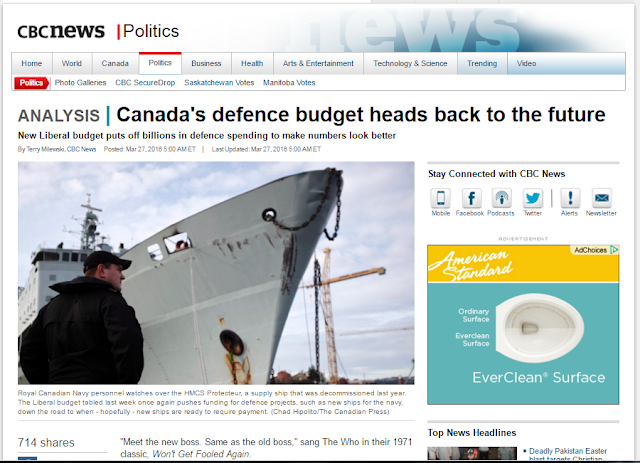
Those hoping that military programs will require the purchase of space based assets might also be in for a disappointment. As outlined in the March 27th, 2016 CBC News post, "Canada's defence budget heads back to the future," the new Liberal government seems set to follow along the same path of inactivity as did its predecessor. For more on the intersection of Canadian space and the military, check out the four part series on "Canada's Military Space Policy." Graphic c/o CBC.

Companies like Telesat, MacDonald Dettwiler, UrtheCast (a space company which has taken advantage of legislation originally designed to support the mining industry) and exactEarth now drive our domestic space agenda irrespective of what Ottawa might want or wish simply because they have the money to do things and not just talk.

So the Federal government has moved on to other, less specific tools which the space industry may or may not decide to use. Innovation, incubators, infrastructure and accelerators are now the order of the day.

However, if someone could find an infrastructure project which required the use of space based assets (for example, the original mandate of Telesat Canada to improve communications in the far north, which required the development and use of communications satellites), then there might still be opportunities for a savvy space company.

Chuck Black.
But the CSA itself has become far less trendy. There are no puppies falling from the heavens with space funding for new programs in this Federal budget.

All that's really left for us to do is to wish our space companies the best of luck. They're in the driver seat now.
___________________________________________________________

Chuck Black is the editor of the Commercial Space blog.

Sunday, February 14, 2016

Newborn exactEarth Faces its First Battle for the Worm

          By Glen Strom

Not unlike a newborn baby bird, exactEarth Ltd. of Cambridge, Ontario has to fight a nest-mate for a worm even before the company’s new-bird smell wears off.

exactEarth Ltd. (XCT) CEO Peter Mabson (center, at the podium) joined Rob Peterman, the director of global business development for the Toronto Stock Exchange and quite a number of others, to open the TSX on February 11th. The company was first listed on the TSX only two days earlier, on February 9th. Photo c/o CNW Group/TMX Group Limited.

The week before, exactEarth officially became a stand-alone company. They were spun off when parent company COM DEV International Ltd. was sold to US-based Honeywell International, as outlined in the January 24th, 2016 post, “Did the Government Let COM DEV Go Because They Have Bigger Fish to Fry?” In their first test as a separate company, exactEarth is looking to keep a Canadian government contract, set to expire this March, away from a foreign competitor.

As outlined in a February 12, 2016 SpaceNews article, “Orbcomm, exactEarth compete for key Canadian satellite-AIS contract,” exactEarth currently provides maritime surveillance data to the Canadian government. Their competitor for the contract is Orbcomm Inc. of Rochelle Park, New Jersey.

Orbcomm would say the competition is local, not foreign, because the official bidder is Skywave Mobile Communications of Ottawa. Seeing as how Orbcomm bought Skyway in January 2015, as outlined on the January 5th, Business Wire press release, "ORBCOMM Completes Acquisition of SkyWave," it’s not unreasonable to say that only one of the battling birdies is Canadian.

Peter Mabson, president of exactEarth, says in the article that they are optimistic about winning the new contract.

The current contract is worth $19Mln CDN, with $7.5Mln CDN of that for selling data to foreign governments. Mr. Mabson said even if they don’t get the new contract, nothing is stopping them from providing data to those foreign governments anyway (It’s always good to have a backup worm in case the first one gets grabbed by a pushy foreign bird).

We’ll soon find out how exactEarth’s first solo flight goes. If you hear a splat, just help the little guy up and point him seaward. He’ll be fine.

"We have a competitor, but here's the difference," said exactEarth president and CEO Peter Mabson during a February 11th, 2016 BNN interview. Screen shot c/o BNN.

As a side note, Mr. Mabson did a February 11th, 2016 video interview on Bell Media’s Business News Network (BNN), “exactEarth: Tracking the world's shipping.” He gave an interesting demonstration of how to avoid an unpleasant question.

Mr. Mabson, who seemingly had excellent hearing throughout most of the interview, appeared to go momentarily deaf when asked who exactEarth’s competitors were. The interviewer repeated the question.

This time Mr. Mabson heard the question but appeared to have a momentary memory lapse. After all, he’s a busy man and can’t be expected to remember everyone. He simply referred to that company as one from “south of the border” and resumed talking about his company.

In case Mr. Mabson reads this, the name of that company you couldn’t remember from south of the border is the aforementioned Orbcomm. They do stuff with satellites. And they like boats.

That’s Orbcomm with two m’s. Yes, those companies south of the border can be excessive. A good Canadian company would use a single m.

At least exactEarth spells their name sensibly. A good Canadian company wouldn’t have a weird spelling for “earth.”
Glen Strom.

Oh...never mind.

Who says the Canadian space biz can’t be fun? Cheep, cheep.
_____________________________________________________

Glen Strom is a freelance writer and editor with a background in business and technical writing. Follow him on Twitter @stromspace for the latest on Canadian space stories.

Support our Patreon Page