Showing posts with label Bombardier. Show all posts

Tuesday, May 07, 2019

Another Storied Canadian Aerospace Company Twists in the Fiscal Wind

          By Henry Stewart

Anyone remember those grand old days when Montreal PQ based Bombardier Aerospace actually built planes?


As outlined in the May 6th, 2019 Leeham News and Analysis post, "The decline and fall of Bombardier," those days are mostly done.

According to the post, with the announcement that its Belfast manufacturing facility and a smaller one in Morocco are for sale, Bombardier retains control over the manufacture of only the CRJ regional series of airliners. However, analysts expect that this facility will also be sold in the near future.

According to the post:
Bombardier pioneered the regional jetliner and dominated the turboprop sector.
(But Brazilian based Embraer surpassed the former and ATR (the Blagnac, France based ATR Aircraft) the latter.
A bold move to jump into the lower end of the market dominated by Airbus and Boeing, coupled with bad management and over-extending the balance sheet, nearly bankrupted the company.
As outlined in the January 29th, 2018 post, "A Pyrrhic Victory for Bombardier," that last near catastrophe was only averted when Bombardier "partnered" with Toulouse, France based aerospace powerhouse Airbus SE.

Earlier this month, as outlined in the May 2nd, 2019 Bombardier press release, "Bombardier Reports First Quarter 2019 Financial Results and New Strategic Direction for Aerospace, the formation of Bombardier Aviation," the company announced that it was consolidating  its aerospace assets "into a single, streamlined, and fully integrated Bombardier Aviation business unit."

Except, of course, for the parts that it's not trying to sell in an effort to cover its over extended balance sheet. Those components include the Belfast manufacturing facility and, as outlined in the May 6th, 2019 Globe and Mail post, "Bombardier to be supplied by Morocco plant after sale: minister," the smaller manufacturing facility in Morocco.

As outlined in the post, "Canada’s Bombardier Inc will sell its wing component plant in Morocco to a manufacturer that will continue to supply Bombardier after a sale, Moroccan Industry Minister Moulay Hafid Elalamy said on Monday."

The new owner will be revealed in three weeks.

Bombardier reported $2.1Bln US ($2.83Bln CDN) in revenues in the three month period ending March 31th, a drop of 11% over the same period last year.
_______________________________________________________________________

Henry Stewart is the pseudonym of a Toronto based aerospace writer.

Monday, January 29, 2018

A Pyrrhic Victory for Bombardier

          By Brian Orlotti

The US International Trade Commission (ITC) has unanimously ruled that the C-Series airliners which Montreal, PQ based Bombardier Aerospace intends to sell to Atlanta, GA based Delta Air Lines do not "injure US industry," despite accusations of “price-dumping” from rival Chicago, IL based Boeing Company.


While Bombardier executives, Quebec politicians, aerospace industry officials and unions are declaring victory, other signs point to it being a pyrrhic one for Canadian aerospace workers.

As outlined in the January 29th, 2018 Aviation Week post, "C Series US Assembly Line Still Planned Despite Trade Victory," the original complaint by Boeing to the US Department of Commerce had been made in April 2017. Boeing had argued that the Canadian and British governments had unfairly subsidized the C-series’ development, allowing Bombardier to sell it at far below cost.

In response, the Department of Commerce imposed a 292% per cent tariff on U.S. imports of C-Series aircraft.

The ruling triggered political shock waves in both Canada and the United Kingdom, both home to large Bombardier facilities and thousands of its employees. Bombardier and the Quebec government vehemently protested the decision and the Trudeau government threatened to retaliate by cancelling its planned purchase of 18 Boeing FA-18E/F Super Hornet fighters.

While many industry watchers considered the ruling Bombardier’s death knell, the company struck back by allying with European aerospace powerhouse Toulouse, France based Airbus SE,  a European multinational aerospace powerhouse.

As outlined in the October 16th, 2017 post, "A Game Changer for Canada: Airbus Takes a Majority Stake in Bombardier's C Series Program," in exchange for Airbus acquiring a virtual majority (50%) stake in the company, Bombardier would gain access to Airbus’ global procurement, sales, marketing and customer support networks. Airbus, in turn, would greatly expand its Canadian presence, gaining greater access to civilian and government contracts.

Bombardier then, in an attempt to circumvent the tariffs, set about to establish a US assembly line for the CS-100 in Mobile, Alabama. Delta Airlines had stated that it would not take delivery of CS100s from the Canadian line in Mirabel, QC but instead wait for aircraft assembled on the US line, expected to be operational by 2019.


Although the threat of the import tariff has now been lifted, Bombardier says it is moving forward with plans to deliver US-assembled aircraft to US airlines “as soon as possible, following regulatory approvals and the completion of the Alabama final assembly line.”

Delta Airlines has welcomed the ITC decision, but has not indicated whether it will take delivery of CS100s from the Canadian line beginning in April as originally planned.

In addition, and as outlined in the January 15th, 2018 Skies magazine post, "Bombardier considering Downsview sale," Bombardier has announced that it is considering selling its massive aircraft manufacturing facility in Downsview, Toronto as part of its five-year turnaround plan, threatening some 3,500 jobs.

The Downsview facility is dedicated to manufacturing the Q400 turboprop and Global business jets.

Given the expected shedding of even more Canadian jobs to come, and uncertainty over Bombardier’s rival’s next moves, celebrations may be premature.

So while Bombardier’s reprieve may be a good thing for Bombardier, but is it good for Canada?
Brian Orlotti.
  ______________________________________________________________

Brian Orlotti is a regular contributor to the Commercial Space blog.

Sunday, October 08, 2017

Au Revoir, Bombardier

          By Brian Orlotti

The protectionist Donald Trump Administration dealt a potentially fatal blow to Canadian aircraft maker Bombardier by imposing a nearly 80% anti-dumping duty on its new C Series airliners that were to be sold in the US market.


As outlined in the October 6th, 2017 Canadian Press post, "Bombardier C-Series hit with 2nd tariff by US," the penalty comes on top of a separate duty of 220% imposed by the US Department of Commerce the previous week. The moves mark an escalation of the United States’ trade war against Canada and casts grave doubt over the already-tense North American Free Trade Agreement (NAFTA) renegotiation currently underway. 

The rulings, prompted by a lawsuit launched earlier this year by US aerospace behemoth Boeing Co., has triggered political shock waves in both Canada and the United Kingdom, both home to large Bombardier facilities and thousands of its employees.

Prime Minister Justin Trudeau has accused Boeing of trying to put Canadians out of work and threatened to retaliate by cancelling a major contract to buy 18 Boeing Super Hornet fighters to augment Canada’s aging fleet of CF-18s.

Quebec Premier Philippe Couillard has stated that from now on "not one bolt, not one part, not one plane" made by Boeing should be purchased by Canada until the dispute is resolved.

In the UK, where the C Series’ wings are assembled, Defence Minister Michael Fallon has also vowed to retaliate, though like Canada, British officials are using political back channels with the United States in an attempt to get the duties dropped.


Combined, the two levies will more than triple the price of Bombardier C Series aircraft sold to the US.

Boeing alleges Bombardier used “unfair” subsidies from the Canadian, Quebec, and UK governments to slash prices on the C Series and make inroads with major U.S. airlines, in effect selling at far below cost.

Yet, as outlined in the September 28th, 2018 Global News post, "Bombardier got subsidies? Boeing received $64B from the U.S. government," the alleged $2.5Bln USD ($3.1Bln CDN) in subsidies is utterly dwarfed by the $64Bln USD ($80Bln CDN) in federal loans and loan guarantees (typically non-repayable) Boeing received from the U.S. government between 2000 and 2014.

This is in addition to Boeing’s entrenched status as a prime military contractor, almost operating as a branch of the US military itself. When viewed in this light, the US rulings come across as rank hypocrisy.

The rulings, though a product of Donald Trump’s ultra-nationalist “America First” policy, are not without  opposition in the US.

Bombardier relies on US-based subcontractors for supplying many of the C-series’ subsystems. In an ironic twist, the US Dept of Commerce’s rulings may put many Americans out of work as well.

As outlined in the October 6th, 2017 Globe and Mail post, "Trump administration punishes Bombardier with another import duty," six members of the US Congress representing Kansas and other states that are home to Bombardier suppliers have also weighed in.

"This decision is short-sighted and threatens thousands of good jobs across the country," they said in a joint statement. "We urge the department to work with the parties to find a responsible solution."

Is the true target of US sanctions against Bombardier Canada or China? The October 9th, 2017 Aviation Week post, "Opinion: Why Boeing vs. Bombardier Is Really About China," argues the latter. Screenshot c/o Aviation Week.

Bombardier’s management say they are confident that they will win several new orders for the C-series this year from customers in Asia and Africa. Meanwhile, the US rulings’ true test will come next year when Boeing will need to prove before the International Trade Commission (ITC) that it suffered injury at the hands of the C Series.

Only then will the duties be finalized. Prospects for a repeal of the rulings are slim, however, since US law is biased in favour of the domestic complainant.

As Boeing and the Trump Administration move to crush their Canadian competition, Bombardier (and Canada) must seek out new partners and finally embrace a global mindset.

It’s time for Canadians to truly stand on guard.
Brian Orlotti.
  ______________________________________________________________

Brian Orlotti is a regular contributor to the Commercial Space blog.

Monday, February 13, 2017

OMX, Trump, Trudeau, Bombardier's Bailout, the UK Space Agency, UK Spaceports, CSA Earth Imaging Grants & MAFIC Studios

          By Henry Stewart

For the week of February 13th, 2017, here are a few of the stories we're currently tracking in the Commercial Space blog:

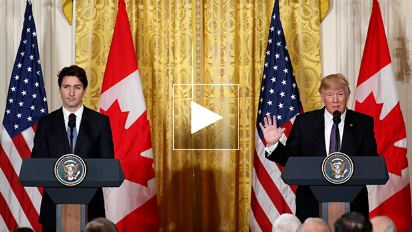
Canadian Prime Minister Justin Trudeau and US President Donald Trump met in Washington, DC on February 13th, 2017. For an overview of their public discussion, check out the February 13th, 2017 CBC News post, "Trudeau meets Trump: Watch the full news conference or read the transcript." Photos c/o CBC News.

  • Toronto, ON based Offset Marketing Exchange (OMX) CEO Nicole Verkindt has an interesting perspective on the February 13th, 2017 meeting between Canadian Prime Minister Justin Trudeau and new US President Donald Trump. 
As outlined in the February 13th, 2017 Linked-In post, "How America Won the Chicken War and why Trump will Try it Again," the real secret to understanding the Trump agenda is to understand a West German tariff imposed at the end of World War II to support small, struggling German chicken farmers, and the US measures imposed in retaliation designed to cut off Volkswagen van imports.
As outlined in the post, "Not all wars have a clear winner, but it would seem today that Americans dominate in pickup trucks much more so than Germans do in chickens. The "Chicken Tax" essentially legislated American success in the light truck market, and now President Trump is hoping to recreate this same sort of success in other markets." 
The article is certainly a more nuanced assessment of Trump, Trudeau and their respective agendas than is typical in these polarized times. Only time will tell if the assessment ends up being more accurate.
OMX was first profiled in the January 23rd, 2013 post, "Buy Canada: New Firm Tracks IRB Offsets." 
  • Montreal, PQ based Bombardier Inc. has its bailout. But the new funds come with new concerns over Brazil's latest World Trade Organization (WTO) challenge to Bombardier's Federal and provincial government support.
As outlined in the February 7th, 2017 CBC News post, "Federal government to give $372.5M in loans to Bombardier," the Justin Trudeau government has said that it will provide $372.5Mln CDN in interest-free loans to Bombardier, "a move that elicited criticism even though it is far less than the transportation giant originally sought more than a year ago." 
As outlined in the June 30th, 2016 Bombardier press release, "Bombardier closes the Government of Québec’s investment in the C Series Aircraft Limited Partnership," the company has also received $1Bln US ($1.31Bln CDN) in recent funding from the Quebec provincial government along with a number of smaller grants and tax breaks. 
But, as outlined in the February 13th, 2017 Globe and Mail post, "Brazil’s WTO challenge over aid to Bombardier is good for the aviation market," the government of Brazil has requested consultations with the Canadian government regarding "subsidies provided to local manufacturer Bombardier for the development of its new C Series commercial jets." 
Brazil’s request, supported by the CEO of Brazilian based Embraer SA, the Brazilian aerospace conglomerate generally considered to be Bombardier's major competition, highlights "subsidies in excess of $4-billion (U.S.) provided by Canada’s national, provincial and local governments." 
As outlined in the article, "attempts to resolve this matter via diplomatic channels have proved unsuccessful, leaving the Brazilian government with no option but to request WTO consultations, action that Embraer supports."
Bombardier was last profiled in the November 1st, 2016 post, "Is Bombardier Another Example of a Company Unable to Find Success in Canada?
  • The UK Space Agency has launched a £10Mln GBP ($16.35CDN) plan to grow the UK based commercial spaceflight market. 
As outlined in the February 10th, 2017 Room post, "UK Space Agency announces £10 million scheme to develop commercial spaceflight launch capabilities," the program is designed to help "develop commercial launch capability for spaceflight – a market that is worth an estimated £25 billion over the next 20 years."
The funding "must be used to develop spaceflight capabilities, such as adapting launch vehicle technology for use in the UK or building spaceport infrastructure." Businesses expected to bid for a share of the newly allocated funding are likely to be joint enterprises of launch vehicle operators and potential launch sites.
While the contest is being held, the UK government has also committed to "preparing legislation to develop a safe and competitive regulatory environment for spaceflight. This work goes hand-in-hand with government’s work internationally to achieve the technical, trade and policy agreements necessary for UK based launch services and developing interest from launch customers and operators from around the world."
All in all, it sounds like the sort of plan that any moderately sized country (and many venture capital firms) could reproduce fairly quickly and easily. Here's hoping the Canadian government takes notice. 
  • The Canadian Space Agency (CSA) is funding a variety of programs exploring new uses for Earth observation (EO) satellites on their own, and in conjunction with Earth based observation techniques.
As outlined in the February 9th, 2017 CSA Earth observation application development post, "Innovative EO solutions: exploring the benefits of using satellites and drones together," the CSA is exploring "the complementary use of drones and satellites to enhance EO applications and provide more comprehensive solutions to end-users," through its Earth Observation Application Development Program (EOADP).
Seven concept studies are currently being funded up to a maximum of $100,000 CDN. They include: 
  • An application for "Mapping and classifying wetlands," through Kawartha Lakes, ON based AG-UAV
  • An application for "identifying the presence of pests in agriculture," through Montreal, PQ based Effigis Geo Solutions
  • Two applications for "monitoring algae blooms" the first, focused around "the use of hyperspectral sensors aboard drones to simulate coarse-resolution data for specific regions," through Quebec City, PQ based Institut National de la Recherche Scientifique (INRS) and the second, focused on collecting data "from EO satellites along with hyperspectral and thermal infrared sensors aboard drones," through Waterloo, ON based H2O Goematics. 
  • An application for "providing land measurements to the mining sector," through Vancouver, BC based TRE Altamira
  • An application for "detecting land movement caused by industrial activities," through Victoria, BC based ASL Environmental Sciences
  • An application to "monitor pipelines" through St. John's, Newfoundland based C-Core.
As outlined in the post, The EOADP program has also provided funding (up to $300,000 CDN) to explore potential uses for EO satellites focused on the management of disasters involving landslides, wildfires, flooding, oil and ice detection, and ice travel. 
The Canadian companies selected to receive funding under this program include 3vGeomatics Inc., AECOM Consultants Inc., Array Systems Computing Inc., AUG Signals Ltd., C-CORE, Hatfield Consultants, MDA Geospatial Services Inc. (a part of Richmond, BC based MacDonald Dettwiler), PCI Geomatics, PolarView Canada and TRE Altamira.
The Sudbury based graphic design firm, last profiled in the April 17th, 2016 post, "Sudbury Graphics Design Firm Sees the Big Picture," is still diligently focused on providing realistic and accurate images for the scientific, engineering and aerospace community. 
As outlined by owner Kris Holland, the new reel was constructed completely in-house, with the exception of the music, which was created by audiojungle.com/Amoebacrew. 
As outlined by Holland, "I'm always trying to improve the products I offer, so that the technical community can better convey its message, in order to raise both awareness and funds.  This demo shows the breadth of what I have to offer, from stills, animation, and full production of scripted media."
For more information, check out the Mafic studios website at http://www.maficstudios.com/
For more, check out future posts in the Commercial Space blog.
_______________________________________________________________________

Henry Stewart is the pseudonym of a Toronto based aerospace writer.

Monday, November 21, 2016

The US Military, CSeries, Roland Berger, Bell, MDA, Airships & Minister Bains at the 2016 Canadian Aerospace Summit

          By Brian Orlotti

Notable not only for its record breaking 1100+ exhibitors and participants, but also as the platform for the release of major new projects and strategic discussions on economic issues, sustainable development and global change, the 2016 Canadian Aerospace Summit wrapped up in Ottawa on November 15th after a successful two day run.

Here are some of the more interesting presentations and discussions.

A full house at the Shaw Centre in Ottawa on the first day of the Summit. As outlined in the November 17th, 2016 Aerospace Industries Association of Canada (AIAC) press release, "2016 Canadian Aerospace Summit Concludes; Attracts Largest Audience Ever," the Summit "brings together industry executives and government decision makers for two days of meetings, networking, and high-level presentations on aerospace growth and competitiveness." The Canadian Aerospace Summit is hosted by the AIAC. Photo c/o Brian Orlotti

The Summit’s first talk, ‘Defense Innovation -- Must be a Team Game,’ was given by retired US Vice Admiral William Landay.
Bill Landay. Photo c/o Linked-In.
Landay made the case that while military innovation has traditionally been driven within the military industrial base and targeted toward specific military needs, many of today’s commercial technologies also have great applicability in this area. 
He argued that US military culture has become too risk-adverse and conservative (with too may regulations and standards) and must change in order to adapt to new threats. 
Military organizations need to create an environment that encourages commercial companies, individual inventors and university researchers to work with them. Landay noted the growing blur between commercial and military technologies, citing unmanned aerial vehicles (UAVs) as an example.
He also discussed non-state actors’ (i.e. terrorist/insurgent groups) rapid adoption of commercial techologies for battlefield use, for instance their use of UAVs for reconaissance and weapon targeting. 
Landay concluded that, in the future, most military technologies will be commercially derived.
Not all the activities at the Summit were wrapped around dense power-point presentations. As outlined in the November 16th, 2016 AIAC press release, "Rob Dewar and the CSeries Aircraft Program Team Named the 2016 Recipient of the James C. Floyd Award for Aerospace Achievement," there was also time to celebrate past successes.  As outlined in the press release, annual the James C. Floyd Award was "established in 2009 in honour of the chief engineer on the Avro Arrow project. AIAC’s James C. Floyd Award for aerospace achievement is an annual award that honours exceptional contributions to the Canadian aerospace sector. Nominations are submitted by AIAC members and evaluated by an independent review panel (and) presented during the Canadian Aerospace Dinner, which is held at the annual Canadian Aerospace Summit." Photo c/o AIAC.

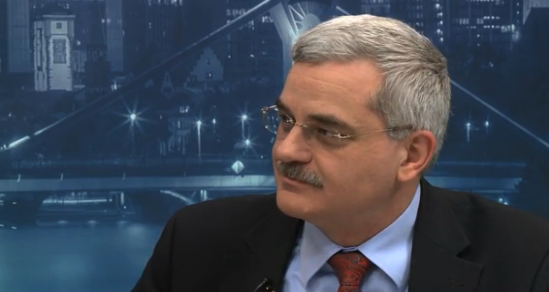
Manfred Hader, a senior partner at the global consulting firm Roland Berger, discussed ‘The Digital Aerospace Supply Chain: A New Paradigm Or Just A Fad?’ 
Manfred Hader. Photo c/o Finance.
Hader discussed digital technologies’ transformative effects on the aerospace supplychain and the aerospace industry’s slow adoption of electronic interchange of order and inventory information between parts suppliers and clients, despite their ability to greatly reduce production and development times (in marked contrast to its rapid adoption in the retail and manufacturing sectors).
He also talked about the steadily increasing use of 3D printing, citing examples such as Local Motors 3D printing cars in localized micro-factories and the US Navy and Maersk Line 3D printing spare parts aboard ships. 
Hader spoke of Airbus working with Uber to adapt its ride-sharing software platform for helicopters and flying cars. Also mentioned was Airbus’ partnership with IBM to provide a cloud-based analytics service that can optimize life cycle management, increasing an aircraft’s ROI by 25%. 
Hader concluded saying that digital transformation will require a new mindset in the aerospace industry and that those who do not adopt it will miss out on opportunities and thus perish.
Costa Rica trade minister Alexander Mora, with AIAC president Jim Quick (both seated) on the second day of the summit, preparing to sign a memo of understanding between AIAC and the Costa Rica Aerospace Cluster (CRAC).  Photo c/o Brian Orlotti.

Mitch Snyder, the president and CEO of Bell Helicopter, spoke about some of his company’s current projects, most notably the Bell 505 Jet Ranger X and its advanced avionics.
Mitch Snyder. Photo c/o Bell.
The Bell 505s are scheduled to replace the Canadian Coast Guard’s decrepit fleet of Sikorsky CH-124 Sea King helicopters. 
Synder said the production line for the Bell 505s was relocated from Lafayette, Louisiana to Mirabel, Quebec earlier this year. Bell’s Canadian workforce had been subjected to numerous layoffs over the past few years that have left it at less than half its peak number of 2,000. 
Bell’s other current projects include the V-290 Valor tilt-rotor transport/gunship (a replacement for the US Army’s Blackhawk and Apache choppers), the Bell 525 Relentless medium-lift helicopter with fly-by-wire and advanced sensor suite and the V-247 Vigilant tilt-rotor combat unmanned aerial vehicle
Synder stated Bell Helicopter’s view that tilt-rotor craft are beginning to displace traditional helicopters.
Don Osborne on stage during the first day of the Summit. Photo c/o Brian Orlotti.

Don Osborne
, the president of the information systems group at MacDonald Detwiller (MDA), spoke at the Summit in lieu of new CEO Howard Lance (who, although scheduled to attend, developed a “not too serious” respiratory infection and stayed home to convalesce).
Howard Lance. Photo c/o Twitter.
After a lengthy recitation of the company’s early history and achievements, Osborne briefly mentioned MDA’s incorporation in Delaware and Mr. Lance’s appointment as the company’s US-based CEO, then capped it off with a statement of MDA’s pride in being Canadian. 
Osborne stated MDA’s view that the Canadian government must invest more in space just as other industrialized nations have. 
He welcomed the new Liberal government, but warned that it must “fulfill its youthful promise,” and said that MDA approves of the Liberals’ Innovation Strategy, but emphasized the need for a "long-term space plan," to prevent Canada from losing its space leadership. 
Responding to a direct question from the audience regarding Mr. Lance’s appointment and its consequences, Osborne stated that MDA had decided to pursue the US market some years ago but that Lance has “no lack of enthusiasm for what happens north of the border” and is “as enthusiastic, if not more so, for what happens in Canada.”
Only one day after the Summit concluded, Lockheed Martin announced the first contract for its hybrid airship project. As outlined in the November 16th, 2016 Fortune post, "Lockheed's Hybrid Airship Gets Launch Customer in Canada," Montreal, PQ based Quest Rare Minerals, has signed a memorandum of understanding to lease the airships as part of its plans to develop a rare earth metal project in northern Quebec, where the airships will be used for transportation and haulage. The total contract is expected to be worth up to $850Mln USD ($1,143Bln CDN) including fuel costs, and cover a 10-year period. Graphic c/o Lockheed Martin.

One of the Summit’s marquee presentations was that of Lockheed Martin CEO Marillyn Hewson. Hewson outlined two initiatives of particular relevance to Canada’s North.
Marillyn Hewson. Photo c/o LM.
She first discussed Lockheed Martin’s hybrid airship project. 
A cross between a blimp and a hovercraft, the airships’ helium-filled chambers have enough lift to haul up to 21,000 kgs of cargo, plus up to 19 passengers. 
With a cruising speed of about 110 kph, they can travel a distance of nearly 2,600 kms. An air cushion landing system enables the hybrid airships to touch down nearly anywhere (land, water or ice) with no ground infrastructure needed. 
Lockheed believes that hybrid airships could revolutionize remote transportation. Hybrid airships could provide a cheaper and greener alternative to the expensive airplanes and helicopters that remote northern Canadian mining operations and communities currently rely on for delivery of basic necessities. Hybrid airships burn less than one tenth the fuel of a helicopter per ton, saving money and reducing carbon emissions. Lockheed is working with Transport Canada to certify hybrid airships.
Hewson also announced Lockheed’s partnership with four Northern communities to establish a pilot program for sustainable energy ‘microgrid’ systems. 
Designed to help reduce off-grid communities’ reliance on diesel generators, the microgrids will consist of sun-tracking solar panels connected to batteries. Monitored by software, the system will be able to switch between generator and battery power as needed. Once fully implemented, Lockheed projects a 40 percent reduction in the amount of diesel fuel used across these communities, in turn reducing carbon emissions by 160,000 tons per year. 
If successful, the company plans to market the microgrids to developing nations seeking energy independence and sustainability.
Minister Bains during a media scrum on the second day of the Summit. Photo c/o Brian Orlotti.

The capstone to the Summit was a speech by the minister of innovation, science and economic development, Navdeep Bains. Among the many points he touched upon:
The Federal Government will revive the Space Advisory Board. 
As outlined in the November 14th, 2014 post, "Industry Minister Moore Announces Space Advisory Board Members," the board was originally created by the previous Conservative government as one of the recommendations of the 2012 David Emerson led Aerospace Review
It originally came with a mandate to report on the direction of the Canadian Space Agency (CSA), but never released a public report. 
Canada’s "New Space Strategy" will be launched in June 2017. 
The expectation/hope from various space advocacy groups, such as the Canadian Space Commerce Association (CSCA) and others, is that this new, but so far unnamed strategy will bear more than a passing resemblance to the traditional Canadian perception of a dense and detailed "long-term space plan" as discussed in posts like the February 15th, 2010, "Ottawa Citizen:" Where did that Long Term Space Plan Go?"
Besides, as outlined in the October 13th, 2015 post, "Part 2: Abandoning the Emerson Aerospace Review?," both the Liberals and NDP made promises to produce one of those more detailed reports during the last election. 
Given that the Liberals actually won the election, perhaps they should follow-through on their campaign promise, just so long as any document produced is in compliance with the governments larger innovation policy.
Canada needs more science, technology, engineering and mathematics (STEM) workers. 
The Federal government is taking a multi-pronged approach by acting to reduce foreign worker visa-processing times down to 2 weeks; working to ensure that Colleges and Universities are aligned with "the needs of the aerospace industry;" expanding the scientific research and experimental development (SR&ED) credit program to provide more research and development (R&D) money to small companies and “unlocking” more Federal R&D money via multi-year funding plans.
An overview of the ministers talking points are included with the November 16th, 2016 Federal government press release, "Setting the stage for a globally competitive aerospace and space industry in Canada."

The 2016 Canadian Aerospace Summit provided a forum for enabling the Canadian aerospace industry to adapt to current challenges while securing its future. The Commercial Space Blog congratulates the AIAC on a smooth and worthwhile event.
Brian Orlotti.
  ______________________________________________________________

Brian Orlotti is a regular contributor to the Commercial Space blog.

Tuesday, November 01, 2016

Is Bombardier Another Example of a Company Unable to Find Success in Canada?

          By Brian Orlotti

Almost a year into the Federal governments mandate, the financial and corporate problems surrounding Montreal, PQ based Fortune 500 multinational Bombardier Inc. do not seem any nearer to a solution despite sales and the slow production ramp up of its CSeries commercial aircraft.

As outlined in the October 29th, 2016 Motley Fool post, "Bombardier Looks for CSeries Jet Orders: Can It Land Spirit Airlines?," the struggling aircraft manufacturer finally met its long-standing goal of lining up 300 firm orders for its brand-new CSeries jet earlier this year. The orders should fill its production capacity from now until 2020, when production ramp-up is expected to be complete. But the early sales have been heavily discounted and Bombardier has announced that it would record a special "onerous contract" charge of about $500Mln CDN to account for the discounts. The company now has to survive until 2020 when the discounted planes are completed and the company can begin to generate profit with new orders. Photo c/o Delta Airlines.

As outlined in the October 21st, 2016 Financial Post article, "Bombardier Inc announces second mass layoff this year — eliminating 7,500 jobs globally, 2,000 in Canada," the sputtering aerospace giant will eliminate 7,500 jobs (over 10 per cent of its global workforce), including 2,000 jobs in Canada. These layoffs are in addition to the 7,000 job cut announced last February.

Two-thirds of this workforce reduction will come from Bombardier’s rail systems division, while the rest will come from its aerospace branch. The company claims that the layoffs will be partially offset by its “strategic hiring” of 3,700 new employees to support the ramp-up of the CSeries jets and the new Global 7000 business jet, scheduled to enter service in 2018.

The layoffs are projected to save Bombardier $300Mln USD (400Mln CDN) a year by the end of 2018 and are part of the company’s five-year plan to improve revenue, margins and free cash flow by 2020. In addition, the CS100 airliner began commercial flights with its first customer, Swiss International Air Lines AG this past summer, with the larger CS300 due to enter service before year’s end.

The company has also secured CSeries sales to two major customers: Air Canada and Delta Air Lines Inc (though at industry-rumoured massive discounts).

Bombardier isn't just designing and rolling out the CSeries. As seen in the graphic above, the Bombardier Global 7000 and 8000 series of long range, high performance business jets, are also on the drawing board. The aircraft, originally designed for roll-out in 2016-2017 but currently delayed until 2018 or later, will be sold much like the CSeries, with early orders heavily discounted to help ramp-up sales and production capacity. This likely means a second "onerous contract" charge to cover the losses expected early in the Global 7000/8000 production ramp-up sometime around 2018/19, which will only be offset by the sale of profitable aircraft after many years of production.  Image c/o Bombardier.

The company’s woes continue, however, including CSeries production delays due to issues at its engine supplier, a global slowdown in demand for business jets and ongoing (and well-publicized) production problems at its rail systems division. On top of all this, Bombardier continues to carry over $9Bln USD ($12Bln CDN) in debt.

Having already received $1Bln CDN in funding from the province of Quebec as well as $1.5Bln CDN from Quebec’s pension fund, Bombardier earlier this year requested an additional $1Bln CDN from the federal government. As outlined in the October 11th, 2016 Financial Post article, "Federal Liberals signal desire for ‘meaningful investment’ in Bombardier but avoid dollar amount," the Trudeau government has not provided this funding but continues paying lip service to the idea, with the caveat of preserving Canadian jobs as a prerequisite for any deal.

As the corporate bloodletting continues, Bombardier’s future seems anything but clear. Canada has a history of difficulties keeping large high tech companies in business and Canadian. Only time will tell if Bombardier ends up being an exception to the general pattern of the RIM's, Nortel's, Avro's and Spar Aerospace's which came before.

Bombardier shares currently stand at $1.78 CDN each.
Brian Orlotti.
  ______________________________________________________________

Brian Orlotti is a regular contributor to the Commercial Space blog.

Sunday, March 27, 2016

No Puppies Falling from the Heavens With Space Funding in this Federal Budget

          By Chuck Black

It's worth noting that puppies haven't begun falling from the heavens with new funding for the Canadian Space Agency (CSA) in the wake of last weeks Federal budget.

It's certainly not focused on growing  the "space class" as can be seen from the cover page of the 2016 Federal budget. For the full document along with the text of Finance Minister Bill Morneau’s budget speech, which he delivered on Tuesday in the House of Commons, check out the March 22nd, 2016 National Post article, "Federal budget 2016: The full document." For Federal government literature on the budget, check out the Budget 2016 website. Screenshot c/o Government of Canada

That budget, the first under the new Liberal government headed by Prime Minister Justin Trudeau, predicted large deficits over the next five years (beginning with $29.4Bln CDN in the first year), which will be used to finance a new tax-free monthly child benefit, more money for First Nations, infrastructure spending and extended employment insurance benefits to hard-hit regions.

But it didn't provide any real boost in Federal funding for space technology development or discuss any new attempt to create a "long term space plan."

As outlined in the October 13th, 2015 post on, "Part 2: Abandoning the Emerson Aerospace Review?," both of those campaign promises were made and promoted in the media, but evidently weren't taken terribly seriously by the Liberal party candidates who originated them in the last Federal election.

Overall CSA funding is an estimated $432Mln CDN in 2016, approximately $49Mln CDN more than 2015's projected budget of $383Mln CDN. That total is actually declining when the RADARSAT Constellation Mission (RCM) is removed from the totals. As outlined in the January 12th, 2013 post "a $706Mln Fixed Price Contract and Hard Launch Date for RADARSAT Constellation," the RCM program should be pretty much wound down except for maintenance and support costs within the next two years.

And the "big announcement," that the government has committed up to $379Mln CDN over eight years (beginning in 2017), in order to maintain Canada's commitment to its International Space Station (ISS) partners, is something the government always knew it had to do in order to preserve slots for Canadian astronauts David Saint-Jacques and Jeremy Hansen to visit the ISS in 2019 and 2021. Of course, those travel commitments were made well before the current government took office.

The Aerospace Industries Association of Canada (AIAC) rather liked the Federal budget, at least if you take the March 22nd, 2016 press release, "AIAC applauds budget commitments to space, innovation, defence strategy" at face value. The press release applauds the $379Mln CDN the budget commits over the next eight years to extend Canada’s participation in the ISS to 2024. According to the press release, the budget "also reaffirmed last year’s commitment to provide $30 million over four years for Canadian participation in the European Space Agency’s Advanced Research in Telecommunications Systems (ARTES) program." However, the press release failed to mention $8.7Mln CDN which was set aside to to upgrade the anechoic chamber at the David Florida Laboratory test facility at Shirleys Bay, Ontario. As outlined in the expansively titled March 22nd, 2016 SpaceRef.ca post, "What You Need to Know About the Budget and Canada's Space Program," the funds will allow the CSA to "continue to support technology development in Canada's space sector through state-of-the-art assembly, integration and testing capabilities." Screenshot c/o AIAC.

Of course, some companies and institutions, although not likely firms focused around space activities, will absolutely benefit from the latest budget. As outlined in the March 25th, 2016 Motley Fool Canada post, "Get to Know 6 Companies Poised to Benefit From the Federal Budget," these firms are mostly focused around infrastructure, which is scheduled to receive $11.9Bln over five years. They include:
  • Etobicoke, ON. based Aecon Group - Canada's largest public construction and infrastructure development company.
  • Winnipeg, MB. based New Flyer Industries - The company manufactures transit buses and, with $3.4Bln CDN is tagged for transit spending. If new vehicles are part of the $3.4Bln tagged for transit spending in the budget, then New Flyer is very likely to get in on the action.
  • Mississauga, ON. based Pure Technologies - The Motley Fool article considers this company, with its focus on pipeline managements technologies, as being well placed to receive a large chunk of the $5Bln allocated in the budget for new water and waste water management technologies.
  • Montreal, PQ. based SNC-Lavalin - A "one stop shop when it comes to engineering and construction" according to the article. 
  • Edmonton, AB. based Stantec - A professional services company wrapped around design, energy, environmental and infrastructure projects.
More money (around $800Mln CDN over four years) is budgeted for incubators and accelerators to help grow new ideas and start small businesses. According to the Canadian Association of Business Incubation (CABI) there are currently 60+ business incubators and accelerators across Canada with a broad range of expertise. That total is sure to grow with this new funding.

A further $2Bln over three years is allocated for a new post-secondary institutions Strategic Investment Fund. This initiative will support up to 50 per cent of the eligible costs of infrastructure projects at post-secondary institutions and affiliated research and commercialization organizations, in collaboration with provinces and territories.

Taken together, it's not too shabby. But its also not directly related to the Canadian space industry, although space companies might certainly take advantage of many of the programs.  

It's worth noting that the Prospectors and Developers Association (PDAC) also came down in favor of the Federal budget. As outlined in the March 22nd, 2016 PDAC post "PDAC welcomes measures to support Canada’s mineral exploration and development sector," the organization was particularly happy with the renewal of the Mineral Exploration Tax Credit (METC) and the expansion of deductions allowed under the Canadian Exploration Expense (CEE)." As outlined in the June 30th, 2012 submission to the Emerson Aerospace Review under the title, "Using Tools from the Mining Industry to Spur Innovation and Grow the Canadian Space Industry," many of the legislative tools and regulations which currently support our domestic mining industry could also be used to support our space industry. Graphic c/o PDAC.

Although not mentioned in the budget, it's expected that Montreal, PQ based Bombardier Inc. will receive substantial Federal funding over the next little while. As outlined in the February 21st, 2016 post on "Saving Bombardier," the giant Canadian company requires the new funds in order to remain solvent and (perhaps) protect Canadian jobs.

Also not mentioned in the budget was funding for the upcoming (at least officially) Polar Communications and Weather (PCW) mission. As outlined in the February 14th, 2014 post, "'Team Canada' Solution for PCW Mission Competing Against US Bid," PCW development (estimated to cost upwards of $600Mln CDN in total) was expected to begin this year.

So where does that leave our space industry? Pretty much where we expected it to be.

As outlined in the September 16th, 2015 post, "Meanwhile, Back in the Real World: Seasoned Entrepreneurs are Jockeying for Position in the Fast Growing NewSpace Economy," the government isn't really in a position to drive space exploration and is not currently funding any large projects, except for those related to previously announced international initiatives.

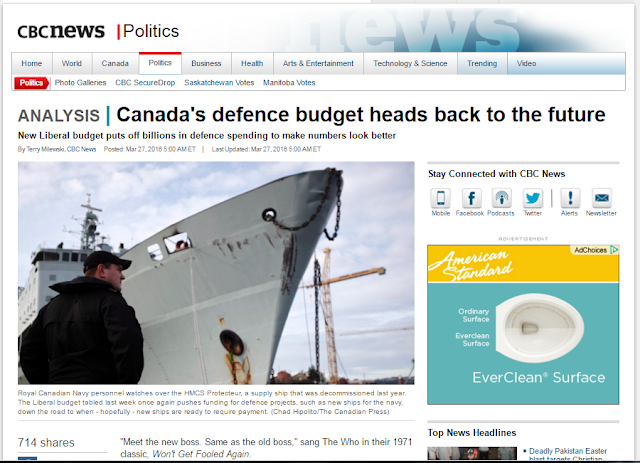
Those hoping that military programs will require the purchase of space based assets might also be in for a disappointment. As outlined in the March 27th, 2016 CBC News post, "Canada's defence budget heads back to the future," the new Liberal government seems set to follow along the same path of inactivity as did its predecessor. For more on the intersection of Canadian space and the military, check out the four part series on "Canada's Military Space Policy." Graphic c/o CBC.

Companies like Telesat, MacDonald Dettwiler, UrtheCast (a space company which has taken advantage of legislation originally designed to support the mining industry) and exactEarth now drive our domestic space agenda irrespective of what Ottawa might want or wish simply because they have the money to do things and not just talk.

So the Federal government has moved on to other, less specific tools which the space industry may or may not decide to use. Innovation, incubators, infrastructure and accelerators are now the order of the day.

However, if someone could find an infrastructure project which required the use of space based assets (for example, the original mandate of Telesat Canada to improve communications in the far north, which required the development and use of communications satellites), then there might still be opportunities for a savvy space company.

Chuck Black.
But the CSA itself has become far less trendy. There are no puppies falling from the heavens with space funding for new programs in this Federal budget.

All that's really left for us to do is to wish our space companies the best of luck. They're in the driver seat now.
___________________________________________________________

Chuck Black is the editor of the Commercial Space blog.

Sunday, February 21, 2016

Saving Bombardier

          By Brian Orlotti

Canadian flag carrier Air Canada, in a move facilitated by the Federal and Quebec governments, has signed a letter of intent to purchase up to 75 new C-Series commercial aircraft from imploding aerospace giant Bombardier Inc. The deal comes on the heels of a series of disasters for the company, culminating in an appeal from Bombardier management to the Federal government for financial aid.

Going up. Perhaps... The first of the Bombardier  C-Series, takes off on its maiden test flight at the Bombardier facility in Mirabel, PQ on September 16th, 2013. As outlined in the November 21st, 2015 iPolitics post, "Mr. Trudeau’s Bombardier problem,"  the situation has been a topic of discussion in the Liberal caucus since transport minister Marc Garneau put the kibosh on the sale of Bombardier jets to Toronto Island based Porter Airlines last November.  Photo c/o Canadian Press /Ryan Remiorz.

Bombardier's hunger for Canadian taxpayer funds carries no small amount of irony,  given the company's zeal for exporting Canadian taxpayers' jobs under the oft-repeated mantra of cost-cutting.

The Air Canada/Bombardier deal is essentially an out-of court settlement to a lawsuit filed by the Quebec government against Air Canada last year. As outlined in the February 18th, 2016 Canadian Press article, "Quebec getting heat for dropping lawsuit against Air Canada in C-Series deal," the Quebec government had accused Air Canada of violating the Air Canada Public Participation Act (which requires Air Canada's maintenance work to be done in specific Quebec locations) by moving some heavy maintenance work to companies in the US, Singapore, Israel and Ireland.  Air Canada appealed to the Supreme Court, but lost.

As part of the C-Series deal, Air Canada and the Quebec Government have agreed to end their litigation and Air Canada has pledged to perform heavy maintenance on the C-Series in Quebec for the next 20 years.

In exchange, the Federal government has agreed to remove the Quebec maintenance requirements from the Air Canada Act. The 25% foreign ownership limit and the requirement that Air Canada’s headquarters be located in Montreal will stand, however.

Bombardier isn't just having trouble with its airplanes. Shown above are Bombardier streetcars in Toronto, ON., which haven't been arriving to replace the existing Toronto Transit Commission (TTC) inventory of worn out streetcars as fast as the City of Toronto would have liked. As outlined in the March 4th, 2013 Canadian Press article, "Bombardier sued over alleged train defects in Germany," at least one other Bombardier client has resorted to the courts for satisfaction. Photo c/o David Donnelly/CBC.

Oddly enough, both transport minister Marc Garneau and Air Canada CEO Calin Rovinescu have publicly denied that there was any Federal government pressure to make the C-series purchase.

But the Quebec lawsuit is but one of many woes plaguing Bombardier:

  • The failure of the C-Series regional jets. Originally marketed as having quieter engines, lighter air-frames and better fuel economy than other aircraft, the program now faces disaster. The C-Series' competitive advantage has vanished due to both the large drop in global oil prices as well as stiff competition from titans like Boeing and Airbus. Bombardier has received no new C-Series orders since 2014 and customers who ordered aircraft in 2009 still await delivery. As outlined in the February 17th, 2016 Globe and Mail post, "Bombardier gets lifeline as Air Canada places order for C Series jets," the new Air Canada order may not provide much reprieve, especially after factoring in industry rumours that Air Canada will be given a 60% discount on each aircraft, paying just $30Mln USD ($41.3Mln CDN) of the $72.4Mln USD ($99.7Mln CDN) list price.
  • An impending $50Mln CDN lawsuit from the City of Toronto against Bombardier over shoddy workmanship and unfulfilled deliveries of the cities' new streetcars. As outlined in the October 28th, 2015 CBC News post, "TTC to sue Bombardier over delayed streetcars," the company has been struggling in this area as well. 

It's worth noting that there is simply not enough money in the Federal coffers to fund every worthy cause and choices will certainly need to be made in the lead up to the next Federal budget. As outlined in the February 21st, 2016 CTV news post, "Notley asks for oilsands aid as feds mull Bombardier bailout," Alberta is also asking for assistance. Screen shot c/o CTV.

As the Justin Trudeau government ponders whether to load even more taxpayer billions onto Bombardier's sinking ship, perhaps it should heed the lessons of the auto industry downturn of 2009. In that year, the Canadian government bailed out both Chrysler and General Motors by purchasing $13.7Bln CDN of preferred shares in the flat-lining auto makers.

In April 2015, the former Harper government sold its remaining shares. As outlined in the April 7th, 2015 Globe and Mail article, "Canadian taxpayers lose $3.5-billion on 2009 bailout of auto firms," that investment didn't work out so well.

As governments kept feeding billions to withering dinosaurs, the industry's true rebirth came from elsewhere.

In 2010, Tesla Motors (in partnership with Toyota) purchased the defunct NUMMI auto assembly plant in Fremont, California. Reborn as 'The Tesla Factory,' this facility now produces electric vehicles like the Tesla Model S sedan and the Tesla Model X SUV. The Tesla Factory employs over 3,000 workers and has produced 33,117 vehicles as of late 2015. Tesla Motors innovative ascension continues, with the company opening a factory in the Netherlands 2013 and preparing to open a plant in China later this year.

The Tesla Factory in Freemont, CA. According to the company website, "the Tesla Factory in Fremont, California is one of the world’s most advanced automotive factories, containing 5.3 million square feet of manufacturing and office space." Photo c/o Tesla.

However, the jewel in Tesla's crown will be the so-called 'Gigafactory 1' currently being built near Reno, Nevada. Begun in 2014 (in partnership with Panasonic) and scheduled to begin operations this year, this $5Bln USD ($6.88Bln CDN) facility will produce lithium-ion batteries for electric vehicles as well as Tesla's Powerwall home battery system. Gigafactory 1 is expected to employ 6,500 workers.

The true lesson of the 2009 auto industry downturn is that genuine innovation, growth and jobs come from supporting innovative new companies and not squandering billions of taxpayer dollars into defunct, fossilized old enterprises.The US government stands to make far more return from its investment in Tesla Motors than the Canadian government did for its support of GM and Chrysler.

Rather than shoveling even more mountains of cash into the maw of the Bombardier clan, perhaps the Trudeau government should focus on helping the 7,000 soon-to-be-unemployed workers and their families, both in the short and long term. It could also more aggressively support innovative new companies that could offer new jobs for these discarded men and women.

MIT Aeronautics and Astronautics department head Jaime Peraire interviews SpaceX and Tesla CEO/founder Elon Musk on October 24th, 2014, at the final session of the AeroAstro 1914-2014 Centennial Symposium. Musk talked about electric aircraft. Screen shot c/o Every Ashley Dove - Jay Video.

As the son of a manufacturing worker whose job was exported to Mexico some 17 years ago (he worked for American Standard, which moved a number of facilities from Canada to Mexico around that time), the author has seen first hand the effects of such mass layoffs as are expected to occur at Bombardier.

While the government of seventeen years ago showed not a flicker of concern as it blundered through an earlier round of private sector layoffs, the current Justin Trudeau government has an opportunity to make a difference by aiding the unfortunate and cutting off old enterprises that are past their best-before date.

Brian Orlotti.
Trudeau could make his own contribution towards the 'Just Society' as his father did long ago.
______________________________________________________________

Brian Orlotti is a network operations centre analyst at Shomi, a Canadian provider of on-demand internet streaming media and a regular contributor to the Commercial Space blog.

Support our Patreon Page