Everyone loves Navdeep Bains, Canada’s innovation minister, especially the innovation community which hungers for those countless semi-trailers full of cash he’s been giving out recently.
We're going to look at that and we're also going to remember the time when we could ask government ministers hard questions and have a reasonable expectation of receiving an honest answer even for the difficult issues.
Sources cited during this episode include the following:
The April 22nd, 2020 update to the National Research Council (NRC) Industrial Research Assistance Program (IRAP) Innovation Assistance Program (IAP). Uploaded on August 3rd.
The August 14th, 2020 Federal Government September 4th, 2018 update to the "Innovation Supercluster Initiative." Uploaded on August 3rd, 2020.
"Age of Ingenuity" tracks Canada's "innovation ecosystem," the organizations, agencies and individuals attempting to turn innovative Canadian start-ups into world class, billion dollar "unicorns," able to anchor industries and create jobs.
Copyright disclaimer under section 107 of the US Copyright Act of 1976, allowing for “fair use” for purposes such as criticism and under section 29 of the 1921 Canadian Copyright Act allowing for “fair dealing” exemptions for criticism, review and news reporting.
Remember to like, comment, share, subscribe and support this vidcast on Patreon and Paypal.
For the week of February 20th, 2017, here are a few of the stories we're currently tracking for the Commercial Space blog:
An overview of Digitalglobe stock price on February 17th, 2017, when the news broke that MDA might be attempting to buy the company. As would be expected, Digitalglobe shares went up in heavy trading on the New York Stock Exchange (NYSE) after the story broke. MDA's shares were down slightly on the Toronto Stock Exchange (TSX). Both the NYSE and the TSX were closed for holidays on Monday but will reopen on Tuesday. Graphic c/o Marketwatch.
But Dow Jones was also hedging its bets on the validity of its source. As outlined in the post, "financial conditions of the deal couldn't be learned and it is also possible that talks might fall apart before a decision is reached, the Dow Jones report said."
DigitalGlobe’s current market cap is approximately $1.8Bln US ($2.4Bln CDN).
Curiously enough, both MDA and Digitalglobe, as publicly traded corporations, will be holding their quarterly conference earnings calls over the next week. DigitalGlobe is set to report its full year and fourth quarter 2016 financial results on Monday, February 27th, 2017 and MDA will release its fourth quarter and year end financial results on Thursday, February 23rd, 2017.
Perhaps by then, the real situation will begin to shake out.
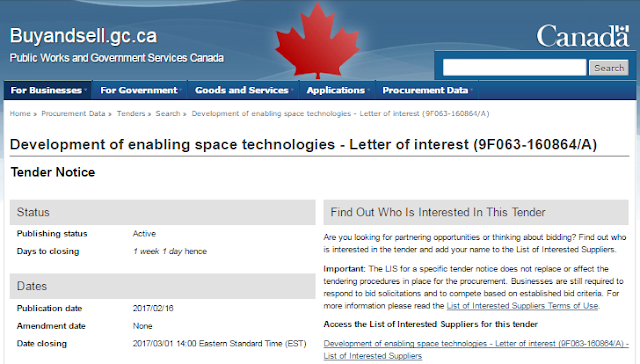
The Canadian Space Agency (CSA) has issued a letter of interest (LOI) for seventeen "enabling technologies," needed in order to facilitate Canadian contributions to a variety of potential international space missions.
TRL-6, as defined by the CSA, normally includes the development of "a representative model or prototype system," suitable for testing and showing off to potential customers.
The technologies identified under the program include upgrades of existing technology relating to Earth imaging, space medicine and rover technologies. The LOI includes time-frame, beginning and ending tech-levels and estimated budgets once the programs are underway,
Budgets range from $75 - $100K CDN (for the "development of technology that will help to
secure Canada’s position as leader of inspace
biological sample analysis in support of space
research and health monitoring") to $1 - $1.3Mln CDN (for the "development of an advanced low frequency power amplifier for the harsh space environment around Mars").
The CSA normally defines "enabling technologies" as components or subsystems of space missions organized by other nations and/or private companies, which the CSA will commit to developing in order to be allowed to participate in the mission.
Seven short videos, highlighting several of the 2017 winners were posted (but with very little fanfare) to the 2017 NSERC Prizes You-Tube page on February 7th, 2017. That's a bit of a shame since the individual awards focus on useful accomplishments from Federally funded scientists and are well worth celebrating.
Sylvain Moineau, from the Université Laval, who received the 2017 John C. Polanyi Award for playing a leading role in the international collaboration which identified the adaptive immunity system known as CRISPR-Cas, found in about half of all bacteria.
André Longtin and Leonard Maler, from the University of Ottawa, who received the 2017 Brockhouse Canada Prize for interdisciplinary research in science and engineering, for combining their expertise in physics, mathematics and neurobiology to uncover the neural code that underlies the operation of the brain.
Zhangxing (John) Chen, from the University of Calgary, who received one of four NSERC Synergy Awards for Innovation for leading a research consortium with a group of partners from the oil and gas sectors, using dynamic simulations to test new operations.
Laurent Drissen, from Université Laval, who partnered with the ABB Group to design and build the first SpIOMM imaging fourier transform spectrometer, a device that lets telescopes see the visible spectrum of every source of light in a field of view a thousand times larger than other spectrometers.
Guy Dumont, from the University of British Columbia, who partnered with Lionsgate Technologies to develop the Kenek O2, a small, easy-to-use diagnostic tool that connects to the audio port on your mobile device.
"Conference season," that time when academia, business and government leaders get together to schmooze and pitch projects and plans, is finally winding down for the holidays, with the notable exception of the 2016 European Space Agency (ESA) Ministerial Conference (which includes the Canadian Space Agency as an associate member), which will be held from December 1st - 2nd, 2016 in Lucerne, Switzerland.
With that in mind, here are a few of the stories we're currently tracking for the Commercial Space blog:
Liberals in Space! Our government supported space activities, operate under numerous funding constraints and need to operate within "Canada's Innovation Agenda," a Federal government program focused around collaboration with other government departments and the application of science to develop new technologies and products. Just look at all the groups which had to come together to build just this one, single image with a question mark. Graphic c/o the Commercial Space blog, SpaceRef.ca, the Canadian Space Agency & the Liberal Party of Canada.
After a grace period covering its first year in office, some are finally beginning to question the ongoing lack of Federal Liberal government support and funding for our space agency.
As outlined in the article, "the new federal government should comply with the 2012 Aerospace Review, which recommended stabilization of overall CSA funding in real dollars."
The post goes on to state that, "the benefits of living in the space age have become so pervasive that their creation and support has been taken for granted, but the investments required to sustain these public goods and to invent new ones require support from the Canadian government. Yet the Canadian government has chosen to tightly limit the CSA’s budget from 2016 to 2019..."
"This act is painful to those already established in the Canadian space sector and it is effectively pulling up the ladder on young Canadians eager to find a job, pursue advanced degrees, start businesses, or attend conferences..."
But is is a reasonable indication of the way the Canadian political winds are beginning to blow. Governments who ignore this leading indicator, do so at their peril.
It's hard to believe given the history, but it seems that the James Webb Space Telescope (JWST) might be on track, on budget and on schedule for launch in October 2018.
Who'da thunk?..
As outlined in the November 27th, 2016 New York Times post, "NASA on track to launch advanced Webb space telescope in 2018," the giant space telescope which once threatened to co-opt the entire NASA astronomy budget, is now "on track and on budget to be launched in October 2018."
The article notes that, while the JWST is now on track, other programs, such "as a proposed space telescope to study dark energy, which the (US) National Academy of Sciences (NAS) had hoped to put on a fast track to be launched this decade," are not. The NAS project has been postponed until 2025 or later.
A November 21st, 2016 tweet showing the ground breaking ceremony at Downsview Park. As outlined in the November 21st, 2016 Centennial College post, "Centennial's Aerospace Campus breaks ground at Downsview Park,"the project has just received an additional $18.4Mln CDN from the Federal Post Secondary Institutions Strategic Investment Funds (SIF) and $25.8Mln CDN from the Ontario government, in order to relocate the college's aviation programs to the new facility. Photo c/o @CentennialEDU.
After six years of "official" campaigning and a further fifteen years of preliminary proposals and politicking, the proposed Downsview Park aerospace hub and its centerpiece, the new Centennial College Aerospace campus, has finally begun construction.
In total, the project is expected to cost $72Mln CDN. The funds will be used to re-purpose the historically significant de Havilland building at 65 Carl Hall Rd., using "selective demolition," plus add new construction, in order to create a new 138,000 square feet facility with instructional space and a new hangar large enough to accommodate current commercial jets.
As outlined in the July 28th, 2015 post, ""Up to $18.4Mln" More for the Downsview Aerospace Hub," this isn't the first time the project has received funding or even the first time construction was expected to move forward. But it is the first time that ground has actually been broken on the site. The project is expected to be completed in 2019.
For more, check out upcoming editions of the Commercial Space blog. _______________________________________________________________________
Henry Stewart is the pseudonym of a Toronto based aerospace writer.
The June 3rd, 2016 release of the Canadian Space Agency (CSA) report on the 2015 "Comprehensive Socio-Economic Impact Assessment of the Canadian Space Sector," originally categorized as "a sweeping study of the benefits of Canada’s involvement in space," seems to have sunk without notice into a summer news cycle more focused around terrorism, consumerism, anecdotal personal interest stories and government PR.
But according to Adam Keith, the managing director of Euroconsult Canada (the firm which compiled the report under CSA contract), there are a number of useful take-aways which could certainly assist with the development of federal economic and innovation policy.
Keith corresponded with the blog last week, with a little help from his colleagues and a little input from the CSA. The questions asked and the answers provided are listed below:
What are the differences in methodologies between the Euroconsult report and previous CSA reports assessing the Canadian space sector, such as the "2013 State of the Canadian Space Sector Report?"
The objective of the CSA report is to measure, on an annual basis, changes to the baseline features of the Canadian space sector.
These baseline features take stock of the number of organizations active in the sector and their composition (i.e. the percentage of small, medium enterprises, or SMEs, the share of universities, etc), the sectors of activity (i.e. Earth observation or EO, exploration, science, navigation, satcom and other), the Canadian space workforce and composition (including its share of highly qualified personnel or HQPs, the regional distribution of the workforce and the types of jobs held by the workforce), R&D and innovation, as well as a few other baseline indicators.
The CSA report [i.e CSA's 2013 report] provided data on the sector for 20 years, following a consistent methodology, which enabled comparisons across the years and with other countries. The objective of this current report (the Euroconsult report) is to assess socio-economic impacts of the Canadian space sector.
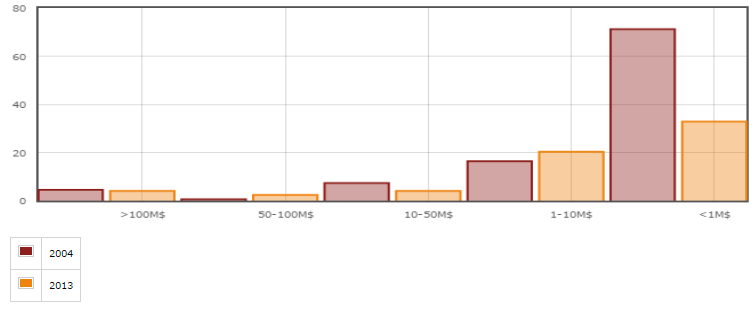
Chart showing the distribution of companies by revenue in the Canadian space sector. As outlined in the Euroconsult report, "the Canadian space sector is characterized by the presence of a large number of SMEs (firms with under 500 employees) who account for nearly 90% of all organizations. These SMEs are primarily anchored in the engineering & research and services segments." Graphic c/o CSA/ Euroconsult.
The scope includes the baseline data of the CSA report, and is wider in that it seeks to determine the impacts of that baseline, its social (e.g. connectivity amongst participants in the sector), environmental (e.g. improved natural resource management), strategic (e.g. increased capabilities for DND); and economic impacts (e.g. GDP and stimulation of job creation in the economy)…
The two reports are complementary and do not intend to replace one another.
Editor's Note: As outlined explicitly in the opening "Note to Reader / Upcoming Transition" preface to the 2013 State of the Canadian Space Sector Report, the 2013 CSA report was intended to be the last to use the standard CSA methodologies.
According to the 2013 CSA report, future assessments would use methodologies developed by the Organisation for Economic Co-operation and Development (OECD) which, as noted below, are the methodologies used in several chapters of the more recent Euroconsult report.
It is interesting to note that a review of the graphs and tables contained in the Euroconsult report appear to terminate with 2013 data, as did those in the CSA's 2013 report. Hence, the two documents appear to cover the same time frame.
The 2013 CSA report coincides very closely with section two of the Euroconsult report (but)... there are two main differences.
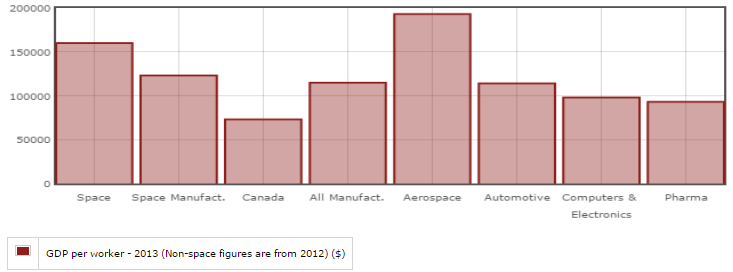
Labour productivity of the typical Canadian space sector worker as compared to other Canadian industry sectors. According to the Euroconsult report, "with a GDP per worker of roughly $123,000, space manufacturing firms had higher productivity levels than several notable manufacturing sector peers including computers and electronics, pharmaceutical and automotive manufacturing firms. Space manufacturers trailed the productivity levels of the aerospace manufacturing sector, partially attributable to the fact that space firms generally manufacture goods in smaller, less standardized batches than their aerospace peers." Graphic c/o CSA/ Euroconsult.
First, the CSA data from 1996-2013 had organized revenues into the following categories: Space Research, Space Segment, Ground Segment, Applications and Services.
In collaboration with CSA, Euroconsult reorganized the presentation of this data into categories that align with a value-chain approach: Research, Engineering and Consulting, Space System Manufacturing, Ground System Manufacturing, Satellite Operations, Products and Applications, Services.
This work was in line with new methodologies developed at the Organisation for Economic Co-operation and Development (OECD) Global Forum on Space Economics. Details about these categories can be found in the report.
The second difference is that, since the definitions of the value chain include an expanded view of downstream services, more organizations with broadcasting revenues were included. You will see reference throughout the report to revenues with and without broadcasting included.
A graphic mapping of private sector and government department end users of space based solutions in Canada. According to the Euroconsult report, "there are three different segments to end users of space based solutions in Canada, falling under the categories Communications, Imagery, and Navigation. All of these segments contain private users in Energy/Mining, Forestry, and Maritime; and public users in DFO (the Department of Fisheries and Oceans), EC (Environment Canada), DND (the Department of National Defence), NRCAN (National Resources Canada), and Parks. Communications and Navigation share private users in Telecom, Air, Rail, Road, and Finance; with public users in Telecom. Communications and Imagery share private users in Media and Retail, and public users in Health. Finally, Imagery and Navigation have overlapping private users in Agriculture and Engineering, with public users in AAFC (Agriculture and Agrifoods Canada)." Graphic c/o CSA/ Euroconsult.
Section three does not have a counterpart in the 2013 CSA report. This section is the core of the economic impact assessment which uses economic modeling to determine impacts on the national GDP and stimulation of jobs created (in addition to those tracked by CSA in the baseline features).
Section three also captures tax benefits to the government. The methodology for this modelling was developed in collaboration with the federal department of Innovation, Science and Economic Development (ISED) and the CSA. A description can be found on page 94 of the Euroconsult report.
Government space activities as outlined in section two of the Euroconsult report on "The Canadian Space Sector," seem limited to the projects listed on page 17 of the report and include no pure research or R&D functions, except as they relate to the fulfilment of the listed programs. Is this a fair assessment of the current responsibilities of the CSA?
The objective of the report was to assess the Canadian space sector, not to perform an exhaustive review or catalogued audit of the CSA’s activities.
Section two outlines the roles of Canadian government agencies in space, including but not limited to the CSA and is certainly not an assessment of the latter’s responsibilities.
The table specifies in its title that it represents a selection of “major current government space projects”. Impacts of the CSA’s R&D and innovation functions are described in other sections of the report, notably section 3.3.1 the “Support to Innovation” chapter.
The Canadian space manufacturing sector and its connected sectors. According to the Euroconsult report, "For the approximately 10 Tier 1 companies, another 55 companies are estimated to be Tier 2 suppliers and over 200 Tier 3 suppliers, all in all active in well over 20 distinct sectors or industries." Source c/o CSA/ Euroconsult.
On page 89 of the report, it states explicitly that "this report does not aim to formulate recommendations." But let's be fair, no government spends $250K CDN without a reasonable expectation that their contracted report will at least collect together some new information useful to the development of policy. What should be the takeaways from the Euroconsult report?
Indeed, providing recommendations was not within the scope of the report. The purpose was to arm the CSA and government policy-makers with a view of the benefits derived from space activities in Canada.
Key takeaways relevant to policy-making are detailed in section five, the “Conclusions” chapter.
A key message/finding derived from the expanded analysis of the sector’s broader economic impacts is that the Canadian space sector, notably within its manufacturing base, is highly productive in terms of its GDP creation per worker as compared to most of Canada’s leading industries.
This is despite the sector’s large number of small and medium enterprises (SMEs), which, as a group, have been historically cited as a reason for Canada’s labor productivity deficit as compared to the United States.
Canada’s space sector also compares favorably in terms of economic (GDP) multipliers (described in the Economic footprint chapter) with the U.K’s space sector, which has benefited from heightened government support in recent years.
It's worth noting that this specific type of report might never have seen the light of day and its creators would almost certainly have felt far less comfortable discussing it publicly under the previous government.
But that was then, and this is now. The current question is perhaps a bit more prosaic. Now that this report has been released, what does the current federal government intend to do with it?
Chuck Black.
Will it contribute to policy or be ignored by the current Federal government? That's the important question, today.
___________________________________________________________
Chuck Black is the editor of the Commercial Space blog.
On April 24th, as part of Waterloo, Ontario's contribution the upcoming International Space Apps Challenge a small Canadian NewSpace start-up plans to help unveil Canada’s first space startup accelerator.
The move is an important milestone in Canadian space history and highlights the continuing shift of space activities away from government/academia-focused models and towards those of the IT industry.
Bob Dylan singing "The Times They Are A Changin," in 1964. Screenshot c/o You-Tube.
SkyWatch is promising to open a “space startup-specific” accelerator sometime in 2016, providing a venue for open source, not-for-profit, and for-profit ventures, who will have access to technical resources,NASA’s open data and tools, community support and mentorship, and business resources to develop the next generation of space innovation solutions.
The tantalizing press release, lacking the specifics of who will fund the program and how it will be administered, seems almost to have been released by accident. As outlined in e-mail correspondence with SkyWatch Space Applications co-founder James Slifierz:
...While the press release mostly pertains to the Space Apps Challenge (which will be held in Waterloo on April 22nd - 24th), there is mention of the accelerator.
Other than the fact that it will be coming in 2016, and that it will be based in Waterloo, we won't be revealing any more facts until we get closer to the Space Apps Challenge...
We'll be putting out a press release the week of the Space Apps Challenge and I would be happy to talk about the details of the program at that point.
Skywatch Space Applications is a Waterloo, ON based company focused on creating apps that harness government open-sourced astronomical data.
Skywatch’s web app (also called Skywatch) provides real-time access to and visualization of astronomical/geospatial data culled from a wide variety of sources, including ground and space-based telescopes, drones, satellites and deep-space probes.
Of course, SkyWatch isn't the only bell weather in this area. Another sign of the ongoing fusion of the space and IT industries occurred just this past week.
The event, focused around machine-learning, automation, robotics and space exploration (MARS), featured attendees from robotics and AI companies (i.e. Rethink Robotics, Toyota) as well as academia (MIT, University of California at Berkeley and ETH Zurich).
Amazon’s CEO Jeff Bezos is the founder and CEO of space company Blue Origin, which launched its New Sheppard reusable rocket last December and earlier this month opened its factory to the media.
The intensifying cross-pollination of the space and IT industries can also be seen in SpaceX CEO Elon Musk’s recent ventures with US-based tech incubator Y Combinator.
As outlined in the December 11th, 2015 BackChannel article, "How Elon Musk and Y Combinator Plan to Stop Computers From Taking Over," Musk and Y Combinator have jointly founded a new non-profit that will pursue artificial intelligence research and open source its data to the public. The space and IT industries, becoming increasingly intertwined, both stand to massively benefit.
Brian Orlotti.
After decades of wheel spinning, broken promises and doctrinal squabbling, the times they are a changin.’
Brian Orlotti is a network operations centre analyst at Shomi, a Canadian provider of on-demand internet streaming media and a regular contributor to the Commercial Space blog.
After the last election in October 2015, Canadian space advocates could reasonably have hoped that ex-astronaut and veteran Liberal MP Marc Garneau was about to be assigned a leading role in redefining the political landscape surrounding the Canadian Space Agency (CSA) and other Federal government drivers of research and technology.
That's not to say Garneau doesn't have his hands full. After all, last week he agreed to put his department under "special oversight" by the Treasury Board after it was reported to have repeatedly overspent its budget.
The last time transportation safety bubbled up into the public consciousness was during the 2013 Lac-Mégantic oil train disaster, which killed 47 and destroyed roughly half of downtown Lac Mégantic, PQ. The March 12th, 2016 PostMedia article, "If financing rail safety has no optics, is it worth it?" suggests that transport safety measures endorsed by the outgoing Harper government, along with new initiatives promised by the incoming Trudeau government are being held up until the Federal budget is tabled on March 22nd. Depending on what's in the budget, some of those initiatives might not ever see the light of day. Screenshot c/o Toronto Sun.
As outlined in the March 9th, 2016 Globe and Mail post, "Marc Garneau vows to fix Transport Canada’s financial situation," the Auditor-General raised concerns in the fall of 2013 over the number of Federal transport inspectors responsible for transportation safety and the costs associated with maintaining them.
According to the article:
Transport Minister Marc Garneau says he’s “not happy” with the financial situation of his department and is vowing to fix the problem without sacrificing the department’s key role in protecting the safety of Canadians.
But unions representing Transport Canada inspectors warn that ongoing restraint is putting safety at risk and that many of the staffing problems identified by the Auditor-General more than two years ago remain unaddressed.
The Treasury Board is the Federal government's only statutory cabinet committee and is responsible for the federal civil service and much of the fiscal operation of the Canadian government.
The first Bombardier C-Series taking off on its maiden test flight at the Bombardier facility in Mirabel, PQ on September 16, 2013. As outlined in the November 21st, 2015 iPolitics post, "Mr. Trudeau’s Bombardier problem," Montreal based Bombardier was looking for the Federal government to bolster the recent billion dollar Quebec government investment in the company, either by providing further direct financial support of an equal amount or else by facilitating the sale of Bombardier jets to Toronto based Porter Airlines, which intended to operate them from Billy Bishop Airport on the Toronto Islands. As outlined in the November 13th, 2015 Toronto Star post, "Ottawa kills Porter’s plans for island airport jets," the Trudeau government eventually rejected this option, which set the stage for the latest Bombardier request for support. Photo c/o Canadian Press /Ryan Remiorz.
Of course, transportation safety isn't the only ball the Transport Minister has been tasked with juggling.
As outlined in the March 8th, 2016 Canadian Press article, "Liberals vote down Tory move to force Bombardier execs to testify at committee," Garneau has also taken point in Federal government discussions related to Bombardier and the types of government assistance it could reasonably expect to receive from the Trudeau government.
As outlined in the article:
Conservative MP Maxime Bernier, who introduced the motion to invite Bombardier executives to testify on why they need federal dollars, said opposition MPs likely won't get any answers from Bombardier or the government about a possible bailout until after it is announced.
The move was part of a larger push by the Official Opposition to pressure the government over Bombardier's future, a possible federal bailout for the company and the government's decision not to allow a runway extension at the Billy Bishop airport in Toronto.
None of this is to suggest that the Transport Minister has any actual decision making responsibilities. Garneau is just the messenger, passing along the decisions of others and ready to take the flack should any of his political opponents feel the need to shoot the messenger.
And none of the above is in any way related to the high hopes held by some space pundits back in November 2015, when all things seemed possible, although it is worth noting that at least one other CSA manager has joined the Transport Ministry to work with Garneau.
As outlined in his Linked-In profile another longtime CSA employee, former director of science and academic development Alain Berinstain was hired as director of policy in the Transport Ministry in December 2015.
It's unlikely that either will return to anything associated with the Canadian space industry anytime soon.
Besides, as outlined in the June 14th, 2015 post, "Jobu Won’t Save Your Space Start-up: Do it Yourself," governments were never really very helpful in this area, anyway.
_________________________________________________________________________________
Henry Stewart is the pseudonym for a Toronto based aerospace writer.
Canadian flag carrierAir Canada, in a move facilitated by the Federal and Quebec governments, has signed a letter of intent to purchase up to 75 new C-Series commercial aircraft from imploding aerospace giant Bombardier Inc. The deal comes on the heels of a series of disasters for the company, culminating in an appeal from Bombardier management to the Federal government for financial aid.
Going up. Perhaps... The first of the Bombardier C-Series, takes off on its maiden test flight at the Bombardier facility in Mirabel, PQ on September 16th, 2013. As outlined in the November 21st, 2015 iPolitics post, "Mr. Trudeau’s Bombardier problem," the situation has been a topic of discussion in the Liberal caucus since transport minister Marc Garneau put the kibosh on the sale of Bombardier jets to Toronto Island based Porter Airlines last November. Photo c/o Canadian Press /Ryan Remiorz.
Bombardier's hunger for Canadian taxpayer funds carries no small amount of irony, given the company's zeal for exporting Canadian taxpayers' jobs under the oft-repeated mantra of cost-cutting.
The Air Canada/Bombardier deal is essentially an out-of court settlement to a lawsuit filed by the Quebec government against Air Canada last year. As outlined in the February 18th, 2016 Canadian Press article, "Quebec getting heat for dropping lawsuit against Air Canada in C-Series deal," the Quebec government had accused Air Canada of violating the Air Canada Public Participation Act (which requires Air Canada's maintenance work to be done in specific Quebec locations) by moving some heavy maintenance work to companies in the US, Singapore, Israel and Ireland. Air Canada appealed to the Supreme Court, but lost.
As part of the C-Series deal, Air Canada and the Quebec Government have agreed to end their litigation and Air Canada has pledged to perform heavy maintenance on the C-Series in Quebec for the next 20 years.
In exchange, the Federal government has agreed to remove the Quebec maintenance requirements from the Air Canada Act. The 25% foreign ownership limit and the requirement that Air Canada’s headquarters be located in Montreal will stand, however.
Bombardier isn't just having trouble with its airplanes. Shown above are Bombardier streetcars in Toronto, ON., which haven't been arriving to replace the existing Toronto Transit Commission (TTC) inventory of worn out streetcars as fast as the City of Toronto would have liked. As outlined in the March 4th, 2013 Canadian Press article, "Bombardier sued over alleged train defects in Germany," at least one other Bombardier client has resorted to the courts for satisfaction. Photo c/o David Donnelly/CBC.
Oddly enough, both transport minister Marc Garneau and Air Canada CEO Calin Rovinescu have publicly denied that there was any Federal government pressure to make the C-series purchase.
But the Quebec lawsuit is but one of many woes plaguing Bombardier:
The failure of the C-Series regional jets. Originally marketed as having quieter engines, lighter air-frames and better fuel economy than other aircraft, the program now faces disaster. The C-Series' competitive advantage has vanished due to both the large drop in global oil prices as well as stiff competition from titans like Boeing and Airbus. Bombardier has received no new C-Series orders since 2014 and customers who ordered aircraft in 2009 still await delivery. As outlined in the February 17th, 2016 Globe and Mail post, "Bombardier gets lifeline as Air Canada places order for C Series jets," the new Air Canada order may not provide much reprieve, especially after factoring in industry rumours that Air Canada will be given a 60% discount on each aircraft, paying just $30Mln USD ($41.3Mln CDN) of the $72.4Mln USD ($99.7Mln CDN) list price.
An impending $50Mln CDN lawsuit from the City of Toronto against Bombardier over shoddy workmanship and unfulfilled deliveries of the cities' new streetcars. As outlined in the October 28th, 2015 CBC News post, "TTC to sue Bombardier over delayed streetcars," the company has been struggling in this area as well.
Bombardier has announced layoffs in Canada and other worldwide locations over the next two years, as outlined in the February 17th, 2016 Canadian Press story "Bombardier Layoffs To Hit 7,000 In Canada, Europe." With its share price hovering at around $1 CDN (its lowest since 1989), the company is also in danger of being de-listed from stock exchanges worldwide, which would certainly imperil any future financing efforts. And, as outlined in the November 19th, 2015 National Post article, "Bombardier Inc gets boost to balance sheet with $1.5-billion from Quebec pension fund," the company is still projected to run out of cash in the latter half of this year.
It's worth noting that there is simply not enough money in the Federal coffers to fund every worthy cause and choices will certainly need to be made in the lead up to the next Federal budget. As outlined in the February 21st, 2016 CTV news post, "Notley asks for oilsands aid as feds mull Bombardier bailout," Alberta is also asking for assistance. Screen shot c/o CTV.
As the Justin Trudeau government ponders whether to load even more taxpayer billions onto Bombardier's sinking ship, perhaps it should heed the lessons of the auto industry downturn of 2009. In that year, the Canadian government bailed out both Chrysler and General Motors by purchasing $13.7Bln CDN of preferred shares in the flat-lining auto makers.
As governments kept feeding billions to withering dinosaurs, the industry's true rebirth came from elsewhere.
In 2010, Tesla Motors (in partnership with Toyota) purchased the defunct NUMMI auto assembly plant in Fremont, California. Reborn as 'The Tesla Factory,' this facility now produces electric vehicles like the Tesla Model S sedan and the Tesla Model X SUV. The Tesla Factory employs over 3,000 workers and has produced 33,117 vehicles as of late 2015. Tesla Motors innovative ascension continues, with the company opening a factory in the Netherlands 2013 and preparing to open a plant in China later this year.
The Tesla Factory in Freemont, CA. According to the company website, "the Tesla Factory in Fremont, California is one of the world’s most advanced automotive factories, containing 5.3 million square feet of manufacturing and office space." Photo c/o Tesla.
However, the jewel in Tesla's crown will be the so-called 'Gigafactory 1' currently being built near Reno, Nevada. Begun in 2014 (in partnership with Panasonic) and scheduled to begin operations this year, this $5Bln USD ($6.88Bln CDN) facility will produce lithium-ion batteries for electric vehicles as well as Tesla's Powerwall home battery system. Gigafactory 1 is expected to employ 6,500 workers.
The true lesson of the 2009 auto industry downturn is that genuine innovation, growth and jobs come from supporting innovative new companies and not squandering billions of taxpayer dollars into defunct, fossilized old enterprises.The US government stands to make far more return from its investment in Tesla Motors than the Canadian government did for its support of GM and Chrysler.
Rather than shoveling even more mountains of cash into the maw of the Bombardier clan, perhaps the Trudeau government should focus on helping the 7,000 soon-to-be-unemployed workers and their families, both in the short and long term. It could also more aggressively support innovative new companies that could offer new jobs for these discarded men and women.
MIT Aeronautics and Astronautics department head Jaime Peraire interviews SpaceX and Tesla CEO/founder Elon Musk on October 24th, 2014, at the final session of the AeroAstro 1914-2014 Centennial Symposium. Musk talked about electric aircraft. Screen shot c/o Every Ashley Dove - Jay Video.
As the son of a manufacturing worker whose job was exported to Mexico some 17 years ago (he worked for American Standard, which moved a number of facilities from Canada to Mexico around that time), the author has seen first hand the effects of such mass layoffs as are expected to occur at Bombardier.
While the government of seventeen years ago showed not a flicker of concern as it blundered through an earlier round of private sector layoffs, the current Justin Trudeau government has an opportunity to make a difference by aiding the unfortunate and cutting off old enterprises that are past their best-before date.
Brian Orlotti.
Trudeau could make his own contribution towards the 'Just Society' as his father did long ago.
Brian Orlotti is a network operations centre analyst at Shomi, a Canadian provider of on-demand internet streaming media and a regular contributor to the Commercial Space blog.
It's well known that lawmakers, entrepreneurs and advocates are often the real facilitators of science and exploration. With that in mind, here are some of the high and low points for the Canadian space sector in 2015.
_________________________________________________________________________________
The year started out on a positive note with the exchange of gifts.
As outlined in the January 10th Yahoo News UK article, "Astronauts Get Their Own LEGO Minifigures on Space Station," LEGO mini-figures customized to look like expedition 43 astronauts Terry Virts, Samantha Cristoforetti and cosmonaut Anton Shkaplerov were given as gifts by the real expedition 43 astronauts to each other on New Year's Day.
The toys were part of an ongoing sales campaign created by UK-based company Minifigs.me.
As outlined in the September 2nd, 2015 CBC News article, "Denmark's 1st person in space brings along 20 Lego astronauts," the little rectangular creations have often been used to promote space science, the space program and increased sales for the Lego Group, the giant Danish family-owned company best known for the manufacture of Lego brand toys.
So everything must have been awesome, especially in Canada where, as outlined in the January 27th, 2015 post, “Canadian Space Company UrtheCast is Hiring," Vancouver BC. based UrtheCast, our fastest growing space company, announced plans to open a second office in Vancouver to house up to 40 new hires specializing in video, GIS, web development and space systems technologies.
In June, as outlined in the June 22nd, 2015 post, "Is UrtheCast Becoming Canada's "Other" Space Program?," the company announced an audacious plan to "build, launch and operate the world’s first fully-integrated, multi-spectral optical and synthetic aperture radar (SAR) commercial constellation of Earth observation satellites."
Only a week later, in an obvious reminder that even moderately sized Canadian corporations were now able to fund space activities using the commercial market, UrtheCast acquired Deimos Imaging, along with its two existing satellites (Deimos-1 and Deimos-2), to begin the process.
Canada also fared well from the historical perspective. Beginning with the February 27th, 2015 post, "Part: 100 Years of Aerospace History in Canada: From McCurdy to Hadfield," historian Robert Godwin put Canadian aerospace history under a microscope to and found it chock full of the very same eccentric millionaires, driven geniuses and all around crazy people we normally only associate with the US.
In an echo of the situation today, some of those historical characters even ended up in the US, after starting out in Canada.
Come fall, and as outlined in the October 4th, 2015 post, "Rocket Spaceflight Accurately Described by Scottish-Canadian Scientist in 1861," Godwin made the case that the fifth principal of Queens University in Ontario, Presbyterian minister William Leitch (1814-1864), was the first trained scientist to have applied scientific principles to accurately describe the rocket as the best device for travelling in space.
But things are never perfect, especially from a political perspective.
As outlined in the February 9th, 2015 post "NASA Will Buy More Soyuz Seats for US, Canadian, European & Japanese Astronauts," the western space agencies hedged their bets to insure future access to the ISS, just in case those new rides to orbit from Boeing (the CST-100) and SpaceX (the Dragon V2) weren't ready for their expected late 2017 roll-out dates.
Trust the Federal government under prime minister Stephen Harper to want to rock the boat. The February 17th, 2015 post, "Taking Sides Via Satellite: Ukraine to Receive RADARSAT-2 Images" was only the latest salvo in the ongoing politicization and militarization of the high frontier.
Even after a few initial challenges, life was getting better for most Canadian space companies.
For example, as outlined in the April 13th, 2015 post, "The MOST Space Telescope Joins the Private Sector," it looked like "curtains" for the plucky Microvariability and Oscillation of STars (MOST) micro-satellite in April 2014 when the Canadian Space Agency (CSA) announced that funding would be withdrawn as of September 9th 2014. But by October 2014 it was back in operation under the watchful eyes of longtime UBC professor and MOST principal investigator Jaymie Matthews, in partnership with satellite operator Microsat Systems Canada Inc. (MSCI) and making enough money to be able to maintain operations as a successful small business.
The 2015 article, written for the Commercial Space blog by Ross Gillett, the director of micro-satellite programs at MSCI, was an excellent reminder of what small private companies can do, if given the opportunity.
"Raw" low-res NEOSSat image of Orion Nebula, taken in early 2015. NEOSSat is a Canadian micro-satellite which uses a 15 cm aperture f/5.88 Maksutov telescope similar to the one used on the MOST spacecraft. It's stabilized on 3-axis and has a pointing stability of ~2 arc seconds in a ~100 second exposure. Image c/o CSA.
A better example of what small private companies can do, even when faced with government intransigence, is the Near-Earth Object Surveillance Satellite (NEOSSat), another MSCI built and managed satellite.
As outlined in the April 20th, 2015 post, "Four NEOSSat Images in Search of Respect," a series of images taken by NEOSSat in early 2015 provided a strong indication that initial difficulties relating to the roll out of the satellite during the 2013 - 2014 period were finally being overcome.
Initially, and like all large government bureaucracies, the CSA didn't want to retract their earlier public comments, which were outlined in the July 7th, 2014 post, "NEOSSat Not Up to the Job; Government Report Blames Contractor." But the publication of the four NEOSSat images in the Commercial Space blog allowed MSCI to go public with their concerns and independently confirm that the Canadian satellite was operating as advertised and able to complete its mission.
Which is a good thing, for the country and MSCI, and even for the CSA and the humble little news service you are currently reading.
An exactEarth promotional video released in 2013 in order to provide an overview of its ability to "monitor all global shipping" with its exactEarth ShipView™ tool. The company, a subsidiary of Cambridge, Ontario based COM DEV International, made the news several times during the year. As outlined in the July 5th, 2015 post, "The REAL Story Behind the Upcoming (Maybe) exactEarth IPO," the initial plan was to spin off the company as a separate entity from COM DEV, but that didn't work. Later, as outlined in the November 7th, 2015 post, "Should the proposed COM DEV sale to US based Honeywell trigger the Investment Canada Act?," exactEarth was included as part of a deal with US based Honeywell International, which needed to keep the cost of its offer to purchase COM DEV under $600Mln CDN in order to avoid an automatic Federal government review. And finally, as outlined in the November 29th, 2015 post, "exactEarth’s Big Bet on The Internet of Things," the company offered up its vision of the future, assuming the Honeywell deal goes through. To paraphrase Harry M. Stevens, you can no longer track a space company without a proper business scorecard. Graphic c/o exactEarth.
According to Friedmann, while MDA was benefiting from a "surging" international demand for Earth observation satellites and data, "none of that business is coming from Canada and the company is currently transferring resources out of the country to follow the market."
MDA CEO Friedmann reconciling contradictory views. Photo c/o Ideacity.
By May, as outlined in the May 12th, 2015 post, "MacDonald Dettwiler, Sherlock Holmes and Why "Daddy" Might not Love Either," his big beef was a lack of new space robotics contracts in Canada, a situation which Friedmann said had essentially forced MDA to seek new business in the US, Europe and Asia.
All I can tell you is that in the run up to the election, the Liberals made positive statements with both respect to space and the defense part that we're interested in, because they spoke about a renewed focus on surveillance and control of the Canadian territory, in particular the Arctic which is what our two biggest space programs (the winding down RADARSAT Constellation mission and the upcoming, but so far unfunded Polar Communication and Weather mission) are centered on.
Why the change in tune? Part of the reason could be the smell of an expected payday accruing from contracts related to the planned Polar Communication and Weather (PCW) mission, an estimated $600Mln CDN chunk of Federal government change, which is expected to be issued in 2016.
But another reason could simply have been the dislike of the Harper government policies relating to "capacity building," a policy designed to maintain existing infrastructure for items like space robotics, even in the absence of new demand. The US equivalency of this activity is the space launch system (SLS), a brand new space shuttle-derived expendable launch vehicle being built using 40 year old components and technology, just in case NASA might ever need to use antiques again.
Under their previous Jean Chrétien incarnation, capacity building was well understood and often practiced within the Liberal party, although in a way often confused with cronyism.
There is also little doubt that Friedmann personally remembers the time, as recently as 2008 when, as outlined in the April 17th, 2015 post, "Part 11: 100 Years of Aerospace History in Canada: From McCurdy to Hadfield," his company was being allocated almost half of the annual CSA budget, with contracts worth $430Mln CDN.
But to be fair, there were probably more than just a few people who didn't like the way things were going, at least as they related to the Harper government.
The October 25th, 2015 post, "A New Government and Renewed Hope for the Canadian Space Industry," discussed the October 19th, 2015 Federal election and noted that the new Liberal government, led by incoming Canadian prime minister Justin Trudeau, will make the decisions about the direction the Federal component of the Canadian space industry will take.
Some changes have taken place with the change in government. Seen above is newly minted Innovation Minister Navdeep Bains at a press conference on Parliament Hill on November 6th. As outlined in the November 6th, 2015 Huffington Post article, "Liberals Unmuzzle Canadian Scientists, Promise They Can Now 'Speak Freely,'" he was fulfilling a Liberal party campaign promise to allow government scientists and experts to comment on their work to the media and the public. Of course, the real test of this new policy will occur sometime in 2016, when some currently unknown Federal government employee attempts to talk about something which conflicts with Liberal government policy. Photo c/o Adrian Wyld/CP.
To be fair to the previous attempt to be fair, and as outlined in the July 24th, 2015 post, "Space Economy Now $330Bln US Annually, Says Report," the industry, pretty much everywhere outside of Canada, has become a worldwide powerhouse, poised on "the cusp of a new era of rapid expansion in both capabilities and customers," after a decade of steady (but lower) annual growth which averaged around 7%.
But traditional government and academic based science activities haven't done so well. An example of this would be the Canadian Space Conference, a CSA organized event which, as outlined in the December 13th, 2015 post, "The Canadian Space Conference: When Will It Be Loved?" has been suffering from a degree of neglect.
So what's going to happen next year in space for Canada?
Find out beginning January 5th, 2016, when the Commercial Space blog returns with all new stories.
___________________________________________________________
Chuck Black is the editor of the Commercial Space blog.